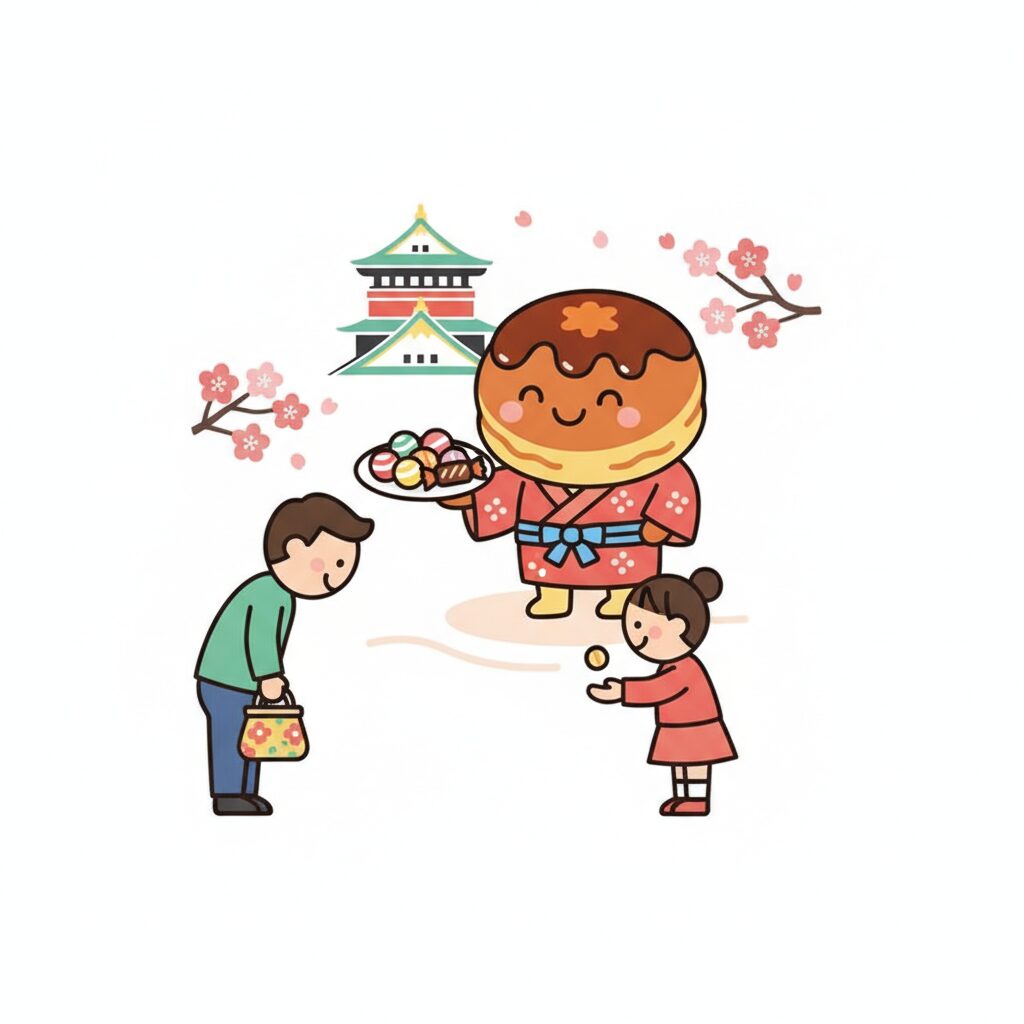
It happened on a Tuesday, on the rattling Hankyu train heading toward Umeda. The air was thick with the usual commuter silence, that unspoken agreement in most Japanese cities to exist in a bubble of personal space. I was staring out the window, minding my own business, when I felt a gentle tap on my shoulder. I turned to see an elderly woman, her face a constellation of smile-wrinkles, holding something out to me in her palm. It was a small, brightly wrapped piece of hard candy. My foreign brain immediately short-circuited. Is this a trick? A sales pitch? A mistake? I muttered a confused “Eh?” She just smiled wider, nudged the candy toward me again, and said with a warm, gravelly voice, “Ame-chan,どうぞ (douzo).” Here, have a candy.
I took it, offered a clumsy “Arigatou gozaimasu,” and watched as she turned back to her friend, the two of them resuming their rapid-fire conversation in the local dialect. The exchange was over in five seconds, leaving me with a lemon-flavored candy and a profound sense of cultural bewilderment. In London, a stranger offering you something on the tube would set off every internal alarm. In Tokyo, it would be almost unthinkable. But here, in Osaka, it was just… Tuesday. This small, sweet gesture was my first real lesson in the city’s operating system. It’s a place that communicates differently, a city that runs on a currency of casual kindness, all wrapped up in a little piece of cellophane. This isn’t just about a sweet tooth; it’s about the heart of Osaka itself.
These gentle exchanges are a window into a broader cultural narrative, where the Osaka akindo spirit exemplifies how everyday interactions seamlessly blend commerce, kindness, and community.
What in the World is ‘Ame-chan’?
Before you can truly grasp Osaka, you need to understand ‘ame-chan’. The word itself holds the key. ‘Ame’ is the standard Japanese term for candy. Yet, in Osaka, it’s almost always ‘ame-chan’. The ‘-chan’ suffix is an affectionate diminutive, typically used for children, pets, or close friends. By adding it to candy, Osakans turn a simple item into something personal, familiar, and warm. It’s no longer just candy; it becomes a little companion, a small token of affection.
Decoding the Sweet Talk
The candy itself is often a particular kind. Forget fancy imported chocolates or gourmet gummies. The classic ‘ame-chan’ comes from the endless purses of Osaka’s older women, the lively matriarchs called ‘obachan’. We’re talking about straightforward, timeless candies. There’s ‘kuro-ame’, a rich dark candy made from unrefined black sugar. There’s ‘nodo-ame’, the common throat lozenge that soothes coughs and smooths conversation. And, of course, there are the milky, buttery hard candies filled with nostalgia. These sweets aren’t trendy; they’re reliable, comforting, and always nearby.
This isn’t a rare or special-occasion gesture. The ‘ame-chan’ exchange is a daily ritual deeply woven into the city’s social fabric. You’ll receive one from the cashier at the local ‘Tamade‘ supermarket as she hands you your change. The taxi driver might offer one as a thank-you at the end of a ride. The old man running the tiny tobacco shop might slip one into your bag with your purchase. It’s a continual, gentle hum of social interaction that makes the city feel less like a vast metropolis and more like a network of connected villages.
The Anatomy of an ‘Ame-chan’ Exchange
The ritual is wonderfully simple and efficient. There’s no elaborate ceremony. It usually starts with a brief phrase like “Ame-chanいる?” (Want a candy?) or “Ame-chan taberu?” (Eat a candy?). Sometimes, there are no words at all, just the rustle of a hand dipping into a purse or pocket, followed by the offering. The exchange is brief, a micro-interaction lasting only a moment. It’s not an invitation for deep, heartfelt conversation. It’s not a request to share your life story.
Instead, it acts as social lubrication. It’s a low-pressure way to acknowledge a shared space. It says, “Hello, fellow human. I see you.” The primary distributors are, without a doubt, the ‘obachan’. They are the guardians of this tradition, the high priestesses of the candy cult. Yet, the practice isn’t limited to them. Shopkeepers use it to build rapport with customers. Office workers share them to break the afternoon slump. It’s a gesture that spans generations, a piece of shared cultural code that everyone knows.
The ‘Why’ Behind the Candy: Osaka’s Social Currency
So why does this occur so frequently in Osaka, when it’s quite rare in other parts of Japan, especially Tokyo? The reason lies deep within the city’s spirit, its history, and its core approach to human connections. The ‘ame-chan’ is more than just candy; it represents Osaka’s social philosophy.
Breaking the Ice, One Wrapper at a Time
Tokyo follows a different set of social norms. It’s a city that values privacy, order, and non-interference. On a Tokyo train, silence signals mutual respect. Initiating conversation with a stranger is often viewed as an intrusion. The invisible barriers between people are strong and carefully maintained. Osaka, on the other hand, treats those barriers more as suggestions than strict rules. The ‘ame-chan’ is the favored means of gently breaking through that barrier.
It’s a disarmingly simple way to initiate contact without seeming threatening or too familiar. You hardly can be offended by the offer of a small candy. It serves as a gentle probe, a social test. If the recipient accepts with a smile, it may lead to a brief, friendly chat. If declined, no offense is taken. It’s a clever social tactic for sparking momentary connections in a society that often promotes anonymity. It’s a way of saying, “We’re all packed together in this train car—why not make it a bit more pleasant?”
The Economics of Generosity
To truly understand Osaka, you must recognize its history as Japan’s merchant capital. For centuries, it has been the nation’s kitchen and commercial hub. Business was never just about cold numbers; it was about relationships, trust, and ‘go-en’ (fateful ties). The ‘ame-chan’ gesture is a direct legacy of this merchant culture. It’s a small, symbolic investment in human connection.
Consider the traditional greetings still heard in Osaka’s covered shopping arcades, the ‘shotengai’. Shopkeepers call out “Mokkari makka?” meaning “Are you making a profit?” The usual reply is “Bochi bochi denna,” a delightfully vague “So-so, can’t complain.” This is more than mere small talk; it reinforces a shared commercial and social identity. Offering a customer a piece of candy fits within that same tradition. It costs very little but generates invaluable goodwill. It humanizes the transaction; it helps you remember the shop and encourages repeat visits. It’s smart, practical, and heartfelt all at once—a distinctly Osakan trait.
A Pocketful of Kindness
The ‘obachan’ is central to the world of ‘ame-chan’ for a good reason. These women often serve as unofficial caretakers of their communities. They function as neighborhood watch, local historians, and keepers of social customs. Their purses aren’t mere bags; they’re mobile command centers, ready for any small daily crisis. A tissue for a runny nose, a safety pin for a loose button, and always, a stash of ‘ame-chan’.
Handing out candy is a nurturing act. Is a child fussing on the bus? An ‘ame-chan’ silently offers relief to a stressed parent. Does the young person across from you look worn out after a long day? An ‘ame-chan’ provides a small energy boost and a silent message of empathy. It’s a quiet way of caring for one another, a form of communal support that exists beneath the city’s official surface.
Your Guide to ‘Ame-chan’ Etiquette: The Dos and Don’ts
As a foreigner, your first few encounters with ‘ame-chan’ can be perplexing. You might feel awkward, suspicious, or uncertain about the proper response. However, mastering this simple exchange is an essential step toward feeling at home in Osaka. Here are the unspoken rules.
How to Receive: The Art of Acceptance
First and foremost, simply accept the candy. This is the golden rule. Unless you have a severe allergy or medical condition, refusing an ‘ame-chan’ can be more uncomfortable than accepting it. You’re not merely declining a piece of candy; you’re gently rejecting a gesture of human connection. To the giver, especially an older person, it may feel like a subtle dismissal of their goodwill.
Your response should be straightforward and warm. A smile is key. Pair it with a clear “Arigatou gozaimasu” (Thank you very much) or a more casual “Sumimasen, arigatou” (Excuse me, thanks). A slight nod or a small bow of the head conveys respect and gratitude. Don’t overthink it. It’s not a bribe, nor the start of a lengthy conversation you want to avoid. It’s a simple, closed loop of social kindness. Accept, smile, thank, and the exchange is complete.
Importantly, there is no expectation of immediate reciprocation. You don’t need to hurriedly search your own bag for something to give back. The gift is the gesture itself, and your graceful acceptance is all that’s required.
When to Give: Becoming an ‘Ame-chan’ Ambassador
After living here for a while, you may wonder, “Can I, a foreigner, give out ‘ame-chan’ too?” The answer is a definite yes, though with some situational awareness. You can’t just hand out candy to random strangers; that might seem odd, regardless of culture. The key is to use it as locals do: as a punctuation mark in a positive social interaction.
Good moments to offer ‘ame-chan’ include: thanking a shopkeeper who has been especially helpful, sharing one with a colleague during a break, or inviting someone you’ve had a pleasant chat with on a park bench. It’s about recognizing a warm moment and adding a little extra sweetness to it. It shows you’re not just a tourist or temporary resident, but someone who understands and respects local customs. Carrying a few individually wrapped candies in your bag is a practical way to be prepared. It’s a small gesture, but a powerful way to bridge cultural gaps and demonstrate you’re on the same wavelength.
Beyond the Wrapper: What ‘Ame-chan’ Really Says About Osaka
The humble ‘ame-chan’ offers a glimpse into the soul of Osaka. It’s a delicious embodiment of the city’s core values, which often sharply contrast with those of the rest of Japan. It helps explain why life here feels so distinct, so vibrant, and at times, so wonderfully chaotic.
A City That Talks to Itself
At its core, Osaka is a city that thrives on communication. The ‘ame-chan’ is just one tool among a wide array of social interactions. People here tend to be more direct, more expressive, and far more willing to engage with strangers than their Tokyo counterparts. This is reflected in the local dialect, Osaka-ben, known for being fast, straightforward, and packed with colorful, humorous phrases. The culture prioritizes lively, human connection over quiet, reserved formality. The ‘ame-chan’ acts as a conversation starter, a tangible sign of the desire to connect.
This cultivates a completely different daily atmosphere. Your commute isn’t always filled with silence. A trip to the grocery store might involve chatting with the cashier about the weather. Life is simply more audible and interactive. For some foreigners, this can initially feel intrusive. But for many, it’s a refreshing break from the polite yet often impenetrable distance found elsewhere. It makes the city feel alive and welcoming.
Practicality Over Pretense
The ‘ame-chan’ gesture is strikingly practical. It’s inexpensive, simple, portable, and universally understood. It accomplishes its social purpose—creating a brief, positive connection—with maximum efficiency and minimal fuss. This sums up Osaka perfectly. It’s a city that has always emphasized substance over style and results over elaborate ceremony.
You see this everywhere. Osaka’s food, from takoyaki to okonomiyaki, is hearty, straightforward, and explosively flavorful. Its comedy, known as ‘manzai‘, is quick, direct, and often physical. Its people are famously pragmatic and down-to-earth. The ‘ame-chan’ fits seamlessly into this mindset. It’s a no-nonsense answer to urban alienation. Why write a poem when a piece of candy will do?
A Sweet Antidote to Urban Anonymity
Living in a huge city can feel isolating. It’s easy to become an anonymous face among millions, a ghost riding the trains and walking the streets. The ‘ame-chan’ culture is a small but potent act of resistance against this modern loneliness. Every candy offered and accepted is a tiny rebellion asserting the value of community.
It’s a constant reminder that you’re not alone. You’re part of a shared space, a member of a community, however fleeting. That stranger on the train, that shopkeeper, that taxi driver—they see you. This steady, low-level flow of human recognition is perhaps the most defining feature of daily life in Osaka. It’s what transforms the city from a concrete jungle into a home. Learning to appreciate and take part in these small rituals is the real key not just to living in Osaka but truly belonging.
Looking back on that first bewildering encounter on the Hankyu line, I no longer see it as just a strange, random moment. I recognize it for what it was: an initiation. That small piece of lemon candy was a key, unlocking the door to understanding this wonderfully complex and warm-hearted city. It was a silent invitation to see the world the Osaka way. So next time an ‘obachan’ with a kind smile offers you a sweet, don’t hesitate. Take it, smile, and say thank you. You’ve just been welcomed into the heart of Osaka—one of the sweetest deals you’ll ever receive.