
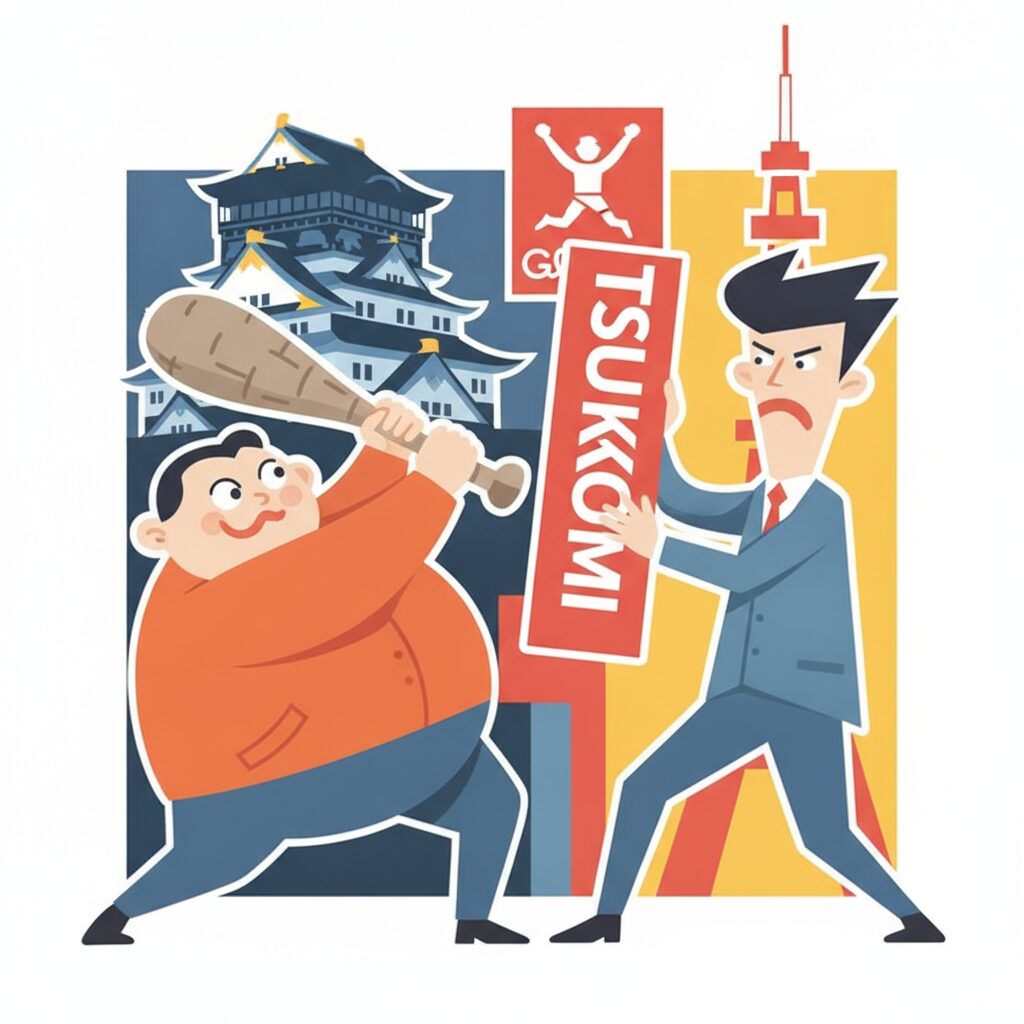
Step off the Shinkansen at Shin-Osaka Station, and you feel it almost immediately. It’s not just the humidity or the slightly different dialect you overhear. It’s a change in the air, a shift in the social rhythm. Conversations seem to bounce and crackle with a unique energy. Listen closely to the group of friends laughing by the ticket gates, or the banter between the takoyaki vendor and his customer. It doesn’t sound like the measured, polite exchanges you might be used to in other parts of Japan. It sounds more like a performance, a rapid-fire volley of witty remarks, feigned ignorance, and sharp corrections. What you’re hearing is the heartbeat of Osaka’s communication style, a cultural phenomenon deeply rooted in the comedic tradition of Manzai (漫才), the Japanese stand-up comedy duo. This isn’t just entertainment reserved for a stage in Namba’s Grand Kagetsu theater; it’s a blueprint for daily interaction, a social language built on two key roles: the Boke and the Tsukkomi.
The Boke (ボケ) is the funny one, the airhead, the one who says something absurd, silly, or slightly off-kilter. Their role is to create an opening, to throw a conversational softball. The Tsukkomi (ツッコミ) is the straight man, the one who points out the absurdity with a sharp, witty retort. They’re the one who “corrects” the Boke, often with the iconic phrase, “Nande ya nen!” (なんでやねん!), which loosely translates to “What the heck are you talking about?!” But this correction isn’t a rebuke. It’s the completion of a social circuit. The Tsukkomi’s response validates the Boke’s attempt at humor, and together, they create a shared moment of laughter. This dynamic is the secret code to understanding Osaka. It explains why people seem so direct, why conversations feel so playful, and why laughter is the preferred currency of connection. To live in Osaka is to learn the rhythm of this dance, whether you’re an active participant or just an appreciative audience. It’s the invisible framework that makes Osaka feel so distinctly, vibrantly, and unapologetically itself.
Osaka’s spirited banter and cultural energy go hand in hand with a surge in Kansai tourism that is inviting visitors to experience a city in constant evolution.
The Unspoken Rules of Osaka Banter
In most places, communication revolves around the clear exchange of information. In Osaka, however, it’s often about crafting a shared moment. The Boke and Tsukkomi dynamic isn’t just about telling scripted jokes; it’s a spontaneous, improvisational art form embedded in everyday conversation. The basic idea is straightforward: one person intentionally inserts a flaw into the dialogue, and the other sharpens it into a humorous gem. This creates a conversational rhythm that might surprise outsiders but feels completely natural to locals.
The Anatomy of an Everyday Exchange
Picture yourself dining with a friend from Osaka. You’re in a bustling izakaya in the Tenma neighborhood, surrounded by the clatter of dishes and cheerful voices. The server brings a huge plate of yakisoba. A typical, non-Osakan response might be, “Wow, that’s a large portion.” An Osaka Boke would take it a step further. You might say, with exaggerated seriousness, “Is this for the whole table? I only ordered for one.” You’ve just delivered the Boke pitch. Now, your friend has a role to play. Instead of answering literally, like, “No, that’s your portion,” they respond with the Tsukkomi. They might lightly smack the table and say, “Who do you think you are, a sumo wrestler? Just eat it!” Or offer a more classic, “Nande ya nen! You were complaining you were hungry just two minutes ago!” The exchange is complete. The goal wasn’t to clarify the portion size, but to share a laugh and strengthen your connection. This playful tease signals closeness, confirming you’re on the same wavelength.
This pattern shows up everywhere. At the supermarket, someone might pick up a daikon radish and declare, “I’ve found the perfect weapon!” The person beside them might reply, “Put that back before you hurt yourself, you big kid.” This isn’t aggression; it’s connection. The heart of the Tsukkomi lies in its speed and wit. A delayed or hesitant reply kills the flow. It must be an instinctive reaction, a reflex sharpened by a lifetime immersed in this conversational culture. The ultimate expression is, of course, “Nande ya nen!” It’s a versatile phrase, meaning “You’re kidding me,” “That makes no sense,” or “Oh, come on,” all delivered with a tone of warmth rather than anger. Mastering this phrase is like learning the city’s secret handshake.
Why Osaka? The Roots of a Comedic Culture
This distinctive communication style didn’t simply emerge spontaneously; it is deeply rooted in Osaka’s history and identity as a merchant city. For centuries, as Tokyo (then Edo) served as the center of samurai governance and Kyoto housed the imperial court, Osaka functioned as Japan’s kitchen and commercial hub. The city prospered through trade, and a merchant’s (akindo’s) success relied on their skill in building relationships, negotiating, and thinking quickly. Humor was a vital tool in this trade—it could break the ice, ease tense negotiations, and cultivate lasting customer loyalty that formal politeness alone couldn’t achieve. This environment nurtured a culture that prized quick wit, directness, and a certain practical charm. The spirit of the akindo—resourceful, personable, and a bit cheeky—still flows through the city’s veins.
The Yoshimoto Kogyo Effect
This historical backdrop was amplified in the 20th century by the emergence of Yoshimoto Kogyo, an entertainment conglomerate founded in Osaka in 1912. Yoshimoto became the driving force behind Japanese comedy, popularizing the Manzai duo format nationwide through television and live theater. With its headquarters firmly established in Osaka, the company made comedy inseparable from the city’s identity. Generations of Osakans grew up watching their favorite Manzai comedians on TV every weekend, internalizing the Boke and Tsukkomi dynamic until it became a natural way of speaking. Comedians became local icons, and their speech patterns and catchphrases filtered directly into everyday dialect. This cultural saturation sets Osaka apart from Tokyo. While Tokyo has its own comedy scene, it doesn’t define the city’s identity so completely. There, conversation often emphasizes harmony through indirectness and careful consideration. A playful Boke might be met with polite confusion or taken literally, as the conversational framework isn’t set up for that kind of exchange. In Osaka, that framework is the default.
Navigating Boke and Tsukkomi as a Foreigner
For someone who is not a Japanese resident, initial encounters with this dynamic can be confusing. A sharp Tsukkomi from a new acquaintance or a shopkeeper might feel surprising or even rude. You may think, “Did I say something wrong? Are they mocking me?” This is perhaps the most common misunderstanding foreigners have about communication in Osaka. In reality, the exact opposite is true. A Tsukkomi is a gesture of inclusion. It indicates that the other person feels comfortable enough with you to engage in this playful exchange. It shows they’re paying attention, listening, and consider you part of their social circle. The worst reaction you can receive in Osaka is a polite, distant smile—that’s the real social barrier. A playful jab, on the other hand, is an open invitation.
Your Guide to Playing the Game
So, how can you navigate this as an outsider? You don’t have to become a top-tier comedian overnight, but understanding the rules will help you enjoy the experience.
Learn to Recognize the Cues: Pay attention beyond the words. A Tsukkomi is almost always accompanied by a smile, laughter, or a sparkle in the eye. The body language is open and friendly. The tone is exaggerated, not genuinely upset. It’s meant to be performative. Once you learn to recognize these signals, you’ll begin to see the warmth beneath the words.
How to React: You’re not expected to deliver a witty Tsukkomi in return. The simplest and most effective response is to laugh along. Laughing shows that you’ve understood the intent and appreciate the humor. A quick, “You got me!” or a playful shake of the head works wonders. You’re signaling that you’re part of the joke, which is all that matters.
Dipping Your Toes In: If you feel bold, you can try joining in. The easiest way to start is by playing the Boke. It takes less linguistic skill and is especially charming coming from a foreigner. Make a simple, obvious exaggeration. For example, if it begins to drizzle, say, “Oh no, a typhoon is here!” You’ve now perfectly set the stage for your Osakan friend to respond with a Tsukkomi, and they’ll appreciate it. Attempting a Tsukkomi yourself is more challenging, but a well-timed, cheerful “Nande ya nen!” in reply to a friend’s silly remark will be met with delight and laughter. It shows you’re genuinely trying to connect on their terms.
The Boke-Tsukkomi Dynamic Beyond Jokes
It’s important to recognize that this structure serves as more than just a means of humor. It functions as a fundamental tool for building relationships and navigating social interactions. The back-and-forth rhythm acts as a continuous gauge of the social atmosphere, fostering rapport through a series of small, shared creative exchanges. It is a method for breaking down the formal barriers that are common in other areas of Japanese society. In many respects, it’s a shortcut to intimacy. A ten-minute conversation filled with Boke and Tsukkomi can create a sense of familiarity that might take hours of polite, formal dialogue to achieve in Tokyo.
This dynamic also influences the way people approach problems. A conversation might start with someone presenting an issue in an exaggerated, Boke-style manner: “This project is impossible! We’ll never finish it. We might as well just give up and open a ramen shop.” This isn’t an actual expression of despair. Instead, it’s an invitation for a Tsukkomi reply that brings the discussion back to reality. A colleague might respond, “Stop being so dramatic. Let’s just focus on the first part. I’ll handle the data, you handle the presentation. And our ramen shop would fail in a week.” The humor reduces the tension, while the practical solution is embedded within the witty comeback. It’s a collaborative and deeply human approach to addressing challenges.
Even in professional environments, though more restrained, the spirit endures. A manager might highlight a mistake not with a harsh, formal correction, but with a gentle Tsukkomi. “Sato-san, I think you might have accidentally attached a photo of your cat instead of the quarterly report. While your cat is very cute, it’s not great with spreadsheets.” This softens the criticism, preserves dignity, and fosters a positive team atmosphere. It’s feedback delivered with warmth.
Misunderstandings and The Osaka Mindset
The biggest challenge for many foreigners is reconciling Osaka’s communication style with the common stereotype of Japanese people as reserved, quiet, and indirect. Osakans are often perceived by other Japanese as loud, brash, and even somewhat aggressive. However, this is a misunderstanding of their intent. What may sound like an argument to an untrained ear is usually just a high-energy exchange of banter. The volume and pace indicate engagement, not anger. Having grown up in a culture that also values a lively, bustling atmosphere—a remen (热闹) or ‘hot and noisy’ feeling—I find the energy of Osaka profoundly comforting. It feels vivid and refreshingly straightforward.
This directness is not intended to be confrontational. It stems from a place that prioritizes emotional honesty and genuine connection over performative politeness, or tatemae. Someone from Osaka would often prefer a quick, humorous, and honest exchange that clears the air rather than engage in layers of vague pleasantries masking what everyone is truly thinking. This preference for efficiency in relationship-building lies at the heart of the Osaka mindset. Why waste time on formality when a shared laugh can reveal everything you need to know about a person? The Boke and Tsukkomi dynamic serves as the ultimate social filter. If you can connect on that wavelength, you’re accepted. It reflects a culture that believes the shortest distance between two people is a good laugh.
What Daily Life Feels Like in a Boke-Tsukkomi World
Living here means your daily soundtrack is filled with bursts of laughter. A visit to the Shinsaibashi-suji shopping arcade isn’t merely a shopping trip; it’s an immersive theatrical experience. You’ll overhear shopkeepers—the renowned Osaka obachan—playfully teasing their customers like old friends. A customer might say, “This shirt is a bit pricey, isn’t it?” The shopkeeper, without missing a beat, replies, “It only seems expensive because you’re comparing it to your cheap sweater! Try it on; it’ll make you look like a movie star.” The customer laughs, and more often than not, ends up buying the shirt. The sale comes second to the interaction, the human connection.
This spirit permeates the most ordinary activities. Ordering coffee, asking for directions, buying train tickets—all become chances for a small, joyful spark of connection. It makes the city feel less anonymous and more like a network of overlapping communities. People engage with one another. They acknowledge each other’s presence with a joke or a compliment. This profoundly contrasts with the quiet, orderly solitude you might experience on a Tokyo subway, where making eye contact can feel intrusive.
To truly understand Osaka, you must learn to embrace this rhythm. It’s the city’s core—a relentless pulse of wit, warmth, and humanity. It’s in the way a grandmother playfully scolds a child with “Akan de!” (You can’t do that!), and in the friendly teasing among friends. It’s a language of laughter that goes beyond words, and once you learn to hear this music, you’ll discover that every conversation is an invitation to join the dance.








