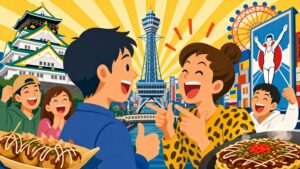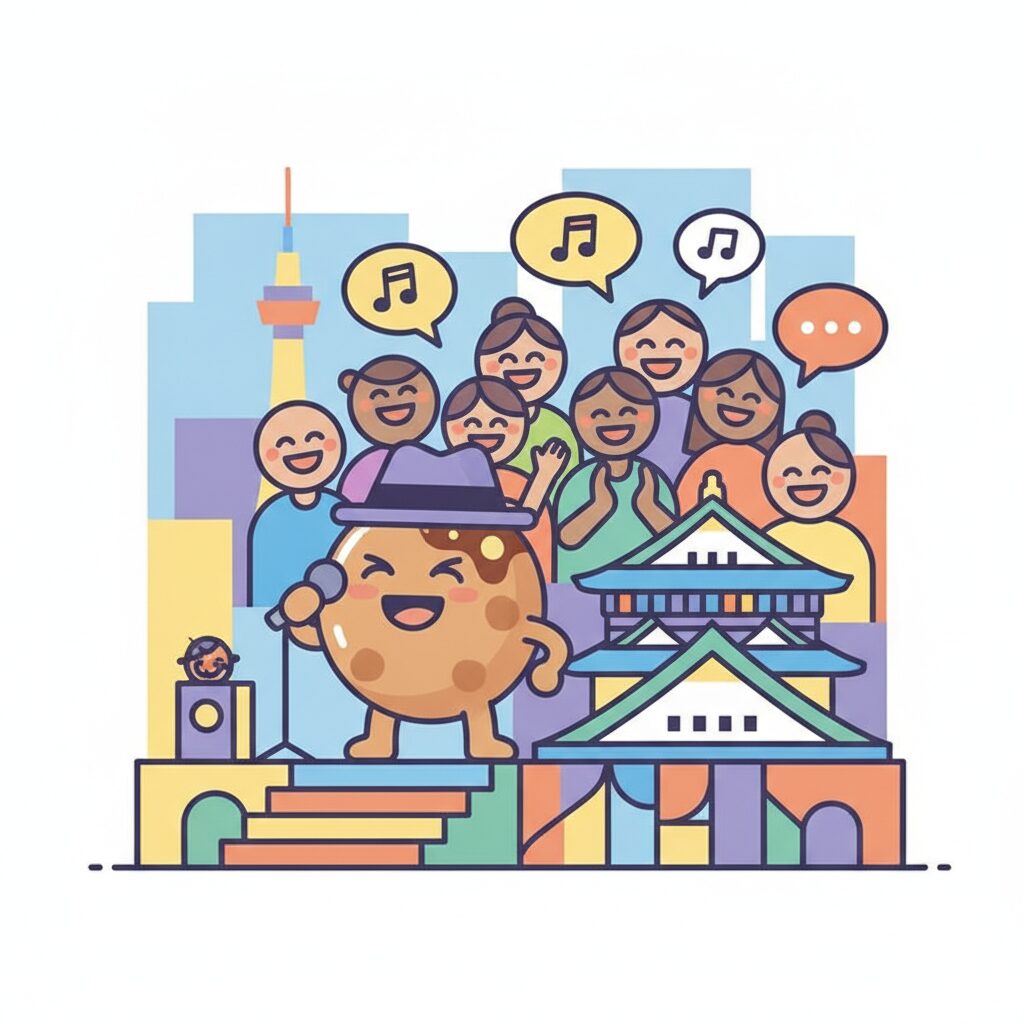
Step off the Shinkansen at Shin-Osaka Station, and you’ll feel it. It’s not just the humidity in summer or the electric buzz of the Midosuji line. It’s a subtle shift in the air, a loosening of the collective tie. The perfectly polished, respectful distance you might have grown accustomed to in Tokyo begins to dissolve, replaced by something more direct, more chaotic, and infinitely more amusing. My first week living here, I bought a bag of apples from a woman in a local shotengai, a covered shopping arcade. She looked at my selections, then at me, and said with a perfectly straight face, “Only three? Are you sure you can handle that much excitement?” I stood there for a beat, confused. Was she mocking my modest purchase? Then her face cracked into a huge grin. The man selling pickles next door chuckled. I stammered something back, and the moment passed. But it stuck with me. This wasn’t just a transaction. It was a performance, and I had missed my cue.
Welcome to Osaka, the city that runs on a different kind of fuel. It’s a city that trades in punchlines, where the currency isn’t just yen, but wit. Where a sharp comeback is worth more than a polite bow. For many non-Japanese residents, this can be baffling. We’re often taught that Japan operates on principles of harmony (wa), indirectness, and a deep respect for formality. And while that’s true in many contexts, Osaka plays by a slightly different rulebook. Here, humor isn’t a niche interest reserved for comedy clubs; it’s a fundamental social lubricant, a tool for everything from closing a business deal to making a new friend at a ramen counter. It’s the city’s unofficial language, and learning a few key phrases is your passport to truly connecting with the people who make this city pulse. Forget the tourist traps for a moment. To understand Osaka, you must first understand its laughter. Your journey into the heart of Japan’s comedic capital starts here, in the lively streets of Namba, home to the legendary Grand Kagetsu Theater.
If you’re captivated by Osaka’s blend of humor and community in every corner, exploring the dynamic shotengai scene provides an insightful look at these local marketplaces as vibrant community living rooms.
The Unspoken Language: Why Humor is Osaka’s Default Setting
In much of Japan, conversation often resembles a carefully choreographed dance, with specific steps to follow, a steady rhythm to keep, and a primary aim to avoid any missteps that might lead to friction. In Osaka, however, it feels more like improv jazz—spontaneous, lively, and where everyone is encouraged to jump in with their own solo. This fundamental difference is embedded in the city’s very DNA.
More Than Just Jokes: The Philosophy of “Owarai”
Osaka has long been known as the kitchen of Japan, a city of merchants, traders, and artisans. In a fast-moving commercial environment, quickly building rapport wasn’t merely a courtesy; it was essential for survival. Formality creates distance, but shared laughter instantly bridges gaps. This is the essence of owarai, the Japanese word for comedy, which in Osaka extends beyond the stage to infuse everyday life. It serves as a way to assess a person’s character, to determine if they’re adaptable, quick-witted, and approachable. A good-natured joke disarms people, making them more open to negotiation, collaboration, or just a friendly conversation. It acts as a social shortcut to trust. That’s why the expectation of a witty comeback runs so deep. A flat, literal response to a playful remark can be seen not as rude but as a sign of disengagement, indicating you’re unwilling to join the game. The aim isn’t simply to be funny; it’s to be connected.
The Tokyo-Osaka Comedy Divide
The contrast with Tokyo is striking and offers a helpful guide to understanding the local mindset. Tokyo humor often trends toward the sophisticated, the シュール (shūru, surreal), or the observational. It’s clever, and you’re usually the appreciative audience. Think of it like visiting an art gallery, where you admire the artist’s skill from a respectful distance. Osaka humor, conversely, is participatory. It’s a contact sport. It pulls you off the sidelines and onto the stage. When a Tokyo shopkeeper gives you your change, they’ll likely do so with polished, practiced politeness. In Osaka, a shopkeeper might theatrically drop coins into your hand from a slight height and shout, “Here’s your fortune!” It’s a verbal volley, a playful jab, signaling that you’re not merely a customer but a co-conspirator in the lively, chaotic drama of Osaka life. In Tokyo, you observe. In Osaka, you engage.
Decoding the Dialogue: A Practical Guide to Osaka Banter
Grasping the theory is one thing; actually stepping into the ring is another. The good news is that Osaka’s comedic language follows a clear structure. At its heart lies a conversational dynamic that, once recognized, you’ll spot everywhere—from TV shows to the supermarket checkout line.
The Art of the “Boke” and “Tsukkomi”
This is the cornerstone of Japanese comedy and Osaka’s unique contribution to the culture. Think of it like a two-person relay.
- The Boke (ボケ): The fool, the airhead, the one who says or does something silly, absurd, or outright wrong. This role sets up the joke.
- The Tsukkomi (ツッコミ): The straight man who highlights the boke’s absurdity with a sharp, witty retort. This delivers the punchline.
In professional comedy duos, these roles are fixed, but in everyday Osaka life, they’re fluid. People switch between them constantly. Someone might deliberately say something a bit off—the boke—as an invitation. Your role is to spot it and respond with the tsukkomi. For example, on a sweltering day, a friend might sigh and say, “Perfect weather for a hot pot, right?” This is classic boke. A literal reply like, “No, it’s too hot for that,” is the wrong response. The ideal tsukkomi would be, “Are you trying to melt?” or “Only if you’re a penguin on vacation.” This quick, playful correction shows affection and intelligence. It means, “I hear you, I get the joke, and I’m clever enough to play along.” Mastering this back-and-forth is the fastest way to sound less like a visitor and more like a local.
Self-Deprecation as a Superpower
In a culture that treasures modesty, self-deprecation is a common tactic. However, in Osaka, it’s elevated to an art form. Making fun of yourself is the ultimate icebreaker. It signals that you’re humble and approachable, instantly lowering social barriers and making others feel comfortable joking with you. Did you just mispronounce a Japanese word? Don’t just apologize—laugh and say, “My Japanese is from another planet today!” Did you mistakenly try to enter the train through the exit gate? Turn it into a little performance. Bow to oncoming passengers and say, “Just checking the structural integrity of the gates, folks. All clear!” The ability to laugh at your own small mistakes is incredibly endearing and core to Osaka’s charm.
The Power of Exaggeration and the Famous “知らんけど (Shiran kedo)”
Osakans love a good story, and great stories often come with a touch of exaggeration. Hyperbole is a hallmark of the local dialect. The ramen you just ate wasn’t just good; it was so delicious it probably added ten years to your life. That new building isn’t just tall; it’s practically scratching the moon. This isn’t meant to mislead but to entertain. But how do you make such bold claims without sounding boastful or foolish? Enter the magical escape phrase: 「知らんけど」 (shiran kedo).
This phrase, roughly meaning “…but I don’t really know, though” or “…or so I’ve heard,” acts as the ultimate conversational Swiss Army knife. Add it at the end of a statement, and it immediately softens the impact, adds a layer of self-aware humor, and frees you from responsibility for the claim’s accuracy. It lets you be confident yet non-committal at the same time. “This is the best takoyaki in the entire world. Shiran kedo.” “If you move to this neighborhood, you’ll be happy forever, guaranteed! Shiran kedo.” It’s a wink to the listener, a shared joke you’re both in on. Using this phrase skillfully is a high-level move that earns instant respect.
Putting It Into Practice: Where and How to Use Your New Skills
Armed with this knowledge, it’s time to find your stage. The entire city can serve as a potential training ground, though some places are more welcoming than others. Your aim isn’t to become a professional comedian, but to learn how to engage with the city on its own terms.
The Izakaya and the Tachinomi: Your Comedy Training Ground
Formal restaurants have their role, but the true social life of Osaka unfolds in the cramped, noisy, and cheerful spaces of izakaya (Japanese pubs) and tachinomi (standing bars). These settings are designed for interaction. You’ll often find yourself sitting shoulder-to-shoulder with strangers, with loosely defined boundaries between groups. This is your dojo. Start small. When the person next to you orders the same drink, you might say something simple like, “Great minds think alike!” When the chef slides your plate of yakitori across the counter, offer a slightly exaggerated bow and say, “I am not worthy!” These small, playful gestures serve as invitations. They might spark a laugh, a brief conversation, or even a new friendship. The key is to stay light, smile, and be open to whatever comes next.
Shopping as a Social Sport
Nowhere is Osaka’s interactive spirit more evident than in its endless shotengai. These aren’t sterile, quiet shopping malls. Instead, they are lively, bustling ecosystems of banter and commerce. The vendors, particularly the older generation (obachan), are masters of their craft. They will tease you, compliment you, and engage you in conversation as part of their sales pitch. Don’t just passively accept it; join in. If a grocer claims her cucumbers are the crispest in Japan, you can examine one with mock seriousness and say, “Hmm, I’ll be the judge of that.” If you try on a rather loud shirt and the shop owner exclaims, “It looks perfect on you!” you can respond, “Perfect for stopping traffic, maybe!” They’ll appreciate it. This back-and-forth, this nori-tsukkomi, is central to the experience. It turns a simple errand into a memorable human interaction.
What Not to Do: Navigating the Pitfalls
As with any language, humor follows rules of grammar and etiquette. A poorly executed joke can create more distance than polite silence. The key is to keep it light and situational. Avoid jokes about sensitive topics like someone’s appearance (unless it’s your own), their family, their job, or other personal matters, especially with people you’ve just met. Humor in Osaka is rarely mean-spirited; it focuses on the absurdity of situations, not on personal flaws. Most importantly, don’t force it. If you’re not feeling it, that’s okay. Being a good audience—laughing at others’ jokes, smiling, and showing appreciation for the humor—is just as important as being the one telling them. A responsive listener, a warai-ya (laugher), is an essential part of any comedic exchange.
Beyond the Laughs: What This Tells You About Osaka
Learning to navigate Osaka’s comedic culture does more than simply help you order a beer or buy vegetables; it provides a deeper understanding of the city’s essence. This is not merely a collection of quirks but a reflection of a long-standing cultural philosophy shaped by centuries of history.
A Culture of Resilience and Pragmatism
Osaka has been destroyed and rebuilt numerous times, experiencing both economic booms and severe busts. It is a city of survivors. In this context, humor serves as a powerful tool for resilience—a way to keep perspective, find joy in daily life, and resist being worn down by hardships. This pragmatic outlook also underpins the eagerness to break down social barriers quickly. In a city founded on trade, there is little patience for lengthy formalities that often define relationships elsewhere. A joke is efficient; it creates a human connection in seconds, enabling you to move swiftly towards business or friendship.
The Real Meaning of “Friendly”
Let’s revisit the common cliché: “Osaka people are friendly.” Is this true? Yes, but “friendly” here carries a different meaning than it might in other places. In Tokyo, friendliness often manifests as impeccable service, politeness, and a desire not to inconvenience others—a passive form of friendliness that maintains respectful distance. In Osaka, friendliness is active and interactive. It’s an invitation to engage, to banter, and to bridge the gap between people. An Osaka person’s joke is not just a joke; it’s a handshake, a test to see if you’re on the same wavelength. When you respond with a laugh or a quick retort, you return the handshake, signaling that you understand the unspoken rules and are willing to join in. This is why many foreigners find it easier to make friends here. The city continually sends out invitations to connect; all you need to do is learn how to RSVP.