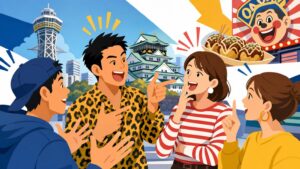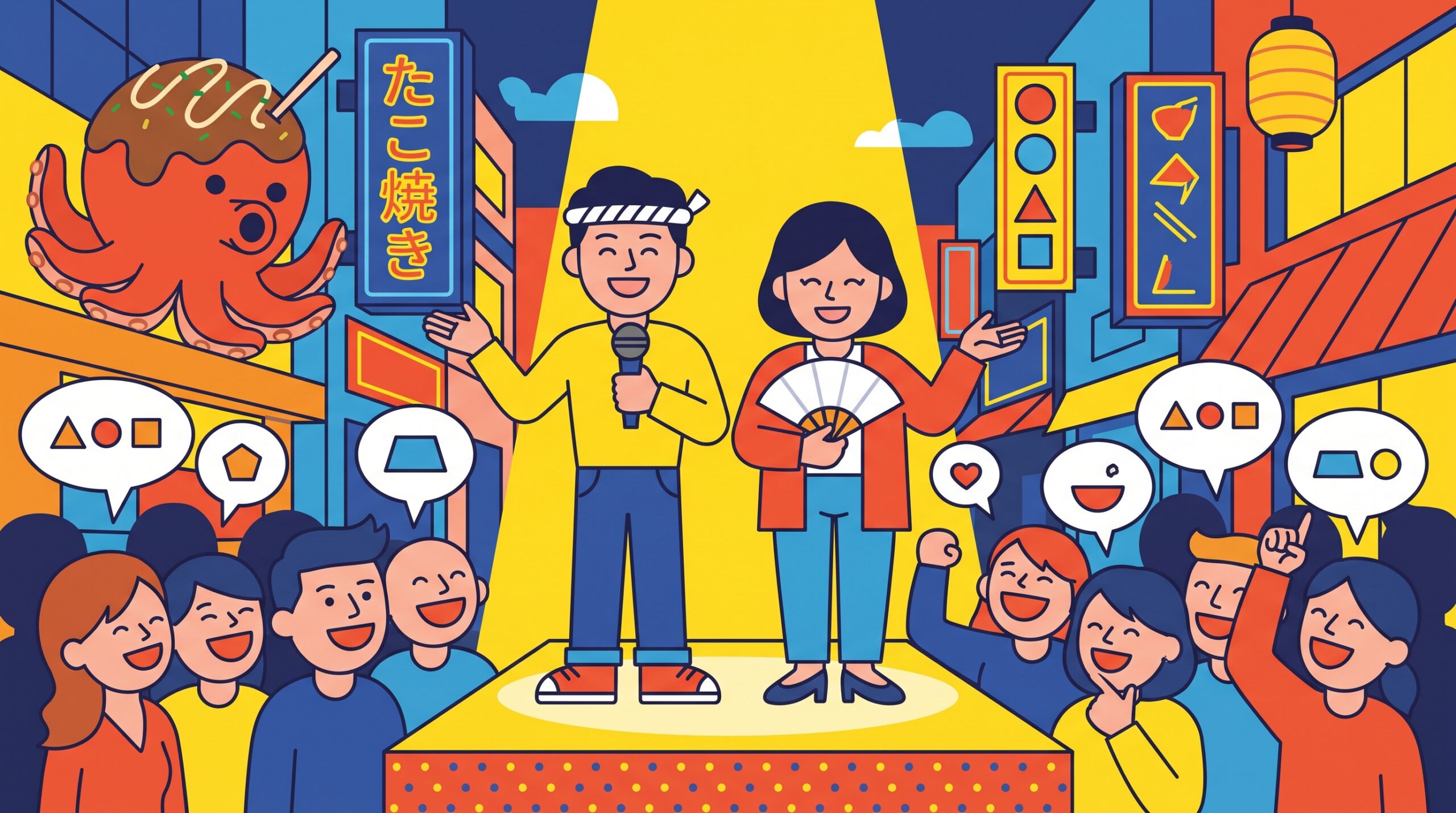
You step off the bullet train at Shin-Osaka Station. The air feels different here. It carries a certain weight, a distinct kinetic energy that you simply do not find in the silent, polished corridors of Tokyo. You scan your transit card, push through the turnstiles, and immediately, the volume of life increases. People are talking. They are not just exchanging information; they are performing. They are projecting. They are alive. For an outsider trying to plant roots in this concrete expanse, this sudden shift in atmosphere can be jarring. It hits you like a sudden gust of wind on an exposed ridge high up in the mountains. I know this feeling well. When I am not navigating the sprawling urban grid of this metropolis, I am out on the trails, scaling peaks and navigating the dense forests of the Kansai region. Out there in the wild, survival depends on understanding the terrain, feeling the shifts in the weather, and finding your rhythm on the ascent. Living in Osaka requires a remarkably similar skill set. You have to read the room. You have to understand the local weather, which in this city, is heavily dictated by humor.
Osaka is a city built on a laugh. It is the beating, chaotic heart of Japanese comedy. But if you have just moved here from abroad, or if you are scouting out neighborhoods and trying to figure out why the local shopkeeper just lightly slapped your shoulder and made a loud remark about your groceries, you might feel completely lost. You might wonder if you are being mocked. You might wonder if you missed a social cue. You did not miss a cue. You just walked onto a stage without realizing the play had already begun. This is not a polished tourist brochure. This is a survival guide to the mindset, the rhythm, and the unspoken rules of the people who call this vibrant city home. We are going to break down the mechanics of local humor, explore why the people here think the way they do, and help you figure out if you are ready to jump into the punchline, or if you should just sit back and watch the show.
Welcome to Osaka: The Comedy Capital of Japan
To understand why your neighbor jokes with the postman, you need to grasp the historical background. Osaka is fundamentally a city of merchants. Centuries ago, while Tokyo focused on being the center of political power and samurai discipline, Osaka served as the nation’s bustling kitchen. It was a hub where goods arrived from every corner of the archipelago and money circulated rapidly. As a samurai in Tokyo, your status was defined by your rank, stoicism, and strict adherence to hierarchy. Silence was golden, and formality was paramount.
However, as a merchant in Osaka, silence meant you weren’t selling anything. To persuade a traveler to buy your dried fish or bolts of silk, you couldn’t just stand there looking important. You had to break the ice, make them smile, and disarm them. A shared laugh lowered defenses and built immediate trust. Over centuries, this transactional necessity transformed into a deeply rooted cultural mindset. Humor in Osaka is not merely entertainment reserved for late-night television; it is the social glue, the currency of everyday interaction, and the way you show someone you acknowledge and appreciate their presence. When a local jokes at your expense, it’s not an insult but a way to test the waters and invite you to join the game.
Foreign residents often find this confusing. We are taught that Japanese culture is universally polite, quiet, and reserved, expecting deep bows and hushed tones. Then, you arrive in neighborhoods like Tennoji or Shinsekai and meet a loud, brassy older woman with dyed purple hair who hands you candy and loudly critiques your winter coat. This breaks the stereotype and causes friction. But once you understand that this behavior arises from a historical desire to connect, to move beyond formalities and discover the shared human experience beneath, the city unfolds in ways you never imagined. You stop seeing it as aggressive and start appreciating it as warmly inclusive.
What is “Owarai”? Understanding Japanese Comedy Culture
The word you will hear repeatedly when discussing this topic is “Owarai.” Simply put, it means laughter or comedy. However, in the cultural context of modern Japan, Owarai represents the vast and diverse entertainment industry that dominates television, theater, and pop culture. It is an umbrella term encompassing everything from slapstick game shows to rapid-fire stage performances. Yet, Owarai is more than just an industry; it is a perspective through which the people of this city view the world.
To live here comfortably, you don’t need to be a comedian or memorize routines. But you absolutely must understand the fundamental structures of how a joke functions in this specific environment. It’s like learning the basic topography of a trail map before heading into the mountains. Knowing where the peaks and valleys lie prevents you from getting lost when the fog rolls in. The landscape of local humor is shaped by a few very specific concepts you will encounter daily.
The Art of Manzai
At the heart of this cultural phenomenon is Manzai, which can be thought of as a traditional stand-up double act. Imagine two people standing side by side before a single, old-fashioned microphone. They wear suits, use no props, and no music; their performance depends entirely on their voices, timing, and the rapid pace of their dialogue. Manzai is fast-paced—a relentless, rhythmic exchange of words that borders on musicality. It’s like a ping-pong match with the ball moving at supersonic speed.
The topics are often incredibly mundane: debates over the best way to eat noodles, how to hail a taxi properly, or the absurdities of a typical job interview. The humor arises from escalation—what begins as a simple conversation quickly spirals into surreal, chaotic absurdity. For foreigners learning the language, watching Manzai is both an intense listening comprehension test and a challenge. The local dialect is heavily used, the slang thick, and cultural references highly specific. Yet, you don’t need to understand every word to appreciate the art form; the energy itself is infectious.
The Dynamics of Boke and Tsukkomi
You can’t discuss Manzai or daily life here without understanding the twin pillars of Boke and Tsukkomi. These are the two roles comedians play, but they’re also roles that people naturally slip into during everyday conversations. This is the single most important concept to grasp if you want to comprehend how locals think and interact.
The Boke is the fool, the one who misunderstands the situation, leaps to ridiculous conclusions, or says something absurd. The Boke initiates the chaos—they are the catalyst.
The Tsukkomi is the straight man. The word literally means “to thrust” or “to plunge into.” The Tsukkomi’s job is to correct the Boke, point out the absurdity, and bring the conversation back to reality. They do this quickly, sharply, and loudly. Often, the Tsukkomi lightly slaps the Boke on the shoulder or the back of the head while delivering a sharp verbal correction.
This dynamic is everywhere—you’ll see it in the office when a junior employee makes a small mistake and the boss exaggerates their reaction as the Tsukkomi. You’ll see it in a bar when one friend tells an exaggerated story and the other friend shuts it down with perfectly timed, loud correction. For a foreigner, the Tsukkomi can sometimes appear aggressive or even bullying. A loud voice and a light physical smack might signal a fight in many Western cultures, but here, it’s an embrace. The Tsukkomi is actually saving the Boke. Without the Tsukkomi’s correction, the Boke just looks crazy. That correction creates the laughter—it’s a partnership built on mutual trust.
Osaka Style vs. Tokyo Style Comedy
The cultural divide between the east and west of Japan is striking, and nowhere is this clearer than in their approaches to humor. Tokyo style tends to be more polished, structured, and relies heavily on clever wordplay, situational irony, and a somewhat detached, cool observation of the world. It’s a comedy of intellect. Punchlines are delivered with precision, like a finely tuned tuning fork. The audience listens quietly, appreciates the craftsmanship, and then laughs politely.
Osaka style, in contrast, is a full-frontal assault. It’s raw, earthy, and aggressively energetic—a comedy of emotion and physicality. The local dialect, Kansai-ben, is essential here. Kansai-ben is naturally more melodic, expressive, and arguably more emotionally open than the standard dialect spoken in the capital. It lends itself to exaggeration and punchy delivery. Locals don’t just tell a joke; they live it, throwing their entire bodies into the punchline. If Tokyo comedy is a pristine, manicured garden, local humor here is a wild, overgrown trail that demands you get your boots muddy.
This difference extends beyond the stage and shapes how strangers interact. In the capital, maintaining a respectful distance is considered the highest form of politeness. Here, closing the distance is the goal. A shopkeeper in a typical Japanese city will thank you with a perfectly formal phrase. A shopkeeper in a bustling local market here will hand you your change, tell you that you look tired, suggest a recipe for dinner, and ask when you’ll finally introduce them to your partner. It can be overwhelming if you’re not used to it, but it’s never meant to intrude maliciously—it’s an invitation to engage.
Famous Faces of Osaka Comedy
To fully appreciate the magnitude of this cultural force, you need to understand the institutions and icons that shaped it. You can’t live here long without noticing the same faces plastered on billboards, train advertisements, and television screens in every restaurant.
Legends of the Scene: Downtown and Beyond
No exploration of this topic is complete without mentioning the comedy duo Downtown. Hitoshi Matsumoto and Masatoshi Hamada are more than just comedians; they are cultural pioneers. Emerging in the 1980s, they transformed the pacing, tone, and very language of modern Japanese entertainment. They took the traditional structure of the double act and infused it with a cynical, conversational, and exceptionally sharp edge.
They popularized the Kansai dialect nationwide. Before their rise, standard Tokyo Japanese was the absolute norm for national broadcasting. The dialect of this region was seen as regional, and somewhat unrefined. This duo compelled the entire country to adopt their rhythm. Today, phrases popularized by them are spoken by teenagers from the far north of Hokkaido to the deep south of Okinawa. They demonstrated that the aggressive, fast-paced humor of the merchant city could captivate the whole nation.
Behind these legends, and many others, stands the towering presence of Yoshimoto Kogyo. This entertainment conglomerate effectively holds a monopoly on laughter in Japan. Founded over a century ago, it is headquartered right here in the city. It is more than an agency; it is a vast empire that operates theaters, produces television shows, and manages thousands of performers. The influence of this single company on the city’s everyday atmosphere cannot be overstated. They are the driving force behind the cultural machine. Knowing this company’s name gives you immediate context when locals talk about their favorite entertainers or the television shows they watched the night before.
How to Experience Owarai as an International Tourist
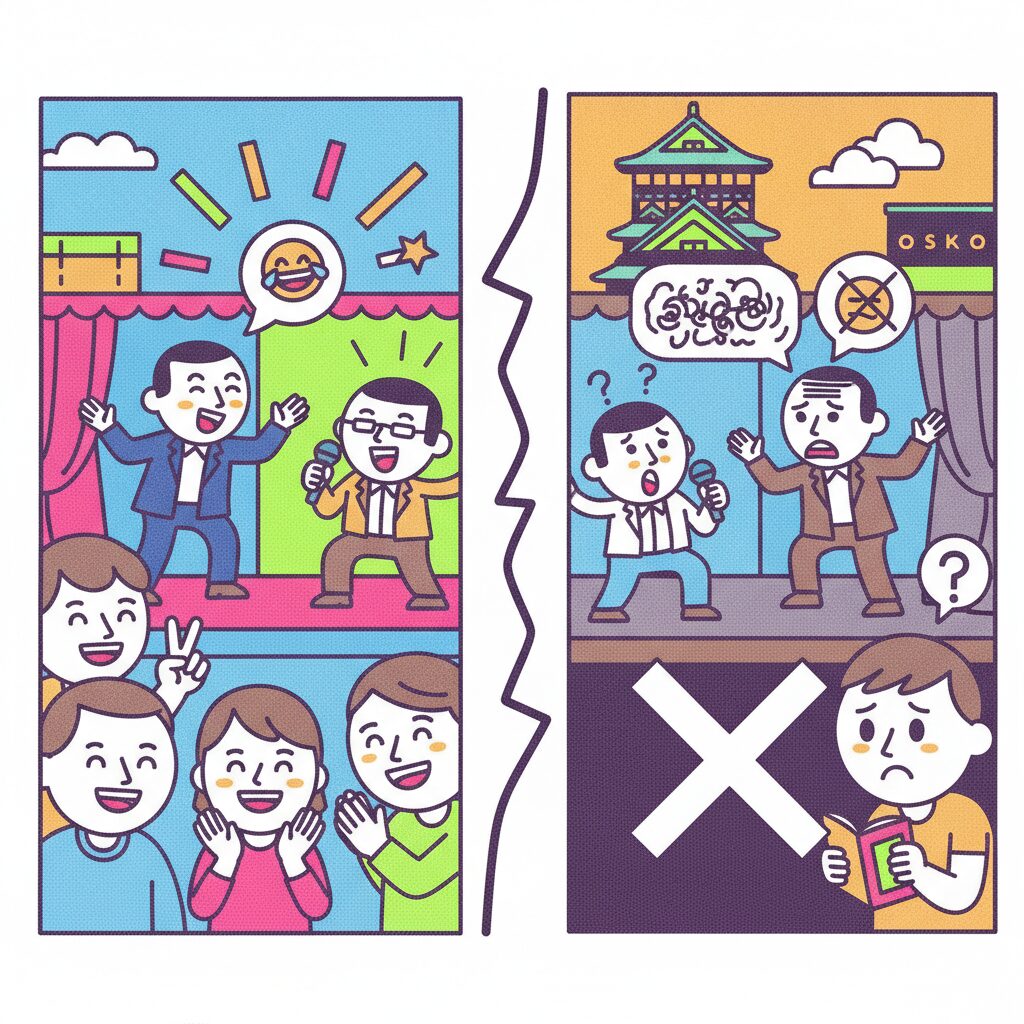
Whether you’re a long-term resident trying to grasp the local mindset or a newcomer seeking a quick immersion into the city’s vibe, you need to experience this culture firsthand. You must step away from the temples and shopping streets and dive into the places where the noise is at its peak. However, the language barrier presents a significant challenge. Watching a rapid-fire comedy routine in a dense regional dialect is completely unintelligible if you’re still struggling to order coffee at a convenience store. Yet, the city has adapted. It knows its strengths and wants to share them with everyone.
Yoshimoto Comedy Night OWARAI in OSAKA (English & Non-Verbal Shows)
For those daunted by the language barrier, there is an amazing gateway. The Yoshimoto Comedy Night OWARAI in OSAKA is a showcase specially created to cross cultural and linguistic divides. This is not a diluted tourist trap. It is a genuine performance produced by the country’s largest entertainment agency, crafted for an international audience.
These shows rely heavily on elements that require no Japanese comprehension. You will witness physical comedy, silent sketches, rhythmic acts, and performances delivered in simple, accessible English. It’s a brilliant distillation of the local energy into a form that anyone can follow. It captures the chaotic spirit of the Boke and the precise timing of the Tsukkomi through pure physical expression. Attending these Friday night showcases is perhaps the best way to grasp the city’s mood without needing a textbook. You sit in the dark; the lights come up, and you immediately feel the relentless, joyful pace that defines the streets outside.
Exploring the Namba and Dotonbori Comedy District
Even without purchasing a ticket to a show, you can sense the heartbeat of the comedy culture simply by wandering through the right neighborhoods. Namba and Dotonbori are the epicenters of this phenomenon. This is the geographic core of the entertainment district.
Strolling these streets is an overwhelming sensory experience. Neon signs are enormous and aggressive. Giant mechanical crabs and huge glowing blowfish hang over the narrow pathways. The air is thick with the aroma of fried dough, sweet sauces, and grilled meat. Everywhere you turn, ticket touts for small comedy clubs shout to passing crowds, trying to attract audiences for groups of unknown performers chasing their big break. The district’s architecture itself feels like a stage set. People here walk a bit faster, talk a bit louder, and respond swiftly to their surroundings. Standing on a street corner and watching groups of friends interact reveals physical nudges, exaggerated reactions, and loud bursts of laughter. The street acts as a masterclass in the local dynamic. You don’t have to understand the words—they can be read in the body language and heard in the rhythm.
Namba Grand Kagetsu (NGK): The Holy Land of Comedy
If Namba is the district, then the Namba Grand Kagetsu theater is the sacred temple. Known simply as NGK among locals, this flagship theater of the Yoshimoto Kogyo empire sits at the heart of the chaos, standing as a towering symbol of the power of a punchline.
Even if you don’t speak a word of the language, passing by NGK is a must. The front of the building is usually bustling with people. You’ll see grandmothers from rural provinces who joined bus tours specifically to see the show mingling with teenagers in casual clothes and businessmen killing time. Mascots representing famous comedians roam the crowd, posing for photos. The energy is electric. It’s a place of pilgrimage. For foreign residents, grasping the respect locals have for this building helps put the entire culture into perspective. It shows that humor isn’t a niche interest here. It’s mainstream. It’s revered. It’s the defining export of the region.
Essential Tips for Enjoying Osaka’s Comedy Scene
Integrating into this environment, whether as a tourist absorbing the atmosphere or a resident trying to establish a life, requires a particular mindset. You need to be willing to lower your guard.
The key concept to grasp is reading the air. In Japanese, this is called “kuuki wo yomu,” which means understanding the unspoken mood of a situation. In Tokyo, reading the air often involves staying silent to maintain harmony. In Osaka, it often means recognizing when the atmosphere is too tense and needs a joke to lighten it.
When a local makes a comment that feels a bit too familiar or slightly teasing, don’t take offense. See it as an attempt to connect. They are casting you as the Boke, waiting to see if you will play along. You don’t have to respond with a clever retort in fluent dialect. A simple smile, an exaggerated sigh, or a playful roll of the eyes is often enough to show you understand the game. You are joining in the flow.
Don’t be afraid to make mistakes. The culture here thrives on imperfection. In a city that values the fool, being a little clumsy, a little lost, or a bit linguistically awkward can actually work to your advantage. It makes you relatable and gives locals a chance to play the Tsukkomi, gently guide you, and share a laugh over the misunderstanding. Perfection is dull here. Vulnerability, expressed through humor, is what forges lasting friendships.
Conclusion: Laugh Like a Local in Osaka
Living in this city isn’t always easy. Summers are unbearably hot and humid. The crowds can feel overwhelming. The noise can sometimes seem relentless. There will be days when the trains are crowded, the sky is gray, and you feel completely disconnected from the world around you.
But then, you’ll stop at a small neighborhood stand to buy a snack. The vendor will hand you your food, notice your damp shirt, and crack a loud, unsolicited joke about how you look like you just swam out of the Dotonbori canal. For a brief moment, you might feel inclined to take offense. But then you’ll look at their face. You’ll see the crinkles around their eyes. You’ll recognize the tone of their voice. You’ll realize they are reaching across the cultural divide, offering you a brief escape from the heat and stress through the only language that truly matters here.
You’ll smile. They’ll laugh. The exchange will be complete. You’ll walk away feeling a little lighter, a little more grounded, and a little more connected to the concrete beneath your feet. That is the true magic of this city. It doesn’t ask you to change who you are. It simply asks that you learn to appreciate the punchline. When you finally stop fighting the noise and start listening to the rhythm, you realize Osaka is not just a place to live. It is an ongoing, loud, beautiful performance, and there’s always an open seat waiting for you in the front row.