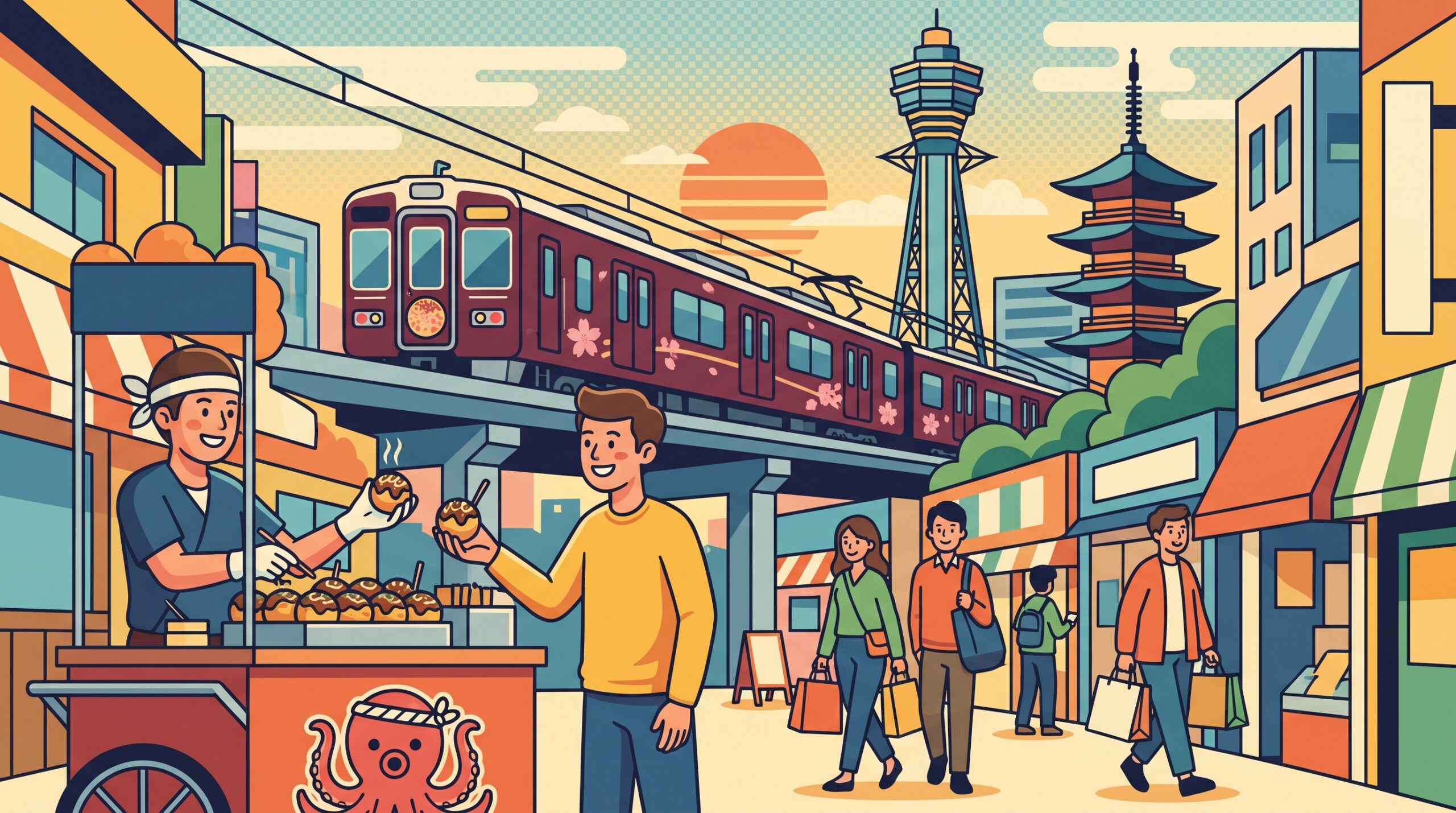
Tokyo whispers. Osaka shouts. You study standard Japanese for years. You memorize the intricate grammar rules. You practice the subtle bowing angles. You arrive in Japan feeling thoroughly prepared to navigate the quiet, polite society you read about in textbooks. Then, you step off the Shinkansen at Shin-Osaka Station. You drag your suitcases down into the neon-lit depths of the Midosuji subway line. You emerge into the chaotic, electric air of Namba. Immediately, you realize something is completely different. The language you spent years perfecting seems to have vanished. The intonation bounces. The vowels stretch out like pulled taffy. The polite, respectful distance of Tokyo is replaced by a warm, sometimes aggressive, relentlessly rhythmic banter. Welcome to Osaka. Welcome to Kansai-ben.
For foreign residents, expats, and anyone attempting to build a life in this vibrant region, understanding the local dialect is not just a party trick. It is a fundamental survival skill. The local language is the clearest window into the soul of the city. It reveals exactly how Osakans think, how they conduct business, and how they connect with one another. If you only rely on the standard, textbook phrases, you will forever remain on the outside looking in. You will miss the underlying warmth of a gruff shopkeeper. You will miss the punchline of a local joke. I am writing this to bridge the gap between the classroom and the concrete streets. We are going to look beyond the surface-level stereotypes. We are going to examine how the rhythm of the city dictates the rhythm of the speech. By the end of this guide, you will understand the city and its people on a much deeper level.
Why Learning Kansai-ben Phrases Will Upgrade Your Trip to Japan

Whether you are visiting for a two-week sightseeing trip or signing a two-year apartment lease in Fukushima ward, understanding the local vernacular fundamentally shifts your experience. Learning these phrases will undoubtedly enhance your trip to Japan, but more importantly, it will transform your everyday life. To understand why this is so essential, you need to look back at the region’s history. Osaka was never a samurai stronghold. During the Edo period, while Tokyo was tightly controlled by military rulers and strict social hierarchies, Osaka was the undisputed kitchen of the nation. It was a city built by merchants, for merchants. The country’s vast wealth flowed through the Dojima Rice Exchange. In a city where everyone is trading, buying, and selling, communication becomes your most valuable currency.
In a rigid samurai culture, language is used to maintain distance and assert authority. In a merchant culture, distance is detrimental to business. You need to close the gap between yourself and the customer immediately. You need to build trust. You need to read the room. This historical reality gave rise to a dialect uniquely designed to break the ice. When you, as a foreigner, drop a perfectly timed local phrase into a conversation, you are signaling something profound. You are telling the locals that you acknowledge their unique identity. You are stepping out of the sterile mold of the ‘polite foreign visitor’ and entering their world. The response is almost always immediate and overwhelmingly positive. Doors open. Prices miraculously drop. Free appetizers appear on your table at the local izakaya. Learning the local tongue is the ultimate cheat code for navigating the city’s social landscape.
Kansai Dialect vs Standard Japanese: What’s the Difference?
When you compare Kansai dialect vs Standard Japanese, you are essentially examining two fundamentally different approaches to human interaction. Standard Japanese, historically influenced by the elite classes of the capital, emphasizes harmony through formality. It depends heavily on intricate levels of polite speech, known as keigo. Its main purpose is to continuously reinforce the social hierarchy between speaker and listener, ensuring no one is offended. The tone tends to be relatively flat, with clipped and precise syllables, while emotional expression is carefully and deliberately restrained.
Kansai-ben completely upends this framework. Because strict hierarchy hindered commerce, the local language developed to be more egalitarian, emotional, and highly expressive. Phonetically, the contrast is striking. Standard Japanese typically features a pitch accent that falls at the end of a sentence, whereas the Kansai dialect has a pitch accent that rises, dips, and bounces dramatically. Vowels are often elongated for comedic or emotional effect. A simple word like ‘te’ (hand) stretches into ‘tee’, and ‘me’ (eye) becomes ‘mee’. This elongation lends the language a musical, elastic quality, making it feel less like a formal decree and more like a lively jazz improvisation.
Moreover, the vocabulary itself is naturally softer and more inviting. The standard negative verb ending ‘-nai’ shifts to ‘-hen’. For example, ‘Wakaranai’ (I do not understand) becomes ‘Wakarahen’. The sharp, harsh edges of the standard language are smoothed out. Foreigners relying solely on textbook vocabulary often find themselves thoroughly confused by these changes, as locals seem to disregard grammatical rules. However, the reality is that the rules here are simply different. The ultimate aim of communication in this city is not perfect, rigid politeness—it is genuine, effortless human connection.
Essential Kansai-ben Phrases for Everyday Travel
If you want to blend seamlessly into the daily rhythm of the city, mastering the foundational phrases is essential. These are the words you’ll hear from the moment you wake up until you stumble out of a late-night diner. These are the most important Kansai ben phrases in japanese for both surviving and thriving in your new environment.
Ookini: The Magical Word for “Thank You”
In standard Japanese, you express gratitude with ‘Arigatou gozaimasu.’ It is perfectly polite and expected. But in Osaka, the true magic word is Ookini (Thank you). The history of this word perfectly reflects the local culture. Originally, ‘ookini’ was an adverb meaning ‘greatly’ or ‘very much.’ Merchants would say ‘ookini arigatou’ (thank you very much). Over time, in the fast-paced market rush, the ‘arigatou’ was dropped entirely, and the adverb became the main expression.
Today, you’ll hear this word echoing through every shopping arcade in the city. When you pay for your coffee at a retro kissaten, the older woman behind the counter will call out a bright, melodic Ookini. When you use it yourself, the effect is remarkable. Handing your change to a taxi driver and offering a casual Ookini instead of a stiff ‘arigatou’ instantly changes the vibe. It shows you are tuned into the local rhythm. It’s a small verbal nod to the historic merchant spirit that built the streets you’re walking on.
Maido: The Ultimate Local Greeting
Step into any locally owned business, from a tiny yakitori stand beneath the train tracks to a bustling hardware store, and you’ll be greeted with a booming Maido (Hello / Welcome). This phrase originates from ‘maido ari,’ which roughly means ‘thank you for your continuous patronage.’ It implies ‘thank you for coming every time.’
What makes this phrase uniquely local is that shopkeepers will enthusiastically shout Maido to you even on your very first visit. It’s a proactive, optimistic greeting, treating you like a loyal regular from the start, assuming you’ll return. This sets a tone of immediate familiarity. While tourists might be puzzled by being thanked for ‘always coming’ on their first visit, savvy locals understand this as the verbal equivalent of a warm embrace. You can even use it yourself when greeting a shopkeeper you visit often. A quick Maido with a slight nod firmly establishes you as a local.
How to Say “Sorry” in Kansai Dialect
Apologies in Japan are famously intricate, deeply woven into social obligations. In standard Japanese, a formal apology carries significant weight, acknowledging a breach of protocol. But if you want to know how to express a genuine, everyday Sorry in Kansai dialect, you have to look beyond the formalities of the capital. Here, an apology is less about rigid protocol and more about quickly and smoothly restoring interpersonal harmony.
You will often hear Gomen ya de (I am sorry about that). It softens the standard ‘gomen nasai’ with a casual, almost affectionate local particle at the end, turning a formal apology into a gentle, verbal pat on the shoulder. Then there’s the historical heavyweight: Kannin na (Please forgive me or Cut me some slack). This phrase carries deep emotional weight, implying vulnerability and relying on the listener’s empathy. When a frantic izakaya owner forgets your drink order and rushes over saying Kannin na, they’re not just apologizing for a mistake—they are appealing to your shared humanity. They ask you to let it slide for the sake of good vibes in the room. Understanding this nuance is essential, as it shows how human connection always takes precedence over strict etiquette in this region.
Funny Kansai-ben Phrases to Make Locals Smile

Life in this region is deeply connected to humor. The city stands as the undisputed capital of Japanese comedy, hosting the vast Yoshimoto Kogyo entertainment empire. Here, conversations often take on the form of comedic performances. If you pick up a few Kansai ben phrases funny enough to surprise a local, you’ll gain lifelong friends.
Nande-yanen: The Timeless Comeback
Any discussion of the local dialect must include the undisputed king of local expressions. Nande-yanen (Why the hell is that? or You have got to be kidding me!) is more than a simple phrase; it is a cultural reflex. To grasp its significance, one must understand the foundation of local entertainment: Manzai comedy. In a traditional Manzai pair, the ‘boke’ is the funny character who utters something absurd, while the ‘tsukkomi’ is the straight man who sharply and logically rebukes the absurdity.
Nande-yanen is the quintessential tsukkomi phrase. It’s the verbal equivalent of a playful slap on the back of the head. On the streets of Osaka, you don’t need to be a professional comedian to use it. It’s the perfect, expected comeback to any exaggerated claim, silly mistake, or lighthearted teasing. If a shopkeeper jokingly says a single strawberry costs one million yen, you don’t politely refuse. Instead, you respond with a perfectly timed Nande-yanen. The result is immediate: hearty laughter, a wide smile, and often a genuine discount. This shows you understand the core principle of the city—every interaction is a potential comedy sketch, and you’re expected to join in.
Meccha: To Express Intense Excitement
Local culture isn’t known for restraint. When people here feel something, they feel it deeply and express it loudly. To capture this intensity, you need the right words. In standard Japanese, ‘totemo’ means ‘very,’ but it’s too mild for the local vibe. You need Meccha (Very / Insanely / Extremely).
Meccha instantly adds impact and strong emphasis to whatever you say. If a bowl of ramen tastes great, it’s not just delicious; it’s Meccha umai. If the scorching August heat is unbearable, it’s not just hot, it’s Meccha atsui. Incorporating this word into your daily speech aligns you with the city’s high-energy spirit. It shows you’re not passively observing but actively, enthusiastically experiencing everything around you.
Akan: The Dramatic Way to Say “No Good”
When things go wrong, standard words like ‘dame’ or ‘ikenai’ get used. These are practical but lack dramatic flair. In this region, when something is bad, forbidden, or completely failing, it’s Akan (No good / Impossible).
Akan is visceral and emotionally charged. You’ll hear parents shouting it at mischievous kids near the street. Salarymen might mutter it into their beer when lamenting a failed deal. It works both playfully and seriously. If you try to eat a piece of octopus that’s too hot, waving your hand and gasping Akan, akan! is a perfectly theatrical and universally understood reaction. Using it lets you engage with the emotive, expressive nature of local communication.
Practical Osaka Dialect Phrases for Dining and Shopping
Daily life inevitably centers around food and trade. This is the city of ‘kuidaore’—where people eat until they are financially drained. It is also a city of hustle, where every price tag serves only as a suggestion. To thrive in the markets and at the dining counters, you need a set of specific Osaka dialect phrases at your disposal.
Praising the Food: “Honma ni umai!”
Food here is almost a religion. The standards for culinary excellence are remarkably high, whether at the cheapest street stall or the most exclusive hidden restaurant. When a chef sets a steaming plate of okonomiyaki before you, a polite standard ‘oishii desu’ is acceptable but lacks enthusiasm. To genuinely honor the cook, you must meet their gaze and say, Honma ni umai! (This is truly delicious!).
‘Honma’ means ‘really’ or ‘truly’, while ‘umai’ is a slightly rougher, more passionate way to say delicious. Together, you’re directly appealing to the chef’s pride. You will almost always receive a beaming smile in response. The local food culture is highly interactive. Chefs want to see that you appreciate their hard work. Offering this loud, wholehearted praise breaks down the barrier between kitchen and counter, turning a simple meal into a shared experience.
Asking for the Price: “Kore nanbo?”
As mentioned earlier, this city was built on trade. Wealth has flowed through its canals and markets for centuries. In Tokyo, openly and aggressively discussing money is often viewed as somewhat vulgar and best avoided in polite company. Here, money stands as a symbol of hard work. It’s the language of survival. When wandering through the expansive arcades of Tenjinbashisuji or the bustling alleys of Kuromon Market, you must confidently ask about the price.
Kore nanbo? (How much is this?) is your essential phrase. It’s direct and rhythmically punchy. But asking the price is just the start of the exchange. In standard Japanese culture, a price is fixed. In Kansai, it’s the opening bid in a friendly negotiation. When you point at a vintage jacket or a box of premium fruit and ask Kore nanbo?, you’re inviting the vendor into a dance. If they give a price, you might respond with a shocked expression and an exaggerated plea for a discount. It’s not about being stingy. It’s about the art of the deal. It’s a way to interact, show respect for the vendor’s hustle, and actively engage in the region’s timeless commerce.
Tips for Communicating with Kansai Locals Like a Pro
Mastering the local language isn’t about achieving perfect grammatical fluency. It’s about showing a sincere willingness to engage with the culture on its own terms. To communicate with locals like an experienced resident, you must first fully let go of the fear of making mistakes. In Tokyo, a grammatical error might be met with a polite, somewhat awkward silence. In Osaka, a mistake becomes a great opportunity for humor. The locals value the genuine effort much more than flawless execution. When you throw out a clumsy, heavily accented local phrase in a crowded bar, you signal your desire to belong.
Body language is just as important. Communication here is highly physical. You’ll quickly notice locals standing much closer together than in other parts of the country. You’ll observe bigger hand gestures and experience more direct, sustained eye contact. Don’t shy away from this lively energy. Embrace it. Match the volume. Match the enthusiasm. A loud voice here doesn’t indicate aggression; it shows engagement.
Additionally, you must learn to read the room accurately. While the dialect is known for its boisterousness and humor, the people also have a profound, unspoken sense of communal responsibility and empathy. The humor is never intended to belittle. The banter is always grounded in mutual respect. When a situation truly requires seriousness, the locals know how to shift accordingly. But in the vibrant, chaotic theater of daily life—the wet markets, the bustling train stations, the late-night diners filled with the aroma of fried pork and spilled beer—the default mood is overwhelming warmth.
Your greatest asset in navigating this city is not a perfect vocabulary or mastery of standard grammar. It’s a sense of humor. It’s the ability to laugh at yourself. It’s the willingness to walk into a crowded room, catch the eye of the person across the counter, and sincerely try to connect. Because in Osaka, effort itself is the triumph, and language is simply the tool you use to succeed.