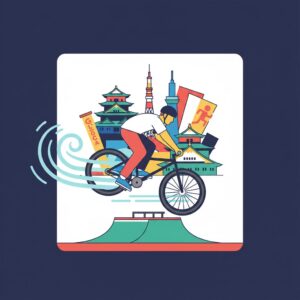
Step off the train in Osaka, and you feel it instantly. Not the humidity, not the wall of sound from the station, but the motion. It’s a city in constant, fluid movement, and the vehicle of choice isn’t the rumbling JR train or a silent, gliding taxi. It’s the humble bicycle. In Tokyo, the subway map is the city’s bible, a complex web that dictates the rhythm of daily life. Here in Osaka, the real map is etched onto the streets, navigated by millions of spinning wheels. Cycling isn’t a weekend hobby or a last-mile solution; it’s the lifeblood of the city, a deeply ingrained part of the local psyche that’s all about pragmatism, efficiency, and a healthy disregard for rules that just don’t make sense on the ground. For anyone looking to truly live here, understanding the way of the bicycle is understanding the heart of Osaka itself. It’s a world that seems free and simple from the outside, but it’s governed by a complex ecosystem of costs, regulations, and unwritten social contracts that can trip up any newcomer. This isn’t just about saving a few hundred yen on a train ticket. It’s about unlocking a hyper-local way of life, but only if you learn the real rules of the road. Let’s break down what it truly costs—in yen and in social currency—to join the flow.
For those eager to delve into the practical intricacies of urban cycling, exploring Osaka’s cycling dynamics can offer a balanced view of its benefits and challenges.
The Financial Breakdown: More Than Just a Bike
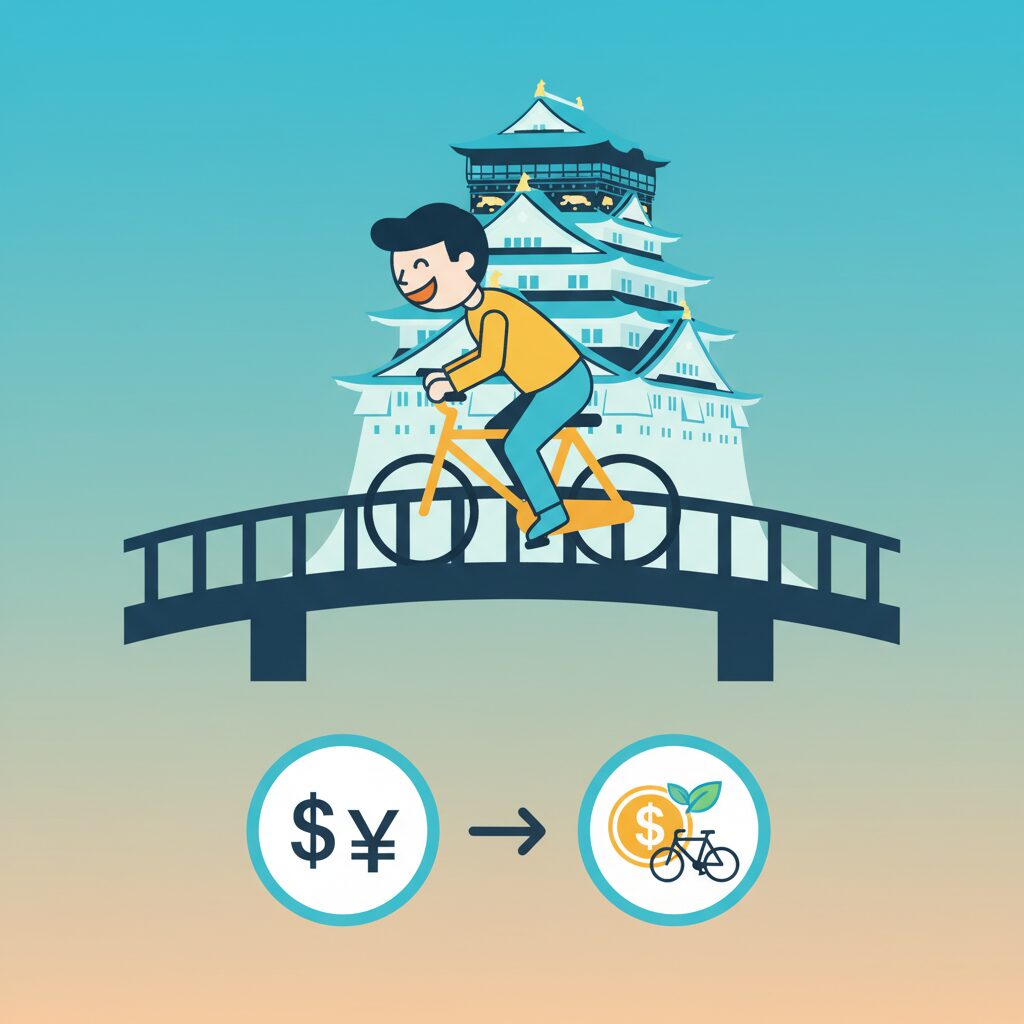
The appeal of cycling in Osaka begins with a straightforward calculation: biking is more affordable than taking the train. A short subway trip costs at least 190 yen. Doing that twice daily adds up to thousands of yen each month. In contrast, a bike feels like a one-time expense. This is a quintessential Osaka mindset—always seeking the most cost-effective option. Yet, the real cost unfolds gradually, from the initial purchase to mandatory fees and the inevitable flat tire on a rainy Tuesday morning. Getting this right from the outset is your first lesson in local life.
The Initial Investment: Picking Your Ride
Your journey starts with choosing a bike, and in Osaka, one model reigns supreme: the mamachari. Literally “mama’s chariot,” this is the city’s practical workhorse. You’ve seen them everywhere. They’re sturdy, single-speed, and built like tanks, featuring a low, step-through frame, a wide, comfy seat, a dynamo-powered front light that buzzes as you pedal, and the essential front basket. The basket is indispensable; it carries groceries, work bags, and sometimes a small, well-behaved dog. A new, no-frills mamachari from big-box stores like Cycle Base Asahi or a local jitenshaya (bike shop) costs between 15,000 and 25,000 yen. It’s not about style; it’s a practical tool. No one is impressed by flashy bikes. What counts is utility, and the mamachari epitomizes practicality on two wheels.
Naturally, Osakans love a bargain, so the second-hand market thrives. Used bikes can be found at recycle shops for as little as 8,000 yen. Expat forums and community groups often host “sayonara sales” where departing residents sell everything, including their bike. These can be great deals, but they carry risks. The bike might need repairs right away, and more importantly, you must ensure ownership is properly transferred. Buying a bike without the correct paperwork invites trouble. The safest route is purchasing a used bike from a trusted shop, where it’s already been serviced and the registration is handled for you.
Then there’s the modern upgrade: the electric-assist bike, or denki jitensha. These are the mamachari’s high-powered cousins, and they’re everywhere now. Once considered a luxury for mothers juggling gentle slopes with kids in tow, they’ve become a mainstream choice for anyone wanting to arrive without breaking a sweat. Prices start around 100,000 yen—significantly higher—but many see this as a smart Osaka investment. It extends your range, levels the city’s few hills (like the climb to Uehonmachi), and makes carrying a week’s groceries effortless. It’s a practical commitment to personal convenience.
Mandatory Registration and Ongoing Expenses
After buying your bike, expenses don’t stop. The first, most essential purchase is the Bouhan Touroku, or anti-theft registration. This is compulsory—a legal must. When buying from a shop, they’ll register it for a modest fee of about 600 yen. You’ll receive a small, durable orange sticker with a registration number placed on the frame. This number links the bike to you. This system strikes a balance between Osaka’s casual vibe and its underlying order. If police stop you for a random check (and they do), this sticker proves the bike is yours. Should it be towed for illegal parking, this sticker is your key to recovery. Without it, you face bureaucratic headaches. This isn’t about distrust; it’s building accountability to keep the city’s chaotic ecosystem functioning smoothly.
Next come ongoing costs. Keeping your tires inflated is a simple matter of self-reliance. Big supermarkets like Life or Mandai offer free air pumps near their entrances. Local bike shops will often let you use theirs free of charge—a small communal courtesy. But when you get a flat tire—a panku—it’s time to visit the local specialist. Repairs typically cost between 1,000 and 1,500 yen. Brake adjustments, a new chain, or a replacement basket add up over time. These small maintenance costs are part of owning a tool you use daily.
A newer and often overlooked necessity is bicycle insurance, or jitensha hoken. It became mandatory in Osaka Prefecture a few years ago, in response to rising accidents involving cyclists. Insurance is very affordable—often just a few thousand yen per year—and can be purchased conveniently at convenience stores. Many foreigners overlook this requirement, but it’s crucial. It signals a societal shift: while cycling culture feels casual and informal, the consequences are serious. It’s another example of Osaka’s pragmatism—enjoy the freedom, but be ready for the responsibility.
The Parking Puzzle: Where Your Yen Really Goes
So, you have your registered, insured, and well-maintained mamachari. You’re saving a bundle on train fares. But then you encounter the hidden expense that chips away at your wallet 150 yen at a time: parking. The romantic notion of a city where you can simply hop off your bike and chain it to the nearest guardrail is becoming a thing of the past. Osaka has taken a firm stance on bicycle clutter, and mastering the parking system has become a daily financial challenge every resident must face.
The Myth of “Free” Parking
For years, Osaka’s streets were overrun with illegally parked bicycles. They cluttered sidewalks, blocked entrances, and caused widespread annoyance. True to Osaka’s style, the problem was overlooked until it became too disruptive to ignore. Now, in most commercial districts and around every train station, signs warn against illegal parking. These warnings are no joke. The city hires contractors who patrol the streets, tagging unlawfully parked bikes with a dreaded warning notice—typically a bright yellow or white slip stubbornly wrapped around your frame or handlebars. If you come back and find the tag, consider yourself lucky. You still have a chance to move your bike. But if you return to find your bike missing, it has been impounded.
Retrieving your bike is a challenging rite of passage for many newcomers. First, you must locate the signpost indicating where the local impound lot, or hokanjo, is situated. These lots are almost always in the most inconvenient locations—often beneath a far-off expressway or a thirty-minute walk from the closest station. Once there, you present your ID and bike key, complete some paperwork, and pay a fine—typically around 2,500 yen. Add the train fare to get there, and that single moment of carelessness has cost you a significant sum. The city’s harsh but effective approach is meant to teach respect for the rules. It’s a financial punishment for causing trouble for others, a serious breach of Osaka’s social norms.
Mastering the System: Public and Private Lots
The best solution is to adopt the use of paid parking lots, known as churinjo. Once you start looking, you’ll find them everywhere. Near train stations, there are large, multi-story garages with automated systems, as well as simpler ground-level lots where a metal bar locks your front wheel. The pricing is designed for commuters and shoppers. Usually, the first 30 to 120 minutes are free. After that, a flat fee of 150 or 200 yen applies for a 24-hour period. This is the standard, expected expense of living in the city. You factor it into your daily budget and learn the locations of the cheapest lots with the longest free parking durations.
This logic also applies to commercial centers. Almost every supermarket, department store, and major shopping arcade offers its own bicycle parking. Places like Hanshin Department Store in Umeda or the Namba Parks complex provide free parking for a couple of hours, often validated with a purchase. This sets a rhythm for your errands. You don’t just visit the grocery store; you go there with 90 minutes of free parking, which is enough time to also stop by the bank and post office nearby. It’s a small-scale optimization game, a means of getting the most out of every trip, reflecting the local merchant spirit.
For the everyday commuter, the smartest option is the monthly contract, or teiki. If you bike to the same station daily, you can rent a spot at the station’s churinjo for a flat monthly fee, usually between 2,000 and 4,000 yen. You’ll receive a sticker for your bike, marking you as a subscriber. This sticker is more than proof of payment; it signifies you’re a local, a regular. You’ve integrated into the system, done the cost-benefit analysis, and found this to be the most efficient method. You’ve learned to think like an Osakan.
The Unwritten Rules of the Road: Osaka’s Cycling Etiquette
Beyond the yen and legal regulations lies the most intricate aspect of Osaka’s cycling culture: its etiquette. These unspoken rules and shared understandings enable millions to navigate a densely packed city without constant conflict. To outsiders, the system may appear chaotic, but it operates with its own internal logic. Mastering it is about more than avoiding fines; it means becoming part of the city’s living, breathing rhythm.
Sidewalk vs. Street: The Great Debate
This is the first and most significant contradiction you’ll encounter. Japanese law classifies bicycles as vehicles, requiring them to be ridden on the street’s left side, following traffic flow. Yet, look around—you’ll see nearly everyone, from grandmothers carrying baskets of daikon to salarymen in suits, riding on sidewalks. This isn’t widespread lawbreaking but rather a clear example of tatemae (official stance) versus honne (actual practice). Streets are often narrow and congested with cars, buses, and trucks. For the typical mamachari rider, it’s simply safer and more practical to stick to the wide, spacious sidewalks.
So how do you navigate this? The secret lies in situational awareness and a deeply ingrained social contract. The sidewalk belongs to pedestrians, and as a cyclist, you are a guest. You must ride slowly, predictably, and always be ready to yield. Weaving aggressively through crowds is out of the question. Use your bell, but sparingly. A sharp, insistent ring is considered rude—it’s like shouting inside a library. A single, gentle ding from a distance politely signals “excuse me, I’m behind you.” It’s a notification, not a command. Mastering this subtlety shows you understand the local social hierarchy.
The “Osaka Weave” and Navigational Nuances
Watch cyclists move through a crowded shopping arcade like Tenjinbashi-suji, and you’ll see a fluid, informal choreography. There are no lanes or traffic lights—just hundreds of pedestrians and cyclists moving in all directions. It works because everyone participates in the “Osaka Weave.” This involves constantly reading body language, predicting movements, and making small, fluid adjustments to speed and direction. You don’t stare at your phone; instead, you look ahead, make eye contact, and anticipate what others will do next. It’s a dance that, once learned, feels entirely natural—the city’s pragmatism expressed physically, efficiently moving large numbers of people through tight spaces.
This pragmatism sometimes results in rule-bending. Without a doubt, you’ll see people riding with open umbrellas during rain showers (kasa-sashi unten). This is officially illegal and punishable by fines due to safety concerns and obstructed vision. Still, it’s common. This practice stems from a simple calculation: getting wet is more inconvenient than the risk of a fine. We don’t recommend it, but understanding why it happens is important. It’s a classic case of convenience outweighing regulation. However, using your phone while riding is viewed as outright negligence. Police rigorously enforce bans on this, and you will be fined. Riding with headphones is a gray area; it’s technically illegal if it impairs your ability to hear important ambient sounds like sirens. The unspoken rule is that if you choose to bend regulations, you must never create a problem for others.
The Social Hierarchy on Two Wheels
On shared sidewalks and streets, an unspoken hierarchy exists. At the top are pedestrians—especially the elderly and children—who must always be given wide berth. Next are the mamacharis, the system’s backbone, moving at a steady, predictable pace and forming the baseline. Following them are faster road and cross bikes, generally expected to stick to the street or exercise extra caution and slow down on sidewalks. Finally, food delivery riders, often moving swiftly and urgently, sometimes disrupt this delicate balance. Understanding your place in this flow is essential. If you ride a mamachari, you ride like one; don’t try to act like a road racer. This mutual understanding and predictability keep the system running smoothly, with everyone aware of their role.
Another notable point is the scarcity of helmets among adult cyclists. While helmets are mandatory for children, most adults on mamacharis ride without them. This is slowly changing as new regulations promote helmet use, but for now, it reflects a casual, “it’ll be fine” (daijoubu) mindset that permeates daily life. This risk assessment favors comfort and convenience, a striking contrast to more overtly safety-conscious cultures.
Why It All Matters: The Bicycle as a Symbol of Osaka Life
Understanding cycling culture in Osaka goes beyond mere transportation. The bicycle serves as a lens revealing the city’s core values. It is a rolling emblem of local character, a daily reflection on what it means to live here.
Practicality Over Prestige
In many cities, your mode of transport signals status—luxury cars or stylish Italian scooters. But in Osaka, the bicycle is the great equalizer. Company presidents, university students, and stay-at-home parents might all ride the same 20,000 yen mamachari. The value of the bike isn’t in its brand or price, but in its practicality. Does it perform the task efficiently and affordably? This practical mentality echoes Osaka’s history as a merchant city built on trade, value, and smart, pragmatic choices. A bike isn’t about style. It’s about smartness. And in Osaka, being smart is always stylish—grounded, unpretentious, and focused on what works.
A Hyper-Local Perspective
While the subway is efficient, it offers a sterile, underground commute that transports you directly between major hubs, making you miss everything in between. Bicycling, by contrast, connects you intimately to the fabric of the city. It keeps you grounded on a human scale. You discover a hidden coffee shop in a Nakazakicho alley, the local butcher in the shotengai with the best korokke, or the quiet park off the tourist map. Cycling ties you to neighborhoods, the seasons, and the subtle shifts in the urban scene. It’s the difference between living in Osaka and truly belonging to it. You feel the land’s slope, smell the takoyaki stands, hear the chatter from local shops. You are fully present.
The Contrast with Tokyo
This deep integration of cycling into daily life stands in stark contrast to Tokyo. Tokyo, with its hills and vast distances, is defined by its world-class rail system. The train shapes the city’s rhythm. Osaka, by comparison, is mostly flat and compact. The downtown core, from Umeda to Namba, is easily navigable by bike. This simple geographic fact shapes local attitudes. Why pay 240 yen and squeeze into crowded trains for a 15-minute trip when you can pedal there in 20 minutes for free? It’s a clear, logical choice. The bicycle symbolizes autonomy and self-reliance unique to Osaka—a city where people pursue the most direct, common-sense solution, even if it means skillfully weaving through crowded sidewalks to get there.
Final Thoughts: Embracing the Osaka Flow
To own and ride a bike in Osaka is to enter into a social contract. The financial obligations are clear: the initial purchase, mandatory registration and insurance, the small but consistent cost of parking fees, and occasional repairs. These are the fees you pay to take part. But the true investment lies in understanding the culture. It means realizing that the rules written in law tell only part of the story. The rest is found in the shared movements of millions.
It involves embracing a certain kind of organized chaos—a system in which individual freedom is balanced by a collective, unspoken responsibility not to be a nuisance. Mastering the bicycle—knowing when to use the sidewalk, how to park without risking a tow, and how to skillfully weave through crowds—is one of the quickest ways to shed the tourist identity and begin feeling like a local. It’s about seeing the mamachari not merely as a machine, but as your key to the city, a tool for living a practical, local, and deeply, unapologetically Osakan life.