You feel it before you see it. It’s a low rumble on the train, a flash of yellow and black on a salaryman’s phone case, a sudden, inexplicable discount on cabbage at your local supermarket. You ask the shopkeeper why, and she just grins, pointing a thumb at a small, crackly television in the corner showing highlights from last night’s game. “Tora ga katta,” she says. The Tigers won. And in Osaka, when the Tigers win, everyone wins. For a newcomer, this city-wide obsession with a baseball team, the Hanshin Tigers, can feel like stumbling into a secret society. It’s a language you don’t speak, a religion you haven’t been baptized into. In Tokyo, sports are a hobby, a pleasant diversion. In Osaka, the Hanshin Tigers are a vital organ, the city’s loud, emotional, and often-aching heart. This isn’t just about balls and strikes; it’s a window into the soul of Osaka, its defiant spirit, its deep-seated rivalry with Tokyo, and its unshakeable sense of community. Understanding the Tigers is the ultimate shortcut to understanding this city. It’s about more than a game; it’s about figuring out why your quiet neighbor suddenly screams at his television, why the normally reserved department store staff break into a cheer, and why an entire metropolis seems to hold its breath in unison for nine innings. This is the beautiful, baffling, and utterly captivating world of the Hanshin Tigers.
To truly immerse yourself in this community spirit, consider exploring other local hubs like the bustling Kuromon Market.
The Sacred Art of Suffering: Why Losing Defines the Tigers
To understand the Tigers phenomenon, you must first set aside everything you know about being a sports fan. In most cultures, fandom is transactional: you support a team and, in return, expect a fair share of victories. You celebrate championships and revel in the reflected glory. Supporting the Hanshin Tigers, however, is mostly an act of faith—an homage to the beauty of struggle. Throughout much of their long history, the Tigers have been magnificently, almost poetically, unsuccessful. Since the two-league system began in 1950, they have won only a handful of league championships and even fewer Japan Series titles. This isn’t a dynasty; it’s a saga.
Their history of coming up just short, of snatching defeat from the jaws of victory, has forged a unique identity. A Tigers fan is not a glory hunter but a loyalist, a believer. The team’s enduring underdog status strikes a deep chord with the Osaka mindset. Osaka has always seen itself as a scrappy, hardworking merchant city, in contrast to the polished, bureaucratic, and powerful capital Tokyo. The Tigers embody that spirit. They are not the elite or the chosen ones—they are our guys—flawed, unpredictable, and capable of both breathtaking brilliance and soul-crushing mistakes. This shared experience of suffering creates a bond far stronger than victory ever could. A win brings a momentary burst of joy, a catharsis. But the losses, the decades of dameya (“it’s no good”), are the adhesive. It’s a communal burden everyone carries together. When you hear an old man in a pub sigh and say, “That’s the Tigers for you,” he’s not just referring to a dropped fly ball; he’s evoking generations of shared disappointment, a collective memory as integral to his identity as his own family history.
Foreigners often misinterpret this. They see the fervent displays and assume they come with consistent success. The truth is quite the opposite. The passion is the fuel that has sustained fans through the long lean years. It’s an emotional investment that yields dividends not in trophies, but in belonging. The most famous story in Tigers lore isn’t about a big victory but an odd curse. In 1985, the last time they won the Japan Series before their recent 2023 triumph, ecstatic fans gathered at the Dotonbori bridge. In their frenzy, they began tossing people who resembled the players into the foul canal. When they couldn’t find anyone resembling the team’s star American slugger, Randy Bass, they grabbed a life-sized statue of Colonel Sanders from a nearby KFC and hurled it into the water. For the next 38 years, the team was plagued by misfortune, a period known as the “Curse of the Colonel.” This isn’t just a humorous anecdote; it is a creation myth. It reflects a fanbase so deeply invested that they crafted their own folklore—a narrative to explain the unexplainable and give meaning to the long wait. To be a Tigers fan is to be a storyteller, a keeper of faith, and a connoisseur of the bittersweet art of hoping against hope.
More Than a Game: The Tigers as Osaka’s Social Fabric
In Osaka, the Hanshin Tigers extend far beyond the sports section. They dominate the front page, the weather forecast, and daily conversations all at once. The team’s performance sets the tone for the entire city. After a victory, the atmosphere lightens, strangers smile at each other on the subway, and shopkeepers in the shotengai (local shopping arcades) become a bit more generous with their service. Conversely, after a defeat, a tangible gloom settles over the city, a collective sigh resonating from the gleaming office towers of Umeda to the humble noodle shops in the suburbs.
This deep integration into daily life is what truly distinguishes Osaka from other cities. A taxi driver won’t ask where you’re from; he’ll ask your opinion on last night’s pitching performance. The butcher, while wrapping your pork, will offer a detailed critique of the new rookie’s batting stance. Baseball is the city’s natural social glue, a shared ground crossing age, gender, and social status. For a foreigner, this can be a remarkable gift. Feeling like an outsider? Learn the name of the current cleanup hitter. Mention it to the person running the local takoyaki stand. Suddenly, you’re not merely a customer—you’re part of the conversation. You belong.
This phenomenon is most apparent in the city’s economic rhythms. The Hanshin Department Store in Umeda, owned by the same parent company as the team, transforms into a festive hub after a major victory. “Victory Sales” are announced, offering steep discounts on everything from designer handbags to basement-level groceries. Other local businesses, with no official ties to the team, spontaneously launch their own promotions. A Tigers win is a boost to the local economy. This direct, tangible link between the team’s fortunes and residents’ daily lives would be unthinkable in Tokyo, where corporate culture is more compartmentalized and public displays of regional loyalty are more reserved. In Osaka, business and baseball blur beautifully and chaotically. The team is a public utility, a collective asset everyone feels connected to. Supporting the Tigers isn’t a consumer preference; it’s a civic responsibility.
Even the media landscape is distinct. While Tokyo news programs might allot a few minutes to sports at the end of the broadcast, Osaka channels often lead with Tigers coverage. A regular season game in May receives in-depth, dramatic coverage akin to a national election elsewhere. Every play is scrutinized, every player’s mood analyzed, and sportscasters speak with the zeal of evangelists. Local newspapers like Daily Sports and Sports Nippon explode with bold headlines and vivid photos, their pages overwhelmingly devoted to every Tigers move. This isn’t mere reporting; it’s myth-making in real time. It reinforces the notion that what happens at Koshien Stadium is the most important event in the world. And for a few hours each day, for hundreds of thousands in Osaka, it truly is.
The Koshien Experience: A Symphony of Organized Chaos

A visit to Hanshin Koshien Stadium, the Tigers’ revered home field, feels less like watching a sporting event and more like taking part in a finely choreographed musical. It is an immersive, overwhelming, and utterly joyous experience that exposes the true spirit of the fanbase. Forget the quiet, polite applause typical of some Japanese events. Koshien is a bubbling cauldron of noise, color, and raw emotion.
The Visual Spectacle
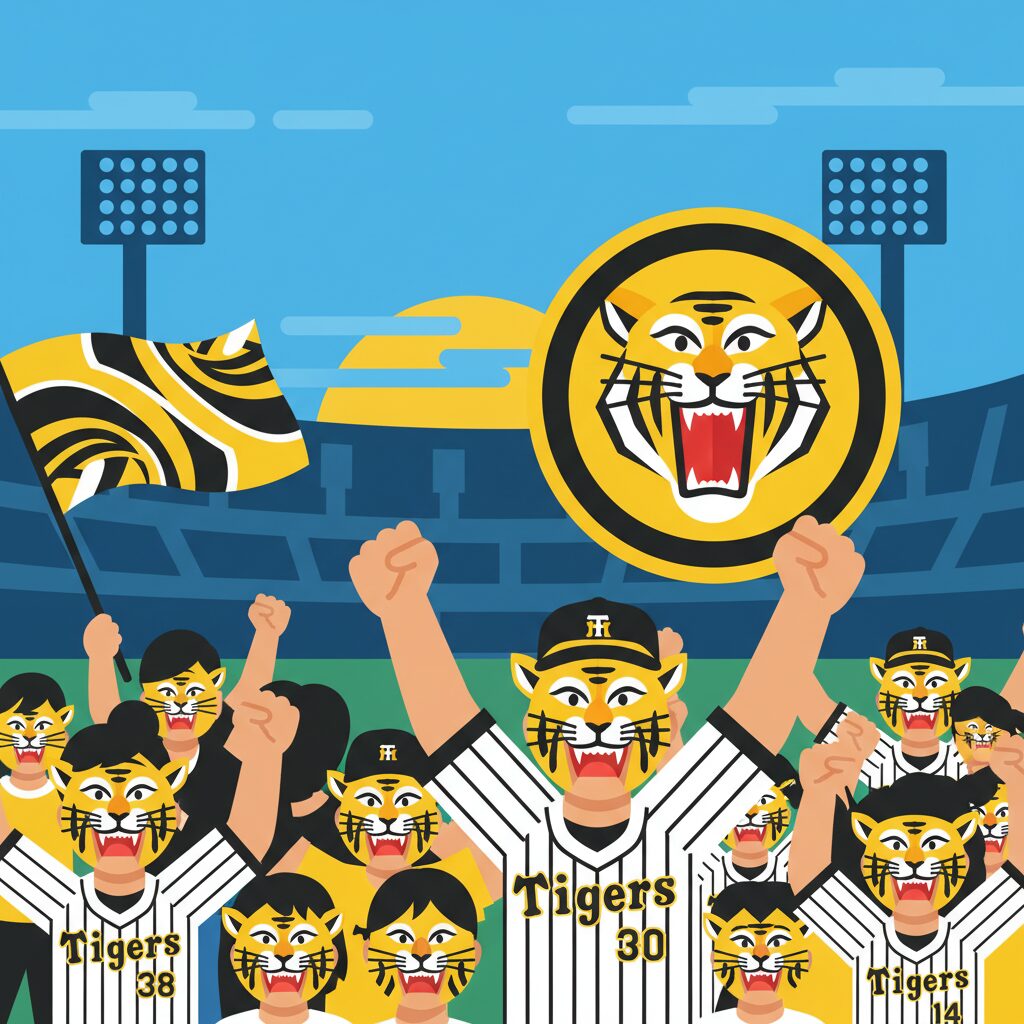
First, the colors stand out. The stands are awash in yellow and black, the official team hues. Fans don’t just sport a jersey; they wear full regalia. There are custom-made happi coats embroidered with players’ names in gold thread, elaborate tiger-striped costumes, and hats decorated with various feline-themed items. The sheer visual unity is stunning. It serves as a uniform of belonging, signaling that for the next three hours, individual identities fade into the collective. Everyone becomes part of the tribe.
The Wall of Sound
Next comes the sound. It is relentless, loud, and remarkably organized. This isn’t the spontaneous, individual yelling common in Western sports crowds. It’s a collective performance led by the ouendan, private cheering squads stationed in the outfield stands. With drums, trumpets, and flags, they orchestrate the entire stadium. Every Tigers player has a unique song, a personalized chant that the whole stadium knows by heart. When a batter steps to the plate, the ouendan launches the music, and tens of thousands sing in unison, punctuating the words with rhythmic claps and the banging of small plastic megaphones. It’s an all-encompassing experience. You feel the drumbeats vibrating in your chest, the energy of the crowd lifting you up. Even if you don’t know the lyrics, you can’t help but be swept away by its sheer power.
The Seventh-Inning Ritual: Jet Balloons
The most iconic Koshien ritual takes place during the seventh-inning stretch, just before the Tigers come to bat. This is the moment of the jet balloons. As the opening notes of the team anthem, “Rokko Oroshi,” play, fans throughout the stadium inflate long, rocket-shaped balloons. During the song, the stadium transforms into a swaying forest of yellow, white, and pink plastic. The anticipation is electric. Then, at the song’s climax, signaled by the scoreboard, everyone releases their balloons. In one explosive instant, tens of thousands of balloons soar skyward, emitting a high-pitched shriek. For a few seconds, the air is alive with a chaotic, beautiful storm of color and sound. It is an act of pure, unfiltered communal joy, a moment of release and shared hope that perfectly captures the Tigers fan experience. It’s a visible expression of collective belief—a prayer sent into the evening sky.
Even defeat has its own rituals. If the team loses, the stadium doesn’t just empty silently. Often, there is a mournful, unified rendition of a song, a shared moment to acknowledge the disappointment before everyone files out into the night, ready to try again tomorrow. The game, win or lose, receives its proper emotional farewell. It’s this structure, this ritualized expression of emotion, that makes the experience so powerful. It’s not mere chaos; it’s a carefully honed liturgy of passion.
The Diamond as a Battlefield: Osaka vs. Tokyo
You cannot grasp the passion for the Hanshin Tigers without also understanding their eternal rival: the Yomiuri Giants of Tokyo. This is more than just a sports rivalry; it embodies the centuries-old cultural, economic, and psychological conflict between Japan’s two largest cities. It’s Kansai versus Kanto, merchants versus samurai, the rowdy upstarts against the refined establishment.
The Giants are everything the Tigers are not. They are the New York Yankees of Japan—wealthy, powerful, and historically dominant. Known as the “Gentlemen’s Team,” their brand exudes cool, corporate professionalism. They are expected to win, and though their fanbase is massive and dedicated, Osakans often view it as more reserved, corporate, and less passionate. They symbolize Tokyo’s central authority—the political and economic force that has shaped Japan for centuries.
In contrast, the Tigers are the people’s team. They embody passion, grit, and a charming kind of chaos, reflecting the defiant spirit of Osaka, a city proud of charting its own path. A game between the Tigers and the Giants, known as the dentō no issen (the traditional match), carries deep symbolic meaning. It’s more than just nine innings of baseball; it’s a proxy battle for cultural dominance.
For Tigers fans, defeating the Giants is the ultimate achievement, often more satisfying than winning a championship. It affirms the Osaka way of life and offers the chance to best the big city, even if just for one night. The cheering at Koshien is loudest and the emotions most intense when the men in pinstripes visit. A home run off the Giants sparks a primal roar that seems to shake the stadium’s very foundations, while striking out a Giants star is met with a venomous glee usually reserved for a villain’s downfall in a historical drama.
This rivalry influences daily life. In Osaka, admitting to being a Giants fan is a bold, almost reckless confession, eliciting good-natured—and sometimes not so good-natured—ribbing, playful scorn, and genuine bewilderment. Why support the dull, arrogant team from Tokyo? This is a common misunderstanding among foreigners, who may see the rivalry as simple sports tribalism. But it runs much deeper, tied to regional identity, language (the distinct Osaka dialect), food culture, and a historical feeling of being undervalued and misunderstood by the capital. The baseball field is merely the most visible stage on which this long-standing cultural drama unfolds, year after year.
A Foreigner’s Field Guide: How to Join the Tribe
So, what does all this mean for you, a foreign resident trying to build a life in Osaka? It means you’ve been given a golden key to unlock the city. You don’t need to become a hardcore baseball expert, but recognizing and engaging with the Tigers phenomenon will open doors that might otherwise remain closed.
You Have a Permanent Icebreaker
Having trouble making small talk? The Tigers are your secret weapon. Simply checking the score from last night’s game gives you an instant conversation starter with nearly anyone. A casual “The Tigers are doing well, aren’t they?” or “Tough loss last night” can turn a brief encounter at the convenience store into a true human connection. People’s eyes will light up. They’ll be impressed and pleased that you’re paying attention to something so important to them. It shows you’re not just a tourist or a temporary visitor; you’re genuinely trying to understand the pulse of their city.
Go to a Game. Any Game.
You have to experience Koshien at least once. It doesn’t matter if you don’t fully understand baseball’s rules. You’re not there for the sport, but for the cultural immersion. Get the cheapest seats in the outfield. Pick up a pair of plastic megaphones. Don’t worry about not knowing the songs. Just stand when everyone stands, clap when they clap, and shout when they shout. The fans around you won’t judge you; they’ll welcome you. They’ll teach you how to inflate your jet balloon, offer you some fried chicken, and try to lead you in the chorus of “Rokko Oroshi.” In that moment, you won’t be a foreigner. You’ll be a Tigers fan. It’s the most inclusive, welcoming tribe in Japan.
Learn the Unspoken Rules
While the atmosphere is friendly, there are a few things to keep in mind. The most important rule: Never praise the Yomiuri Giants. Not even in jest. It will be met with either a cold silence or a playful but firm correction. It’s the one sacred taboo.
Also, understand that passion can sometimes run high. The image of the fan diving into the Dotonbori Canal is famous for a reason. Fans are emotional and express it openly. This contrasts with the more reserved demeanor you might find elsewhere in Japan. Don’t mistake this passion for aggression. It’s a profound, communal love for the team and the city—Osaka’s spirit in its purest, most unfiltered form.
Finally, embrace the local media. Turn on the TV after games. Pick up a copy of the Daily Sports, even if you can’t read the kanji. Look at the photos, headlines, and the drama. It will help you follow the season’s narrative and appreciate the importance of each game.
The fever for the Hanshin Tigers is more than just a sports obsession. It’s the city’s personality made visible. It’s loud, emotional, fiercely loyal, and it holds a long memory. It’s the collective hope that this year could be the one, even after decades of disappointment. It’s the shared joy of a walk-off home run and the shared sorrow of a ninth-inning collapse. To live in Osaka is to live within this phenomenon’s orbit. You can ignore it, treat it as background noise, or you can lean in, learn a player’s song, buy a cheap yellow hat, and join the chorus. If you do, you’ll find you’re not just watching a baseball team—you’re becoming part of the vibrant, chaotic, and wonderfully human story of Osaka itself.