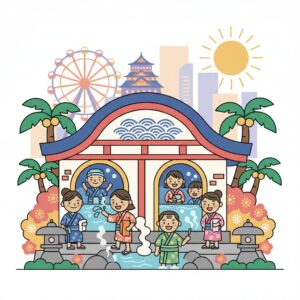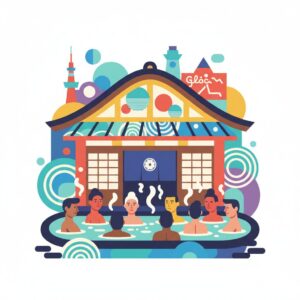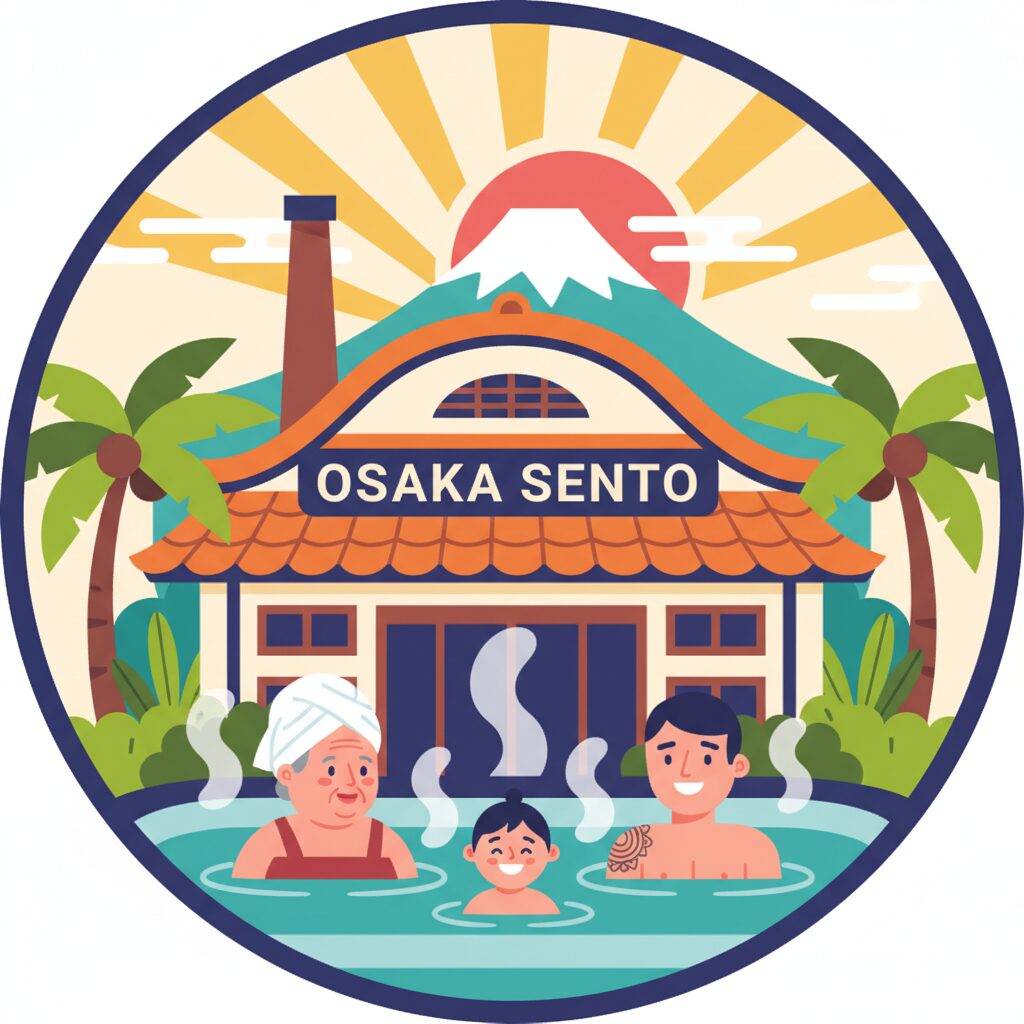
Walk down almost any residential street in Osaka, one of those narrow arteries snaking between low-rise apartment buildings and weathered single-family homes, and you’ll eventually see it. It might be a grand, temple-like structure with a sweeping karahafu gabled roof, or a more modest, mid-century concrete building with a tall, slender chimney reaching for the sky. A soft-glowing lantern might hang by the entrance, illuminating a dark blue noren curtain printed with the unmistakable character for hot water, ゆ (yu). This is the neighborhood sentō, the public bathhouse. And for the uninitiated, the very existence of these places in the 21st century can feel like a charming, if slightly baffling, anachronism. After all, virtually every home in Osaka has its own private, perfectly functional bathroom. Why would anyone pay 500 yen to go bathe with a crowd of strangers?
This is a question that misses the point entirely, but it’s an understandable one. It approaches the sentō as a utility, a place to simply get clean. But in Osaka, the sentō is not a utility. It’s a stage. It’s a clubhouse, a therapist’s office, a newsroom, and a living room all rolled into one steamy, tile-lined package. It’s one of the last true bastions of unfiltered, unpretentious community life in a world that’s becoming increasingly digital and isolated. While in Tokyo, the public bath can often be a quiet, almost meditative space for personal reflection, here in Osaka, it’s the opposite. It’s loud. It’s interactive. It’s where the city’s raw, unfiltered personality is on full display. It’s where you learn the real rhythm of the neighborhood, the subtle shifts in the price of cabbage at the corner market, whose son just passed his university entrance exams, and which local Hanshin Tigers player is in a slump. To understand the Osaka sentō is to understand a fundamental truth about this city: community isn’t a concept, it’s a daily practice, and sometimes, that practice happens when you’re naked.
For a foreigner living here, stepping through that noren curtain for the first time can be intimidating. It feels like crossing a threshold into an intensely local world with its own set of unwritten rules and social codes. But it’s also one of the most direct and rewarding ways to connect with the city on its own terms. It’s an invitation to shed not just your clothes, but the formalities and social armor we all wear every day. It’s where you stop being a visitor or a foreigner and start becoming just another neighbor, another body in the water, part of the warm, noisy, and profoundly human fabric of Osaka. Forget the flashy lights of Dotonbori for a moment; the real soul of the city is often found here, in the gentle clatter of plastic washbowls and the echo of laughter off wet tile walls.
To truly immerse yourself in this unique culture, consider exploring the vibrant weekend rituals at a super sentō.
The Sentō as Osaka’s Social Glue
To understand the role of the sentō in Osaka, you first need to grasp a concept called hadaka no tsukiai. The literal translation is “naked communion” or “naked relationship,” which sounds more dramatic than it truly is. It doesn’t refer to intimacy in a physical way, but rather a social one. The idea is that when you remove your clothes, you also drop the markers of status, wealth, and profession that define you in the outside world. In the bath, the company president and the construction worker, the professor and the shopkeeper, are all simply people. They become equals, sharing the same hot water and experiencing the same bodily aches and pains. This concept exists throughout Japan, but in Osaka, it’s practiced with a distinct, lively energy. It’s less about quiet, serene understanding and more about spirited, direct interaction.
Beyond the Bubbles: What “Hadaka no Tsukiai” Truly Means Here
At an Osaka sentō, hadaka no tsukiai is a vocal experience. It’s the sound of an elderly woman, towel wrapped around her head, holding court from the jacuzzi’s bubbling depths, her voice carrying as she tells a story to a friend sitting ten feet away on a plastic stool. It’s the sharp, witty retort—the famous Osaka tsukkomi—offered in response. It’s the unsolicited advice. While scrubbing your back, a nearby stranger might grunt, “A bit higher on the left, you’re missing a spot.” In Tokyo, this kind of intrusion might be viewed as an invasion of personal space. It would feel uncomfortable. But here, it’s a form of connection—a casual recognition of shared humanity, delivered with the city’s trademark straightforwardness.
One evening at my local sentō in the Tennoji area stands out in my memory. It’s an old place, featuring beautiful but cracked tile art of leaping carp on the wall. I was sitting in the hottest bath, a scalding 44 degrees Celsius, said to relieve stiff shoulders. An elderly man, likely in his eighties, slipped into the water opposite me. He nodded, then regarded me for a moment. “You’re not from around here,” he declared, not as a question but as a statement. I replied that I lived a few blocks away. He grunted again. “You foreign folk don’t know how to take a proper bath. You have to get in, get out, cool down, then get back in. Three times. That’s the secret. Opens up the pores.” Then he launched into a detailed, ten-minute lecture on the medicinal benefits of the different baths—the electric bath (denki-buro) for his arthritis, the herbal bath for good skin. He wasn’t being nosy or rude; he was initiating me. He shared local wisdom, ensuring I used this shared resource correctly. That is the heart of Osaka’s hadaka no tsukiai. It’s participatory. It’s instructive. It’s a bit bossy, but it stems from genuine, communal care.
The Unspoken Architecture of Communication
The traditional sentō’s physical layout is a masterclass in social design, crafted to encourage these interactions. The experience begins at the entrance, with the getabako, wooden lockers for your shoes. Choosing a locker is your first small act of participation. Then you pass through the curtain into the datsuijo, the changing room. This is the central hub, the core of all sentō activity. Real social life happens here. Wicker baskets or metal lockers line the walls for clothes storage. At the center, there might be a worn leather couch or a few benches facing a large, old-fashioned television, perpetually tuned to a baseball game or variety show. An old-fashioned weighing scale and a height chart hang on the wall. This space serves as the pre- and post-bath lounge.
Dominating the room is the bandai, a raised platform occupied by the attendant—often an elderly man or woman. From this vantage point, they collect the entrance fee, sell soap and towels, and keep watch over both male and female changing rooms (in older sentō, the dividing wall is low enough to see over). They serve as gatekeepers, moderators, and the living memory of the neighborhood. They greet regulars by name, inquire about their families, and hold spare keys. They form the human core of the institution.
From the datsuijo, you enter the bathing area, the arai-ba. This is the preparation zone. Low faucets line the walls, each accompanied by a small plastic stool and a washbowl. This is where washing is done but also where brief social exchanges occur. Finding an empty spot, you may offer a slight nod, an eshaku, to neighbors on either side—a small but important gesture, acknowledging that you’re now sharing this intimate space. Quick pleasantries are exchanged: “Maido” (Thanks as always), “Ee oyu desu na” (Nice hot water, isn’t it?).
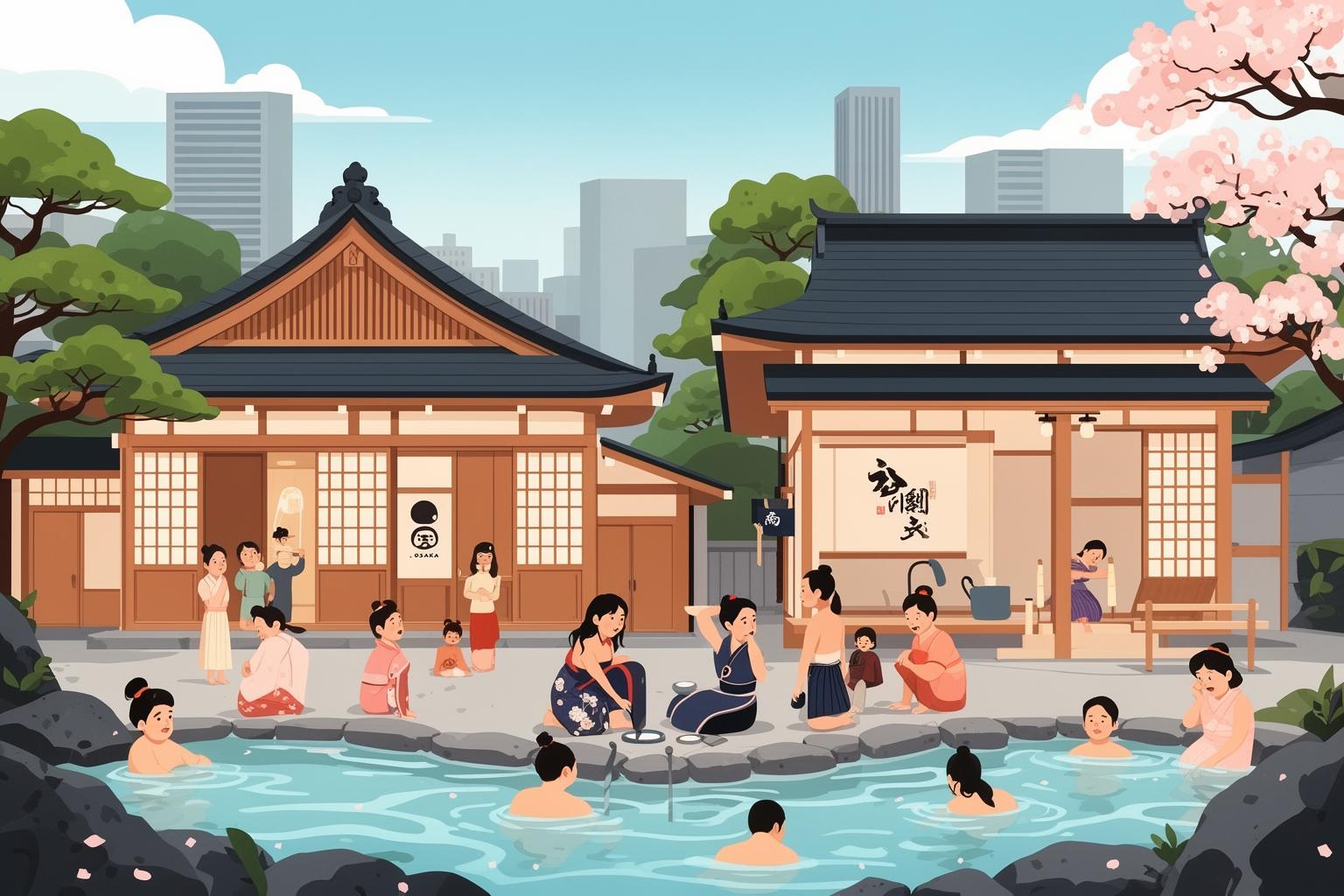
Finally, after thoroughly cleaning yourself, you enter the fune, the baths themselves. Typically, there are several options, each with a different temperature or feature. There might be a jacuzzi, an herbal bath with medicinal herbs floating in it, a cold plunge pool (mizuburo), and sometimes an outdoor bath (rotenburo). This is where extended conversations happen. People soak and talk, their voices softened by the steam. The water acts as a great equalizer and social lubricant. It’s hard to keep up airs when you’re boiled red like a lobster. It’s in these baths that the neighborhood’s social bonds are formed and nurtured, one relaxed conversation at a time.
A Cast of Characters: The People You’ll Meet
Every neighborhood sentō is like a theater, and, as with any good theater, it has its regular cast of characters. Spend enough time in one, and you start to recognize the archetypes—the familiar faces who play their roles in the ongoing drama of community life. These are not just anonymous bathers; they are the pillars of the sentō ecosystem, each playing a part in shaping its unique social atmosphere.
The Nushi (The Master of the Bath)
Every sentō has a nushi, usually an elderly man or woman who has been a daily visitor to that particular bathhouse for fifty or sixty years. The nushi is not the owner, but commands similar respect. They have an unofficial, permanently reserved spot at the arai-ba, marked by their personal yellow washbowl and bar of soap, which no one would dare to move. The nushi is the living archive of the neighborhood, knowing everyone and everything.
The male nushi often presents as a stoic figure—a man of few words but deep knowledge. He’ll be the first to notice if the water’s temperature is slightly off, giving the attendant a knowing look that says it all. The female nushi, on the other hand, is often the social queen bee, leading conversations from her seat in the jacuzzi, her voice carrying across the room. The nushi serves as the unofficial enforcer of etiquette. When newcomers, especially young people, commit faux pas—like dipping their towel in the bathwater or splashing excessively—it’s the nushi who gently but firmly corrects them. “Nii-chan, taoru wa oyu ni tsuketara akan de” (Hey sonny, you can’t put your towel in the water). This is less a scolding and more an induction into local customs. This straightforwardness is quintessentially Osaka—a style known as “ame to muchi,” or “candy and whip.” The correction is the whip, but it’s wrapped in communal affection—the candy—meaning, “You’re one of us now, so learn our ways.” The nushi is the guardian of the sentō’s spirit.
The Oyakodon (Parent and Child)
The sentō is an intergenerational space, most clearly seen in parents with their young children. A father carefully washing his son’s back or a mother teaching her daughter to neatly fold her towel and place it on her head are common and heartwarming sights. This is about more than hygiene—it’s a life classroom. The child learns not only bathing rituals but also something deeper: how to behave in a shared public space. They learn to be considerate, to avoid splashing others, to greet elders, and to feel at ease in their own skin around others. They absorb the rhythms of adult conversation, informal banter, and casual gossip. It’s a fundamental lesson in community membership.
These interactions contrast sharply with the more privatized nature of modern family life. In the sentō, parenting is a semi-public act. Other bathers, especially older women, coo over babies, offer unsolicited parenting advice, and share stories about their own children. A child’s first trip to the sentō is a rite of passage, an initiation into the wider neighborhood family. It’s where they learn that the world extends beyond their own home and is full of others you must learn to live harmoniously with. For many Osaka natives, their earliest memories are of the steam, the soap’s scent, and the warmth and security of the big bath with a parent.
The Young and the Restless: A New Generation Finds Its Place
For years, the sentō was viewed as a domain for the elderly. Younger generations, with their modern apartments and busy lives, seemed to have left the public bath behind. But recently, a fascinating revival has emerged. A new generation of Osakans in their twenties and thirties is rediscovering the sentō—not just for its retro appeal but for the genuine sense of connection it fosters in an often isolating modern world. This is particularly true in creative and gentrifying neighborhoods like Nakazakicho and Kitakagaya.
This new wave of sentō-goers interacts differently. They might be attracted by “designer sentō” renovated with modern aesthetics, craft beer on tap, and upscale saunas. The “sauna boom” has been a major driver, with enthusiasts traveling across the city to sample various facilities. Their conversations might focus less on grocery prices and more on new art exhibits or favorite bands. They document their visits on Instagram, celebrating beautiful tilework and nostalgic vibes. Yet, the core purpose remains unchanged: they seek a “third place” that isn’t home or work, where they can relax and connect. They might soak in the bath with friends, sharing their week, or come alone to enjoy the feeling of being among others in a silent communion that counters city loneliness. By adapting a century-old tradition to their needs, they ensure the warm waters of the sentō will continue to flow for generations to come.
The Osaka Rules of the Tub: An Unwritten Etiquette Guide
For any foreigner visiting a sentō for the first time, the greatest source of anxiety is often the worry about unintentionally breaking some sacred, unwritten rule. The good news is that the etiquette mostly revolves around common sense and hygiene. Even better, in Osaka, people tend to be more direct and forgiving than in other parts of Japan. Mistakes are more likely to be met with laughter and a quick correction than a cold glare. Still, understanding the local nuances can make the experience smoother and far more enjoyable.
“Kakeyu” Is More Than Just a Rinse
Before you even consider stepping into one of the main tubs, you must wash your body thoroughly. This is the single most important rule of the sentō. At the entrance to the bathing area, you’ll find large barrels of warm water and ladles for kakeyu—a preliminary rinse to remove surface grime and help your body adjust to the bathwater temperature. But this is just the beginning. After the kakeyu, you need to find a vacant washing station, with a low faucet and stool, and give yourself a proper, thorough scrub with soap. This is not only about personal hygiene; it’s a fundamental act of respect toward everyone else sharing the bathwater. The tubs are for soaking and relaxing, not for cleaning.
In Osaka, if you skip this step and try to head straight for the tub, you won’t be ignored. An experienced local will almost certainly call you out—not with malice but with a matter-of-fact statement: “Anata, saki ni karada arai ya” (You, wash your body first). This kind of directness can be startling if you’re used to the more indirect communication commonly found in Tokyo, where someone might merely resent you silently. But in Osaka, straightforwardly stating the issue and helping to fix it is seen as more efficient and honest. They’re not aiming to shame you; rather, they’re trying to educate you and protect the integrity of their shared space. Once you’ve washed, all is forgiven and you are welcomed in.
The Towel Conundrum: On Your Head, Not in the Water
When you enter a sentō, you’ll be given a large towel for drying off afterward and a small towel, roughly the size of a washcloth, for use inside the bathing area. This small towel comes with very specific rules. You can use it to scrub your body while washing and to modestly cover yourself when walking between the washing area and baths. Many people also fold it and place it on top of their head while soaking, which helps keep them cool. However, you must never put the small towel into the bathwater. Even if freshly cleaned, it is considered unclean and contaminates the communal water.
This is another rule where Osaka’s directness shines. If your towel slips off your head and into the tub, you’ll likely hear a chorus of light-hearted “Ah, akan, akan!” (Oh, no, no!). Someone might laugh and point. It’s a moment of gentle, communal teasing. The expectation is that you’ll quickly fish it out, wring it out outside the tub, and place it on the tiled edge. The response isn’t anger but amusement at a common mistake. It’s a small social test, and by replying with a quick apology and a smile, you demonstrate your understanding and respect for local customs.
The Art of the “Eshaku” (The Head Nod)
While Osaka sentō tend to be more conversational than those in Tokyo, there’s no obligation to engage in talking. For many, the sentō remains a place to relax quietly. The key to navigating this atmosphere is the eshaku, a slight nod of the head. When you enter the changing room, a general nod is customary. When you sit at a washing station, nod to your neighbors. When you enter a bath where others are soaking, nod to them as well. This simple, silent gesture is a powerful way to say, “I see you. I acknowledge our shared space. I mean you no harm.” It serves as a social lubricant that costs nothing but fosters a comfortable atmosphere. It lets you participate in the community non-verbally, showing respect without needing to use words. It is the perfect opening move for a quiet bather or a shy foreigner.
Claiming Your Spot (But Not Really)
Regulars definitely have preferred spots in a sentō. The nushi may have their throne, someone else might favor a washing station with excellent water pressure, and another might prefer the jacuzzi’s corner seat. Personal washbowl and soap placement usually mark these spots. However, this is not a strict reservation system but one based on habit and mutual understanding. If you, as a newcomer, unknowingly take someone’s “spot,” it’s not a serious offense. They will simply find another place. Being observant, however, can help you integrate more smoothly. If you see a station with a washbowl already there, it means the person is soaking in a tub and will return. Choose an empty station instead.
This flexible approach to personal space is very much in line with Osaka’s pragmatic spirit. It’s less about rigid rules and more about reading the room and adjusting. People will make space for you. If the washing area is crowded, someone finishing up will often gesture to their spot, indicating you can have it next. This ongoing, subtle negotiation and cooperation is the sentō’s invisible dance. It’s about sharing a limited resource with minimal fuss and maximum mutual consideration—an important lesson that extends far beyond the bathhouse walls.
The Sentō Economy: More Than Just a 500-Yen Entry Fee
The sentō does not exist in isolation. It is intricately embedded in the economic and social fabric of the neighborhood, serving as an anchor for other local businesses and a key destination in the daily life cycle. Its impact goes beyond its tiled walls, generating a micro-economy that supports the surrounding community. Recognizing this connection is essential to viewing the sentō not as a mere relic but as a vital, functioning part of the neighborhood’s body.
The Pre-Bath Ritual: Shopping in the Shōtengai
For many elderly residents, a visit to the sentō is the highlight of their daily routine. It’s the final stop after an afternoon spent running errands in the local shōtengai, the covered shopping arcade that forms the commercial core of many Osaka neighborhoods. You’ll see them arriving at the sentō in the late afternoon, carrying not only their small bath baskets but also plastic bags filled with daikon radishes, green onions, and fresh fish. The datsuijo often carries a faint scent of groceries mingled with soap and steam.
This close proximity is intentional. The conversations that begin in the shōtengai carry on in the bath. “Did you see the price of mackerel at Tanaka-san’s shop today? Such a bargain!” one woman might say to another across the tub. “I went to Sato-san’s instead; his ginger is much fresher.” The sentō becomes an informal hub of information for savvy, budget-conscious Osaka homemakers. It’s where you get real-time updates on the best deals, freshest produce, and neighborhood business gossip. The health of the sentō and the shōtengai are deeply intertwined. They sustain each other, creating a circular flow of people, money, and information that keeps the local community vibrant and connected in a way that a large, impersonal supermarket or shopping mall never could.
The Post-Bath Glass Bottle: Milk, Coffee, or… Beer?
The sentō experience doesn’t end when you step out of the bath. The second act unfolds in the datsuijo, the changing room, fueled by drinks from the vending machine or the classic top-loading glass-door cooler. The post-bath drink is a cherished ritual. For generations, the unchallenged favorites have been milk (gyūnyū) and coffee milk (kōhī gyūnyū), served in iconic returnable glass bottles. There’s a particular, highly satisfying way to drink it: place one hand on your hip, tilt your head back, and down the entire bottle in one smooth motion. It is believed to be the perfect way to rehydrate and replenish the body after a hot soak.
This refreshment moment also acts as an important social catalyst. People don’t just grab their drink and leave. They linger. Sitting on benches in their yukata or wrapped in towels, fanning themselves, sipping milk, and continuing conversations from the bath. This is where plans are made, advice is exchanged, and friendships are strengthened. The old television in the corner hums softly, providing a communal focal point for commentary on the Hanshin Tigers game. In recent years, this post-bath culture has evolved. Responding to changing tastes, many sentō now offer a wider selection. You’ll find fruit juices, yogurt drinks, and increasingly, beer. Some of the more modern, revitalized sentō even serve local craft beers on tap. This has created a fresh social dynamic, where younger crowds might gather for a post-soak beer, mingling alongside the older generation still devoted to their coffee milk. Though the drink may have changed, the role of this space as a community lounge remains as vital as ever.
Osaka vs. Tokyo: A Tale of Two Bathhouses
To truly grasp the unique character of an Osaka sentō, it’s helpful to compare it with its counterpart in Tokyo. While both cities uphold the basic tradition of public bathing, their atmospheres, social dynamics, and aesthetics can differ dramatically. These contrasts reveal deeper cultural divides between Japan’s two largest metropolises. Experiencing a sentō in each city offers more insight into their distinct personalities than dozens of guidebooks ever could.
The Volume Control: Quietude in Tokyo, Liveliness in Osaka
The most noticeable difference is the sound. A typical Tokyo sentō often maintains a volume akin to a library. Conversations are infrequent, and when they occur, they’re whispered between people sitting close together. The prevailing mood is one of calm reflection. People come to be alone, together. The emphasis is on the internal, personal experience: the sensation of hot water, the steam, and the quiet ritual of cleansing the body. It’s a meditative retreat from the overwhelming stimuli of the city outside. Speaking loudly would violate the unspoken social contract and disturb the shared tranquility.
In contrast, an Osaka sentō resembles a lively pub. The background noise is a steady, energetic buzz of chatter, laughter, and the clang of plastic stools and buckets on tile floors. Silence is rare. Conversations carry across the room, and jokes fly between the sauna and cold plunge pool. The hadaka no tsukiai is an outward, performative social act. The aim isn’t to escape the city, but to engage with it at its most concentrated, neighborhood level. It’s a space for social release, where the Osakan love for communication—the joke, the story, the witty comeback—runs free. A foreigner used to the quiet reverence of a Tokyo sentō might initially view the Osaka atmosphere as chaotic or rude, but this is a misunderstanding. The noise isn’t disrespectful; it’s the sound of a community actively connecting.
Design and Philosophy: “Wabi-Sabi” versus “Gote-Gote”
The aesthetic philosophies of these cities also appear in their bathhouses. Many classic Tokyo sentō, especially those constructed in the pre-war era, embrace a refined, traditional elegance. A hallmark is the giant mural of Mount Fuji painted on the wall above the main bath. This iconic image links bathers to a shared, idealized vision of Japanese identity and natural beauty. The overall design tends to feel deliberate, balanced, and imbued with wabi-sabi—the beauty found in imperfection and transience.
Conversely, Osaka sentō often feel more pragmatic, eclectic, and sometimes downright flamboyant. While Mount Fuji murals exist there too, you’re just as likely to find elaborate, colorful tile mosaics depicting Japanese folklore, leaping carp, or even European landscapes. The style can lean towards what Osakans jokingly call gote-gote—a look that’s a bit gaudy, busy, and over-the-top. The emphasis is less on a single, sublime image and more on creating a lively, enjoyable atmosphere. You may encounter a wider variety of novelty baths, elaborate water features, or quirky decorative elements. This reflects a broader Osaka mindset that often values functional fun, personality, and value for money over the more restrained, philosophically driven aesthetics prized in Tokyo. An Osaka sentō isn’t necessarily a place for quiet reflection on nature; it’s a “super sentō” in miniature—a watery playground for the local community.
The Future of the Sentō: Preservation and Reinvention
Despite its deep cultural significance, the neighborhood sentō is becoming increasingly rare. Across Japan, hundreds of bathhouses shut down each year. The causes are many and persistent: widespread access to private bathrooms, aging infrastructure with costly upkeep, rising fuel prices, and most importantly, a shortage of successors to take over from aging owners. Osaka has not escaped this pattern. With every closure, a neighborhood loses far more than just a bathing spot; it loses its communal living room, social cornerstone, and a fragment of its heritage.
The Fight to Keep the Fires Burning
However, the story of the Osaka sentō is not solely one of decline; it is also one of resilience and dedicated community involvement. In neighborhoods throughout the city, residents are determined to keep their cherished bathhouses alive. When a local sentō faces closure, it is common for patrons to mobilize. They may launch petitions, initiate crowdfunding campaigns to cover necessary repairs, or organize community events and festivals to attract new visitors. These initiatives demonstrate just how deeply valued these establishments are. They are regarded not merely as private enterprises but as vital public facilities, essential to the neighborhood’s wellbeing as parks or libraries.
These preservation efforts stem from a profound awareness of what is at risk. Regular visitors understand that if a sentō closes, the elderly man living alone nearby will lose his primary source of daily social interaction. They recognize that the young mother will lose a place to unwind briefly while her child is entertained by a group of caring “grandmothers.” They appreciate that the social fabric supporting their everyday lives will be irreparably damaged. The battle to save a sentō is, at its heart, a struggle to preserve the concept of face-to-face, intergenerational community.
The “Designer Sentō” and the Sauna Boom
Alongside these preservation movements is a strong wave of innovation. A new generation of owners and entrepreneurs is revitalizing old bathhouses, turning them into attractions that resonate with a 21st-century clientele. These “designer sentō” or “neo-sentō” honor the traditional role of the bathhouse while modernizing the experience to suit contemporary preferences. Renovations often blend retro touches with sleek, minimalist design. The emphasis might be on delivering a premium sauna experience, offering varying temperatures, humidity levels, and special “löyly” (steam-generating) sessions that draw enthusiasts citywide.
These reimagined sentō are also broadening their function as community centers. Some add craft beer bars or cafés at the entrance, encouraging patrons to mingle before and after their baths. Others integrate art galleries, live music venues, or co-working spaces. This pragmatic, creative, and commercially astute approach embodies the spirit of Osaka. When the old model becomes unsustainable, the institution is not abandoned but adapted. New revenue streams and fresh incentives to visit are created. This evolution guarantees that the core principle of the sentō—as a communal third place for relaxation and connection—will endure and flourish amid changing times. It proves that the need for a gathering space is timeless, even if the décor and a post-bath beverage may evolve.
What This Means for You, the Foreign Resident
So, you live in Osaka, in a clean, modern apartment with a perfectly functional bathroom. The idea of the sentō might still feel like a novelty—a cultural experience to try once, like a tourist attraction. But seeing it that way means missing its true potential to enrich your life here. The sentō is not a spectacle; it’s an invitation. It’s a key that can unlock a deeper, more meaningful connection to the neighborhood you call home.
Why Your Apartment Bath Isn’t Enough
Your private bathroom provides convenience and privacy. The sentō offers something much more valuable: community. In the vast, anonymous city, it’s easy to live in the same building for years without really knowing your neighbors. You might exchange polite nods in the hallway, but remain strangers. The sentō breaks through that isolation. It’s an environment designed for casual, low-pressure interaction. By becoming a regular at your local bathhouse, you shift from being an anonymous resident to a known member of the community. People will start greeting you on the street. The woman from the bath might share a tip at the local supermarket. The elderly man might ask how you’re settling in. These small connections are the threads that weave you into the fabric of local life. Choosing to rely only on your apartment bath means staying on the outside looking in.
Your Invitation to the Neighborhood Living Room
Taking the first step can be daunting, but here’s a simple guide for your initial visit. Find your nearest sentō. Carry about 1000 yen. Bring a small towel for washing, a large towel for drying, and a small bottle of soap and shampoo (you can often buy these there if you forget). Walk in, remove your shoes, and place them in a locker. Approach the bandai or front desk and say “Otona hitori” (One adult). Pay the fee (usually around 500 yen). Go to the appropriate changing room (男 for men, 女 for women). Find an empty locker or basket, undress, and enter the bathing area with just your small towel and washing supplies. Wash thoroughly at an empty station. Then, and only then, ease yourself into a tub. Relax. No one is judging you. They’re just glad to see a new face.
Don’t worry about making mistakes. The etiquette is simple, and Osakans—more than anyone else in Japan—appreciate those who make an effort to join in. They value sincerity over perfection. Your willingness to engage with their culture will be met with warmth and openness. The local sentō is a microcosm of Osaka itself: a bit loud, very direct, sometimes chaotic, but essentially warm, unpretentious, and deeply human. It’s where you don’t just wash the city grime off your body; you soak in the very essence of its culture. Go ahead. The water’s fine.