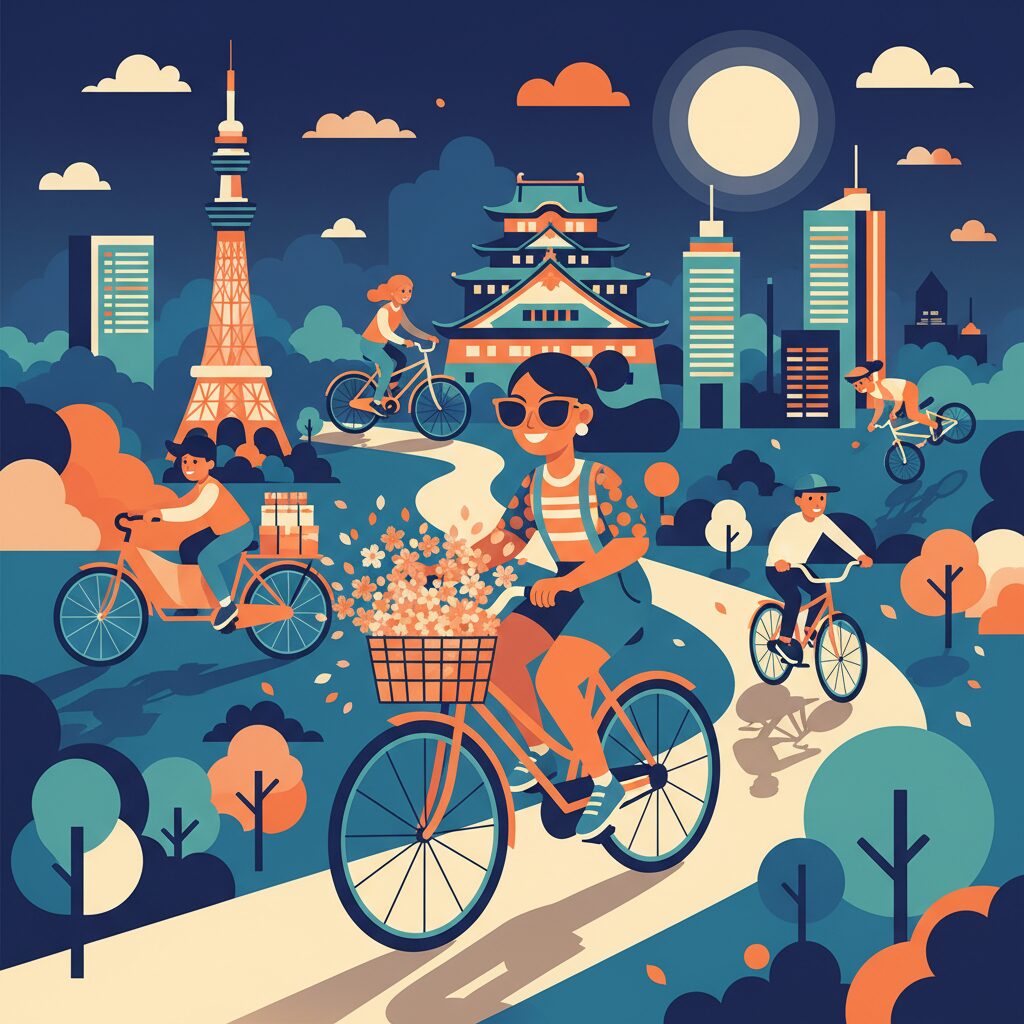
Stand on any street corner in a residential Osaka neighborhood, away from the neon glow of Namba or the commercial canyons of Umeda, and just watch. For a solid ten minutes, do nothing but observe the flow of life. What you’ll see is a city not primarily defined by its cars or its world-class train system, but by something far more humble, ubiquitous, and revealing: the bicycle. They stream past in a constant, hypnotic parade. A mother with two children, one in the front seat and one in the back, her grocery basket overflowing with daikon and leeks. An elderly man in a work cap, his movements slow but deliberate, pedaling a machine that looks as old as he is. A salaryman in a suit, his briefcase strapped precariously into the front basket, weaving through pedestrians with an ease born of a lifetime of practice. This is the true pulse of Osaka, and it’s powered by human legs and rusty chains.
For the uninitiated, the newcomer from London, New York, or even rule-abiding Tokyo, this scene can register as pure, unadulterated chaos. Cyclists glide silently along crowded sidewalks, treating them as personal thoroughfares. They materialize from blind corners without warning, navigate dense shopping arcades against a tide of humanity, and park their steeds in great metallic tangles that seem to defy both logic and municipal code. The initial reaction is often a cocktail of anxiety and disbelief. Are there no rules? Is this a free-for-all? How does anyone survive? But the longer you watch, the more you realize that what appears to be anarchy is, in fact, a highly complex, self-regulating system. It’s a dance, and everyone, somehow, knows the steps. This unspoken choreography is built on a foundation of pragmatism, mutual, if grudging, respect, and a situational awareness that borders on a sixth sense. To live in Osaka and not understand its bicycle culture is to be fundamentally disconnected from the city’s daily rhythm. It’s more than just getting from point A to point B; it’s a masterclass in the Osakan mindset, a lesson in how this vibrant, fiercely independent city truly works.
To truly understand the city’s unique rhythm, one must also explore the quiet, communal world of Osaka’s public baths.
The Mamachari: Osaka’s Unsung Workhorse

Before we can start analyzing the rules of the road, we must first pay tribute to the monarch of Osaka’s asphalt: the mamachari. The name translates literally to “mom’s chariot,” a title perfectly suited to it. This bicycle isn’t designed for speed, sport, or style. Instead, it is a marvel of practical engineering, a workhorse built solely to master the challenges of everyday urban life. Forget about sleek carbon frames and thin tires; the mamachari is defined by its sturdy, step-through frame, making it easy to get on and off, even while wearing a skirt or carrying a child. Its handlebars sweep back, encouraging an upright, almost regal posture that maximizes visibility. Its key features include a large front basket—a vast container for groceries, school bags, and sometimes a small dog—and a heavy-duty rear rack, almost always equipped with a child seat.
The mamachari’s true brilliance lies in its remarkable stability. A double-legged kickstand keeps it upright even when fully loaded. A built-in lock on the rear wheel provides a measure of security. Every aspect of it is designed for convenience. It’s the urban equivalent of a pickup truck, and in Osaka, it’s the preferred vehicle not only for mothers but also for students, grandfathers, and construction workers alike. The mamachari serves as a social equalizer. It signals that you’re a resident, an active participant in the local economy of grocery shopping and daycare runs—not a tourist or a cycling enthusiast. Recently, the electric-assist mamachari has become standard, its gentle hum filling the city’s residential streets. These bikes, fitted with a small motor, let riders conquer mild hills and carry heavier loads without strain, making them even more essential. Seeing an “Osaka oba-chan,” a local grandmother, effortlessly cruising uphill on her electric chariot loaded with a week’s groceries is a poignant symbol of the city’s practical, resilient spirit.
The Unwritten Laws of Motion: Sidewalks, Streets, and the Sixth Sense
For many foreigners, the most striking aspect of cycling in Osaka is the casual use of sidewalks. In most Western countries, and even in many parts of Tokyo, sidewalks are strictly pedestrian zones. Riding a bike on them almost always results in angry shouts and disapproving looks. However, in Osaka, sidewalks function as a shared space. Although the official law in Japan generally requires bicycles to be ridden on the left side of the road, the reality is far more flexible. Many of Osaka’s streets are narrow, busy, and lack dedicated bike lanes. For cyclists traveling at the leisurely speed of a mamachari, sharing the road with cars, buses, and delivery trucks is not only intimidating but also inefficient and often dangerous. As a result, by an unspoken consensus, sidewalks have effectively become bike lanes for a sizable portion of the city’s cyclists.
This shouldn’t be mistaken for an unchecked free-for-all. An implicit set of rules governs this shared space, with one simple hierarchy: pedestrians come first. Cyclists are expected to give way, adjusting their speed to match the flow of foot traffic, often moving at a quick walking pace. The aim is to glide, weave, and anticipate—not to rush through crowds but to find the path of least resistance. This demands a high level of situational awareness, what the Japanese refer to as kuuki wo yomu, or “reading the air.” Cyclists don’t just look ahead; they scan for shoppers stepping out of stores, children who might suddenly dart into their path, and elderly pedestrians who may not hear them approaching. This ongoing, subconscious process of risk assessment and prediction can seem perplexing to Tokyoites, who tend to adhere more strictly to written rules. Osaka, by contrast, embraces a practical pragmatism, prioritizing what works best in the moment over rigid procedural correctness.
The Sidewalk Shuffle: A Shared Space Mentality
This system works because everyone understands that all parties are simply trying to go about their day. Cyclists on the sidewalk are not being aggressive; they are just taking the most sensible route. Pedestrians generally accept this and often make slight adjustments by stepping to one side to let bikes pass. There is a silent agreement at play: as a cyclist, your role is to be as unobtrusive as possible. This means no sudden movements, no excessive speed, and no sense of entitlement. You are a guest in the pedestrian’s domain. When approaching from behind, you don’t speed past; instead, you slow down, give plenty of space, and pass gently. If the sidewalk is too crowded, you wait for an opening or simply dismount and walk. The worst mistake is acting as if the sidewalk belongs to you. That’s when you’ll encounter the collective disapproval of the crowd, expressed not through loud protest but through cold stares and a palpable sense of social breach. This shared-space mentality is deeply ingrained in Osaka’s urban culture. Though it can feel chaotic, it’s a highly effective way to move many people through a dense cityscape with minimal infrastructure.
The Bell, The Nod, and The “Sumimasen”
Communication is crucial in this delicate dance but is seldom verbal. The bicycle bell, a standard feature on every mamachari, is used with great restraint. Recklessly ringing the bell to clear the way is considered extremely rude—like shouting “Get out of my way!” in a library. The bell serves only two functions. The first is a soft, single “ring-ring” from a distance, a polite signal to alert a pedestrian who might not have noticed the cyclist’s approach—a gentle “pardon me, just letting you know I’m here.” The second is a last-ditch warning to prevent an imminent collision. Most communication relies on much subtler means: a slight nod, a small wave, or a quiet, almost whispered “sumimasen” (excuse me) when passing. Often, no signal is necessary at all. Eye contact and body language usually suffice. Cyclists learn to read nuanced cues—pedestrians’ posture, gaze direction, and walking rhythm—and become part of the flow, individual particles in a larger current of movement, communicating through shared intention rather than explicit commands. This reliance on non-verbal, intuitive understanding is a defining feature of Japanese culture, and it’s vividly expressed on Osaka’s sidewalks every day.
The Great Wall of Bicycles: Parking in the Urban Jungle

If cycling in Osaka offers a lesson in fluid dynamics, then parking a bike there teaches spatial negotiation amid organized chaos. Approach any train station, supermarket, or public library, and an astonishing sight awaits: an extensive, sprawling sea of bicycles. They rest on sidewalks, chained to railings, lined against walls, and squeezed into every imaginable nook and cranny. At first glance, it may resemble a bicycle graveyard—a clutter of abandoned machines. Yet this is the city’s vibrant, living parking system, showcasing the sheer number of people dependent on two-wheeled transport. Official bicycle parking lots, known as churinjo, do exist. Some are multi-story automated garages, impressive engineering feats; others are simple, designated areas with metal racks. However, these are seldom sufficient, often inconveniently placed, or require a small fee. The Osaka response to this challenge is, as always, profoundly pragmatic.
This results in the widespread practice of “guerilla parking.” People park where most convenient, guided by a cost-benefit analysis: is the convenience worth the risk of being a nuisance or, worse, having the bike impounded? For a quick five-minute trip to the supermarket, parking right at the entrance makes sense. For all-day parking while at work, finding a discreet, out-of-the-way spot is preferable. This behavior highlights a fundamental aspect of the Osaka mindset: prioritizing jissai (the practical reality) over tatemae (official rules or public facade). Though signs may read “No Bicycle Parking,” wide stretches of pavement not obstructing anyone are often treated more as polite suggestions than strict laws. This contrasts strongly with Tokyo, where greater emphasis on public order means such signs are more rigorously followed, and illegal parking draws more social disapproval.
Guerilla Parking and the Social Contract
Even in this seemingly unregulated world of guerilla parking, unwritten rules apply. The greatest offense is causing meiwaku—trouble or inconvenience to others. One must not block building entrances, park in front of fire hydrants, or block tactile paving for the visually impaired. Pedestrian flow on narrow sidewalks must remain unimpeded. A social contract operates here: if you park considerately, minimizing your impact on others, your rule-breaking is likely to be tolerated. Shopkeepers often overlook bikes in front of their stores, recognizing them as customers. Apartment residents develop an unspoken system for sharing limited bike space. It’s a delicate balance between individual convenience and collective tolerance. The objective is to blend your bike into the landscape of illegally but acceptably parked bicycles—lining it up neatly, avoiding being the one that stands out or causes problems. It’s a quiet, daily negotiation for public space.
The Silver Van of Doom: The Day of Reckoning
Yet this tolerance has boundaries. To prevent chaos from spiraling into gridlock, enforcement arrives in the form of a dreaded silver van. In high-traffic, low-tolerance areas—usually around major train stations and busy commercial districts—municipal workers conduct periodic sweeps. They leave paper warnings on illegally parked bikes, and if the bike isn’t moved in time, they cut the lock, load it onto the van, and take it to an impound lot. This serves as the ultimate deterrent—the system’s pressure-release valve. Retrieving your bike is a bureaucratic ordeal: you must determine which impound lot it went to, travel to its often remote location, present ID and your bike lock key, and pay a fine of several thousand yen. It’s an expensive, time-consuming lesson in the limits of Osakan pragmatism. The threat of the silver van maintains this fragile balance, forcing cyclists to distinguish between low-risk residential streets and high-risk commercial areas. It’s the city’s way of saying: we will tolerate your convenient chaos, but only to a certain degree.
Shotengai Purgatory: The Ultimate Test of Skill and Patience
If you really want to grasp the essence of cycling in Osaka, you need to venture into a shotengai. These covered shopping streets are the lifeblood of local neighborhoods—long, bustling corridors filled with commerce and community. Some, like Tenjinbashisuji, extend for several kilometers, forming a city within a city. They are noisy, lively, and packed with people. For cyclists, they represent the ultimate challenge, a true test of your ability to navigate the unwritten rules. The first thing you’ll notice are the signs at the entrances, often featuring a charming cartoon, clearly instructing you to dismount and walk your bicycle. Yet, you’ll quickly see dozens of people ignoring the signs and riding straight through.
This perfectly illustrates Osaka’s approach to rules. The sign isn’t an absolute command; it expresses an ideal. The reality depends entirely on context. On a quiet Tuesday morning, when the arcade is nearly empty, riding slowly and carefully is usually acceptable. It’s efficient and doesn’t disturb anyone. But try that at five o’clock on a busy Saturday afternoon, when the shotengai is a sea of shoppers, and you’ll be met with cold stares. The real rule isn’t “don’t ride your bike.” It’s “don’t be inconsiderate.” Your right to convenience ends where another person’s right to a safe, pleasant shopping experience begins. Learning when to ride and when to walk is an intuitive skill developed over time, a crucial part of integrating into the local culture.
The Human Pinball Machine
When you do choose to ride through a shotengai, it feels like maneuvering a human pinball machine. Progress is slow, measured in inches rather than miles per hour. Your hands stay ready on the brakes. Your head constantly swivels. Shoppers will stop abruptly to admire window displays. Friends will block the entire path while chatting. Children, safe from car traffic, dart unpredictably with joyful energy. You must anticipate all of this. You become an expert in the slow-speed wobble, maintaining balance almost at a standstill. You learn to follow closely behind a mother pushing a stroller, using her as a kind of snowplow to clear your way. It demands extreme patience and precise control. There’s no aggression or hurry—just being a small part of a slow-moving, organic whole. Navigating a crowded shotengai on two wheels without causing anyone to flinch or change course marks you as a true Osaka cycling veteran.
Assimilating into the Flow: A Foreigner’s Survival Guide
So how does a newcomer adjust to this distinctive and often daunting cycling culture? It’s not about memorizing a list of rules, but about embracing a mindset. It takes observation, patience, and a readiness to discard preconceived ideas of how traffic should operate. The aim is to blend in, becoming a predictable and considerate element of the urban ecosystem.
Your First Steed: Choosing and Registering Your Bike
First, select the right bike. Resist the urge to buy a flashy mountain bike or a fast road bike. The best option is a simple, single-speed mamachari. It immediately signals that you are a resident participating in the local rhythm of life. These bikes are comfortable, practical, and their slow, steady nature encourages you to adopt the proper pace. When purchasing a bike, new or used, it must be registered with the police—this process is called bouhan touroku. The bike shop will typically handle this for a small fee. You will receive a small orange sticker with a registration number to attach to your bike’s frame. This sticker is crucial; it verifies the bike is not stolen and is essential for reclaiming it if it is ever impounded or recovered after theft. It serves as your bike’s official ID.
The Art of the Lock: Defending Against Theft
Although Osaka is a very safe city, bicycle theft remains frustratingly common. A simple built-in wheel lock is insufficient. You need to invest in a second, high-quality lock, such as a sturdy chain or a U-lock. The usual practice is to use this second lock to secure your bike’s frame to a fixed object like a railing or a designated bike rack. This makes it much harder for a thief to simply pick up and steal your bike. Always lock your bike, even if you’ll be gone only briefly. This simple habit can save you considerable trouble and expense.
Developing Your “Osaka-dar”: Cultivating Situational Awareness
Finally, the most vital skill to develop is your “Osaka-dar”—an intuitive radar for the city’s rhythm. Before you start riding regularly, spend time just watching. Sit on a bench and observe how cyclists and pedestrians interact. Notice the traffic flow at different times of day. When you do begin riding, start slowly. Stick to quieter streets until you feel confident. Your main goal is to be predictable. Ride straight, signal your turns with your hands if possible, and avoid sudden swerves. Assume others have not noticed you. Make eye contact whenever you can. Above all, embrace a slow pace. Cycling in Osaka is not a race; it’s a journey. It’s about efficient effort, not speed. Yield to pedestrians, be patient with the elderly, and forgive small mistakes from others, as you will likely need the same in return.
Osaka’s bicycle culture, ultimately, is a perfect reflection of the city itself. On the surface, it can seem chaotic, somewhat rough around the edges, and unconcerned with the formal rules governing life elsewhere. It lacks the polish and pristine order of Tokyo. But beneath that surface lies a deeply functional, highly efficient, and surprisingly considerate system. It’s a culture founded on shared understanding, mutual tolerance, and a steadfast focus on what works in practice rather than what looks good on paper. Learning to ride here is more than acquiring a practical skill; it’s a rite of passage. It marks the moment you stop seeing the city as just streets and buildings and start feeling its pulse. It’s when you stop resisting the current and learn to flow with the riptide. In that seamless, intuitive movement, you realize you’re not just navigating a sidewalk—you’re becoming a part of Osaka.