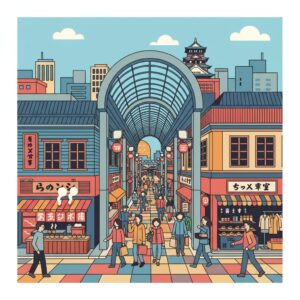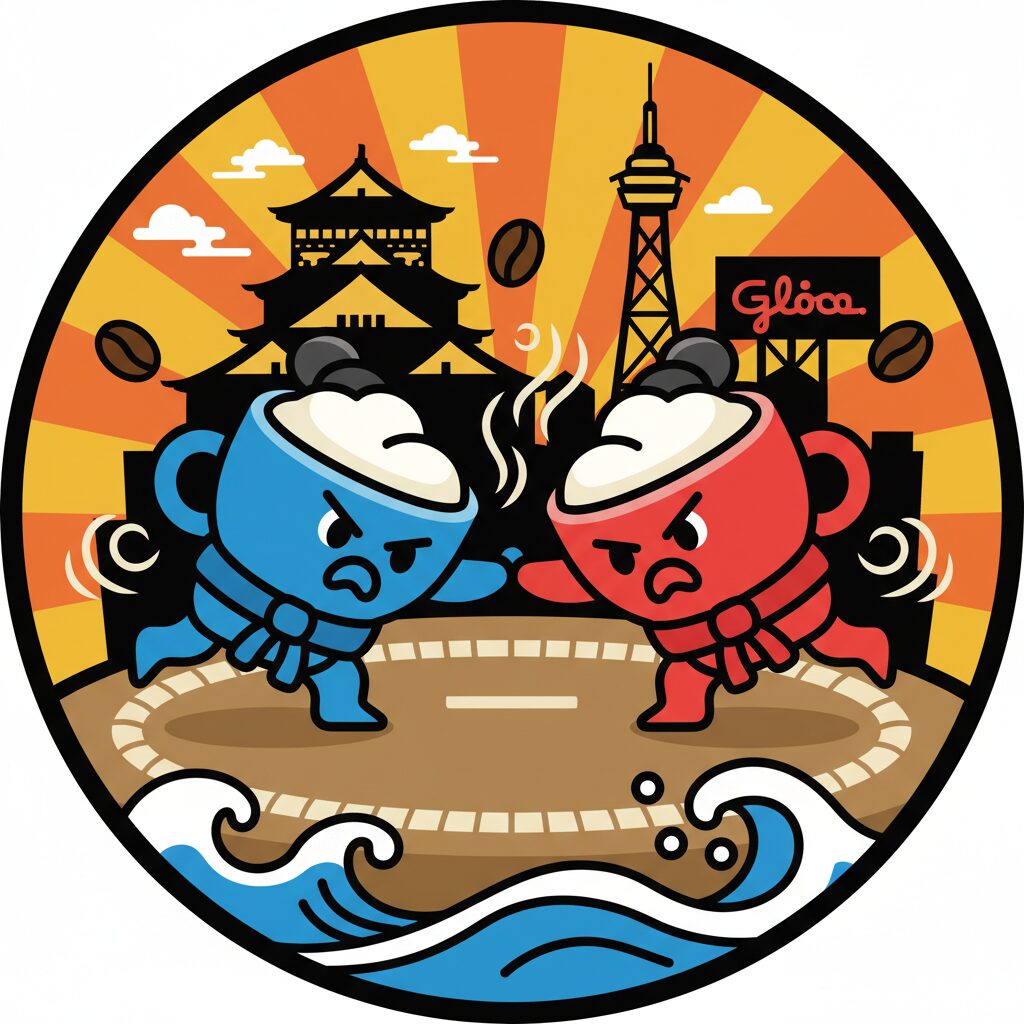
Walk with me for a minute. We’re ducking under the canvas awnings of a covered shopping arcade, a shotengai, somewhere deep in the belly of Osaka. The air is thick with the scent of fried croquettes from the butcher shop and the sweet smell of roasted tea from the little stall next to it. Sunlight streams through the dusty plastic ceiling panels, illuminating a chaotic, beautiful river of daily life. Bicycles with baskets full of leeks weave through crowds of shoppers. Grandmas haggle over the price of mackerel. And right there, nestled between a discount pharmacy and a tiny shop selling handmade rice crackers, you see them. Two doors, two worlds, one choice.
On the left, a familiar green siren beckons. It’s a Starbucks, its windows gleaming, the interior bright, clean, and humming with the productive buzz of a globalized world. You know exactly what’s inside: the precise aroma of Pike Place Roast, the comfortable chairs, the free Wi-Fi, the friendly baristas asking for your name. It’s a safe harbor, a predictable slice of home, no matter where you are on the planet.
On the right, there’s another door. It’s dark wood, with a small, curtained window you can’t quite see through. A single, faded plastic food model of a luridly-colored parfait sits in a dusty display case. Above the door, a sign written in elegant, old-fashioned script might say something like 「珈琲館 待夢」— “Coffee House: Time.” This is a kissaten, a Showa-era coffee house, and it feels less like a business and more like a secret you’re not sure you’re allowed to know. It’s mysterious, maybe a little intimidating. What lies behind that door? Who goes in there? And most importantly, as a foreigner navigating this vibrant, sometimes baffling city, which door should you choose?
This isn’t just a question about where to get your caffeine fix. In Osaka, it’s a question about how you want to experience the city. It’s about choosing between the smooth, friction-free surface of modern life and the textured, sometimes challenging, but deeply rewarding depths of its local culture. One offers comfort and connection to the world you know; the other offers a key to understanding the heart of Osaka itself. So before you make up your mind, let’s push open that heavy wooden door and see what’s really waiting inside.
If you’re intrigued by the idea of experiencing Osaka’s unique local culture firsthand, you might also enjoy exploring the vibrant world of Osaka’s standing bars, or tachinomi.
The Vibe Check: Decoding the Kissaten Atmosphere
A Step Back in Time (Literally)
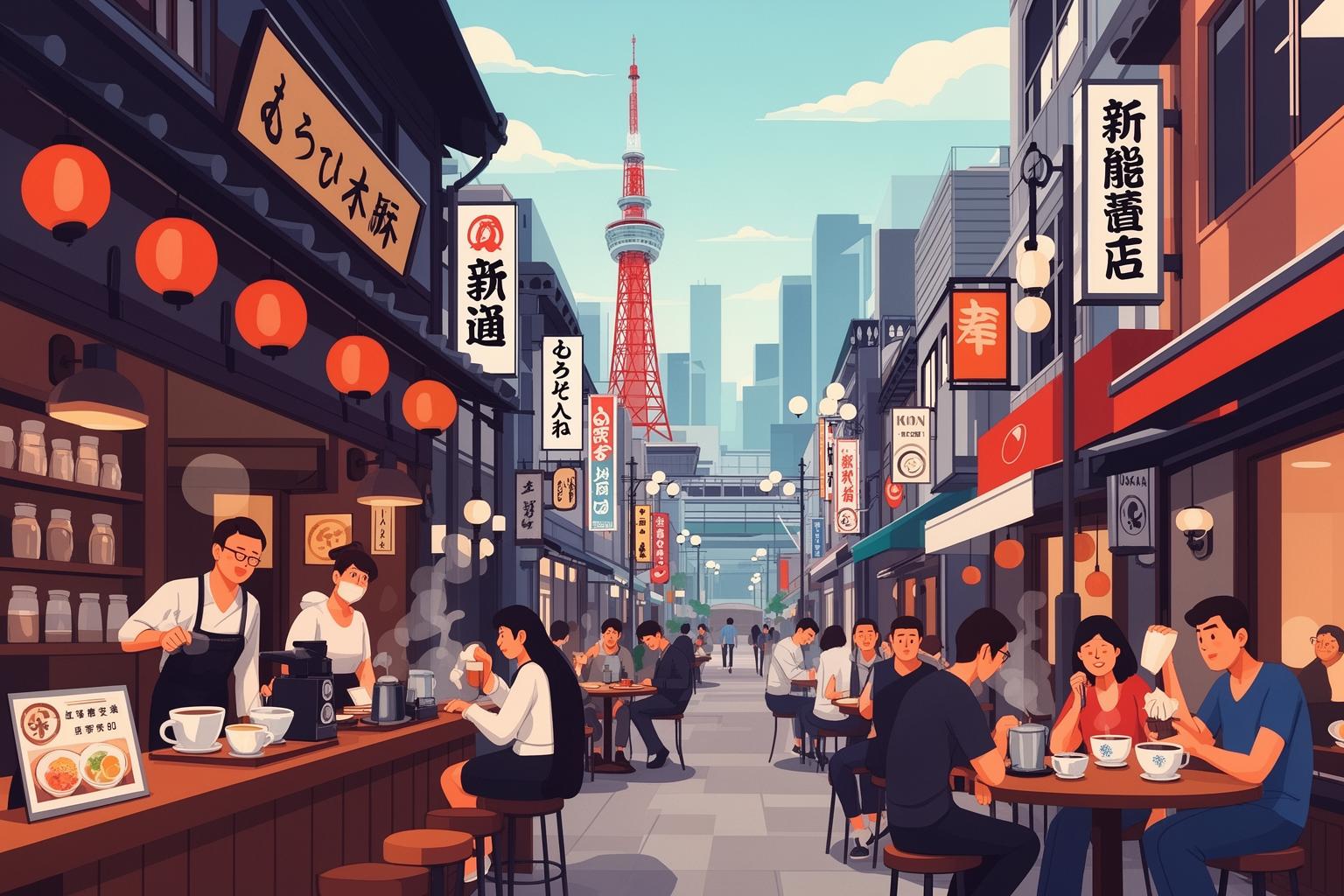
The first thing that strikes you upon entering a classic kissaten isn’t the aroma of coffee—it’s the texture of time. The air feels still, heavy with echoes of a thousand conversations. You’ve just stepped out of the bright, noisy 21st-century shotengai and into a flawlessly preserved bubble of the Showa era (1926-1989). The design language stands in stark contrast to the minimalist Scandinavian aesthetics of modern cafes. You’ll find dark, lacquered wood paneling on the walls, plush velvet or worn leather seats in shades of burgundy or forest green, and ornate, brassy light fixtures casting a warm, dim glow over everything. Perhaps a grandfather clock ticks solemnly in a corner, or a large, bubbling aquarium hosts lethargic goldfish drifting through plastic castles. Nothing is new, nothing gleams. Everything bears the gentle patina of age—the silent dignity of decades of use and affection.
This is sharply different from the Starbucks experience, which is meticulously engineered for brightness and efficiency. Starbucks aims to be a “third place,” universally welcoming and, importantly, uniform. The lighting is bright to keep you alert, the layout open to encourage flow, and the decor contemporary but neutral. It’s a space that feels deliberate, designed by a corporate team in Seattle. In contrast, a kissaten feels organic, almost accidental. It resembles the owner’s personal living room—the “Master”—curated over a lifetime with whatever felt right at the moment. It’s a space meant for lingering, sinking into a chair and letting the outside world slip away. It’s not designed for productivity; it’s designed for retreat. This marks a fundamental philosophical divide. Starbucks wants you energized and connected, while a kissaten wants you quiet and detached.
The Sound of Silence (and Smoke)
Listen closely. Inside a Starbucks, the soundtrack is a carefully chosen playlist of upbeat, unobtrusive indie pop layered over the rhythmic symphony of a bustling cafe: the hiss of espresso machines, clatter of ceramic mugs, shouted orders and names, and the constant murmur of numerous conversations and business calls. It’s a soundscape of productivity—a white noise of busyness.
Now, step back into the kissaten. The silence is what first stands out. It’s not awkward silence, but a comfortable, weighted quiet. Background music, if present, might be instrumental jazz, classical tunes on a slightly crackly sound system, or the melancholic ballads of Showa-era kayokyoku. The sounds you hear are distinct and isolated: the gentle clink of a spoon against porcelain, the rustle of newspaper pages turning, the soft murmur of a conversation between regulars at the counter, the bubbling of siphons. It’s a soundscape of contemplation.
But let’s be honest about another defining aspect of the kissaten atmosphere: cigarette smoke. For many non-Japanese, this is the biggest barrier to entry. Although Japan has advanced in banning smoking in public spaces, many old-school kissaten continue operating under exemptions or cling to tradition. For them, coffee and cigarettes are an inseparable classic pairing. You might see an elderly man wearing a flat cap, peacefully reading the sports pages amidst a blue-gray haze. This isn’t a mere oversight; it’s part of the authentic experience. The smell of stale cigarette smoke is as integral to the kissaten’s sensory profile as dark-roast coffee. For health-conscious, non-smoking Westerners, this can seem alien and unpleasant. Starbucks, by contrast, is a smoke-free haven. This is not a trivial detail; it’s a critical dividing line. Your tolerance for secondhand smoke will often decide your choice.
The “Master” and the Regulars
At Starbucks, you encounter friendly, well-trained baristas who follow scripts, smile, and excel at efficient, pleasant service. The relationship is transactional and brief—you likely won’t see the same person twice, as they serve hundreds of customers daily.
A kissaten follows a completely different social model. Behind the counter is the “Master” (マスター, masutā), usually an older man, or sometimes a couple, who has owned and run the same shop for thirty, forty, or even fifty years. He is not a barista but the proprietor, curator, and soul of the establishment. His demeanor may feel gruff or reserved. He may not smile, taking your order with a simple nod and serving your coffee without a word. Don’t mistake this for poor service—it’s the quiet professionalism of an artisan who has performed the same ritual thousands of times. His focus is on perfecting the craft of coffee, not on performing friendliness.
Then there are the regulars, the jōren-san (常連さん), the other living pillars of the kissaten. They have their usual seats, their customary orders, and a deep, unspoken rapport with the Master. They’re neighborhood elders, local business owners, retired couples—people who come here to read, chat quietly, or simply take a break. When you, a foreigner, enter this space, you’re not just a customer; you are a guest entering a private, long-standing social club. The regulars might eye you with mild curiosity but will likely leave you be. The key is understanding that you’ve stepped into their territory. This is the crucial distinction between public and private space that often confounds foreigners in Japan. Starbucks is a public space designed for anonymous individuals. A kissaten is a semi-private community hub that graciously welcomes outsiders—provided they respect the established atmosphere. This subtle but powerful difference defines the entire experience.
The Menu: Predictability vs. Personality
Coffee, Slow and Deliberate
Let’s focus on the coffee itself. At Starbucks, you face a dizzying variety of options: Venti, grande, tall; soy, almond, oat milk; a splash of vanilla, a pump of caramel, an extra shot. It’s a system crafted to deliver exactly what you want, tailored to your exact preferences. The coffee is made quickly and consistently by advanced espresso machines.
At a kissaten, however, you often encounter just one choice: 「コーヒー」 (kōhī). If it’s a bit more modern, you might see 「ブレンド」 (burendo, blend) and 「アメリカン」 (amerikan, a milder coffee, not to be confused with an Americano). The emphasis isn’t on variety or customization, but on the Master’s single, perfected house style. The brewing itself is often a performance. Many kissaten specialize in siphon coffee, a beautifully scientific method involving glass globes, open flames, and vacuum pressure. It resembles a chemistry experiment and yields a clean, nuanced cup. Others utilize the flannel drip, or neru dorippu, a meticulous pour-over technique requiring great skill and patience. The Master measures the beans, grinds them fresh, and pours hot water with the intense focus of a surgeon. The process may take five to ten minutes. You’re not simply purchasing a drink; you’re witnessing a craft demonstration.
And you are paying for this. A single cup of kissaten coffee can easily cost ¥600 or ¥700, far more than a basic drip coffee at Starbucks. This often surprises newcomers. Why pay so much for just black coffee? Because you aren’t paying only for the liquid. You’re paying for the seat, the quiet ambiance, the Master’s time, and the privilege to linger for an hour or more. It’s an admission to a peaceful sanctuary. This is the unspoken understanding. The coffee’s price buys you space and time, a concept very different from the fast turnover model of chain cafés.
More Than Just Toast: The Kissaten Food Menu
The food offerings tell a similar story of personality over predictability. Starbucks’ food display is filled with globally familiar items: croissants, muffins, scones, pre-packaged sandwiches. They’re reliable, decent enough, and consistent from Osaka to Ohio.
In contrast, the kissaten menu, or fūdo menyū (フードメニュー), recalls the golden age of Japanese-Western fusion cuisine (yōshoku). The highlight is often the “Morning Set” (モーニングセット, mōningu setto), a cherished tradition especially in Osaka and Nagoya. For the price of a coffee plus roughly a hundred yen, you receive a thick slice of fluffy white toast (shokupan), usually spread with butter, along with a hard-boiled egg and a small side salad dressed with sesame. It’s a simple, perfect, and incredibly comforting way to start the day.
For lunch, the menu offers heartier options. You’ll find dishes like Napolitan spaghetti, a nostalgic meal of soft pasta stir-fried with onions, peppers, and sausage, all coated in a sweet ketchup sauce. There’s curry rice, a thick, mild Japanese curry served atop a mound of white rice. The sandwiches are an art form: the ミックスサンド (mikkusu sando, mixed sandwich) layered with egg salad, ham, and cucumber on soft, crustless white bread, cut into neat, easy-to-eat triangles. For dessert, skip the Frappuccino. Kissaten specialize in the magnificent Parfait, a tall glass layered with ice cream, cornflakes, canned fruit, whipped cream, and colorful syrups, all topped with a maraschino cherry. Or try the Cream Soda, a glass of vividly green melon soda crowned with a scoop of vanilla ice cream. This isn’t haute cuisine. It’s Japanese comfort food, the taste of childhood for many generations. It feels handmade, a bit imperfect, and full of character — worlds away from the shrink-wrapped efficiency of a global chain.
The Osaka Mindset: Why Kissaten Thrive Here
A City of Merchants and Neighborhoods
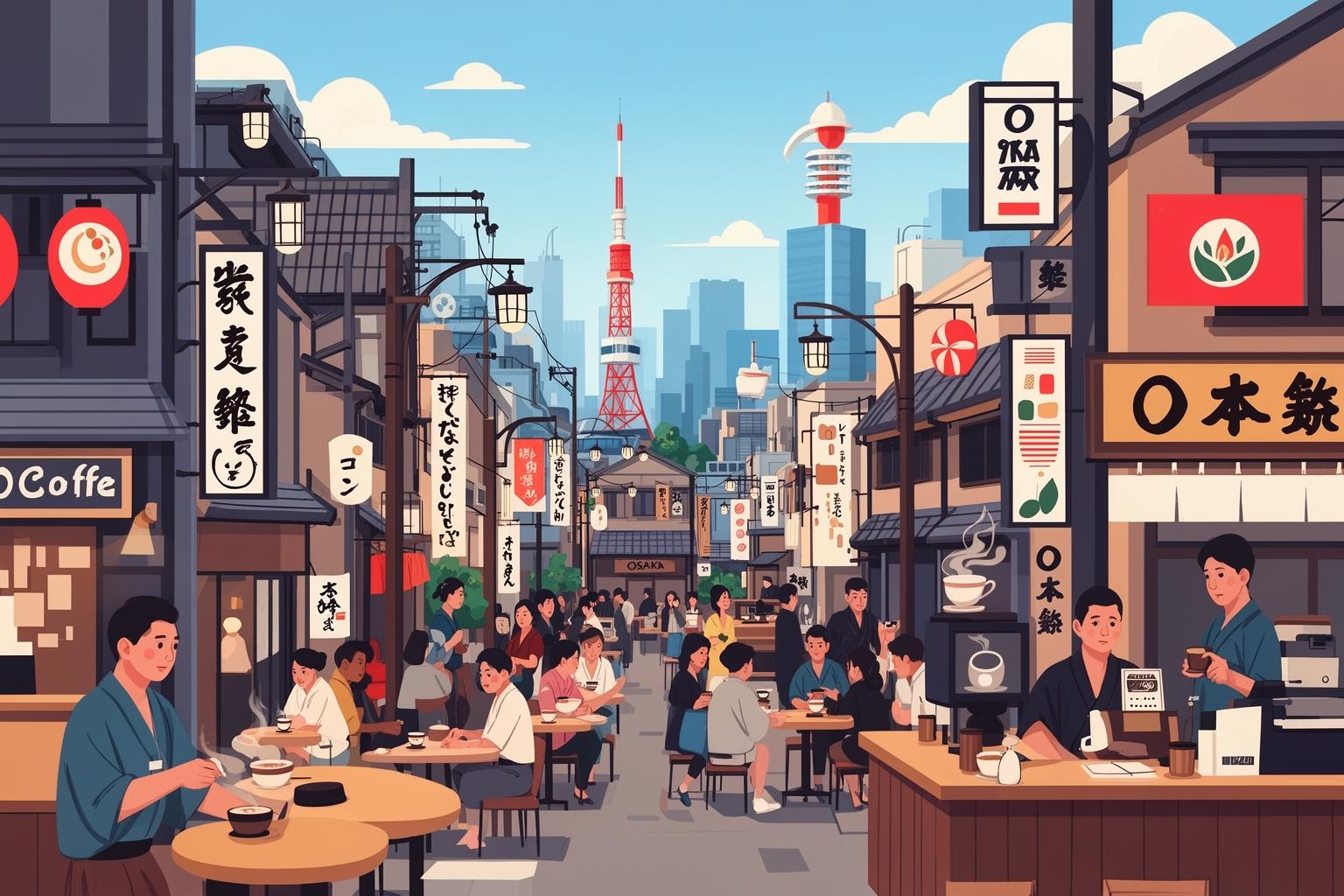
Why does the traditional kissaten culture endure so strongly in Osaka, perhaps even more than in the ever-changing landscape of Tokyo? The answer lies in the city’s history and identity. Tokyo is known as the city of samurai and bureaucrats, a top-down center of power and governance. Osaka, by contrast, has always been a city of merchants—a bottom-up city built on commerce, pragmatism, and close community ties. For centuries, the kissaten played a vital role within this merchant culture. It was an unofficial office, a neutral space where deals were made, contracts were negotiated, and business relationships were fostered over a cup of coffee and a cigarette. It was neither a formal office nor a private home, but the perfect “third place” for the city’s business class.
Moreover, Osaka is a city of neighborhoods. Unlike Tokyo, which often feels like a sprawling, anonymous megalopolis, Osaka is a mosaic of distinct communities, each with its own shotengai, local character, and cherished kissaten. The kissaten acts as the neighborhood’s living room. Here, shop owners take their mid-morning breaks, local housewives gather to chat after shopping, and elderly residents find social connection close to home. This deep, local community function is something global chains like Starbucks struggle to replicate. Starbucks caters to everyone and therefore belongs to no one in particular. A kissaten belongs to its neighborhood, and its lasting presence testifies to the enduring strength of Osaka’s local communities.
The Unspoken Rules of Engagement
To truly appreciate a kissaten, understanding the unspoken rules is essential. Many foreigners, accustomed to explicit guidelines and attentive service in Western cafes, may find this challenging. The main rule is to respect the atmosphere—kūki wo yomu (空気を読む), or “read the air.” If the space is quiet, keep your voice down. This is not the place for loud, animated conversations with friends or taking business calls. Laptops are frequently discouraged. While some modern kissaten may tolerate them, using one in a traditional spot can feel like breaking the space’s unwritten code. The expectation is that patrons come to disconnect from the digital world, not bring its hectic energy inside.
The service style may also be surprising. The Master is not there as a friend but to serve with quiet dignity. Don’t expect small talk or casual questions about your day. Interaction is minimal and efficient. He will take your order, prepare it precisely, deliver it, and then leave you in peace. For some, this can seem cold or distant. For others, it offers a profound relief. It’s a service that honors your solitude and asks nothing in return. In a world constantly demanding your attention, the kissaten grants the rare gift of being left alone.
“Ma, Ikka” – The “Oh, Well” Attitude
Most importantly, the kissaten reflects a central aspect of the Osaka mindset that contrasts sharply with Tokyo. Tokyo is obsessed with perfection, polish, and staying on the cutting edge. Everything must be new, clean, and flawless. Osaka, by contrast, embraces a more pragmatic, down-to-earth approach, often expressed by the phrase ma, ikka (まあ、ええか), roughly meaning “ah, well, it’s fine.” It’s an acceptance of imperfection and a focus on substance over style.
This attitude is evident throughout the kissaten. Chairs may be worn, wallpaper peeling slightly in a corner, and menus yellowed with age. Nobody minds. It works, it’s comfortable, and it has character. Why change it? This is the opposite of Tokyo’s relentless pursuit of the new. Osaka values things that are old, functional, and rich with history. This lived-in, gritty feel is a defining trait of the city. A kissaten doesn’t strive to be the newest place; it’s content being the best old place. It embodies Osaka’s practical, unpretentious spirit—a city that treasures what is genuine over what is perfect.
The Verdict: Who Belongs Where?
So, after considering all this, which door should you choose? The answer depends entirely on what you’re seeking—not only in your coffee but also in your experience of Osaka. It’s a kind of personality test.
You’re a “Kissaten Person” If…
You should step into the smoky, time-warped world of the kissaten if you yearn for quiet and solitude. If your perfect afternoon includes a good book, a comfortable chair, and no interruptions, this is your refuge. You’re a great fit if you’re a patient observer who delights in people-watching and absorbing the subtle rhythms of a place without feeling the need to join in. If you appreciate retro aesthetics and the beauty of things that are well-worn and rich with stories, you’ll find immense charm here. Most importantly, you must have a high tolerance for cigarette smoke; otherwise, it’s not for you. Ultimately, you’re a kissaten person if you want to experience the slow, deep, authentic pulse of a local Osaka neighborhood and are willing to adapt to its quiet, unspoken rules.
You Should Stick to Starbucks If…
Conversely, you should embrace the green siren if your needs are more practical and modern. If you’re a digital nomad, a student, or anyone who relies on dependable, high-speed Wi-Fi and a place to charge your devices, Starbucks is essentially your office. If the smell of cigarette smoke is an absolute deal-breaker, your choice is clear. Stay in the clean air of the chain cafes. You should choose Starbucks if you want the comfort and convenience of a familiar menu, where ordering your complicated, multi-modifier drink won’t be hindered by language barriers. If you’re meeting friends and prefer a bright, lively space where you can talk openly without worrying about disturbing others, Starbucks is the perfect spot. It’s the right option if you favor a modern, clean, and predictable environment and don’t want to expend energy figuring out a new set of cultural norms just for your coffee.
Beyond the Stereotype: Finding Your Third Place
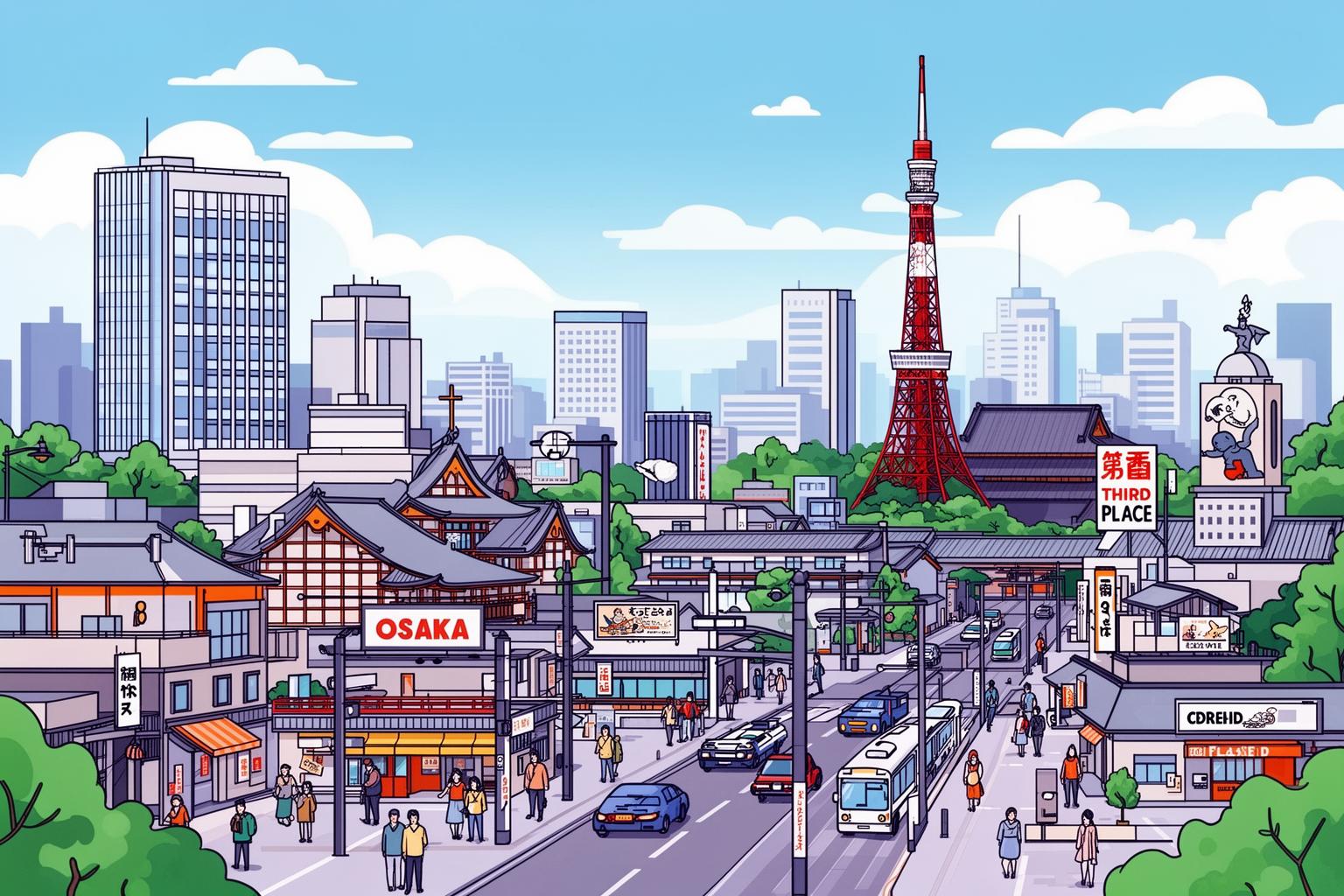
Ultimately, this isn’t a contest where one side must come out ahead. The charm of Osaka lies in the coexistence of both worlds, often side-by-side on the very same street. It’s not about labeling the kissaten as more “authentic” or Starbucks as “inauthentic.” Both are genuine facets of the modern Osaka experience.
Starbucks and its counterparts (Tully’s, Doutor, etc.) fulfill a crucial role in the city. They serve as accessible, user-friendly “third places” essential for students, remote workers, and especially foreigners. They offer a comfortable, low-pressure space to be in public, where the rules are clear and the experience is consistent. They act as social lubricants and functional necessities in a densely populated urban environment.
But to truly understand Osaka’s essence—the deep-rooted value of community, the merchants’ appreciation for quiet spaces of negotiation, and the city’s proud, stubborn refusal to erase its past—you owe it to yourself to push open that heavy wooden door at least once. You don’t need to become a regular. You might dislike the smoke or find the silence unsettling. Yet, spending thirty minutes there with a cup of meticulously brewed siphon coffee, watching the Master wipe down the counter he’s cleaned countless times before, you’ll encounter a side of Osaka not found in any tourist guide. You’ll see the city’s living history, quietly breathing in a velvet chair.
Choosing where to have your coffee in this city is a daily decision about how you want to engage with your environment. Do you prefer the seamless efficiency of the global village, or are you in the mood for the quirky, time-honored intimacy of the local neighborhood? In Osaka, a city that is simultaneously fiercely local and globally connected, you have the rare luxury to choose both. Within that choice lies the entire rich, wonderful, and contradictory story of life in this city.