There’s a specific kind of electricity at a Kappo counter in Osaka. It’s not just the subtle hiss of fish skin crisping over charcoal or the sharp, satisfying thud of a perfectly weighted yanagiba knife meeting a cutting board. It’s a current of conversation that flows between the chef, the Taisho, and the dozen or so guests seated before him. In this intimate theater of cuisine, the counter is the stage, the ingredients are the cast, and the chef is the director. But in Osaka, unlike anywhere else in Japan, you, the guest, are not just a passive audience member. You are an active participant, a collaborator in the evening’s performance. Your words, your questions, your laughter—they become an invisible seasoning, subtly altering the rhythm and flavor of the entire experience. For anyone coming from the hushed, almost reverential temples of gastronomy in Tokyo, this can be a shock to the system. You might feel like you’ve walked into a private dinner party where everyone already knows each other. The barrier between patron and artisan feels porous, almost nonexistent. This isn’t a flaw in the fine dining experience; it is the very soul of it. To eat Kappo in Osaka is to understand that a meal is not something you are served, but something you create together. It’s a dialogue, a dance of wit and warmth that reveals the very heart of this city’s pragmatic, personable, and profoundly human culture. Understanding this dynamic is a key to unlocking not just a better meal, but a deeper comprehension of what it truly means to live and connect in Osaka.
This collaborative spirit, where a simple conversation becomes a form of social currency, echoes the city’s broader culture of connection, much like the friendly custom of sharing candy, or Osaka’s ‘ame-chan’.
The Counter as a Stage: Understanding Kappo Dining
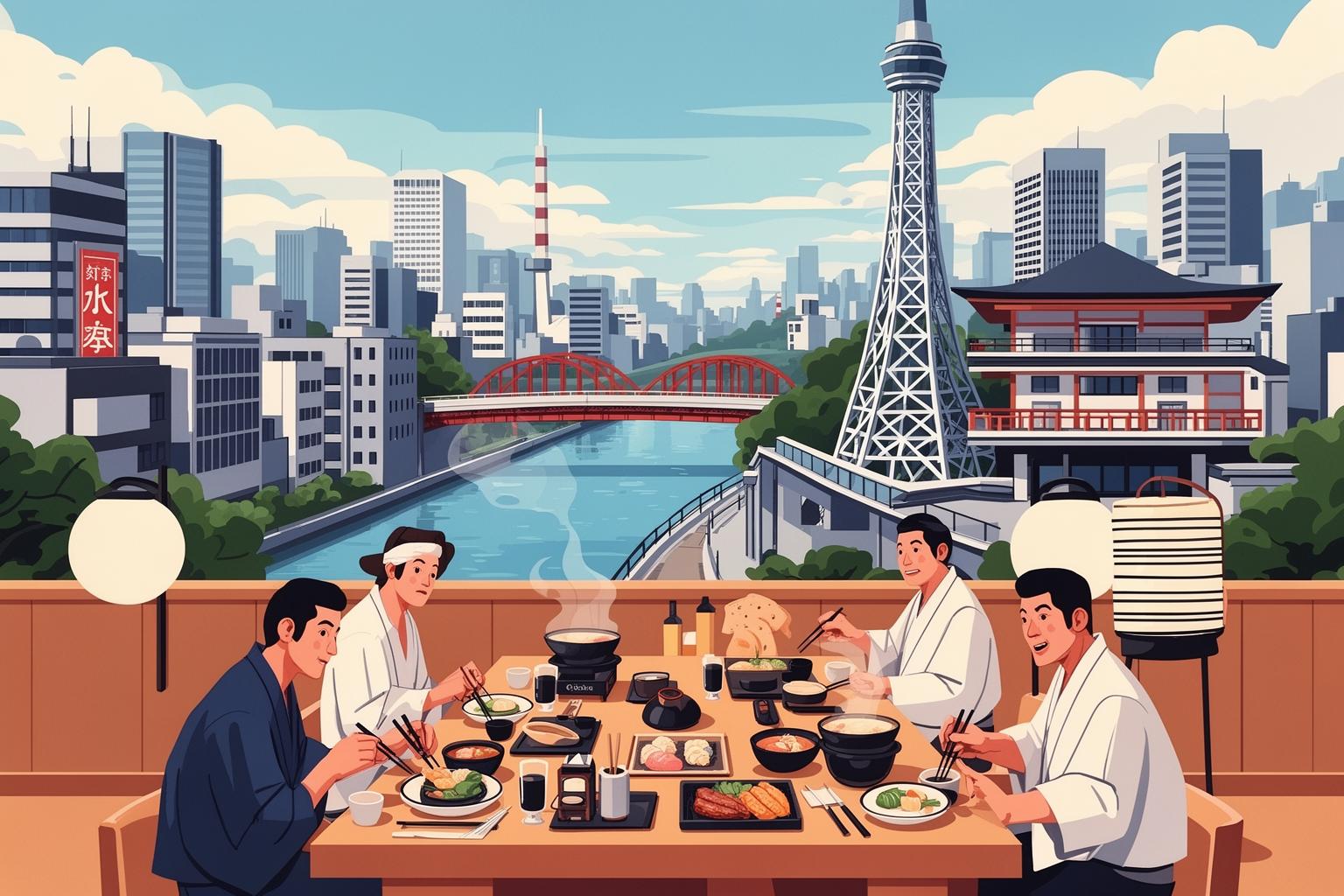
The word “Kappo” (割烹) itself offers the first clue. It is a compound of two verbs: “to cut” (割) and “to cook” or “to simmer” (烹). This is more than just a name; it is a mission statement. It represents a style of dining where the essential acts of culinary creation take place right before your eyes. The kitchen is not a hidden, mysterious space behind swinging doors. The kitchen is the room itself. The chef, or Taisho, presides over this domain from behind a pristine wooden counter, often made from a single slab of hinoki or keyaki wood planed to a silky finish. This counter is more than merely furniture; it acts as the proscenium arch of a culinary stage. Every movement the Taisho makes is precise, economical, and infused with years, if not decades, of experience. The way he wipes his knife, the angle at which he slices a gleaming piece of tai (sea bream), the flick of his wrist as he plates a delicate arrangement of seasonal vegetables—it is a performance of disciplined artistry.
In this environment, the diner is offered an unparalleled degree of intimacy. You can observe the quality of the ingredients up close. You can smell the savory aroma of dashi simmering, hear the crackle of tempura batter hitting hot oil, and feel the warmth radiating from the charcoal grill. This multi-sensory immersion lies at the heart of the Kappo experience. It is designed to dissolve the barrier between creator and consumer, encouraging a direct appreciation for the craft involved. The Taisho is not an anonymous figure; he is the host of the evening, the guide on your gastronomic journey. His presence, personality, and philosophy are as integral to the meal as the food itself. He selects the pottery for each dish thoughtfully, explains the origin of specific ingredients with pride, and orchestrates the flow of courses with the skill of a conductor. In its purest form, Kappo dining celebrates immediacy, transparency, and the deeply personal connection between the person who prepares the food and the one who enjoys it.
The Tokyo Silence vs. The Osaka Banter
Although the physical setup of a Kappo restaurant may appear similar in Tokyo and Osaka, the atmosphere could not be more different. This contrast is one of the most immediate and striking distinctions you’ll find in Japanese high culture, reflecting the distinct personalities of the two cities. It’s a difference you sense the moment you slide open the door—a contrast between quiet reverence and lively engagement.
Tokyo’s Reverent Atmosphere
Enter a high-end Kappo or sushi restaurant in neighborhoods like Ginza or Nishi-Azabu in Tokyo, and the first thing you often notice is the sound—or rather, the near absence of it. The ambiance is usually one of hushed, focused attention. Conversations, if they occur, are spoken in low, respectful tones. The main sounds are those of the chef’s work: the tap of a knife, the rustling of seaweed, the gentle placement of a dish on the counter. The Taisho is often a figure of great gravitas, a shokunin (master artisan) whose every movement is observed with the silent admiration typically reserved for a master calligrapher or a Noh actor. Interaction tends to be formal and minimal. You might express your appreciation for a dish with a quiet “Oishii desu,” receiving a subtle, acknowledging nod in return. The emphasis is firmly on the food as a work of art. The chef’s expertise is meant to speak for itself, and the diner’s role is to appreciate it through quiet contemplation. This is not coldness or aloofness; rather, it is a deep respect for the purity of the craft. The silence serves as a vessel for a more profound, internal experience of taste and texture.
Osaka’s Conversational Flow
Now, imagine a similar Kappo counter in Osaka’s Kita-Shinchi or Minami district. The experience is quite the opposite. The room buzzes with sound. Laughter erupts along the counter. The Taisho engages in a lively debate with a customer about the Hanshin Tigers baseball team. People talk over one another, share sake, and generate a warm, communal energy. The Taisho is not a distant, revered master but a charismatic, often witty, center of attention. He cracks jokes, asks about your day, and shares stories about the fisherman who caught this morning’s sawara (Spanish mackerel). This is not viewed as a distraction from the food; it’s seen as an essential complement. For an Osakan, a delicious meal in a silent, sterile room is only half the experience. The true enjoyment derives from the entire occasion—the food, the drink, the company, and especially the banter. Hospitality here isn’t defined by quiet respect but by active participation. The chef’s main aim is to make you feel comfortable, included, and entertained. A reserved customer might even cause concern for an Osaka Taisho, who might gently ask, “Is everything okay? Not to your liking?” because in his world, a happy customer is one who talks. This lively exchange is the cultural seasoning that defines Osaka dining; it embodies the belief that having a good time is just as important as enjoying good taste.
Decoding the Dialogue: The Unspoken Rules of Engagement
To an outsider, the easy, free-flowing banter at an Osaka Kappo counter might seem chaotic or even intimidating. It can feel like a private club with its own unwritten rules that you haven’t learned. However, the seemingly random chatter is actually a refined form of communication—a way to build relationships and personalize the dining experience in real time. Grasping the subtleties of this dialogue is essential to genuinely connecting with the culture.
It’s Not Just Small Talk; It’s Relationship Building
When you ask the chef, “Where is this uni from?” or “Which sake would you recommend with this?” you’re doing more than simply seeking information. You’re opening a door. In Tokyo, such a question might receive a polite, factual answer. In Osaka, it acts as an invitation for the chef to perform, to share a part of himself. He won’t just reply, “It’s from Hokkaido.” Instead, he’ll dive into a story: “Ah, this uni! I have a guy, Tanaka-san, in Hakodate. He’s a crazy old fisherman who wakes up at 3 AM even during blizzards, but he saves the absolute best kelp-fed uni just for me. We argued about the price on the phone for ten minutes this morning, but look at this color! Definitely worth it.” Suddenly, you’re not merely eating sea urchin—you’re tasting Tanaka-san’s hard work, the result of a long-standing business relationship, and a testament to the Taisho’s discerning eye. This narrative transforms the ingredient from a mere commodity into something with history and character. Showing curiosity signals that you’re not just a passive consumer but an engaged connoisseur. This elevates your standing in the chef’s eyes and deepens your appreciation for the dish. The conversation becomes a way to add value—a story woven around the food that makes it taste all the more special.
The Rhythm of “Nori-Tsukkomi” at the Counter
At the core of Osaka communication is the comedic rhythm of manzai, a stand-up comedy style involving a funny man (boke) and a straight man (tsukkomi). This dynamic, called nori-tsukkomi, permeates everyday talk, and the Kappo counter is a prime arena for it. The Taisho often takes on the role of the boke, deliberately saying something slightly absurd or self-deprecating to see how you respond. For example, after presenting a beautifully arranged sashimi plate, he might say with a deadpan face, “Gomen ne, kyou no sakana, amari yoku nai wa.” (Sorry, the fish isn’t very good today.) A visitor unfamiliar with this style might feel confused or alarmed. But an Osakan—or a guest who understands the game—knows this is their cue to perform the tsukkomi. The right response is not agreement but a playful rebuttal: “Nani yutten no, Taisho! Meccha kirei ya nai desu ka!” (What are you talking about, Chef! This looks incredible!) or “Jaa, shoganai na, tabete ageru wa.” (Well, if I have to, I guess I’ll eat it for you.) This exchange, this playful give-and-take, instantly forges a bond. It’s a shared joke that signals you’re on the same wavelength. It shows social savvy and a readiness to engage with the local culture. Mastering this rhythm is like learning a secret handshake; it tells the Taisho you ‘get’ Osaka, which often makes him warm up to you even more.
Why This Matters for Your Meal
The rapport built through these conversational rituals has a tangible impact on your meal. A chef is an artist, and like any artist, he’s sensitive to his audience. When a Taisho feels a genuine connection with a guest—seeing that you’re curious, engaged, and willing to share a laugh—he becomes more invested in your experience. This isn’t about receiving “special treatment” in a transactional sense. It’s about a human connection inspiring a more personal level of creativity and generosity. He might shave a little extra truffle onto your chawanmushi because he enjoyed your story. He might pour you a taste of rare, expensive sake from his private stash, thinking you’d appreciate it. He might even create an off-menu dish on the spot, based on a flavor or ingredient you mentioned loving earlier. Your meal ceases to be a pre-planned sequence and becomes a dynamic, evolving creation shaped by the energy at the counter. The conversation is not separate from the meal; it is woven directly into its very fabric.
“Omakase” is a Conversation, Not a Command
The term “Omakase,” meaning “I’ll leave it up to you,” is one of the most well-known yet frequently misunderstood concepts in Japanese dining. For many foreigners, it evokes an image of complete and silent submission to the chef’s will. You sit down, say the magic word, and a sequence of dishes chosen by an all-knowing master begins to unfold. While this passive interpretation may hold true in some of the more austere, temple-like establishments in Tokyo, in Osaka, “Omakase” follows a different philosophy. It is not a monologue delivered by the chef; rather, it is the opening line of a collaborative conversation.
When you say “Omakase” to an Osaka Taisho, you are not surrendering your control. You are granting him permission to be your personal guide—a guide who depends on your feedback to navigate. The process is interactive from the start. He will likely begin with a series of questions to establish a baseline: “Do you have any dislikes?” “Are you very hungry tonight, or would you prefer lighter fare?” “What kind of alcohol will you be drinking?” His initial dishes often serve as probes, designed to assess your palate. He might serve a piece of delicate hirame (flounder), followed by something richer, like fatty nodoguro (blackthroat seaperch), all the while observing you closely. He’s not just checking if you finish your plate; he’s interpreting your non-verbal reactions. Did your eyes widen slightly when you tasted the nodoguro? Did you savor it a bit longer? Did you immediately take a sip of sake to refresh your palate? He takes note of all this. After a few courses, he may check in directly: “How are we doing with portion size? Was that last dish too oily for you?” Your honest feedback is not seen as rude; it is vital information that allows him to customize the rest of the meal precisely to your tastes. If you reveal a particular fondness for shellfish, don’t be surprised if an extra course of grilled abalone or creamy shirako appears later. In this setting, “Omakase” means “Trust me to create the best possible meal for you, based on the ingredients I have and the preferences you communicate.” It is a fluid, responsive process—a partnership between your desires and his skill.
From Customer to “Jouren”: The Ultimate Osaka Compliment

In Osaka’s world of restaurants and bars, no status surpasses that of the “Jouren,” or regular customer. Yet becoming a Jouren involves much more than just frequent visits or spending money. It represents a social contract, a shift from being an anonymous visitor to becoming a recognized member of the establishment’s family. In a city shaped by merchants, where business has always intertwined with personal relationships, being accepted as a Jouren is the highest compliment. It signifies trust, value, and a true sense of belonging.
Reaching this status is a gradual journey built on the conversational thread of your visits. On your first visit to a Kappo restaurant, you are simply a guest. By the second visit, if the Taisho recalls your face and perhaps a detail from your previous conversation, you are seen as a promising newcomer. By the third or fourth visit, a change takes place. The greeting becomes warmer and more personal. “Ah, Nakamura-san, welcome back! We got that sake from Akita you liked today.” Questions move beyond just food to your life. “How did that work project you mentioned last month go?” The Taisho begins to anticipate your preferences without needing to ask: your preference for smaller beer glasses, your dislike of anago (conger eel), and your love for unagi (freshwater eel). This attentive, personalized service marks Jouren status. The meal itself evolves, becoming less formal as the Taisho feels comfortable experimenting with new dishes, seeking your feedback as a trusted palate. The commercial barrier dissolves, and dining feels like visiting a skilled friend’s home for dinner. This commitment to nurturing Jouren is deeply embedded in Osaka’s merchant spirit. A one-time, big-spending customer is appreciated, but a loyal, long-term relationship is far more valuable. It provides steady business and, more importantly, fuels the vibrant, communal atmosphere that sustains the restaurant’s essence. For Osaka residents, having a few places where you are a Jouren is essential to feeling grounded in the city—your network, your community, your anchor amid the bustling metropolis.
What This Teaches You About Living in Osaka
The dynamics at the Kappo counter serve as a microcosm of life in Osaka. The lessons learned in that intimate setting—sitting across from a chef wielding a knife and sharing a joke—translate directly to navigating the city’s wider social and business scenes. It offers an education in the Osakan worldview, functioning as a practical guide to the city’s unwritten social codes.
First, you come to value directness and genuine expression over strict formality. In Osaka, what you see is generally what you get. Honesty and straightforwardness are appreciated. Just as you are expected to provide candid feedback on a dish, you are also expected to express your opinions clearly in business meetings or personal conversations. Avoiding directness or relying on subtle, unspoken signals—a communication style more typical in Tokyo—can be misread here as evasiveness or even weakness. Osakans prefer to get straight to the point, engage in lively discussions, share a laugh, and then move on. This pragmatism forms the foundation of the city’s culture.
Second, the progression from customer to Jouren underscores that in Osaka, relationships are the real currency. Business transactions, social opportunities, and everyday life all revolve around a network of personal connections. People tend to do business with those they know, like, and trust. Cultivating these relationships takes time and effort, requiring presence, participation, and the kind of reciprocal interaction experienced at the Kappo counter. It goes beyond merely exchanging business cards; it involves sharing stories, recalling personal details, and building authentic rapport. This relational approach is a direct legacy of Osaka’s history as Japan’s merchant capital, where a trader’s reputation was the most prized asset.
Lastly, and perhaps most importantly, the Kappo experience shows that life in Osaka is not a spectator sport. The city’s vitality springs from active participation. You aren’t meant just to watch; you are invited to jump in, join the conversation, and become part of the performance. This holds true at the dinner counter, at a lively Hanshin Tigers game, or during a neighborhood festival. This expectation of engagement is what makes Osaka feel so vibrant and alive, though it can be daunting for those used to more reserved social settings. The city asks you to bring your personality to the table. The lively, conversational, and profoundly human experience of an Osaka Kappo meal is the ideal training ground. It teaches you that here, connecting with people is the most satisfying and enriching course of all.