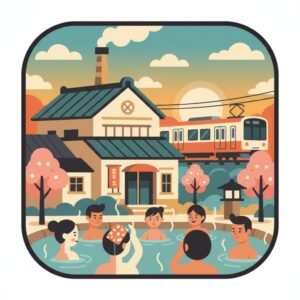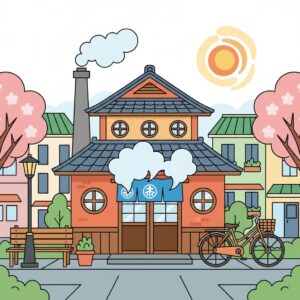
You see it just before the sun dips below the horizon, painting the sky in shades of orange and purple over the tightly packed rooftops of Osaka. It’s a subtle shift in the neighborhood’s rhythm. The frantic energy of the day-trippers in Namba and the suited warriors of Umeda fades into something softer, more local. The air, thick with the scent of grilled eel from one shop and sweet soy from another, starts to carry a new aroma: the clean, steamy smell of soap and hot water. This is when you see them. Small groups of grandmothers, their backs bent slightly from a lifetime of work, carrying small plastic baskets with their favorite soap and shampoo. Solitary grandfathers, walking with a steady, unhurried gait, a small towel draped over their shoulder. They’re all heading in the same direction, drawn by an invisible thread to a place that, to an outsider, might just look like an old, slightly weathered building with a tall chimney and a tell-tale curtain, a noren, bearing the character for hot water, ゆ (yu).
This is the neighborhood sento, the public bathhouse. And if you’re trying to understand the soul of Osaka, to peel back the layers of takoyaki stands and glitzy shopping arcades, this is where you need to look. Because in this city, the sento is so much more than a place to get clean. It’s the neighborhood’s living room, its newsroom, its unofficial counseling center, and its most resilient social safety net. It’s a raw, unfiltered expression of the Osakan spirit—a spirit that values connection over privacy, community over anonymity, and a good, loud chat over quiet, solitary contemplation. Forget what you think you know about quiet, zen-like Japanese bathing. In Osaka, the sento is a full-contact social sport, and it’s one of the most revealing windows into the daily life of the city’s older generations. This isn’t a tourist attraction; it’s the beating heart of the community, hidden in plain sight.
To truly understand the city’s unique social fabric, consider how its residents navigate daily life, from the sento to the streets, as seen in the unique and fast-paced Osaka bicycle culture.
The Rhythm of the Neighborhood: Why the Sento Still Matters
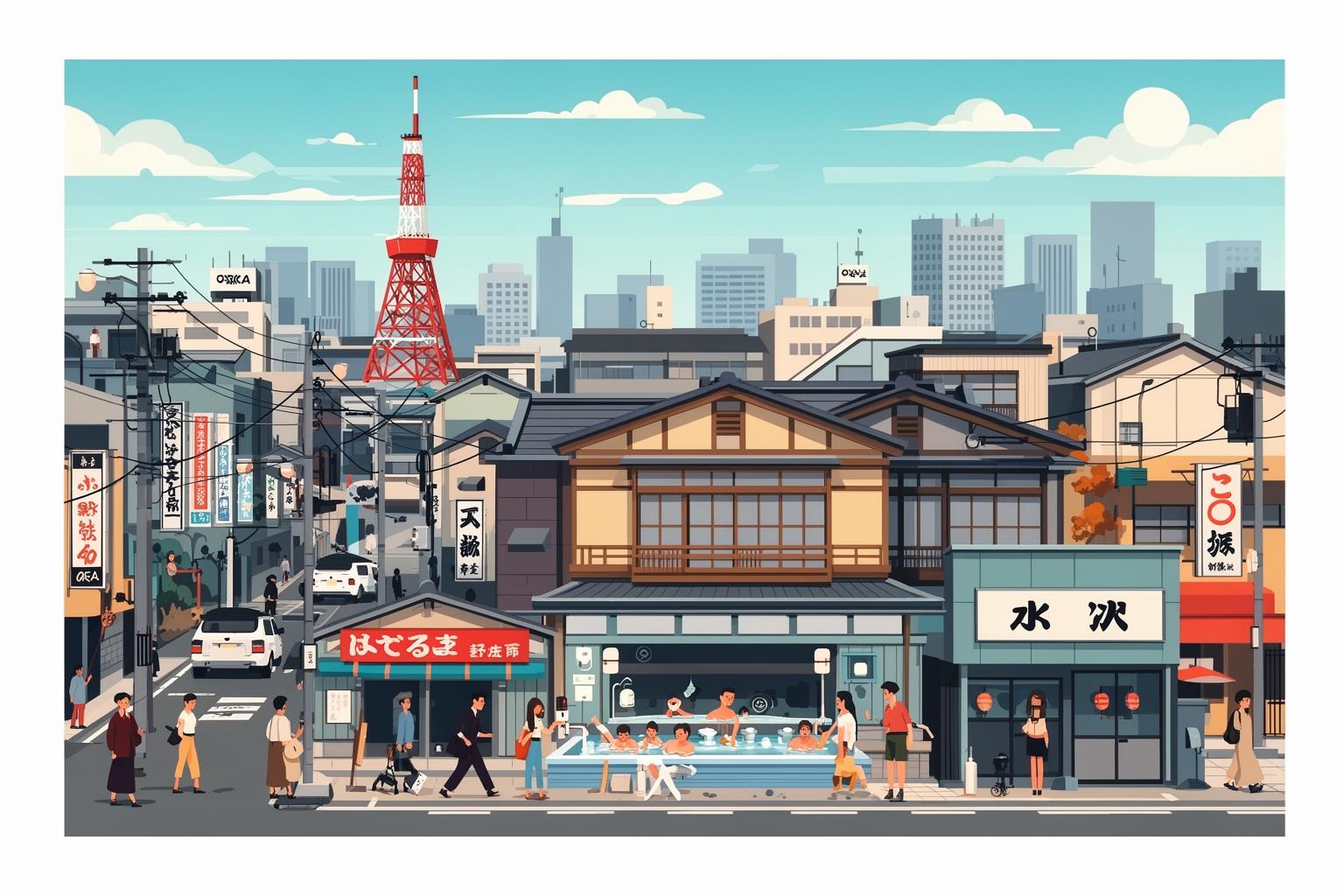
In an era when nearly every apartment, no matter how small, includes its own private bathroom—a prefabricated unit bath made from sterile plastic—the continued presence of the sento feels like a relic from another time. Why would anyone spend 500 yen to bathe with strangers when they can do so for free at home? This question itself exposes a basic misunderstanding of the sento’s role, especially in Osaka. The real answer has little to do with cleanliness and everything to do with habit, community, and the rhythm of localized daily life.
For many older Osakans, visiting the sento isn’t merely a choice; it’s the anchor of their day. It serves as a constant in a world that often feels isolating. Their day revolves around it. Afternoons are reserved for errands, a trip to the local shotengai (shopping arcade) to buy groceries, a chat with the butcher, and then, as the clock nears four or five, it’s time. The basket is packed. The walk, often their only significant exercise, begins. This routine is a defense against loneliness, providing structure, a reason to step outside, and a guaranteed social exchange.
At the center of this ritual is the bandai, the raised platform at the entrance where the owner, or bandai-san, sits. This figure is far more than a simple cashier. The bandai-san acts as the neighborhood’s switchboard operator, memory keeper, and guardian. They greet every regular by name, not with the formal, scripted irasshaimase of a convenience store clerk, but with a warm, familiar, “Ah, Tanaka-san, maido! (thanks as always!) Bit chilly today, isn’t it?” They know who’s been ill, whose daughter is visiting from Tokyo, and who has welcomed a new grandchild. The entrance fee is exchanged alongside this essential social information. It’s an analog social network, far more effective and compassionate than anything Silicon Valley could design.
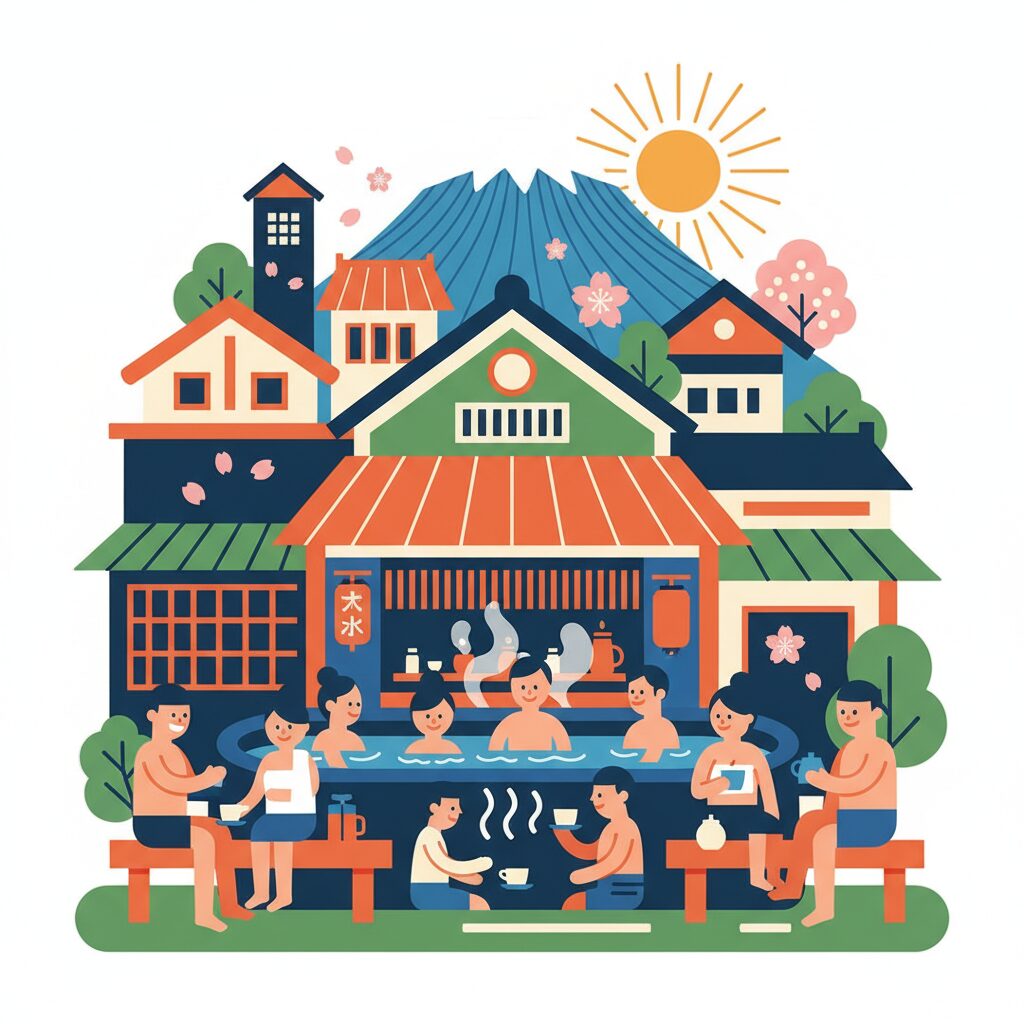
Inside, the sento feels like a cathedral of the everyday. The high ceilings and tiled walls enhance the acoustics, turning the sound of water and conversation into a soothing symphony. The iconic, often kitschy, mural of Mount Fuji remains—a tradition that endures even in Kansai, acknowledging a shared national bathing culture. Bright yellow plastic stools and washing buckets stamped with the Kerorin brand are everywhere, so common they’ve become collectibles. The metallic clang of old locker doors and the satisfying hiss of a post-bath milk bottle being opened fill the air. These sensory details are threads of memory woven into daily life over decades. It’s a world apart from the sterile quiet of a private bathroom—and for its patrons, that is exactly what makes it special.
The Unspoken Rules of the Osaka Sento
Every culture has its own codes, and the Osaka sento is no different. For a foreigner, stepping through the noren for the first time can feel intimidating. The nudity, the protocols, the language barrier—it can all be overwhelming. However, understanding the local rules is key to grasping the local mindset. Interestingly, many of these rules focus on what you should do, rather than what you shouldn’t.
It’s Not About Silence
This is perhaps the greatest contrast to the usual image of Japanese bathing. If you’ve visited a high-end onsen (hot spring) resort, you know the atmosphere of quiet reverence. The bath is a place for silent reflection, communion with nature, and inner peace. An Osaka sento is the exact opposite. It’s a lively hub of conversation.
Silence here isn’t golden; it’s actually suspicious. As soon as you enter the bathing area, you’re met with a wave of chatter. It’s almost always in the rich, expressive Osaka-ben dialect, making it sound even more animated and emotional. People do not speak in whispers; they project their voices. Two elderly men soaking in the 42-degree Celsius bath might loudly analyze the latest collapse of the Hanshin Tigers’ bullpen. Nearby, a group of women debate the best way to pickle radishes, their voices bouncing off the tiled walls. Someone complains about their son-in-law, another about a bad back.
This isn’t considered rude; it’s the very purpose of the space. The sento is where you unburden yourself, both literally and figuratively. It’s a place to vent, celebrate, gossip, and connect. To outsiders, it can seem as if everyone knows one another, but that’s not always true. It’s perfectly normal for a regular to strike up a conversation with a complete stranger. The shared vulnerability of being naked together in hot water seems to dissolve usual social barriers. This is the practical truth behind the cliché “Osaka people are friendly.” It’s not about wanting a lifelong friendship; it’s an ingrained belief that shared space calls for shared experience, and conversation is the simplest way to share.
The Locker Room is the Real Meeting Room
The social interaction doesn’t stop when you leave the water. In fact, some of the most important exchanges happen in the datsuijo, or changing room. This area serves as a crucial transition zone—a decompression chamber between the heat of the bath and the outside world. It’s outfitted with the essentials for post-bath relaxation: a few wicker benches, an old-fashioned analog scale that everyone eyes warily, a buzzing hair dryer that costs 20 yen for three minutes, and, most importantly, a row of vending machines stocked with cold drinks.
The post-bath ritual is as significant as the bath itself. You dry off, weigh yourself (then either complain or brag about the result), and grab a drink. Classic choices include a small glass bottle of milk—plain, coffee-flavored, or fruit-flavored—or a bottle of Ramune, the soda with a marble stopper. Then, you sit down. Wrapped in just a towel or your underwear, you join the ongoing conversation. This is where the real community building takes place.
Here, talk is more relaxed and personal. Plans for tomorrow are made. Health tips are exchanged. Someone might be organizing a neighborhood festival, using the locker room as a recruiting spot. This is where you’ll hear the question that exemplifies the sento’s role as a social safety net: “Sato-san, I didn’t see you yesterday. Everything okay?” It’s a simple, casual question, but it carries deep meaning. It implies “You were missed. You belong here. Your absence was noticed.” In a megacity of millions, being noticed is a powerful form of care.
Your Body is Just a Body
Let’s tackle the most obvious hurdle for many newcomers: nudity. In Western cultures, public nudity is often tangled up with issues of body image, sexuality, and vulnerability. In an Osaka sento, it’s a complete non-issue. It acts as the great equalizer.
When you strip off your clothes, you also shed your social status. The CEO of a small manufacturing company and the retired bus driver are, here, equals. They’re just two people trying to rinse soap out of their eyes. This radical absence of pretense is a key principle of the Osaka worldview. There’s a certain impatience with formality and hierarchy in this city, and the sento physically embodies that attitude. No one is looking at you. No one is judging your body. After the first few minutes of self-consciousness, you realize your nakedness makes you invisible in the most freeing way.
For the older generation who frequent these baths, bodies are simply vessels that have carried them through life. Scars, wrinkles, and ailments are all openly visible without shame. This straightforward acceptance of the physical self creates an environment of remarkable honesty. It’s hard to be pretentious when you’re naked. This shared vulnerability forms the foundation of the loud, lively, and deeply human community that defines the sento.
Osaka vs. Tokyo: A Tale of Two Tubs
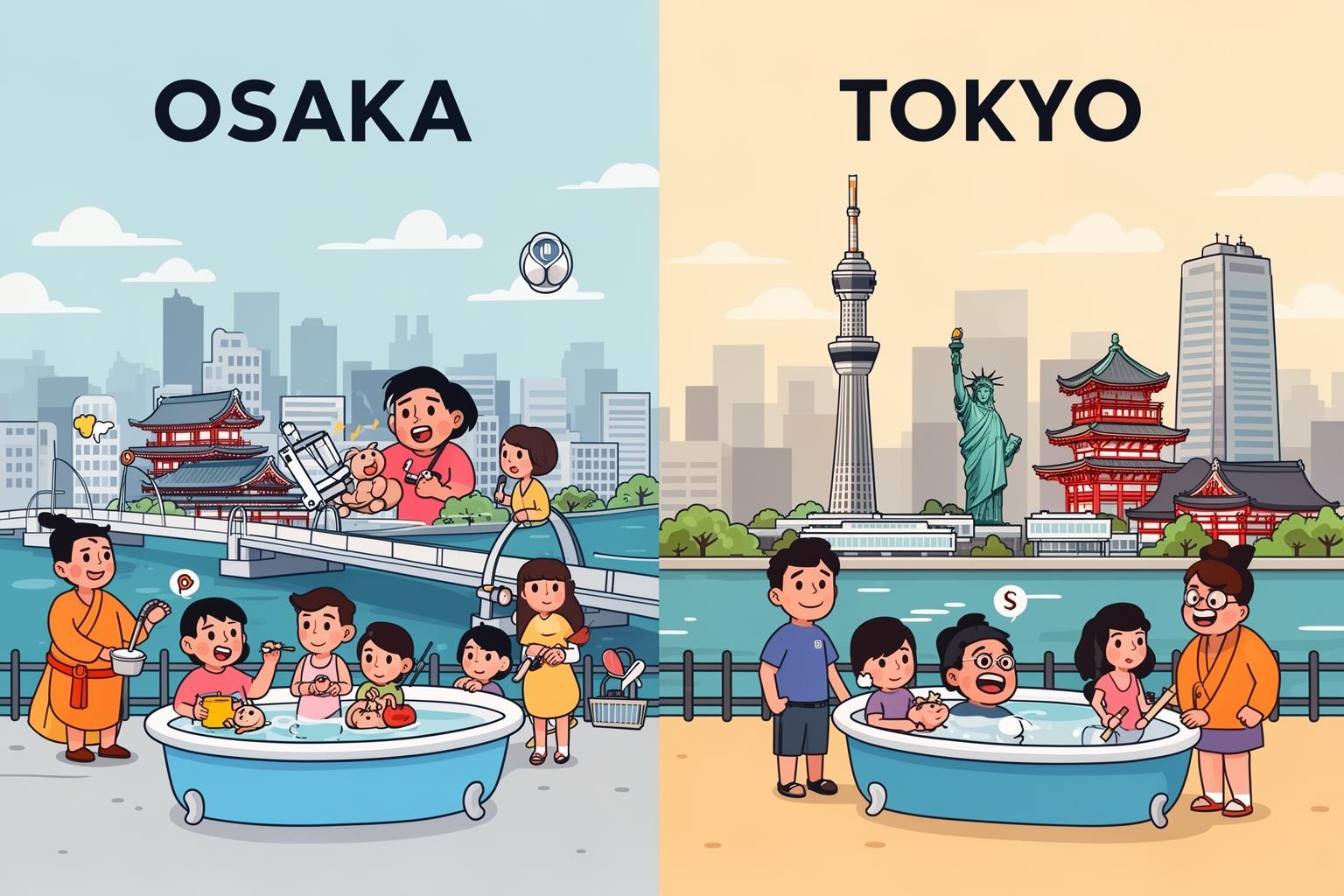
At first glance, a sento in Tokyo and one in Osaka appear quite similar. They share the same basic layout, the iconic Mount Fuji murals, and the familiar Kerorin buckets. However, the experience—the very ambiance of these places—can be vastly different. Understanding this difference reveals the fundamental divergence in the social characters of Japan’s two largest cities.
Tokyo, despite its vibrancy, values a degree of public anonymity. People tend to keep to themselves in communal spaces, and conversations on the train are uncommon. This tendency is often mirrored in Tokyo sentos, which can be much quieter. Visitors come, bathe, soak, and leave. Although regulars do exist and friendships form, there is less expectation that the sento serves as an open forum for public interaction. Especially in more central, gentrified districts, you’ll encounter “designer sentos” or “sento renewals” that draw a younger, trendier crowd. These establishments might feature craft beer on tap, modern art on the walls, and weekend DJs. The emphasis is on the experience of bathing as a curated, almost consumerist event. These places are clean and stylish but sometimes feel transient.
In Osaka, sentos rarely aim to be “cool” destinations. They function as utilities and institutions, deeply and stubbornly local. The sento feels less like a business to visit and more like a club to belong to. It belongs to the jōren, the regulars, who set the tone. This is a crucial aspect of Osaka’s social life. Being a regular at a restaurant, bar, or sento carries status and responsibility. The jōren serve as the custodians of the culture.
As a newcomer, you enter a pre-established social ecosystem with clear rules. For instance, if you enter the tub without thoroughly washing first, you won’t receive a passive-aggressive glare. Instead, a 75-year-old grandmother might tell you directly and kindly, “Hey, you need to wash first.” This is not hostile; it’s a form of social upkeep—a community policing itself to maintain its standards. This straightforwardness can be startling to those used to Tokyo’s more indirect communication style, but in Osaka, it is seen as honest and efficient engagement. It’s preferable to direct feedback than to having people gossip about the clueless foreigner behind their back.
This strong localism reflects a wider Osaka mindset. It is a city of neighborhoods, each with its own unique character and pride. Residents often identify more with their local station or shopping arcade than with the city as a whole. The sento serves as the town hall of that smaller community. Whereas Tokyo is a vast, interconnected network, Osaka often feels like a patchwork quilt of small, self-sufficient villages sewn together.
The Sento as a Social Safety Net
Beyond fostering camaraderie and conversation, the sento holds a deeply significant role in the well-being of Osaka’s elderly population. It serves as an exceptionally effective, informal public health service and social safety net. This is not an exaggeration; it is a daily reality.
Japan faces the challenge of a rapidly aging society, with one of the greatest issues being social isolation among the elderly, known as kodokushi, or lonely death. Individuals, particularly those living alone, may pass away in their homes without being discovered for days or even weeks. In Osaka neighborhoods where community ties remain strong, the sento is one of the primary safeguards against this tragedy.
Consider this: the bandai-san and the jōren maintain a mental log of who visits on which days. They know Mr. Ito comes every single evening around 6 PM, right after his favorite sumo broadcast ends. They know Ms. Tanaka only attends on Mondays, Wednesdays, and Fridays, as she volunteers at the community center on other days. If Mr. Ito misses two consecutive evenings, it raises a red flag. His absence doesn’t disappear into an anonymous municipal database; it’s noted by his neighbors.
The first response is a casual inquiry. Another regular might ask the bandai-san, “Haven’t seen Ito-san lately. Is he okay?” If no one has information, the informal network activates. The bandai-san might know he frequents the Kudo Tofu shop down the street. A quick phone call is made: “Kudo-san, have you seen Ito-san today?” If the answer is no, concern grows. Someone nearby might be sent to check on him. Often, it’s a false alarm—he may just have a cold or be visiting his son. But sometimes, it’s not. Occasionally, that knock on the door saves a life, finding someone who has fallen and cannot get up.
This system of mutual, low-key vigilance developed naturally. It wasn’t created by a government committee but evolved from the simple, repeated act of sharing a bath. It powerfully shows how community infrastructure can provide care beyond what official services offer. It’s preventative, personal, and grounded in genuine human connections. In a city that often prides itself on practicality and a bit of roughness, this quiet network of compassion remains one of its most defining and admirable qualities.
The Future of the Neighborhood Hub
Despite its cultural significance, the traditional sento is becoming endangered. The numbers tell a clear story. Decades ago, Osaka had thousands of public bathhouses. Today, only a few hundred remain, and more close each year. The reasons are straightforward. The owners are aging and have no successors to take over the family business. The old boilers are costly to maintain and repair. Most importantly, the customer base is shrinking as the older generation passes away and younger people prefer the convenience of private baths.
However, there are signs of hope. A new generation of younger Japanese, along with curious foreigners, is discovering the simple charm of the sento. There’s a minor retro revival, with people seeking authentic Showa-era experiences. Some sento owners are adapting by renovating their facilities to attract this new clientele. They’re adding modern features like carbonated springs, cold plunge pools, and saunas—the latter especially popular with a growing group of sauna fans. Lounge areas are being improved with craft beer, snacks, and small community events.
Yet this modernization raises a paradox. In trying to save the sento, does it risk losing what made it special? The renovated sentos are often beautiful, clean, and comfortable, but they can also become quieter, more anonymous spaces where the old lively conversations no longer happen. The emphasis shifts from community to individual wellness. For elderly regulars, fancy saunas and craft beers hold little appeal. What they valued was consistency, familiarity, and the assurance of seeing a familiar face and having a place to belong.
So, if you live in Osaka or are considering making the city your home, I encourage you to seek out your local sento. Not the ultra-modern, spa-like ones, but the old, slightly worn bathhouses hidden on side streets. Visit more than once. Buy a kaisuuken, a discounted ticket booklet, to show commitment. Learn the simple etiquette: wash before entering, don’t bring soap into the tub, and dry off before returning to the locker room. Don’t force conversations but remain open to them. Smile and nod. Eventually, someone—likely a curious old man or a friendly grandmother—will start a conversation. They’ll ask where you’re from, what you’re doing in Osaka, and if you’re enjoying the bath. In that moment, you’ll no longer be a visitor. You’ll be taking your first step into the warm, noisy, and wonderfully human heart of real Osaka. You’ll realize this isn’t just a place to wash your body; it’s a place to connect your life with the life of the neighborhood.