When people talk about Osaka, they often paint it with a single, broad brush. It’s loud. It’s friendly. It’s the city of takoyaki and talking fast. And sure, there’s truth to that, but it’s like describing New York City by only talking about Times Square. It misses the point entirely. As an event planner from Tokyo, my life revolves around understanding the subtle currents of a city’s culture, the unspoken rules that define a space. When I moved to Osaka, I expected a monolithic culture shock. What I found was something far more complex, a city of a dozen different cities, all strung together on a single, vital artery: the Midosuji subway line.
In Tokyo, the Yamanote line circles the city’s power centers, connecting massive commercial hubs that feel distinct yet uniformly metropolitan. Riding it is like flipping through the different sections of a glossy magazine. The Midosuji line is different. It slices straight through the heart of Osaka, running from the manicured northern suburbs down to the grounded, working-class south. To ride the Midosuji from end to end isn’t just a commute; it’s a journey through the city’s class structure, its history, and its soul. Each station unlocks a neighborhood with a fiercely unique personality, a different way of living, a different answer to the question, “What does it mean to be from Osaka?” This isn’t a guide to the tourist spots you’ll find along the way. This is a deep dive into the residential fabric of the city, an exploration of how life changes, dramatically, from one stop to the next. We’re going to ride the rails to understand the real Osaka, the one that lives and breathes far from the flash of the Glico Running Man sign.
To truly understand the city’s soul, one must also explore the reality behind its famous kuidaore culture, which is far more nuanced than the “eat till you drop” myth suggests.
The North: Aspirations and Old Money (Senri-Chuo to Shin-Osaka)
The northern section of the Midosuji line feels like Osaka holding its breath, striving to be polite. This is the realm of planned communities, corporate headquarters, and a quiet that feels earned rather than natural. Here, Osaka’s chaotic energy is restrained and shaped into orderly grids and leafy parks. For many, this represents the ideal: earning money amid the chaos of the south and then enjoying it in the tranquility of the north. It’s a vision of Osaka life that feels aspirational, a conscious departure from the city’s rowdy stereotype.
Senri-Chuo: The Polished and Planned Suburban Dream
Step off the train at Senri-Chuo, the northern terminus, and you might question if you are still in Osaka. The atmosphere feels different. The pace is slower. This is Senri New Town, one of Japan’s first large-scale planned communities, born during the post-war economic boom. The mood is overwhelmingly orderly. Wide, clean streets, green parks interspersed between apartment buildings, and a strong sense of middle-class stability. It’s less gritty Kansai and more pristine Kanto.
Who Lives Here?
This area is family-oriented. It’s home to professionals—doctors, Osaka University professors, and corporate managers—seeking space, good schools, and a safe environment for their children. They have traded city center convenience for backyards and community spirit. Conversations here are softer, the Kansai-ben dialect more subdued, sometimes deliberately so. It’s Osaka with its tie straightened and voice lowered. People come here for the perks of proximity to a major city without the constant sensory overload.
The Rhythm of Daily Life
Daily life in Senri-Chuo follows a different tempo. The morning rush consists of a stream of crisp suits heading to the Midosuji line, while the rest of the day is marked by mothers pushing strollers through Senri Chuo Park or gathering for lunch at the Senchu Pal department store. There is a strong sense of local, yet curated life. It’s a world of piano lessons, weekend tennis, and community center events. A common misconception is that Osaka is all concrete jungle. Senri-Chuo disproves this, illustrating that many Osakans, like people everywhere, seek a peaceful life. The key difference from a Tokyo suburb like Kichijoji is the intentional design. Senri-Chuo seems engineered in a lab to be the perfect suburb, whereas Tokyo’s popular suburbs often develop their appeal more organically.
Esaka: The Corporate Outpost with a Residential Core
Just a few stops south, Esaka offers a different northern vibe. At first glance, it appears to be a purely functional corporate hub. The streets near the station are lined with headquarters of national companies, business hotels, and straightforward chain restaurants serving weekday lunch crowds. It has the antiseptic feel of a business park—a place to work, not to live.
A Tale of Two Blocks
But that’s the trick with Esaka. Walk just two blocks away from the main street in any direction, and the corporate facade gives way. Suddenly, you find yourself in a dense, quiet residential area filled with mid-rise apartment buildings, or “mansions” as they are called in Japan. This is Esaka’s essence: a practical neighborhood offering a strategic compromise. You enjoy a significantly shorter, less crowded commute to Umeda than from the distant suburbs, while paying rent that is a fraction of what you’d find just a few stations closer to the city center.
The Esaka Lifestyle
Who lives here? Young professionals at the start of their careers, salarymen on temporary transfers from other cities (known as “tanshin funin”), and people who prioritize a low-stress commute above all else. Daily life is efficient. You grab a bento on the way home, your weekend might include a trip to the large Tokyu Hands store—a local landmark—and socializing usually happens in Umeda or Namba rather than Esaka itself. This neighborhood reveals Osaka’s practical, no-frills side. It’s not about flash or tradition; it’s about finding a workable solution. It’s a place to live while focusing on other priorities. Tokyo has similar areas, like around Shin-Yokohama, but Esaka feels more integrated, with a thinner, more permeable boundary between corporate and residential zones.
Shin-Osaka: The Gateway That’s Not a Destination
For many visitors, Shin-Osaka station is their first impression of the city. As the hub for the Shinkansen bullet train, it’s a whirlwind of frantic arrivals and tearful farewells. It’s a place of transit—a non-place defined by movement. And that’s the biggest misconception foreigners have. Seeing the name “New Osaka,” they assume it’s the city center. In reality, it couldn’t be farther from it.
Living in a Transit Lounge
The area around the station is surprisingly unremarkable. It’s a cluster of business hotels, office buildings, and residential apartments seemingly built without any sense of character. The vibe is purely functional. The streets lack the lively shotengai shopping arcades or cozy izakayas that characterize much of Osaka.
Living in Shin-Osaka is a conscious choice prioritizing convenience over culture. Residents are often those whose jobs require frequent travel. They value being able to step out of bed and catch a bullet train to Tokyo in under an hour. Yet, by choosing this, they sacrifice a core part of the Osaka experience: neighborhood identity. Osaka is a city of strong local attachments. People identify with Tennoji, Namba, or Kyobashi. To say you’re “from Shin-Osaka” doesn’t carry the same cultural weight. It’s like living at an airport—connected everywhere but rooted nowhere. This underscores a crucial aspect of the local mindset: for most Osakans, life is intensely local. Their world is their neighborhood station and its nearby stops. Living in a transient hub like Shin-Osaka is, in many ways, very un-Osaka.
The Core: Commerce, Chaos, and Concrete Identity (Nishinakajima-Minamigata to Namba)
As the Midosuji line heads south from Shin-Osaka, the city’s rhythm intensifies. The stark functionality of the north yields to the raw, chaotic energy of the center. This is the Osaka of popular imagination: a dense, overwhelming, and exhilarating urban core. This section of the line is a passage through the city’s twin hearts—the polished northern downtown of Kita and the boisterous southern downtown of Minami. Here, the city doesn’t just hum; it roars. This is where fortunes are made, trends are born, and the city’s identity is forged amid the fires of commerce and consumption.
Umeda: Osaka’s Refined Commercial Face
Umeda station is more than just a station; it’s a universe—a sprawling, multi-layered maze of train lines, department stores, and an endless underground city of shops and eateries. This is “Kita,” the northern downtown, representing Osaka’s bid for sophisticated, international modernity. It’s the city dressed in a tailored suit. The gleaming glass facades of Grand Front Osaka and the towering Umeda Sky Building stand as a direct challenge to Tokyo’s sleekness.
The Human River
Few actually live within a stone’s throw of the station itself. Umeda is a place of work and leisure. The defining experience is being part of the human river that flows through its veins daily. Navigating the underground mall known as “Whity Umeda” is a rite of passage—a delicate dance of avoiding collisions while purposefully heading toward your destination. Here, you witness Osaka’s take on salaryman culture. Compared to Tokyo, it’s slightly more relaxed. The suits are a bit less sharp, the laughter in after-work izakayas a touch louder and freer. Business talks overheard on the platform are peppered with the direct, deal-focused language of merchants, a stark contrast to the more nuanced, layered communication typical in Tokyo.
Osaka Trying to Be Tokyo?
It’s often said that Umeda is Osaka’s Shinjuku or Ginza. While its scale rivals Shinjuku and its luxury brands recall Ginza, the atmosphere differs. Umeda feels as if it’s constantly striving to prove something. There’s an underlying ambition to be perceived as equally sophisticated as Tokyo. Yet the mask often slips. The impeccable service at Hankyu department store is delivered in a warm, rolling Kansai dialect. The dense, slightly chaotic layout of interconnected stations reveals a fundamentally Osakan approach to urban planning: build it big, make it convenient, and don’t fret too much if it’s a little messy. It’s a polished surface over a still-beating, chaotic core.
Yodoyabashi & Hommachi: The Old Merchant’s Spirit
Just one or two stops south of Umeda, the mood shifts from frenetic consumption to serious business. Yodoyabashi and Hommachi form the historic and financial heart of the city. The Midosuji boulevard here is at its grandest, lined with majestic ginkgo trees and dominated by the imposing headquarters of major banks and trading firms. This isn’t the flashy new money of Umeda; it’s old money, built on centuries of trade.
The Spirit of Shobai
The atmosphere is sober and focused. This is the land of “shobai,” the Osaka term for business that extends beyond mere commerce; it’s a philosophy. It’s about cultivating relationships, driving hard but fair bargains, and a deep pragmatism that prioritizes results over appearances. This defines Osaka’s DNA. The city’s wealth was built here—in trading houses and textile wholesalers. Whereas Tokyo’s business world often revolves around grand corporate strategies and brand image, Hommachi’s spirit centers on the deal itself. It’s a more personal, direct form of capitalism.
From Office Hub to Residential District
Traditionally, this area emptied after 6 PM. But a recent surge in high-rise condominium developments has changed that. A new type of resident is moving in: dual-income professional couples seeking a walkable commute, and affluent retirees drawn to the city’s cultural amenities. Living here means embracing the urban canyon. Your neighborhood park is the compact, elegant Nakanoshima Park—a river island oasis. Your local grocery store is likely a high-end supermarket tucked in an office basement. It’s a lifestyle of supreme convenience, but one somewhat removed from the traditional, community-focused neighborhood life found elsewhere in the city.
Shinsaibashi: The Kingdom of Consumption
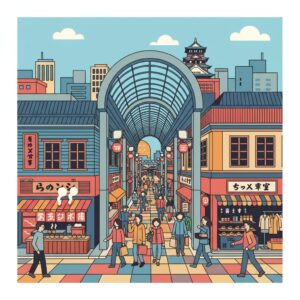
Crossing the river of office buildings at Hommachi, you plunge into Shinsaibashi, the epicenter of Osaka’s youth culture and retail obsession. The Shinsaibashi-suji—an apparently endless covered shopping arcade—is the main artery, a torrent of shoppers, tourists, and street vendors. The energy is electric, overwhelming, and unapologetically commercial. It’s loud, bright, and on around the clock.
Living in the Spotlight
Choosing to live in Shinsaibashi means opting for a life without an off-switch. Residents include young workers in surrounding shops and restaurants, artists and musicians drawn to the nearby Amerikamura district, and foreigners eager to be at the heart of the action. Apartments here are small, often tucked above storefronts or down narrow alleys. Peace and quiet are rare luxuries. Your soundtrack is the constant murmur of crowds, jingles from countless stores, and the distant thrum of nightclubs. Your backyard is a concrete alley; your grocery run a battle through waves of tourists.
Performance and Reality
Foreigners often mistake this area for the entirety of “real Osaka.” It both is and isn’t. It’s the city’s public face, its stage for performance. It embodies Osakans’ love of good times, flashiness (“hade”), and bargain hunting. But authenticity often hides in the cracks—in tiny five-seat bars run by families for fifty years, tucked away on second floors of unassuming buildings, where regulars grumble about tourists flooding their neighborhood. Life here demands resilience—an ability to thrive in chaos and carve out your own pocket of sanity amid the madness.
Namba: The Southern Capital of Everything
If Umeda is Osaka’s polished head, Namba is its loud, messy, glorious gut. This is “Minami,” the southern downtown, and the city’s uncontested center for entertainment and food. It’s a sprawling, chaotic ecosystem spanning the high fashion of Namba Parks, the traditional kabuki of the Shochikuza Theatre, the divey smoke-filled alleys of Sennichimae, and the otaku culture of Den Den Town.
The Naniwa Spirit
Namba embodies the “Naniwa” spirit—an old name for Osaka evoking an earthy, unpretentious, occasionally rough-around-the-edges character. The vibe is less about curated sophistication and more about raw, unfiltered life. The principle of “kuidaore”—eat until you drop (or go bankrupt)—is practiced here with religious devotion. The air is thick with the scents of grilled meats, savory takoyaki batter, and sweet crepes. It’s sensory overload at its most exhilarating.
A True Melting Pot
Unlike Umeda, Namba is where people from all walks of life really live. Sleek new residential towers stand shoulder-to-shoulder with older, somewhat worn low-rise apartment buildings. The population is a genuine cross-section: affluent professionals, students, foreign residents, bar hostesses, shopkeepers, and everyone in between. To live in Namba is to have the entire city at your doorstep—you can buy anything, eat anything, and do anything at nearly any hour. It’s a life of ultimate convenience and constant stimulation. The trade-off, naturally, is the noise, the crowds, and the beautiful, beautiful grit. Namba’s chaos isn’t the calculated, trend-driven frenzy of Tokyo’s Shibuya; it’s a more organic, historic disorder, where layers of the city’s past remain visible, refusing to be paved over by the new.
The South: Deep Roots and Daily Grind (Daikokucho to Nakamozu)
Leaving behind the dazzling, high-pressure intensity of Namba, the Midosuji line opens up into the expansive residential core of southern Osaka. The towering skyscrapers give way to a lower, denser cityscape filled with apartment complexes, single-family homes, and the lifeblood of local Osaka: the shotengai. Here, stereotypes dissolve, revealing the true daily lives of most Osakans. It’s less about showcasing Osaka-ness to the world and more about simply living it, day after day. The pace eases, the dialect thickens, and the community’s roots run deep.
Tennoji: The Intersection of Past and Future
Tennoji is a neighborhood full of striking contrasts, where Osaka’s history and future collide with remarkable intensity. On one side of the station stands Abeno Harukas, Japan’s tallest skyscraper, a shining symbol of modern commerce with a luxury hotel, a sprawling department store, and an observation deck offering breathtaking city views. On the opposite side lies Shinsekai, a district that feels delightfully frozen in the early 20th century, boasting its kitschy Tsutenkaku Tower, affordable kushikatsu eateries, and streets populated by elderly men playing shogi.
A City of Contrasts
This dual nature is key to understanding Tennoji, and perhaps Osaka itself. Who lives here? Everyone. Students from the nearby university reside in affordable apartments. Young families are attracted to the new condos and the vast Tennoji Park with its zoo. Meanwhile, generations of the same families remain in the older, low wooden houses bordering the historic Shitennoji Temple. Daily life is a study in contrasts. You might enjoy a delicate, expensive cake in the Harukas food hall for lunch, then stroll ten minutes for a 300-yen bowl of noodles and a beer in a gritty Shinsekai tavern for dinner. This lack of pretension and the ability to embrace two opposing realities side by side without conflict is a core Osaka trait. Unlike Tokyo, often seen replacing the old with the new, Osaka builds the new right on top of—and beside—the old, weaving a messy yet fascinating urban tapestry.
Showacho & Nishitanabe: Heartland of the Shotengai
Traveling further south to stations like Showacho and Nishitanabe, you enter the true heart of Osaka. Tourist landmarks and corporate offices disappear, replaced by endless residential streets. The defining characteristic here is the shotengai, covered shopping arcades. These are far from the tourist-packed arcades of Shinsaibashi; these are working arcades, the open-air living rooms of the local community.
Community at the Core
This is where real life unfolds. Instead of sterile, brightly lit supermarkets, daily shopping is a social experience. You buy fish from the familiar fishmonger who asks about your children. You get your vegetables from the greengrocer who saves the best daikon just for you. You pick up freshly made croquettes from the butcher for an affordable, easy dinner. The shotengai embodies Osaka’s community spirit. People stay connected, know each other’s business—for better or worse—and share a sense of mutual support.
The Sound of Osaka
Here, the Osaka dialect, Kansai-ben, rings out in its purest, most undiluted form. It’s quick, expressive, and spoken with a directness that can surprise outsiders. The iconic Osaka “obachan” (middle-aged woman), known for her loud voice, leopard-print shirt, and straightforward attitude, reigns supreme in the shotengai. She may appear intimidating, but her bluntness is a form of familiarity. She’ll tell you you’re paying too much for tomatoes, then slip you a free orange for your child. This stands in sharp contrast to the more reserved, formal social interactions typical of Tokyo. In these neighborhoods, life is lived out loud.
Abiko & Nagai: Green Spaces and Grounded Living
At the southern end of the line, around stations like Abiko and Nagai, the urban density begins to loosen. The presence of Nagai Park—a vast green area with a botanical garden and two major sports stadiums—gives the neighborhood a more open, relaxed atmosphere. This is solidly working- and middle-class Osaka, a land defined by practicality and steadiness.
The Unvarnished Reality
Those who live here are the backbone of the city: office workers, civil servants, factory employees, and small business owners. They are Osaka lifers, families rooted in the city for generations. They choose these neighborhoods for affordability, good schools, and a straightforward, unpretentious quality of life. The daily rhythm centers on commuting to the city for work, with weekends reserved for family activities. This might mean a picnic or kids’ soccer game in Nagai Park, or a visit to the local Aeon mall.
The Quiet Majority
This is the Osaka that rarely appears in guidebooks. It’s neither flashy nor trendy, but it may be the most authentic Osaka of all—a life focused on essentials: work, family, and community. The brash confidence of Namba and the corporate drive of Umeda seem far removed. This groundedness forms the foundation of the city’s more flamboyant character, a reminder that beneath the loud, food-obsessed, money-driven stereotypes, Osaka is a place of hardworking people living ordinary, relatable lives. It’s the quiet base supporting the city’s vibrant energy.
The Red Thread: What Ties It All Together?
Our journey along the Midosuji line has carried us from the polished, aspirational calm of the northern suburbs, through the bustling and chaotic furnace of the city’s core, and down into the deep-rooted, grounded residential areas of the south. Each station unveiled a unique facet of the city’s character, a distinct way of living and being. So what is the common thread, the essence of Osaka-ness that runs through it all?
It’s not as simple as a dialect or a fondness for takoyaki. It’s a deeper mindset. First, there’s an unshakable pragmatism. Whether negotiating a high-stakes business deal in Hommachi or haggling over the price of fish in a Showacho shotengai, there is a relentless focus on value, on what works, on cutting through the noise to get to the point. This can sometimes be mistaken for stinginess, but it’s more accurately described as being value-conscious. Fluff and formality are met with suspicion.
This gives rise to a culture of directness. Communication in Osaka tends to be less cushioned and less ambiguous than in Tokyo. People usually say what they mean, which can come across as blunt or even confrontational to those used to more indirect styles. But it’s rarely born of malice. It’s a communication style optimized for clarity and efficiency, a tool of the merchant culture where misunderstandings can be costly.
Finally, despite the vast differences between neighborhoods, there is a strong sense of place. Osakans have a fierce loyalty not just to their city in its rivalry with Tokyo, but to their specific neighborhood. A person’s identity is tied to their local station. This creates a human-scale feeling, even in a metropolis of millions. The city is not an anonymous sea of people; it’s a mosaic of distinct, vibrant villages connected by a subway line. The Midosuji isn’t just a means of transport; it’s the central nervous system linking these diverse parts, allowing you to experience the city’s full, contradictory, and utterly captivating personality with every stop along the way.