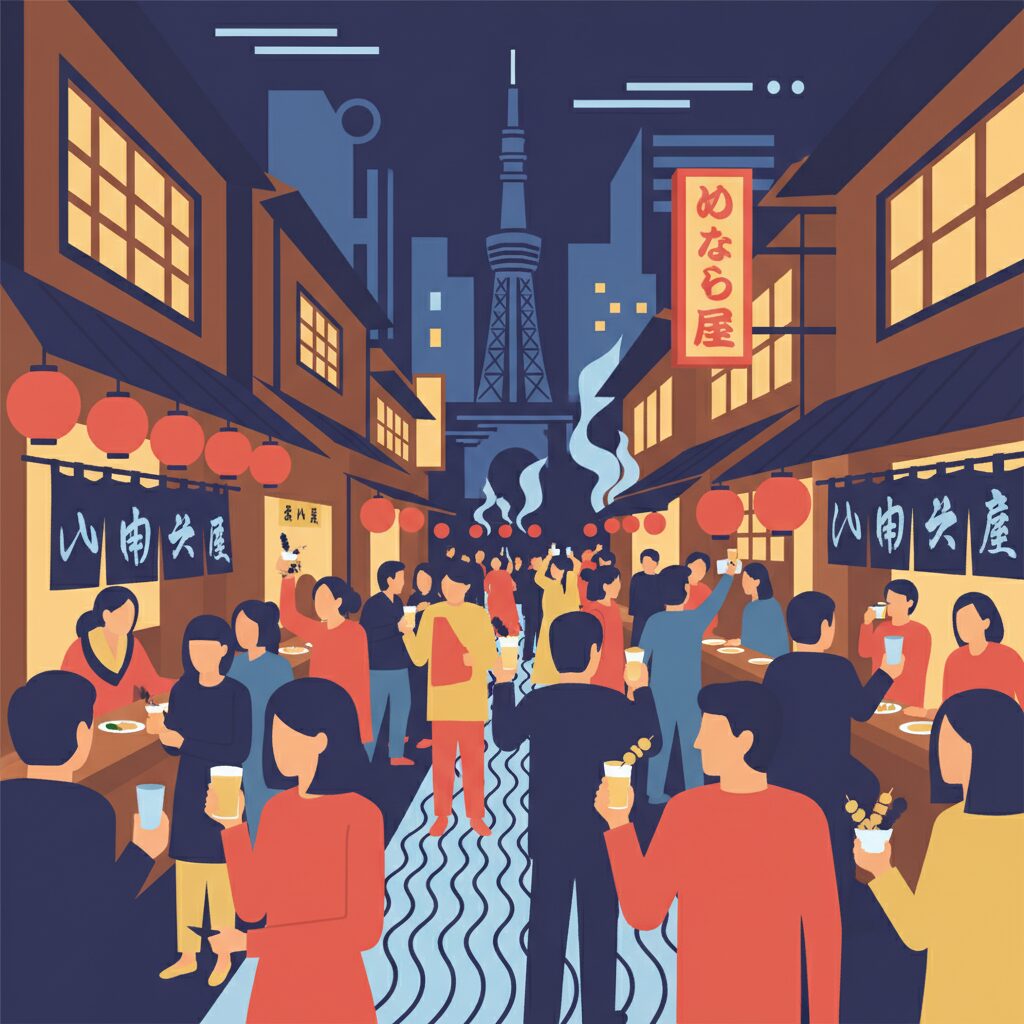
Hey everyone, Sofia here! Let’s talk about a scene you’ve definitely witnessed if you’ve spent any time wandering through Osaka after 5 PM. You’re walking down a narrow shotengai, maybe in the electric maze of Tenma or the gritty-cool streets of Kyobashi. You pass a brightly lit doorway with no door, just a plastic curtain. Inside, it’s a crush of humanity. People are packed shoulder-to-shoulder, standing around high counters, glasses clinking, a cloud of delicious, smoky air billowing out into the street. It’s loud, it’s vibrant, it looks like the most fun party in the city. This, my friends, is the tachinomi—the standing bar. Your first thought might be, “Wow, this place is buzzing! I should bring my friends here on Friday!” or maybe, “This looks so authentic and lively, what a great spot for a first date!” And right there, you’d be making a classic, well-intentioned, but culturally catastrophic mistake. A mistake that reveals you’re still looking at Osaka from the outside in.
The tachinomi is not just a bar without chairs. It’s a finely tuned social machine, a cornerstone of daily life that operates on a set of unspoken rules deeply rooted in the Osakan psyche. It’s a place of beautiful, fleeting connections and solo decompression, but it is fundamentally, unequivocally not designed for lingering, for large groups, or for the delicate dance of a first date. Trying to use it for those purposes is like trying to eat ramen with a spoon—you can do it, but you’ll look silly and miss the entire point. To truly understand Osaka, to move from being a visitor to a resident, you have to understand the soul of the tachinomi. It’s where the city’s pragmatism, its transient friendliness, and its unwritten social contracts are all on glorious display. So grab a virtual spot at the counter, and let’s break down why this beloved institution is the solo drinker’s sanctuary and a minefield for the uninitiated.
To truly understand the city’s unwritten social contracts, it’s also essential to learn about the unspoken rules of cycling in Osaka.
The Solo Drinker’s Sanctuary: The Tachinomi’s True Purpose
First and foremost: the tachinomi is designed for one. Its entire structure, both physical and social, is tailored to the individual. Think of it as a pit stop for the soul. In a city that moves relentlessly, the tachinomi provides a vital pause in the long sentence of a workday. It’s the comma between leaving the office and boarding the train home. This isn’t a destination; it’s a transition. The salaryman with his slightly loosened tie, the woman carrying shopping bags, the young creative with a sketchbook—they aren’t there because they’re lonely. They’re there for a purposeful, efficient, and personal moment of respite.
The Glorious Efficiency of Being Alone
In the West, entering a bar alone can sometimes feel like a social act of courage. You might feel a subtle urge to look busy, check your phone, or seem like you’re waiting for someone. In an Osaka tachinomi, that pressure simply disappears. Being alone is the default, the expectation. The space is designed for it. You slip into a narrow gap at the counter, a spot that wouldn’t accommodate two people anyway. You catch the eye of the taisho (the master), order your draft beer and a plate of doteyaki (beef tendon stew) with a simple gesture. It arrives quickly. You eat, drink, and pay. The whole interaction can take less than twenty minutes. It’s a seamless, frictionless experience. This is not about killing time; it’s about making the most of a small window. This reveals much about the Osaka mindset, rooted in a merchant culture where time is money, and efficiency a virtue. Why sit and wait for a server when you can stand, get what you need, and move on? It’s pure practicality.
The Welcome Mat for the “Hitori-sama”
Japan has a wonderful term, “hitori-sama,” which honors the solo individual as a valued customer. While this is true nationwide, Osaka’s tachinomi culture expresses it most strongly. There’s no social stigma attached to drinking alone. In fact, it’s seen as a mark of self-sufficiency, a sign of someone comfortable in their own skin. You are not a patron to be pitied; you are a guest to be served efficiently. The counter itself forms a subtle boundary and a stage. You face the chef, the wall of bottles, the hustle of the kitchen. Your attention is inward, or fixed on the bar’s own theater, not on other customers. This inward-facing design is an intentional choice that makes the solo experience both comfortable and self-contained. You belong to a collective yet remain perfectly anonymous within it. You share the space, but your experience is entirely your own. It’s a beautiful paradox of public solitude.
The Art of the Fleeting Conversation
So if everyone is stopping by for a quick solo drink, why do these places feel so loud and sociable? This is the second layer of the tachinomi experience and where the well-known “friendly Osaka” stereotype gets a much-needed reality check. The friendliness in a tachinomi is genuine, but it’s a particular type of friendliness—transient, low-pressure, and rooted in the shared moment. You’re not forming a lifelong friendship; you’re simply sharing a moment.
Reading the Unspoken Invitation
Mastering the social aspect of a tachinomi means mastering the Japanese art of “kuuki wo yomu”—reading the atmosphere. The bar is a living entity, and its mood can shift instantly. The key is to pick up on subtle signals. Is the person next to you wearing headphones? Give them space. Are they focused on their phone? Same response. But if they catch your eye and nod as your food arrives, or laugh at a joke the bartender makes, that’s a small opening. Any conversation will almost always revolve around the immediate environment: “That looks delicious, what is it?” “Wow, the Hanshin Tigers are actually winning tonight!” “This sake is really good, have you tried it?” It’s a quick exchange, not a deep dive into personal history. The chat lasts a few minutes, maybe until one of you finishes your drink, then it ends. A polite nod, a quiet “osaki ni” (I’m leaving before you), and they disappear back into the city. There’s no awkward swapping of numbers or pressure to connect on social media. The charm lies in its brevity.
How Osaka Banter Differs from Tokyo Reserve
This highlights a distinct cultural difference between Osaka and Tokyo. While Tokyo also boasts excellent tachinomi bars, the vibe tends to be quieter, focusing more on savoring the food and drink. Solo customers usually keep to themselves. In Osaka, there’s a subtle expectation to join in. The staff often act as conductors of this social symphony, teasing regulars, asking newcomers where they’re from, or joking about the day’s news. This creates a shared energy that encourages interaction. The humor often draws on the traditional Osaka manzai comedy style of “boke” (the silly fool) and “tsukkomi” (the quick-witted straight man). A customer might say something slightly silly, and the bartender replies with a playful comeback. Joining this lighthearted back-and-forth shows you get Osaka. It’s a performance of social harmony that’s utterly delightful once you grasp the rhythm.
Why Your First Date Will Fail Miserably Here
Now let’s apply this understanding to a romantic setting. You’ve met someone wonderful and want to share an authentic, cool slice of Osaka life. You suggest going to a tachinomi. Please, I implore you, do not do this. It is a social faux pas of the highest degree, and here’s why.
A Space Lacking Intimacy
The entire atmosphere of a tachinomi is designed to prevent intimacy. First, there is the absolute absence of personal space. You will be physically closer to a random stranger next to you than to your date. You’ll feel their elbow digging into you, overhear every word of their phone call, and even smell their cigarette smoke. Creating a private bubble for just the two of you is impossible. Second, the noise level is often overwhelming. You’ll find yourselves shouting to be heard, leaning in so far you’re practically tasting their drink. This is not the setting for whispering sweet nothings; it’s the setting for ordering another round of fried chicken cartilage. Third, the constant flow of people is incredibly distracting. The door curtain is always fluttering, new patrons squeeze in, and others are leaving. The energy is kinetic, frantic, and scattered — the exact opposite of the focused, calm atmosphere needed to build a connection.
The Unflattering Impression It Gives
Beyond practical concerns, taking a date to a tachinomi sends several unfortunate messages. To a local, it might suggest you’re cheap, since tachinomi are prized for their affordability. It can also imply that you don’t plan to spend much time with them, given the quick in-and-out nature of the place. Most damagingly, it reveals a fundamental misunderstanding of the local culture. It’s like proposing a picnic in a hurricane. You’re showing that you don’t grasp the purpose of the space you’re in. A date is about creating a shared experience, focusing on each other. A tachinomi is about a brief, individual experience that happens in a shared space. These two aims are completely at odds. Save the tachinomi for the third or fourth outing, when you can stop by for a quick pre-dinner drink as part of a larger evening — then it becomes a fun, knowing nod to local culture rather than a disastrous main event.
The Large Group’s Logistical Nightmare
If a tachinomi is troublesome for a duo, it’s a disaster for a group. I’ve witnessed the stunned, deer-in-the-headlights expression on a taisho’s face when a lively group of six tourists attempts to descend upon their tiny bar, which only holds 12 people. It’s a moment of sheer panic, followed by a polite but firm refusal.
The Tyranny of Small Spaces
By definition, tachinomi are small. This contributes to both their charm and business model. Less floor space means lower rent and a more intimate (non-romantic) atmosphere. A group of four already stretches the physical limits of most venues. You’ll block the narrow path between the counter and wall, making it impossible for anyone to reach the bathroom or exit. You’ll be shouting over one another, creating a bubble of noise that overwhelms the entire bar. Rather than contributing to the atmosphere, you’re suffocating it. You become an obstacle, a human dam disrupting the natural flow of customers essential to the bar’s survival.
Violating the unspoken social contract
Even more importantly, large groups fundamentally break the social contract of a tachinomi. The service model relies on quick, individual interactions between staff and customers. Six people all ordering at once, asking questions, and paying separately is a logistical nightmare that halts the entire system. Other solo patrons, there for a quick 20-minute escape, end up waiting and silently fuming. This is a serious failure to “read the air.” In Osaka, being considerate of others in shared public spaces is crucial. By nature, a large group acts selfishly in a tachinomi. While the staff will likely be too polite to ask you to leave, their service will become terse, smiles will disappear, and the atmosphere will thicken with unspoken resentment. You’ll sense it, even if you don’t know exactly why. Regular customers will simply wait for you to leave, releasing a collective sigh of relief the moment your group steps back out onto the street.
Mastering the Tachinomi: Your Unwritten Rulebook
So how can you truly enjoy this remarkable aspect of Osaka culture? By understanding and respecting its unspoken rules. Imagine you’re a guest in someone’s home: you observe, you adjust, and you show respect.
The Graceful Entry and Exit
Don’t just rush in. Pause at the entrance and look for an available spot. Seek out a space clearly meant for one person. Make brief eye contact with the staff; a slight nod is enough to convey your intention. Once settled, be mindful of your belongings. Large backpacks don’t belong on the counter or on the floor where others need to pass. Keep your presence compact. When leaving, do so smoothly. Pay your bill, offer a small nod and a quiet “gochisousama deshita” (thank you for the meal), and exit as unobtrusively as you arrived.
The Art of the Quick Order
These places are busy, and the staff don’t have time for hesitation. Have a rough idea of what you want before reaching the counter. The classics are always reliable: “nama biiru” (draft beer), a highball, or sake. Observe what others are having or simply point to the appealing dishes laid out on the counter. Ordering should be swift and clear. Many tachinomi operate on a cash-on-delivery basis (“kyasshu on” locally), where you place money in a small tray and the staff take payment as you order. Others might run a tab. The easiest way to figure this out is to watch the person next to you for half a minute. Copying them is the best approach.
The Etiquette of Proximity
Your personal space equals the width of your shoulders and the small section of counter in front of you—nothing more. Don’t spread out or lean back. Be aware of your elbows. The aim is to coexist harmoniously in tight quarters. And remember the golden rule: don’t overstay your welcome. The tachinomi isn’t a library or a café. It’s not a place to nurse a single drink for an hour while scrolling through Instagram. The ideal stay is between 20 and 45 minutes. Have one or two drinks, perhaps a couple of small dishes, then make way for others, keeping the lively flow of the place alive.
The Soul of Osaka in a Glass
Ultimately, the tachinomi is far more than just an inexpensive spot for a quick drink. It serves as a microcosm of Osaka itself, reflecting the city’s renowned pragmatism—a vestige of its merchant heritage where everything serves a purpose and efficiency reigns supreme. It’s a place where Osaka’s unique style of friendliness—warm but not intrusive, open yet with clear boundaries—is expressed nightly. Many people mistakenly interpret Osaka’s friendliness as an open invitation to deep, lasting friendships at every turn, but the tachinomi offers a more subtle lesson. It’s about a shared, fleeting humanity—a kindness in recognizing a fellow traveler after a long day, sharing a moment of warmth before continuing on separate ways.
To stand in a tachinomi, enjoy a quick beer and some grilled fish, exchange a few words with a stranger, then vanish—that reveals something profound about the city’s rhythm. It’s a space that values independence while flourishing on casual connection. It’s a culture that has mastered the art of being alone, together. So, find a small corner, order a drink, and listen to Osaka’s heartbeat. You’ll discover more in those twenty minutes than in a week spent touring castles and temples.