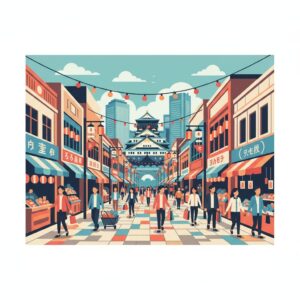
Walk down almost any side street in Osaka after 6 p.m., away from the neon glow of Dotonbori and the polished corridors of Umeda. You’ll see them. A simple sliding door, a fogged-up window, and a single red lantern (`akachochin`) casting a warm, inviting glow onto the pavement. Inside, through the condensation, you can make out a crowd of people packed shoulder-to-shoulder along a wooden counter. There are no chairs. Laughter and the clatter of plates spill out onto the street. This is the neighborhood `tachinomi`, or standing bar, and for many foreigners, it remains a fascinating, slightly intimidating mystery. Is it a private club? A place for a quick, serious drink before the train home? Is it okay for me to just walk in?
The short answer is yes, you should absolutely walk in. Because the tachinomi is not just a bar. It’s the living, breathing heart of workaday Osaka. It’s a hyper-local social hub, a community canteen, and one of the most direct windows into the soul of this city. Forget what you think you know about Japanese formality and reserved public behavior. The tachinomi is where the mask comes off. It’s where you’ll find the city’s unwritten rules of pragmatism, community, and an obsession with quality, all playing out in real-time. It’s a place that explains why Osaka feels so fundamentally different from Tokyo, far better than any textbook or travel guide ever could. To understand the tachinomi is to understand the rhythm of daily life for millions of Osakans. It’s a place for a quick, cheap, and shockingly high-quality meal, but more than that, it’s a masterclass in the city’s culture.
As you uncover the inner workings of Osaka’s neighborhood tachinomi, you might also enjoy experiencing the city’s communal vibe through hyper-local Osaka festivals, where authentic social connections come to life.
More Than Just a Drink: The Tachinomi as a Third Place
Sociologists refer to the “third place”—a space that is neither home (the first place) nor work (the second place). It serves as a crucial anchor of community life, fostering creative social interaction. In many Western cultures, this could be the local pub, a coffee shop, or a community center. In Osaka, the quintessential third place is the neighborhood tachinomi. It is much more than just a simple watering hole; it acts as the community’s shared living room, where social divisions and professional boundaries blend into a harmonious hum of conversation and camaraderie.
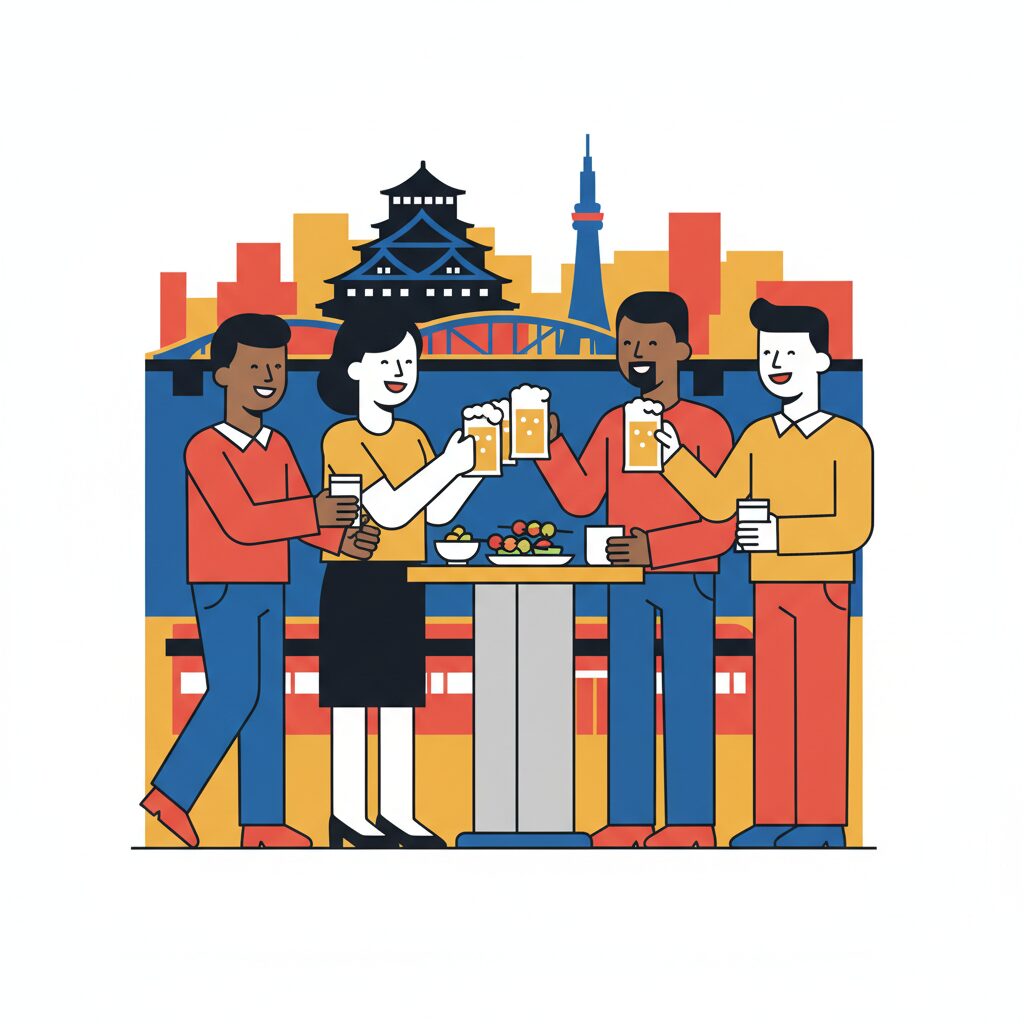
Step inside, and you’ll find a perfect cross-section of the neighborhood. In one corner, a group of `sarariman` in matching dark suits with loosened ties laugh loudly as they unwind after a long day at the office. Nearby stands a solo construction worker in his work clothes, quietly enjoying a beer and a plate of sashimi. A few seats down, two young women, likely local shop or office workers, share a bottle of sake and some tempura. At the end of the counter, a retired gentleman—an old regular—often holds court, leisurely reading a sports newspaper and chatting with the bar’s owner, the `taisho`. This isn’t a staged or trendy scene; it’s the unvarnished reality of the neighborhood’s residents taking a collective pause.
The underlying philosophy is one of transience and ritual. A tachinomi is not meant for a long night out. The average visit lasts between thirty minutes and an hour. It acts as a pit stop on the commute from work to home, a daily marker that separates professional life from personal time. This efficiency reflects a core aspect of Osaka’s character. Why settle in for a two-hour dinner when you can enjoy an equally delicious, more affordable meal and some social interaction in a fraction of the time? The absence of chairs is not merely a space-saving choice; it is a deliberate statement. It encourages movement, preventing anyone from getting too comfortable and monopolizing a spot. This keeps the energy lively and the space open for the next group of commuters heading home.
The Unspoken Rules of the Counter
For those unfamiliar, the controlled chaos of a bustling tachinomi can feel overwhelming. There are no hosts to seat you, no formal menus to hand you, and the etiquette is guided by a set of unspoken rules that everyone seems to instinctively follow. However, once you understand these simple principles, you’ll realize they are all designed to promote fairness, efficiency, and a shared sense of experience.
Space is Social
Personal space is a luxury you must leave behind. You’ll be standing shoulder-to-shoulder with strangers, and that’s exactly the point. This close proximity acts as a social catalyst. It’s almost impossible to ignore the person beside you, breaking down the invisible barriers that usually separate strangers in a Japanese city. You’ll learn the subtle dance of turning slightly to let someone pass behind you, and accepting a plate passed along the counter. You’re not an individual customer at your own table; you’re a temporary but essential part of a single, flowing organism. Avoid spreading out your belongings; keep your bag at your feet and tuck in your coat. Your space is limited to your own vertical column and no more. This shared limitation is the basis of the communal atmosphere.
The Rhythm of Ordering
Most tachinomi run on an unspoken “one drink, one dish” rule, at minimum. It’s not a place to nurse one beer for an hour. The business model—and the social contract—depend on a steady turnover. You order a drink and some food. When finished, you either order more or make room for someone else. This keeps the kitchen busy and the energy lively. Many bars use a `kyasshu on` (cash on delivery) system. You’re given a small tray where you place a few thousand-yen bills. Each order, staff takes the exact amount from your tray. It’s an efficient, transparent system that avoids the hassle of splitting bills or waiting for checks. Built on trust and a pragmatic Osaka spirit, it works beautifully.
Conversation and Connection
While you’re under no obligation to talk, the barrier to conversation is very low. The easiest way to begin is by commenting on the food. A simple “Oishisou desu ne” (“That looks delicious”) to the person next to you about their dish can open the door. The `taisho` (bar manager) is also a key social hub, acting as the conductor of this orchestra, often engaging both regulars and newcomers alike. Don’t be surprised if someone asks where you’re from or jokes about the local baseball team, the Hanshin Tigers. Conversations tend to be light and situational, serving as social glue. It’s the city’s way of letting its guard down.
The Graceful Exit
Perhaps the most important unspoken rule is knowing when to leave—it’s an art of reading the room. If you see a line forming outside or the space behind you getting crowded, it’s time to finish your drink and move on. Lingering is considered poor manners. A graceful exit includes a quick “Gochisousama deshita” (“Thank you for the meal”) to the `taisho` and a slight nod to your neighbors. You pay, gather your belongings, and slip back into the night, freeing your spot for the next person to enjoy their moment of delicious, communal respite.
Why the Food is So Good (and So Cheap)
One of the most frequent sources of confusion for foreigners is how a tiny, no-frills standing bar can serve food that rivals what you’d find in a mid-range restaurant. The explanation lies in the business model and the very mindset of the Osaka consumer. The low overhead costs are crucial. With no chairs, minimal space, and often just one or two staff members, the `taisho` can devote all their resources to what truly matters: the quality of the ingredients.
This directly connects to the `kuidaore` (“eat till you drop” or “eat yourself into ruin”) culture that defines Osaka. Osakans are famously discerning and budget-conscious diners. They have an inherent, unwavering demand for high `kosupa` (cost performance). They refuse to accept mediocre food, regardless of the price. A tachinomi simply couldn’t survive in this competitive environment if its food wasn’t exceptional. It’s a matter of local pride. The `taisho` at these spots are often masters of their craft, demonstrating incredible skill in a tiny kitchen.
Here you won’t find just fried snacks and edamame. The menus are often surprisingly refined and change daily depending on what’s fresh at the market. You can expect immaculate sashimi, rich and savory `doteyaki` (a slow-cooked stew of beef sinew and miso), seasonal vegetable tempura fried to crispy perfection, and delicate grilled fish. It is a full, proper, and deeply satisfying meal. A generous plate of fresh tuna might cost 400 yen, a large draft beer 350 yen. For under 2000 yen, you can leave having enjoyed two drinks and several stunningly good dishes. This isn’t just cheap food; it’s a celebration of culinary excellence in its most unpretentious and accessible form.
Tachinomi vs. Tokyo: A Tale of Two Cities
Tokyo naturally has its own standing bars, often concentrated near major train stations like Shimbashi and Shinjuku, bustling with commuters grabbing a quick drink. However, the experience—the very essence of these places—is fundamentally different. This contrast provides a compelling perspective on the cultural differences between Japan’s two largest cities.
Many Tokyo tachinomi feel more transactional and impersonal. They serve as efficient, no-nonsense stops for fuel. People usually keep to themselves, quietly looking at their phones or speaking softly with a colleague. The main purpose is to offer a quick, affordable drink and snack before the long commute home. While the food can be good, the focus is often more on speed and convenience than on enjoying a shared social experience. It can seem like an extension of the office, only with beer.
Conversely, an Osaka tachinomi feels like an extension of the neighborhood. It’s louder, messier, and decidedly more human. Social interaction is deeply ingrained in the atmosphere. The `taisho` is not just a cook but a community figure. The other customers aren’t obstacles but temporary neighbors. The vibe is filled with a warm, lively energy that is distinctly Osaka. It mirrors the city’s history as a merchant center, where communication, negotiation, and building relationships were crucial for survival and success. In Tokyo, you stand beside people. In Osaka, you stand with them. This subtle but meaningful difference reveals much about the character of each city.
Your First Tachinomi: A Practical Guide
Stepping into a tachinomi for the first time can feel like crashing a private party, but in reality, these places are much more welcoming than they seem. With a bit of knowledge and the right mindset, you can confidently slide that door open.
How to Choose a Spot
As you stroll through neighborhoods like Tenma, Kyobashi, or the backstreets of Namba, watch for the red lantern. A handwritten menu posted outside and the sound of lively conversation inside are good signs of an authentic, local spot. Avoid bars that are completely empty, as that could indicate poor quality. On the other hand, venues packed to the brim with a line outside might be overwhelming for a first-timer. Aim for the perfect balance: a lively, busy spot with just enough space at the counter for you to squeeze in.
Making Your Entrance
Take a deep breath and slide the door open. A simple, friendly “Konbanwa” (Good evening) is the ideal way to begin. Make eye contact with the `taisho` and indicate how many people are in your group. If you’re alone, hold up one finger and say “Hitori desu.” They will direct you to an open spot. Don’t hesitate; you’ll need to gently but confidently move into the space. A soft “Sumimasen” (Excuse me) to those you’re passing is all it takes.
The First Order
This is often where people feel nervous. There might not be an English menu available. See it as part of the experience rather than a problem. Start with the easiest order in Japan: “Nama biru, kudasai” (A draft beer, please). For food, observe what your neighbors are enjoying. If something looks appealing, simply point and say “Are, onegaishimasu” (That one, please). You can also check out the food displayed in refrigerated cases along the counter. Pointing is a universally understood gesture. Safe and delicious choices include `karaage` (Japanese fried chicken), `edamame`, or `doteyaki` if you notice a large pot simmering. The staff won’t judge your Japanese; they appreciate the effort.
The Heart of the Matter: Why It’s So Osaka
Tachinomi is neither a passing trend nor a novelty. It perfectly embodies Osaka’s fundamental cultural values and stands as a testament to the city’s deeply rooted pragmatism—a system crafted for maximum enjoyment with minimal hassle. It represents the passion for `kosupa`, the principle that everyone, no matter their social status, should have access to high-quality food at a reasonable price. Most importantly, it celebrates community and human connection in an increasingly isolated world.
By simply standing at a bustling counter, sharing a dish, and exchanging a few words with a stranger, you engage in a daily ritual that defines the city. It’s a place where the formal hierarchies of Japanese society temporarily fade into a more egalitarian, lively atmosphere. So, next time you spot that glowing red lantern, don’t just pass by. Slide the door open, order a beer, point to something tempting, and immerse yourself in the city’s most genuine, vibrant moments. You’ll gain a deeper understanding of Osaka’s people and enjoy a fantastic meal in the process.