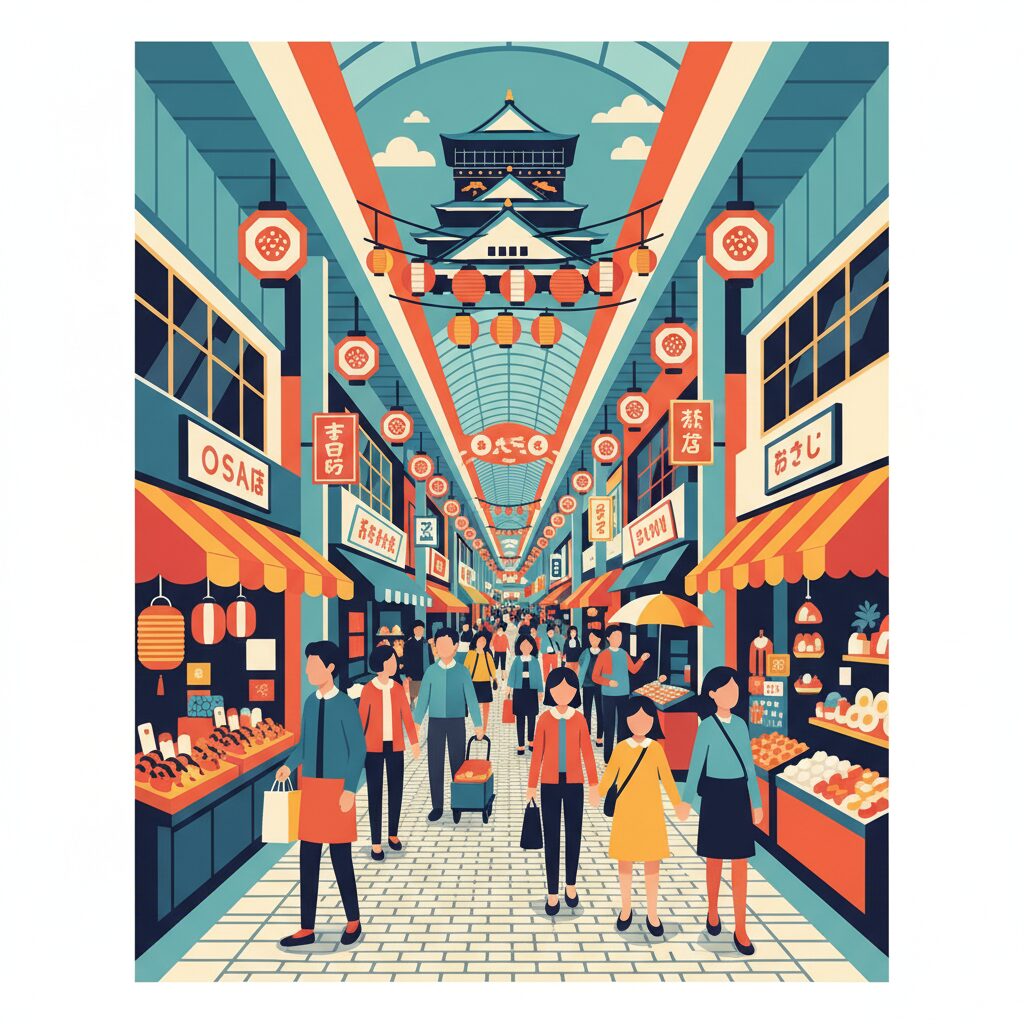
Walk away from the shimmering towers of Umeda, step off the train a stop or two from the neon blaze of Namba, and listen. You’ll hear it. A different kind of urban music. It’s not the hushed efficiency of a Tokyo subway or the serene chime of a Kyoto temple. It’s a symphony of the mundane, a chorus of commerce, a rhythmic, rumbling, wonderfully human noise. It’s the sound of a shotengai, Osaka’s covered shopping arcades, and it’s the truest heartbeat of the city.
For many foreigners, Japan exists in two distinct, polished images: the hyper-modern, Blade Runner-esque cityscape of Tokyo, and the timeless, geisha-in-a-garden elegance of Kyoto. Osaka, wedged between them, often gets defined by what it’s not. It’s not as sleek as Tokyo, not as refined as Kyoto. But to understand Osaka is to understand that it’s not trying to be either. It’s playing a completely different game, and the rules are written, sold, and shouted along the weathered linoleum floors of its shotengai.
These arcades are the arteries of daily life here. They are not mere tourist attractions or quaint relics of a bygone era. They are living, breathing ecosystems where grandmothers buy their daily daikon radish, where shopkeepers banter like old friends, and where the city’s unapologetic, pragmatic, and deeply communal soul is on full display. To grasp the essence of Osaka, you don’t need a ticket to a museum; you need to walk the length of a shotengai.
To truly unpack this, we need a tale of two markets. We’ll journey through Tenjinbashisuji, Japan’s longest shotengai, a 2.6-kilometer-long testament to Osaka’s love affair with the practical. Then, we’ll contrast it with a quick trip on the Hankyu line to Kyoto’s famous Nishiki Market, often called “Kyoto’s Kitchen.” On the surface, they are both markets. But in reality, they are manifestos, each one a perfect reflection of the city that houses it. One is a sprawling, chaotic, comfortable living room; the other is a pristine, curated gallery. And the difference between them tells you everything you need to know about what it’s really like to live in Osaka.
To continue exploring the authentic, communal side of Osaka beyond its shotengai, consider experiencing the city’s local culture through a relaxing sentō-hopping weekend.
The Endless Everyday: A Walk Through Tenjinbashisuji
More Than Just Longest
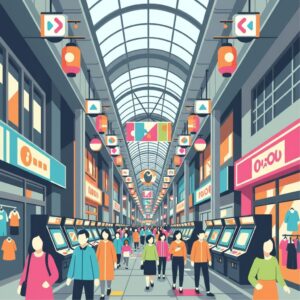
They say Tenjinbashisuji is the longest shotengai in Japan—2.6 kilometers. The number is impressive, but also somewhat misleading. It implies a single, monolithic entity, a marathon of shopping. That’s not the experience it offers. Walking Tenjinbashisuji feels like moving through a series of interconnected villages. Each section, marked by numbered blocks from 1-chome to 7-chome, carries its own subtle character and distinctive rhythm.
The walk starts near Tenmangu Shrine, where the first stretch feels a bit more traditional, a nod to the spiritual anchor at its end. But soon enough, that gives way to the glorious, unpretentious chaos that defines the arcade. The ceiling varies in height and design. The width of the arcade expands and contracts. It isn’t a meticulously planned commercial space; it’s an organic entity that has grown and sprawled over decades, absorbing streets and shops into its covered embrace.
The sights form a collage of the functional. There are no artful minimalist displays here. Instead, you find hand-drawn signs shouting about a sale on eggs, bright red banners announcing a new flavor of senbei (rice crackers). Bicycles—the preferred local mode of transport—are parked at jaunty angles, their baskets overflowing with leeks and toilet paper. Fluorescent lights cast a flat, honest glow over everything, not designed for flattering selfies but for inspecting the freshness of a mackerel.
The Rhythm of Real Life
Look at the shops. This is the key. For every trendy café or souvenir stall, there are twenty shops devoted to the unglamorous essentials of life. There’s the butcher, his white coat faintly pink as he expertly slices pork for tonight’s tonkatsu. Next door, a tiny stall sells nothing but konbu and dried fish, foundational ingredients of Japanese cuisine, heaped high in fragrant piles. There’s the pharmacy—not a slick chain store but a small, cluttered place where the pharmacist knows the local elderly by name and asks about their grandkids.
You’ll find knife sharpeners, stalls selling only tea, bakeries pumping out the sweet scent of melon pan, and grizzled men running tiny hardware stores stocked with every imaginable screw and bolt. This is where you buy your kids’ school uniforms. This is where you get a cheap, hearty bowl of udon for 500 yen at a standing-only counter. This is where a korokke (croquette) stand—a greasy, wonderful institution—sells potato and mince cutlets for 100 yen each. Buying one, wrapped in a small piece of wax paper and eating it as you walk, is a quintessential Osaka experience. It’s not a gourmet indulgence; it’s fuel. A small, affordable pleasure in the midst of a busy day.
This isn’t a place you visit. It’s a place you use. The people rushing past aren’t tourists leisurely strolling; they’re locals on a mission. They have a shopping list. They know which vegetable stand offers the best prices on Tuesdays, and which fishmonger gets the freshest squid. The shotengai is their pantry, their toolbox, their community center, all rolled into one long, covered street.
The Osaka Conversation
Stop and listen. The noise is constant but never jarring. It’s the sound of commerce in its purest form. Shopkeepers don’t wait silently for customers—they call out, their voices a familiar refrain: “Irasshai! Yasukattende!” (Welcome! It’s cheap!). Their shouts are directed at everyone and no one, a continuous vocal energy that keeps the arcade alive.
And when you pause, the interaction is unlike anywhere else in Japan. In Tokyo, service is a model of flawless, polite efficiency. In Kyoto, it’s infused with formal, reserved grace. In Osaka, it’s a conversation. Direct. Personal. Often hilarious.
The woman selling pickled ginger might size you up and ask, “Anata, doko no hito?” (Where are you from?). It’s not an interrogation but an opening gambit. Tell her you live nearby, and her attitude shifts instantly. You’re no longer a tourist—you’re a potential regular. She might even throw in an extra pickle as omake (a small bonus), a gesture that builds a bond.
The butcher might tease you about how much meat you’re buying. The baker might comment on the weather. This isn’t small talk; it’s the social glue of the neighborhood. It’s a performance of familiarity that, over time, turns into genuine connection. They speak Osaka-ben, the local dialect, rich with colorful words like meccha (very) and honma (really). It’s a language that feels warmer, more grounded, and less formal than standard Japanese. It’s the language of the shotengai.
Foreigners sometimes mistake this directness for rudeness. It’s not. It’s a form of intimacy—a way to break down the barrier between customer and vendor, turning a simple transaction into a human interaction. In Osaka, a good deal and a good laugh often come as part of the same package.
Kyoto’s Kitchen: Nishiki Market as a Curated Experience
A Feast for the Eyes (and Instagram)
Now, take that short train ride to Kyoto and step into Nishiki Market. The difference is immediate and striking. The first thing that catches your eye is the aesthetics. Nishiki is stunning. It is overwhelmingly, purposefully beautiful. While Tenjinbashisuji is a chaotic mosaic, Nishiki is a carefully curated gallery of food.
Each stall is a work of art in presentation. Pickles aren’t just piled in barrels; they’re arranged in vibrant, colorful mosaics. Tiny, red baby octopuses are candied and skewered, their heads stuffed with quail eggs, resembling alien lollipops. Fresh yuba (tofu skin) floats in crystal-clear water. Perfectly grilled eel is glazed with a shiny sauce. Everything is crafted to be visually captivating. The lighting is softer and more intentional, bringing out the textures and hues of the food.
The sounds differ as well. The loud calls of Osaka vendors give way to a more respectful murmur. The predominant noises are the clicking of cameras and the admiring gasps of tourists. The aromas are exquisite—the subtle fragrance of high-quality dashi, the sweet scent of matcha from a nearby tea stall, the fresh, briny smell of oysters. It’s a feast for the senses, but a refined, controlled one.
Nishiki is famous for tabe-aruki—eating while walking. The shops cater to this with single-serving portions on sticks: a skewer of grilled scallops, a perfect square of tamagoyaki (rolled omelet), a single fried fish cake. Each is a perfect, bite-sized, photogenic sample of Japanese cuisine.
The Tourist Transaction
Engaging with a vendor in Nishiki, the interaction is pleasant, polite, and professional. They explain ingredients patiently. They package your purchase with care. They thank you with a graceful bow. It is the pinnacle of Japanese omotenashi (hospitality). Yet, it is almost always a transaction. It lacks the playful, personal banter of Osaka. You are a respected customer, an honored guest. You are not, however, a neighbor.
Then there are the prices. Nishiki is pricey. A single, flawless skewer of wagyu beef might cost 1,000 yen or more. The beautifully arranged pickles come at a premium. You’re not only paying for the food; you’re paying for the Kyoto brand, the artistry, the experience of being in Nishiki Market. It’s a classic case of value versus price. Osaka shotengai focus on delivering great value for daily life. Nishiki Market offers a premium experience for special occasions or tourists’ itineraries.
The key question is this: Do Kyoto locals do their weekly grocery shopping here? For the most part, the answer is no. They might come for a specific, high-quality ingredient for a special meal—a certain type of fish or a rare vegetable. But for everyday needs? They shop at local, less glamorous supermarkets or smaller shotengai, places more reminiscent of Tenjinbashisuji. Nishiki has become a victim of its own success; it has shifted from being Kyoto’s kitchen to a showroom of Kyoto’s kitchen.
The Shotengai Mindset: Why Osaka Breathes Through These Arcades
Practicality Over Polish
The contrast between Tenjinbashisuji and Nishiki is not a judgment but an explanation. It reveals the fundamental difference in the mindset of the two cities. Kyoto’s culture is deeply rooted in its imperial history, valuing aesthetics, tradition, and formality. It presents a polished, beautiful face to the world, with Nishiki Market embodying that spirit perfectly.
Osaka, by contrast, is a city of merchants. It has always been a hub of commerce, industry, and trade—people making, selling, and moving goods. Its culture prizes pragmatism, efficiency, and a good bargain above all else. While polish is appreciated, practicality is paramount. Tenjinbashisuji stands as the cathedral of this philosophy. Its beauty lies not in appearance but in function. It is an ideally designed system that supports the daily lives of thousands affordably and efficiently. It exudes a strong sense of seikatsu-kan—the tangible feeling of lived daily life. It’s messy, loud, slightly worn at the edges, and yet it functions beautifully.
Put simply: Nishiki Market is like the formal guest parlor (zashiki) of a traditional Kyoto home—immaculate, carefully arranged, and intended to impress visitors. Tenjinbashisuji is the bustling, somewhat cluttered kitchen and living room (daidokoro and ima) of an Osaka family home—the place where the real work happens, where the family gathers, and where life unfolds in all its unvarnished reality.
“Moukarimakka?” – The Spirit of Commerce
In Osaka, there is a classic greeting that often puzzles people from other parts of Japan: “Moukarimakka?” Literally, this means, “Are you making a profit?” To someone from Tokyo, the question can seem shockingly direct or even rude. Yet in Osaka, it’s a common greeting among business owners, as casual as “How are you?” The usual response is “Bochi bochi denna,” meaning something like “So-so, can’t complain.”
This exchange offers a glimpse into the Osaka spirit. Business here isn’t a cold, corporate affair; it’s a vital part of life, a shared struggle, and a common language. Shop owners are not salaried employees of large companies but entrepreneurs—often second or third-generation family business owners. Their survival relies on their skill, hard work, and, above all, their relationships with customers.
This breeds fierce loyalty. People do not shop at the shotengai just because prices are low; they shop because they know Mr. Tanaka at the fish stall who always offers the freshest cuts, or Mrs. Sato at the vegetable stand who saved the last bundle of good spinach. It’s a deeply human, reciprocal economic system where the price reflects not just the product but also the banter and the continuation of a community. This is why these arcades withstand the pressure from giant supermarkets and online retailers—you cannot get omake (extra favors or gifts) from a website.
What Foreigners Misunderstand
A common misconception foreigners have about Osaka is that it is loud, brash, or even aggressive compared to other parts of Japan. This is only a surface-level interpretation. The shotengai invites you to see it differently.
The loudness is not aggression but engagement—a city eager to communicate, include, and connect. The obsession with getting a good price (negi-ru, or haggling, still practiced in some places) isn’t about being cheap but about a shared appreciation for the value of money and hard work. The apparent chaos of the shotengai doesn’t indicate neglect but rather a space prioritizing function over decoration.
Osaka doesn’t feel the need to adopt the refined airs of Kyoto or the cool professionalism of Tokyo. It is unapologetically itself—a city that works, eats, laughs, and lives openly. The shotengai is the stage for this daily drama, and understanding it is key to understanding the city.
Beyond the Big Two: Finding Your Own Shotengai
The Hyper-Local Heartbeat
Tenjinbashisuji is the longest and most famous, but it is only one among hundreds of shotengai in Osaka. Every neighborhood, every cluster of residential blocks, seems to have its own. They may be shorter, quieter, and more specialized, yet they serve the same essential purpose.
There’s Kuromon Ichiba, which, like Nishiki, has become a popular tourist destination known for its amazing seafood, while still maintaining a core role for local chefs and residents. Then there’s Shinsaibashisuji, a more modern, commercialized area filled with chain stores and fashion boutiques, attracting a younger crowd. But the real charm lies in those you’ve never heard of.
Pick a random stop on a local train line, like the Tanimachi Line or the Midosuji Line. Get off, walk a few blocks, and you will almost certainly come across one. It might only be about a hundred meters long, with just a dozen shops: a tofu maker, a rice seller, a tiny barber, a stationery store. These hyper-local arcades are the true capillaries of the city’s circulatory system. They are even more intimate than Tenjinbashisuji. Here, shopkeepers don’t just know their regular customers; they know their entire life stories.
Your Ticket to Belonging
For any foreigner considering living in Osaka, my single most important piece of advice is this: find your local shotengai and become a regular. It’s the quickest and most genuine way to become part of your community.
At first, you will be a stranger, a new face. But visit the same fruit stand every week. Buy tofu from the same elderly woman. Get your bread from the same small bakery. Try to use a few words of imperfect Japanese. Smile. Be consistent.
Something extraordinary will happen. One day, the fruit vendor will see you approaching and say, “The good strawberries are in today! I saved some for you.” The tofu maker will ask how you liked the atsuage (thick fried tofu) you bought last week. The baker will know your usual order before you even say a word.
At that moment, you will no longer be just another anonymous foreigner. You will become part of the neighborhood’s delicate social fabric. You will have a place. That feeling of recognition, of casual belonging, is something you will never experience in the sterile aisles of a 24-hour supermarket. It’s a small thing, but in a foreign country, it feels monumental. It feels like home.
More Than a Roof, It’s a Relationship
Ultimately, the covered roof of a shotengai is more than mere shelter from the sun and rain in Osaka. It stands as a symbol—an architectural feature that creates a shared space, a communal corridor uniting individual shops into a unified whole. It transforms commerce into community.
A tourist strolling through Kyoto’s Nishiki Market might think, “This is beautiful Japanese food.” They snap a photo, savor a skewer, and enjoy a polished, idealized slice of Japanese culture. Meanwhile, a local walking through Osaka’s Tenjinbashisuji thinks, “I need some potatoes for dinner, and I should check if the butcher still has that cheap mince.” They chat, get a small discount, and engage in the authentic, unfiltered, everyday life of their city.
So, if you truly want to understand Osaka—beyond the clichés—and see how this lively, practical, and deeply human city actually operates, set the guidebook aside. Find the nearest shotengai. Walk its full length. Don’t just observe. Listen to the conversations. Watch the interactions. Smell the frying oil and fresh fish. And for heaven’s sake, buy a hot, greasy korokke for 100 yen.
In that simple, savory morsel, you’ll taste something more genuine than any multi-course kaiseki dinner. You’ll be savoring the flavor of daily life in Osaka. You’ll be tasting the honest, unapologetic, and wonderful soul of the city itself.