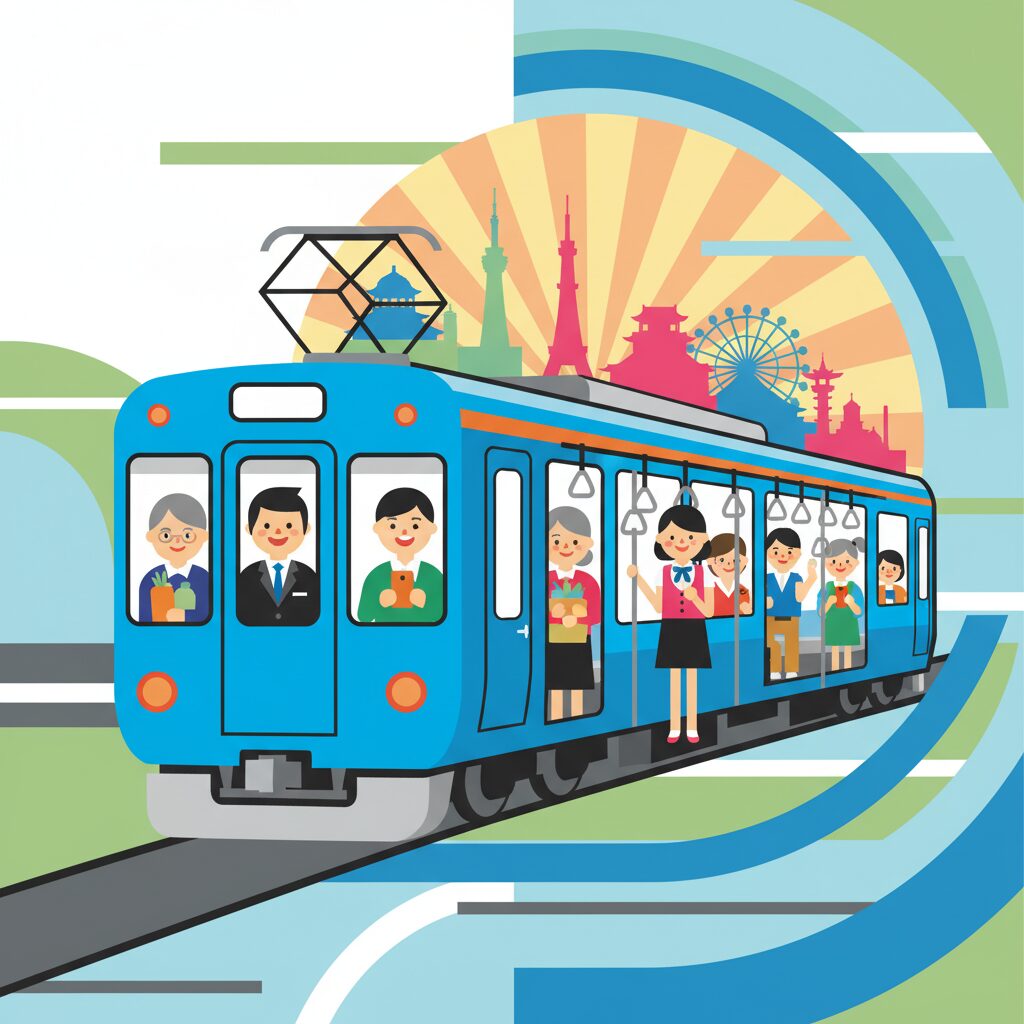
I remember my first time on the Osaka Loop Line. It was a Tuesday afternoon, a jarring transition after a week spent in Tokyo’s hushed, orderly embrace. In Tokyo, the Yamanote Line felt like a mobile library, a silent, circulating vessel where the loudest sounds were the automated announcements and the collective, soft tapping on a million phone screens. It was a space of profound, shared invisibility. You could ride for an hour pressed against a stranger and never once acknowledge their existence. It was the art of being together, alone. And then, there was Osaka. The moment the doors slid open at Tennoji, a wave of sound washed over me. Not just the clatter of the train on the tracks, but the sound of life itself. A group of high school girls were laughing, their voices bright and uninhibited. Two older men in work jackets were having a spirited debate about the Hanshin Tigers. A mother was patiently explaining something to her child, her tone conversational, not a frantic shush. Someone’s phone rang, and they answered it. They actually answered the call. It was a short, clipped conversation, but it happened. In that moment, the sterile, predictable world of Japanese public transport I thought I knew was completely upended. This wasn’t a library; it was a moving community hall, a rolling town square. It wasn’t rude or chaotic, not really. It was just… human. This single train ride became a Rosetta Stone for understanding Osaka itself. It revealed a city that operates on a different social frequency, one that prioritizes a raw, unvarnished humanity over the pristine, performed harmony of its eastern and northern neighbors. For anyone looking to live here, to truly understand the rhythm of this city, the train is your first and most important classroom. It’s where you see the unspoken rules of Osaka play out in real-time, a daily drama of personal space, public voice, and a social contract written in invisible ink.
To truly master this daily drama, you must also learn the city’s other unspoken rules, such as standing on the right side of the escalator.
Tokyo’s Mobile Monastery: The Art of Invisibility
To truly understand what sets Osaka’s trains apart, you must first immerse yourself in the profound silence of Tokyo’s. Riding the subway or JR lines in the capital serves as a masterclass in collective social discipline. It’s not just quiet; it’s a carefully constructed and sustained state of non-existence. The social contract is straightforward and absolute: you must not impose your presence on anyone else. Your voice, music, conversations, and physical presence—all must be minimized to near invisibility.
This begins with the sacred rule of silence. Phone calls are the greatest breach. Even having your ringer on is a minor offense. Seeing someone actually speak on their phone in a crowded train is so rare it feels like a tear in reality’s fabric. When it happens, it is met with a wave of silent, sharp judgment. Glances are exchanged, eyes narrow. The pressure is immediate and intense. This goes beyond politeness; it is a core pillar of navigating a city of nearly fourteen million people. To maintain sanity and order, everyone must retreat into their personal bubble, protected by unspoken agreement. Conversations between passengers are equally rare and, when they do occur, happen in hushed, conspiratorial whispers, as if sharing secrets of state.
The physical experience of a Tokyo train ride is a ballet of avoidance. People line up on the platform in perfectly straight, orderly queues, embodying a shared belief in process. They wait for every last person to disembark before boarding. Once inside, every effort is made to avoid contact. Backpacks are swung to the front to prevent accidental bumps. If you need to pass, you perform the “sumimasen shuffle,” a delicate, apologetic movement through the crowd, with your hand raised in preemptive apology. Eye contact is avoided at all costs. The goal is to become a ghost, an anonymous commuter sharing space without truly occupying it.
The prevailing mindset emphasizes harmony through non-interference. In Tokyo, being a good citizen on the train means being unnoticeable. It’s a display of consideration, a daily ritual where millions agree to erase their individuality for the duration of their commute for smooth, efficient, and stress-free transit. It’s a survival strategy for a hyper-dense urban environment. You respect others by pretending they don’t exist, and they return the favor. This creates a serene, almost meditative atmosphere, but also one that can feel cold and impersonal, a stark contrast to the warm, vibrant energy found just a few hours west.
Kyoto’s Whispering Corridor: A Study in Understated Pressure
If Tokyo’s trains resemble a silent monastery, Kyoto’s resemble a traditional tea room in motion. The atmosphere is completely different, yet the expectation of quiet remains. It’s not the stark, utilitarian silence of Tokyo, born out of necessity and efficiency. Rather, it is a deliberate, attentive quiet, imbued with centuries of aesthetic and social codes. It’s less about avoiding intrusion and more about preserving a certain public grace, or hin.
On a Kyoto train, especially the refined, maroon-colored Hankyu line connecting Osaka and the ancient capital, you sense that you are being observed. The pressure isn’t forceful; it’s a gentle yet firm social expectation. A loud laugh or a rowdy conversation from tourists doesn’t merely break the silence; it feels like a breach of decorum, akin to wearing muddy boots into a pristine temple. The reactions are not the sharp, irritated glares of a Tokyo commuter whose calm has been disturbed. They are more subtle, more powerful: a slow turn of the head, a look of mild disappointment, a quiet sigh. It’s a social signal that you have failed to honor the unspoken atmosphere of refined composure.
Conversations do occur but are held in low, measured tones. The volume is self-regulated. It’s not about being invisible, as in Tokyo, but about presenting a polished, deliberate public self. Kyoto’s culture is famously rooted in the concepts of omote (the public face) and ura (the private reality). On the train, you inhabit the realm of omote. Your posture, your voice, the way you hold your belongings—all contribute to a performance of social awareness and quiet dignity. There’s a strong sense that one should never be yabai or common.
This is why Kyoto can feel even more daunting for foreigners than Tokyo. In Tokyo, the rules are straightforward and impersonal: be quiet, take up no space. In Kyoto, the rules are more subtle and aesthetic. It’s about sensing the mood, understanding that your behavior shapes a shared atmosphere of understated elegance. The silence on a Kyoto train isn’t empty; it carries the weight of cultural expectation. It’s a beautiful, if somewhat unnerving, experience—a moving corridor where the city’s deeply ingrained values of beauty, order, and social harmony are quietly yet firmly maintained.
Welcome to the Osaka Rumble: The Unspoken Rules of Getting Real
And then you arrive in Osaka. Boarding a train here, especially during the bustling evening hours on the Midosuji subway line or the JR Loop Line, feels like stepping into a completely different world. The carefully maintained silence of Tokyo and the elegant quiet of Kyoto disappear, replaced by the lively, chaotic, and unapologetic sounds of everyday life. At first, it may seem like disorder, a complete breakdown of the Japanese manners you’ve diligently learned. But it’s not disorder—it’s simply a different system, governed by its own intricate and deeply rooted unspoken rules.
The Myth of “No Rules”: It’s Just a Different Language
A common misconception among foreigners is assuming that because Osaka’s trains are noisy, there are no rules. This couldn’t be further from the truth. The social contract on an Osaka train is just as strong, but it rests on a different set of values. The primary aim is not silent, smooth transit. Instead, it strives for pragmatic, human-centered functionality, designed to accommodate real life—that people converse, children make noise, friends laugh, and that life doesn’t pause between stops. Osaka’s rules focus less on preventing every disturbance and more on judging intent. The key question isn’t “Are you making noise?” but “Are you being inconsiderate?” This subtle but vital distinction unlocks the understanding of everything that follows.
The Volume Dial: Conversations, Laughter, and the “Akan” Line
This is the most apparent difference. People talk—on their phones, to each other, across the aisle. But there are levels. A brief, necessary phone call—“I’m on the train, I’ll be there in five”—is perfectly acceptable. No one will notice. However, a long, loud, personal conversation will start to draw annoyed glances. You’ve crossed a line. Similarly, friends chatting and laughing after a day out is a normal, expected part of the train’s soundscape, adding to the city’s energy. But a shouting match or obnoxious drunken yelling is akan—unacceptable. The boundary is marked by meiwaku, the idea of being a nuisance to others. In Tokyo, almost any noise is seen as potential meiwaku. In Osaka, meiwaku is tied more to the impact and intent of behavior. Are you sharing a joyful moment with friends, or selfishly forcing everyone to listen to your drama? Osakans instinctively sense this difference. They tolerate the noise of everyday life but have very little patience for deliberate selfishness.
The Physical Space: A Contact Sport with a Smile
The delicate boarding choreography of Tokyo is absent here. Especially during rush hour, boarding a Midosuji line train feels like a fluid, fast-paced scrum. The unspoken rule is not to wait for a perfectly clear path. As some people shuffle off, others are already moving on. It’s a dance of mutual, understood impatience. The goal is to get everyone on and off the train quickly, and a bit of organized chaos proves most efficient. Waiting patiently on the side might mean missing your train.
Personal space is more flexible. You will be bumped. You will be leaned on. An obachan (an older, often feisty woman) might steady herself on your arm without hesitation. This isn’t aggression—just a practical response to crowded conditions. In Tokyo, a bump demands a deep, apologetic bow. In Osaka, a bump is met with a quick “Gomen!” (Sorry!) or “Suimasen!” and an equally quick “Iie, iie” (No, no, it’s fine), and then it’s forgotten. There is a shared understanding that in a crowded city, incidental contact is unavoidable. It’s this forgiving spirit that defines the Osaka style—a relaxed acceptance of human imperfection.
Eating, Drinking, and the Aroma Test
Though eating is officially discouraged on most Japanese trains, rule enforcement varies widely. In Osaka, eating on trains is more common but governed by a specific, sensory guideline: the aroma test. Sipping a can of beer or a bottle of tea is totally acceptable. Eating a simple, odorless onigiri or a piece of bread discreetly will likely go unnoticed. However, opening something with a strong, invasive smell is a serious faux pas. Unwrapping a steaming pork bun from 551 Horai or opening pungent takoyaki is the ultimate sin. The rule isn’t about eating itself; it’s about not forcing your sensory experience on others. You can quietly enjoy your own snack, but you cannot impose the carriage’s shared air with your food’s aroma. This perfectly captures the Osaka mindset: your personal business is fine, so long as it doesn’t become everyone else’s problem.
The Heart of the Matter: Prioritizing “Ningenmi” (Human-ness)
Why are the rules so different? It comes down to a cultural value Osaka deeply cherishes: ningenmi, or human-ness. This term embraces warmth, personality, directness, and a touch of charming imperfection. Osaka’s culture, born from commerce and trade, values straightforwardness, practicality, and authenticity over polished politeness. The city operates with less concern for flawless appearances and more for genuine—if sometimes messy—human connection.
The train, then, is not a sterile capsule for moving bodies from point A to point B. It’s a public space where life continues. It reflects a city that allows its residents to be themselves. You don’t have to wear a mask of stoic silence. You can be tired, happy, and talkative. There’s a fundamental belief that a little noise and a bit of mess is the price paid for a city with a vibrant, beating heart.
Case Studies: A Tale of Three Train Lines
To witness these cultural philosophies in practice, one need only ride three distinct train lines, each serving as a perfect microcosm of its city’s essence.
The JR Yamanote Line (Tokyo): The Silent Circle
A rush hour trip on the green-striped Yamanote Line, which continuously loops around central Tokyo, offers an almost spiritual experience in collective self-discipline. Platforms are marked with exact spots for each carriage door, and commuters line up with military precision. Inside, the train is packed to an almost impossible density, yet the dominant feeling is one of deep silence. The soundtrack consists of the gentle hum of the train, the steady clatter on the tracks, the soothing female voice announcing the next stop, and the nearly inaudible tap-tap-tap of countless thumbs on smartphone screens. The sea of dark suits and muted clothing creates a visual uniformity. The passengers resemble a community of ghosts, masters of occupying space without disturbance. The journey is impeccably efficient, sterile, and entirely impersonal.
The Hankyu Kyoto Line: The Velvet Rope
Riding the Hankyu line from Osaka-Umeda to Kyoto-Kawaramachi feels like an elevated experience. The train cars boast plush, golden-olive velvet upholstery, and wood-grain paneling that evokes old-world elegance. The passengers seem to embody this atmosphere. There’s a quiet, composed mood. People read quietly. Conversations are rare and subdued. The vibe is less about Tokyo’s practical silence and more about a shared appreciation for calm, orderliness, and aesthetic refinement. It’s a journey where you instinctively check your posture and temper your voice. The Hankyu line is not merely transportation; it’s a 30-minute rendition of the Kyoto ideal—graceful, understated, and ever-conscious of appearances.
The Osaka Loop Line / Midosuji Line: The Rolling Izakaya
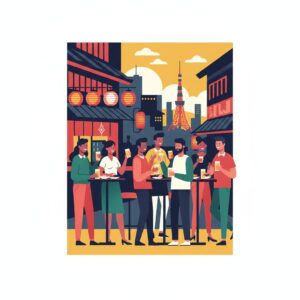
A Friday evening ride on the bright red Midosuji subway line or the orange Osaka Loop Line is a full sensory dive into the city’s spirit. The sound hits first: a cacophony of laughter, overlapping conversations, music leaking from headphones, and cheerful announcements. Then come the smells: a blend of department store perfume, street food clinging to coats, and the faint but unmistakable scent of beer. Groups of friends gather, sharing stories from their week. A salaryman might be dozing, his head resting on his neighbor’s shoulder, who remains unbothered. There’s a dynamic, kinetic energy in the space. It’s crowded but relaxed. It’s loud but never hostile. It feels like a true public space—a place where the city’s diverse inhabitants come together, not to isolate themselves, but to share a noisy, vibrant, and deeply human experience.
What This Means for You, the Foreign Resident
Grasping this train culture is essential to understanding how to live in Osaka. It serves as a daily indicator of the city’s social norms and a guide to navigating its distinctive character.
For those used to the quiet customs of Tokyo or the reserved demeanor of many Western cities, Osaka’s trains can feel initially overwhelming. The noise and close quarters might be mistaken for rudeness or a lack of consideration. However, the key is to shift your perspective. It’s not about the absence of rules; it’s a different set of guidelines. The tolerance for noise reflects not disrespect for others, but respect for the complex reality of human life. The emphasis is on a more forgiving, adaptable kind of social harmony.
Living in the Kansai region teaches you the skill of code-switching. You learn to read the atmosphere, or in this case, the train car. When boarding the Shinkansen to Tokyo, you instinctively lower your voice and hold your bag in front of you. On a day trip to Kyoto, you absorb the calm ambiance and behave accordingly. And when you return home to Osaka, you can relax, breathe out, and feel the city’s lively, chaotic energy embrace you. Here, perfection isn’t expected; you just need to be a reasonable human being.
A common misconception is that Osaka is somehow “less Japanese” than Tokyo. It is not. Rather, it expresses its Japanese identity through a different cultural lens—one that values honesty over harmony, directness over formality, and ningenmi over perfection. A crying baby on a Tokyo train may provoke cold looks of disapproval. In Osaka, such a child is more likely to receive a sympathetic smile from an elderly woman who might even offer candy. That small moment reveals everything you need to understand. In Osaka, the train is not an escape from the city; it’s a place to experience it at its most raw, vibrant, and genuinely human.