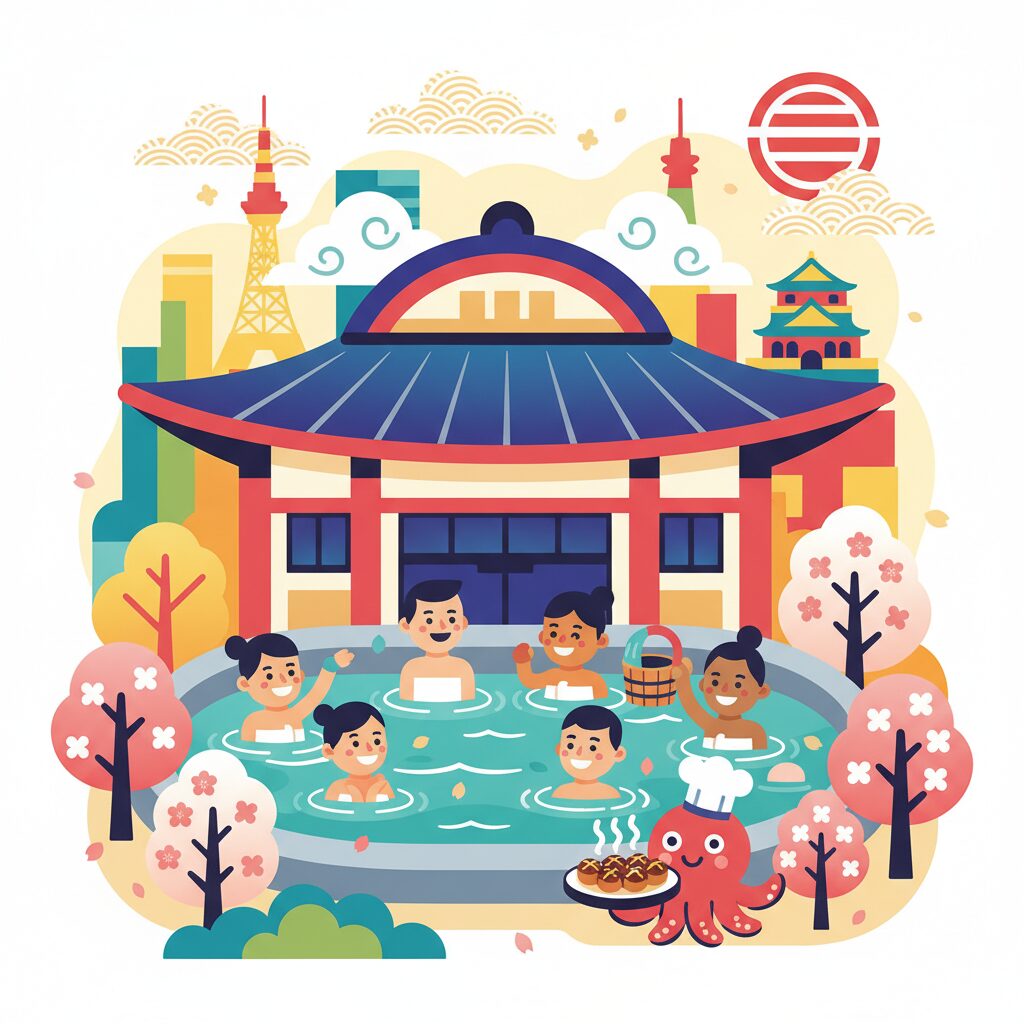
The first time you walk into a neighborhood sento in Osaka, your senses get a shock. It’s not the steam, though it hits you like a warm, wet blanket. It’s not the clatter of plastic stools on tiled floors or the distinct, clean scent of soap and cypress. It’s the noise. A cheerful, unrelenting, rolling wave of human conversation. Men and women, separated by a high wall but united in spirit, calling out greetings, laughing, debating the Hanshin Tigers’ latest game, their voices echoing off the high ceilings and the majestic mural of Mount Fuji. It feels less like a bath and more like a party you’ve stumbled into, a party where everyone happens to be naked. This is the moment you realize that in Osaka, a bathhouse isn’t just a place to get clean. It’s the neighborhood’s living room, its social epicenter, its beating, steaming heart. And understanding this place is the key to understanding the city itself.
For many foreigners arriving in Japan, the cultural image is one of quiet reserve, of polite distance and unspoken rules. We learn to navigate the subtle dance of social interaction in Tokyo, where silence in public spaces is often a golden rule. But Osaka operates on a different frequency. Here, connection is currency, and friendliness isn’t a performance; it’s the default setting. The local sento is the ultimate expression of this ethos. It’s a space that strips away everything—your clothes, your job title, your social standing—and leaves you with nothing but your shared humanity. It’s where the city’s unwritten social codes are on full display, offering a raw, honest, and deeply immersive lesson in what it truly means to live in Osaka. This isn’t about sightseeing; it’s about life-seeing. It’s about pulling back the curtain on the daily rhythms and attitudes that make this city so profoundly different, so wonderfully, chaotically human.
To further explore how this culture of connection extends to other social settings, consider learning about managing dietary restrictions at an Osaka nomikai.
More Than Just a Bath: The Unspoken Social Contract
In a city where private bathrooms have been standard in most homes for decades, the continued presence of the public bathhouse may seem like a charming anachronism—a relic from a past age. But viewing it that way misses its true purpose. The Osaka sento isn’t about a shortage of home facilities; it addresses a social need that a private, sterile bathroom can never fulfill. It functions on an unspoken social contract, a collective understanding that this space prioritizes community over hygiene. It’s a place to unwind from the day’s stresses, yes, but also a place where neighborhood bonds are strengthened. When you pay a few hundred yen at the entrance, you’re not just buying access to hot water; you’re purchasing a ticket to engage in community life.
“Hadaka no Tsukiai”: The Great Equalizer
A beautiful Japanese concept perfectly embodies the social role of the sento: hadaka no tsukiai, or “naked communion.” This idea suggests that when you shed your clothes, you also shed social barriers like status, profession, and wealth. In the warm, egalitarian environment of the bathhouse, the CEO and the construction worker, the shopkeeper and the student, meet as equals. They are neighbors, united by their shared vulnerability and mutual pursuit of comfort and relaxation. This principle forms the foundation of the Osaka sento experience and offers insight into the spirit of the city.
In Tokyo, social distance is generally maintained, but in Osaka, those boundaries blur immediately. You might see a man covered in full-body tattoos—who could seem intimidating on the street—chatting amiably about cabbage prices with a frail elderly gentleman. You’ll overhear a man in his twenties asking a middle-aged neighbor for advice on fixing a leaking faucet. Such interactions rarely, if ever, happen in the structured, hierarchical world outside. The shared nakedness acts as a potent social lubricant, breaking down inhibitions and fostering a level of honesty and openness rarely encountered elsewhere. It’s in these moments that you realize Osaka’s renowned friendliness isn’t just casual chatter; it stems from a deep-rooted belief in shared humanity, a belief continuously practiced and renewed daily in the warm waters of the local sento.
The traditional sento’s layout reinforces this dynamic. There are no private stalls or hidden corners. Washing stations line the open space, large communal tubs invite everyone, and the sauna is often a small, crowded room where you’re nearly shoulder-to-shoulder with strangers. This is no design flaw; it’s intentional. The space is crafted for interaction—accidental eye contact becomes a nod, a nod leads to conversation, and conversation blossoms into connection. It is the great equalizer, a place where the community sees itself, stripped down and genuine.
The Rituals of Arrival and Departure
The sento’s social contract begins the moment you slide open its entrance door. At the front desk, you’re met not by a faceless ticket machine but by the bandai-san, who oversees both men’s and women’s changing rooms from an elevated seat. Often an older man or woman from a family that has operated the bathhouse for generations, the bandai-san serves as gatekeeper, information center, and the establishment’s heart.
This exchange is more than just a transaction. As you hand over your coins, you greet the bandai-san with a “Konnichiwa” or “Kombanwa.” After a few visits, they’ll recognize you, offering a familiar nod or comment on the weather. They know the regulars by name, who’s been ill, whose daughter recently had a baby, and who can recommend the best takoyaki nearby. They are the living social registry of the neighborhood.
Inside the changing room, the rituals continue. You find an empty locker or a wicker basket for your clothes, joined by a steady chorus of greetings as people come and go. An “Otsukaresama desu” (“Thank you for your hard work”) is exchanged among neighbors returning from work. A “Gokurosama” is offered to elders. These aren’t hollow pleasantries but affirmations of presence and shared experience. They are small verbal threads weaving the social fabric of the room. When leaving, warm and relaxed, you call out “Osaki ni” (“Excuse me for leaving first”) to those still soaking, and receive a chorus of “Otsukare” in reply. It’s a simple, beautiful ritual that strengthens the sense of belonging to a temporary family of bathers, who will gather again the next day.
The Osaka Sento vs. The Tokyo Sento: A Tale of Two Cities
To truly grasp the unique character of an Osaka sento, it helps to have a point of comparison, and there’s no better contrast than the sento of Tokyo. While both serve the same basic purpose, their atmospheres can differ drastically, reflecting the deep-rooted cultural distinctions between Japan’s two major cities. Visiting a sento in each city is like hearing two distinct types of music: one a quiet, ambient meditation, the other a lively, improvisational jazz performance.
The Sound of Silence vs. The Buzz of Conversation
The most noticeable and immediate difference is the sound. Many Tokyo sento, especially the more modern or “designer” ones, foster an environment of serene calm. They are spaces for introspection and quiet reflection. People usually keep to themselves, immersed in silence, their expressions calm and peaceful. Conversation is rare, often limited to whispered greetings. Prolonged eye contact can feel like a small breach of etiquette. The aim is to escape the city’s noise, retreating into a personal world even within a public setting. Anonymity is considered a form of respect.
Step into an Osaka sento, and the atmosphere changes completely. The air buzzes with conversation. Groups of older women, the obachan, gather in the hottest tub, chatting effortlessly about local gossip, health concerns, and bursting into raucous laughter. In the sauna, men passionately debate the merits of various sumo wrestlers or baseball players, sounding like sports commentators. It’s common for complete strangers to strike up a conversation, asking where you’re from, what you do, and your thoughts on Osaka. Silence is not prized here; instead, it’s a space eagerly waiting to be filled with human interaction. The goal isn’t to escape the city, but to immerse oneself in its community. Here, engagement is a way of showing respect.
This contrast reveals much about the two cities. Tokyo, the political and corporate capital, values order, efficiency, and a certain courteous formality. Its sheer size demands a level of social anonymity for daily functioning. Osaka, a historic merchant city, was founded on relationships, face-to-face negotiation, and the vibrant energy of the marketplace. This spirit endures in its social spaces. Osakans often prefer directness and sincere connection over subtle, unspoken manners. For many locals, a quiet sento would simply be dull.
Community Over Anonymity
This atmospheric difference points to a deeper philosophical divide in how the sento is viewed. In Tokyo, it often feels like a service: you pay for access to quality baths, relaxing music, and maybe a stylish lounge area. It’s a personal wellness experience.
In Osaka, the sento resembles less a business and more a public utility, as essential and taken for granted as a park or library. It’s a piece of community infrastructure. The value lies not just in the hot water, but in the people sharing the space with you. You see familiar faces week after week, and over time, these strangers become a part of your life’s backdrop. You might not know their names, but you know their routines—the elderly man who always arrives at 4 PM, the father bringing his two young sons on Saturday afternoons, the group of women who share a bottle of fruit milk afterward.
This fosters a strong sense of belonging and informal security. It’s the kind of place where if a regular elderly visitor doesn’t show up for a few days, someone will notice and ask after them. The bandai-san might even call to check in. This is neighborhood vigilance in its most natural, unpretentious form—an increasingly rare communal oversight amid the anonymity of modern urban life. The Osaka sento isn’t a place to be alone together; it’s a place to be together, together.
Decoding the Sento Scene: A Foreigner’s Field Guide
For a newcomer, the Osaka sento can feel like embarking on an anthropological expedition. It is a complex social ecosystem with its own unique characters, unwritten rules, and long-standing rituals. Learning to navigate this environment is a rewarding journey that takes you beyond the typical tourist experience and into the authentic, everyday life of the city. Here’s a field guide to help you understand this scene.
The Cast of Characters
After a few visits, you’ll begin to recognize the recurring archetypes—key figures in the sento community. Their presence gives the bathhouse its distinct flavor and character.
The Nushi (The Master): In nearly every sento, there is a nushi, a longtime regular who is practically a permanent fixture. Usually an elderly man or woman, they have been coming to the same bathhouse for 50, 60, or even 70 years. They know every tile crack and every quirk of the boiler. They have their favorite spot at the washing station and their designated seat in the tub. They serve as unofficial historians and custodians of the sento’s culture, commanding quiet respect; their views on everything from politics to water temperature are taken as authoritative.
The Sauna Gundan (The Sauna Brigade): This dedicated group, almost always male, takes sauna-going very seriously. They arrive in groups, sit according to an established hierarchy on the wooden benches, and endure the intense heat with steady resolve. They have mastered the art of the mizuburo (cold plunge pool), entering and exiting with practiced gasps and groans. Their conversations are brief, punctuated by drips of sweat, usually revolving around sports or work. They form a brotherhood forged in extreme temperatures.
The Datsuijo Divas (The Changing Room Divas): This lively group of middle-aged and elderly women (obachan) treat the changing room as their personal salon and clubhouse. Bathing is merely a prelude to the main event: the post-soak gossip session. Lounging on the benches, sometimes for an hour or more after their bath, they share neighborhood news, exchange recipes, watch TV, and offer unsolicited but well-meaning advice to anyone within earshot. Their laughter forms the sento’s primary soundtrack.
The Parent-Child Combo: The sento is often where traditions are passed down. You’ll frequently see young fathers carefully bathing their sons, or mothers with their daughters. It’s a classic bonding experience. The parent teaches the child proper etiquette: how to wash, how to enter the tub quietly, and how to fold their towel neatly. It’s a heartwarming scene that ensures the sento’s culture is carried forward to the next generation.
Navigating the Unwritten Rules (Osaka Style)
Every sento in Japan has basic rules: wash thoroughly before entering the tubs, don’t put your towel in the water, and so forth. However, Osaka adds its own layer of social etiquette that’s important to grasp.
Eye Contact is an Invitation: Unlike many other parts of Japan where direct eye contact with strangers is often avoided, in an Osaka sento, it serves as an opening. A brief glance and a nod are universal signs of acknowledgment. Don’t be surprised if this simple gesture prompts a question like “Atsui desu ne?” (“It’s hot, isn’t it?”). This is your cue—a simple agreement can open the door to conversation.
Curiosity is a Compliment: As a foreigner, you are likely to attract gentle curiosity. People may ask where you’re from, how long you’ve been in Japan, or if you can handle the hot water. This isn’t intrusive; it’s a sign of interest and inclusion. They’re welcoming you into their space by wanting to know your story. Responding openly and warmly will earn you instant acceptance.
Sharing is Standard Practice: The sense of personal property is somewhat relaxed here. If you forget your soap, it’s perfectly fine to politely ask the person next to you to borrow some. If someone needs a bucket and you have an extra at your station, they might take it with a quick nod of thanks. This is part of the communal atmosphere. The key is to be easygoing and go with the flow. Hoarding your shampoo as if it’s a secret will mark you as an outsider.
Don’t Fear the Tattoo: While tattoos are still linked to the yakuza in some conservative areas of Japan, and many gyms and onsen ban them outright, most neighborhood sento in Osaka have a much more relaxed attitude. You will almost certainly see men with extensive tattoos. The rule is simple: as long as they aren’t causing trouble, nobody minds. The sento reflects real life, and in Osaka, that life includes people from all walks, inked or not.
The Post-Bath Ritual: The Datsuijo as the True Living Room
The experience doesn’t end when you step out of the water. In fact, some of the most meaningful social interactions occur in the datsuijo, the changing room. This space truly embodies the “neighborhood living room” concept. After drying off, people don’t just dress and leave—they linger. Sitting on worn vinyl or rattan benches, a small towel preserving modesty, they relax.
Here the classic post-bath refreshments come into play. Grabbing a cold drink from the vintage refrigerator is a cherished ritual. Choices are often nostalgic: glass bottles of milk (plain, coffee, or fruit-flavored) or a bottle of Ramune soda. For many, a cold beer is the ultimate reward. People sip their drinks slowly, letting their body temperature normalize.
An old, boxy television is often mounted in a corner, tuned to a baseball game or variety show. It serves as a communal focal point, sparking discussions and commentary. People weigh themselves on ancient, clunky scales, groaning or celebrating the number. They use communal hair dryers, chat with the bandai-san through the service window, and generally treat this space as an extension of their own home. In this unhurried, post-soak glow, some of the deepest connections form, as the warmth from the bath extends into the easy camaraderie of the changing room.
Why the Sento Endures in a City of Modern Apartments
In an era of technological convenience and urban isolation, the continued existence of the humble sento seems almost miraculous. With nearly every home in Osaka featuring a private, often high-tech, bathroom, the sento’s initial purpose—offering basic sanitation—is now outdated. So why do people still faithfully visit these aging bathhouses day after day? The answer reveals profound insights into the human need for connection and the distinct cultural values of Osaka.
A Cure for Urban Loneliness
Modern city life is paradoxical: despite being surrounded by millions, it’s incredibly easy to feel deeply alone. We reside in anonymous apartment buildings, commute in silence, and communicate through screens. The sento provides a powerful, tangible counter to this isolation. It offers a low-pressure, affordable, and reliable form of social interaction. For many elderly people living alone, the daily trip to the sento might be their only meaningful conversation of the day. It serves as a vital lifeline, keeping them connected to their community.
But it’s not only for the elderly. For parents, it offers a respite from the confines of a small apartment. For single office workers, it’s a place to unwind and feel part of something beyond their solitary routine. The sento embodies what psychologists call a “third place”—a setting neither home nor work, where people gather, interact, and cultivate community. In Osaka, a city that values human warmth, the sento’s role as a shield against loneliness is more crucial than ever.
Guardian of Neighborhood History
Many sento are more than businesses; they are cultural institutions. Often housed in stunning, temple-like wooden structures (miyazukuri), they are architectural gems that have endured for generations. Inside, they serve as living museums. The exquisite tile murals (penki-e), often depicting Mount Fuji or local scenes, are folk art masterpieces. The old wooden lockers with intricate keys, the massive, rumbling boilers in the back, and the weathered local business advertisements on the walls—all carry rich history. They are tangible links to the Showa Era, a time before glass and steel towers dominated the city.
These bathhouses safeguard a neighborhood’s collective memory. The nushi can point to the spot where he sat as a boy after the war. The bandai-san can recount stories from before the nearby train station existed. When a sento closes—which sadly happens often due to aging owners, rising fuel costs, and fewer visitors—it is more than just a business lost. A piece of the neighborhood’s soul fades away. The community loses its living room, its memory palace. The passionate, sometimes desperate, efforts by local communities to save their cherished sento through crowdfunding or volunteer work show just how deeply these establishments are embedded in the identity of a place.
What This Teaches Us About Osaka
Spending time in Osaka’s local bathhouses offers a masterclass in the city’s character. The sento acts as a microcosm of Osaka society—a space where the city’s core values are practiced, performed, and passed down. Here, you move beyond the clichés of “friendly” or “loud” and begin to grasp the deeper cultural dynamics that drive Osaka.
Pragmatism and People First
Osaka is known for its pragmatic, down-to-earth spirit, shaped by its history as a merchant city where what mattered most was what worked. The sento exemplifies this perfectly. Practically, it’s an efficient method to heat water for an entire neighborhood. Yet Osakan pragmatism is never cold or detached; it’s deeply rooted in valuing human connection. The reasoning is simple: why bathe alone when you can do it together? Why stay quiet when you might share a laugh? The sento turns a basic, utilitarian act into an occasion for community building. This “people first” mindset—prioritizing social bonds in everyday life—is perhaps the city’s most defining trait.
A Different Kind of Politeness
For foreigners used to Tokyo’s more reserved and formal etiquette, Osaka’s straightforwardness can feel jarring, sometimes mistaken for rudeness. The sento teaches a different perspective. It’s not a lack of politeness; it’s another form of it—a politeness based on inclusion rather than exclusion, on engagement rather than distance. In the sento, ignoring someone nearby would be seen as cold and unfriendly. Asking personal questions is a sign of interest and an effort to bridge the gap between strangers. Offering to scrub someone’s back is an act of communal care. Osaka shows that true politeness isn’t always about what you don’t do (don’t speak loudly, don’t make eye contact); sometimes it’s about what you do (engage, share, connect).
The City’s Beating Heart
Ultimately, the sento reveals that Osaka’s true essence isn’t found in famous landmarks like Osaka Castle or the Dotonbori billboards—those are for visitors. The real, living city exists in its dense, vibrant, and fiercely local neighborhoods such as Tennoji, Taisho, and Juso. At the heart of these neighborhoods lies the local sento.
If you’re thinking about making a life in Osaka, my best advice is this: find your local sento. Set aside your initial hesitation, learn the simple rituals, and just go. Sit in the hot water, close your eyes, and listen. Hear the stories, the jokes, the debates, and the laughter. Within the steam and echoes, you’ll hear Osaka’s true voice. You’ll realize this city is built not on grand designs, but on countless small, warm, everyday interactions that happen when people aren’t afraid to be open, vulnerable, and simply, nakedly human. You’ll understand why, for so many, Osaka feels less like a place to live and more like a place to belong.