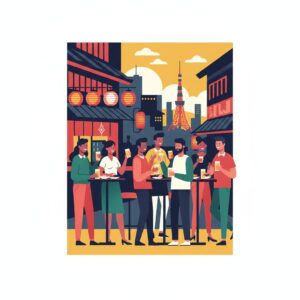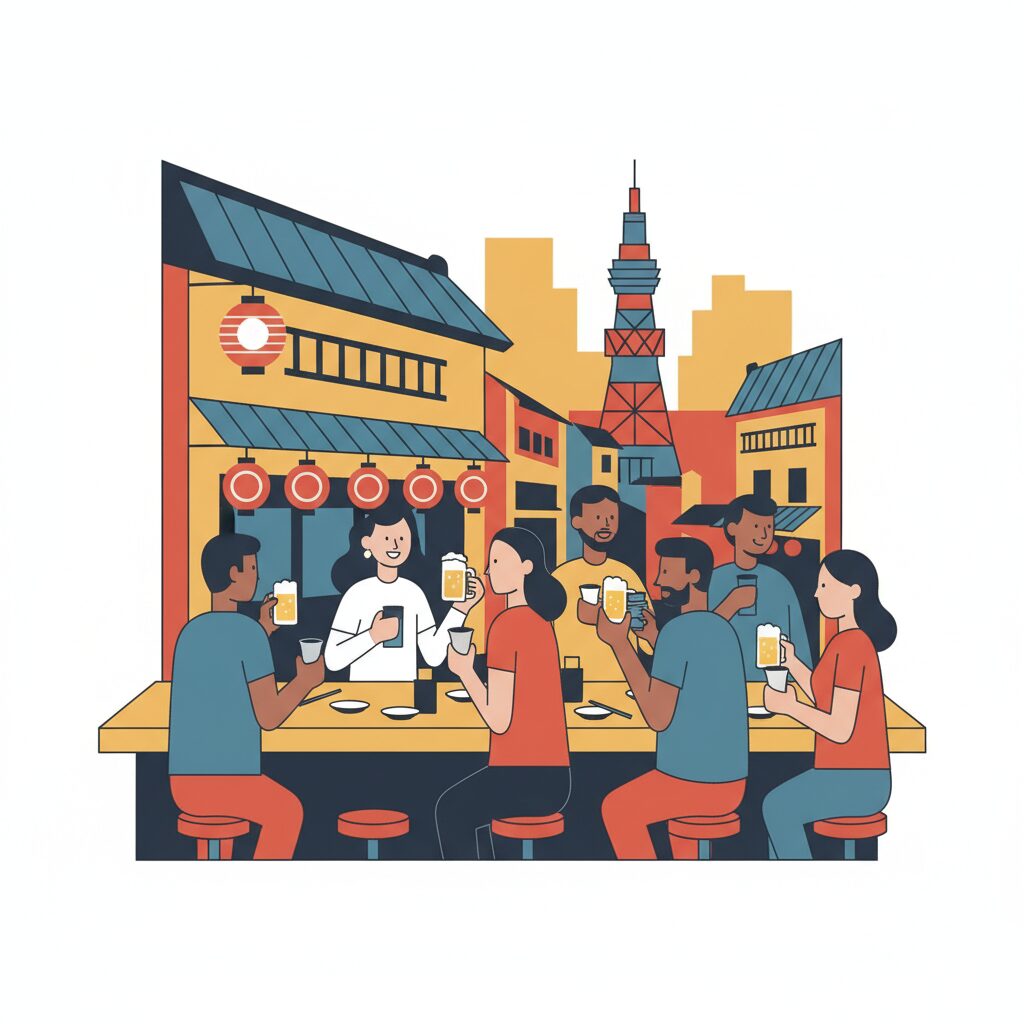
You see them tucked under railway arches, squeezed into narrow shotengai alleyways, or glowing on a street corner just as the offices empty out. They’re small, often a little grimy, and always crowded. A haze of cigarette smoke and fried food steam hangs in the air. Inside, people are packed shoulder-to-shoulder, drinks in hand, shouting over the clatter of plates and the sizzle of the grill. This is the tachinomi, the Japanese standing bar, and in Osaka, it’s more than just a place for a cheap drink. It’s the city’s social engine, a proving ground for its unique brand of communication, and perhaps the single best classroom for understanding what makes this city tick. For a foreigner, the scene can be intimidating. It looks chaotic, impenetrable, a private party you weren’t invited to. You might wonder, why would anyone choose to stand in a cramped space after a long day of work? Isn’t the point of a bar to relax? The truth is, tachinomi are designed for a different purpose. They aren’t about unwinding in quiet comfort. They’re about connection, pure and simple. They are the physical embodiment of Osaka’s personality: direct, efficient, communal, and unapologetically human. Forget everything you think you know about reserved Japanese social etiquette. Here, the rules are different. This isn’t a tourist guide to the best standing bars; it’s a field guide to the people you’ll meet inside them, and a decoder for the unspoken social language that powers the city of Osaka itself.
To truly understand the city’s communal spirit beyond the tachinomi, consider how locals bond in another quintessential neighborhood hub, the Osaka sento.
The Architecture of Conversation: Why Standing Matters
Step into a typical bar or izakaya anywhere else in Japan, and you’ll be guided to a table. Your space is clearly defined. You have your chair, your section of the table, your invisible boundaries. Your world is your group. The people at the next table might as well be in another city. An Osaka tachinomi fundamentally challenges this idea. Simply removing chairs transforms the entire social dynamic. It’s not a cost-cutting tactic; it’s a brilliant form of social engineering.
No Walls, No Barriers
The most notable aspect of a tachinomi is the complete absence of personal space. The layout is deliberately open, typically just a long counter or a few tall tables. There are no booths, no dividers, no designated sections. This demands a level of physical closeness that would be unimaginable in most other social contexts. You’re literally brushing elbows with the person beside you. Your drink could be mere inches from a stranger’s plate of doteyaki. This forced intimacy acts as a powerful icebreaker. It bypasses typical social awkwardness because the physical barrier has already been removed. It instantly fosters a subconscious feeling of shared experience. You’re all together in this cramped, noisy, lively space. In a seated izakaya, initiating a conversation with a stranger is a deliberate effort; you have to lean over, raise your voice, and consciously close the gap. In a tachinomi, you just need to turn your head. The absence of furniture creates a fluid, open social environment where interaction is the norm, not isolation. The entire bar functions as one shifting organism, not a collection of separate, fixed groups.
The Counter as the Stage
The counter at a tachinomi is the heart of the venue. It’s not just a place for ordering and receiving drinks; it’s the stage for the evening’s unfolding drama. Behind it, the master, or ‘Taisho,’ is much more than a bartender. They are the conductor, host, and social catalyst for the entire room. A skilled Taisho knows regulars by name, recalls their favorite drinks, and senses the room’s mood. They’ll spot a newcomer, perhaps looking uncertain, and might casually remark to the person next to them, creating an instant connection. “This guy’s from America,” they might say to the salaryman on your left, “His Japanese is pretty good, huh?” And just like that, a conversation sparks. The Taisho and staff act as social hubs, linking different patrons and keeping conversations flowing. They’ll playfully tease a regular about their favorite baseball team’s loss, a performance that invites commentary and shared laughter from the whole bar. This public, performative style of interaction turns the entire space into a collective experience. You’re not just a customer at the bar; you’re part of the audience and potentially part of the show.
The Fluidity of Space
A central philosophy of the tachinomi is its transient nature. The unspoken rule is “satto nonde, satto kaeru”—drink quickly and leave quickly. These venues aren’t meant for lingering over a long, leisurely evening. They serve as social pit stops, designed for rapid turnover. People stop by for a quick beer and a skewer or two on their way home from work, a 20 or 30-minute visit. This constant flow is crucial to the social atmosphere. The person standing next to you now might be gone in fifteen minutes, replaced by a completely new face. This dramatically lowers the social stakes. You’re not committing to a deep, hours-long conversation. You’re simply having a brief chat with a temporary neighbor. If the conversation clicks, great. If it doesn’t, no worries—one of you will be leaving soon anyway. This fleeting quality makes starting conversations far less intimidating. It encourages spontaneous, light exchanges because the commitment is minimal. It also means that within a single one-hour visit, you might interact with a broad cross-section of Osaka life: a construction worker, a bank employee, a shop owner, a student. The tachinomi is a social kaleidoscope, constantly shifting to reveal new patterns and faces.
The Unspoken Rules of Engagement: How to Talk to a Stranger in Osaka
For many foreigners, the biggest barrier to enjoying a tachinomi is the fear of inadvertently breaking some unseen Japanese etiquette rule. The thought of striking up a conversation with a complete stranger can be daunting, especially in a culture often seen as reserved. However, in an Osaka tachinomi, the rules are flipped. The greater social misstep is not attempting to engage; it’s standing silently in the corner, giving off an air of isolation. Osakans are experts at breaking the ice, and mastering their techniques is essential to fully experiencing tachinomi.
The Opener: More Than Just “Kanpai!”
You don’t need a clever or rehearsed opening line. The simplest and most common way to initiate a conversation is to comment on what the person beside you is eating or drinking. It’s a classic for good reason. Leaning in slightly and saying, “Sore, oishisou desu ne. Nan desu ka?” (“That looks delicious. What is it?”) is a universally accepted way to invite conversation. It’s non-threatening, shows genuine interest, and gives the other person an easy topic to respond to. The key lies in the delivery—a curious, friendly tone is everything. Another distinctly Osaka tactic is playful teasing, a simplified version of the ‘tsukkomi’ (straight man) and ‘boke’ (funny man) comedy style that’s central to the region’s humor. If you see someone order a huge plate of karaage, a lighthearted “Zenbu tabereru?” (“You can eat all that?”) with a smile makes a perfect Osaka-style opener. It’s a gentle challenge, testing the waters with humor. The expected reply isn’t offense, but a witty comeback like, “Of course! This is just an appetizer!” This playful exchange sets the rhythm of Osaka conversation. It’s about not taking yourself too seriously and being open to sharing a laugh.
Reading the Room: The Art of Knowing When to Engage
While the default mindset is “open to conversation,” it’s important to be mindful of social cues. Not everyone is looking to make new friends every night. Some prefer a quiet, solitary drink to unwind. Recognizing the difference is a skill. Notice their body language. Is someone turned inward, shoulders hunched, focused intently on their phone or the television? That’s a clear do-not-disturb signal. Are they making eye contact with others around the bar, smiling as they watch the general commotion? That’s an invitation to engage. The staff can also serve as a good indicator. If the Taisho is chatting with a customer, that person is likely a regular who welcomes being part of the bar’s social scene. The most important thing to remember is that it’s always acceptable to try. A simple “Konbanwa” (“Good evening”) is a low-risk way to test the waters. If you receive a short nod and they turn away, no offense is taken—you can simply move on. Unlike Tokyo, where an unsolicited approach might be met with suspicion, in Osaka, the attempt is often appreciated even if it doesn’t lead to a lengthy conversation. The willingness to connect is what matters most.
The Currency of Laughter and Reciprocity
Once a conversation begins, the unwritten social contract of the tachinomi comes into play. It’s a two-way street where you’re expected to participate, ask questions, and share a bit about yourself. It’s a give-and-take. One of the most common and sometimes puzzling customs is when a regular, for no apparent reason, offers to buy you a drink or shares some of their food. “Kore, tabete mi?” (“Wanna try this?”) while offering a skewer your way. For many foreigners, this can feel awkward—wondering if a hidden expectation exists. The answer is almost always no. This gesture is an expression of welcome and acceptance into the bar’s temporary community. The proper response is to accept with a surprised and grateful “Ee, ii n desu ka? Arigatou gozaimasu!” (“Oh, is it okay? Thank you very much!”). Reciprocity is important but not strictly transactional. You don’t have to immediately buy them a drink in return. The expectation is that you contribute to the positive atmosphere, keep the conversation flowing, and perhaps, another day, you’ll be the one extending a friendly gesture to a newcomer. It’s about investing in the collective goodwill of the space. Above all, laughter is the universal currency. Even if your Japanese is awkward and broken, a willingness to laugh at yourself and join in the general humor will win you more friends than perfect grammar ever could.
Osaka vs. Tokyo: A Tale of Two Drinking Cultures
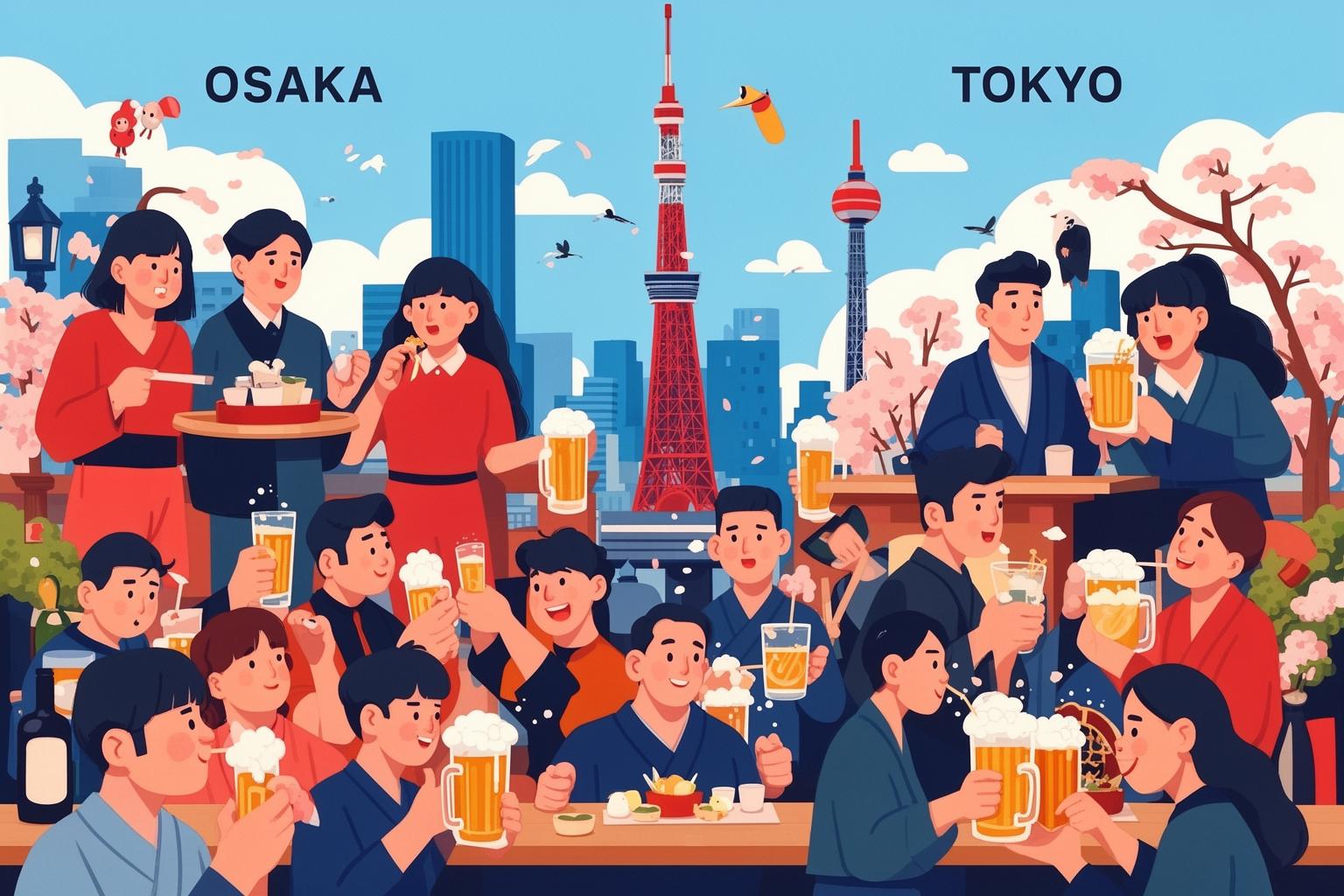
To fully understand the uniqueness of Osaka’s tachinomi culture, it’s important to compare it with its counterpart in Tokyo. While both cities feature standing bars, they frequently serve fundamentally different social purposes and highlight the deep-rooted cultural contrasts between Japan’s two largest urban centers. Visiting a tachinomi in Tokyo followed by one in Osaka is like experiencing a play in two distinct languages; the setting may appear similar, but the narrative and emotions differ greatly.
Tokyo’s Calculated Anonymity
A typical Tokyo tachinomi, particularly in polished business areas like Marunouchi or Shinjuku, often feels more refined and meticulously designed. The décor might be minimalist, the lighting elegant, and the menu centered on high-quality craft beer, select sake, or artisanal food pairings. The atmosphere tends to be more subdued. Though not silent, the background noise consists of polite conversations, mainly within established groups of colleagues or friends. Spontaneous interaction between strangers is rare. The default social environment embraces a kind of respectful anonymity—you acknowledge others’ presence but avoid intruding on their space. The experience focuses more on appreciating the drink and food quickly and efficiently. This mirrors Tokyo’s broader culture: professional, orderly, and respectful of personal boundaries. It’s a place to drink, but not necessarily one to connect.
Osaka’s Chaotic Community
Step into a traditional Osaka tachinomi in neighborhoods like Kyobashi or Tenma, and the contrast is striking. It’s louder and livelier. The air is thick with the scent of grilled offal and inexpensive shochu. The emphasis isn’t on the artisanal quality of a single-origin sake; instead, it’s on the boisterous, freewheeling human energy—the ‘waiwai gaya-gaya’ atmosphere. The main product served is community, with beer and fried chicken as its medium. This cultural divergence has historical roots. Tokyo was the city of samurai and bureaucrats, a top-down society grounded in order and protocol. Osaka, in contrast, was the city of merchants (‘shonin no machi’). Its prosperity emerged from trade, negotiation, and relationship-building. For merchants, communication was crucial for survival. They needed to converse with anyone, quickly read people, build rapport, and close deals. Tachinomi served as informal boardrooms and networking spots where these interactions took place. This pragmatic, results-driven approach to socializing is ingrained in Osaka’s identity. The “friendliness” of Osakans is not just a personality trait; it’s a time-honored business tool and a foundation for community, with the tachinomi as its natural environment.
The Language of the Bar
The very language spoken highlights the difference. In Tokyo bars, you’ll hear standard Japanese, with polite verb endings and formal speech. In Osaka, you’re immersed in Osaka-ben, the local dialect, which perfectly reflects the local culture. It’s more direct, expressive, and efficiently conversational. You’ll hear phrases like “Meccha umai!” (“Sooo delicious!”) instead of the more standard “Totemo oishii desu.” The playful, teasing “Nande ya nen!” (“Why the heck!?”) acts as a conversational spark, prompting a response. The intonation is more melodic and dramatic. For non-native speakers, it can be intimidating at first, but it’s also an invitation. Even using a simple phrase in Osaka-ben, such as saying “Okini” instead of “Arigato” for thank you, sends a strong signal. It shows you’re not merely a tourist passing through; you’re making an effort to engage locally. This linguistic shibboleth can instantly shift your status from outsider to honored guest, often prompting a delighted and surprised chorus of cheers from your new neighbors at the counter.
A Practical Field Guide: Navigating Your First Tachinomi
Grasping the theory is one thing, but crossing the threshold of a crowded, noisy tachinomi for the first time is quite another. It can be a sensory overload. Menus are often scribbled on yellowing strips of paper pasted to the wall, the ordering system can seem mysterious, and finding a spot to stand can feel like joining a rugby scrum. However, with a few practical tips, you can confidently navigate your first visit and come away with a full belly and maybe a few new friends.
Choosing Your Venue: From Gritty to Gourmet
Not all tachinomi are the same. They range widely, and selecting the right one for your comfort level is crucial. On one end, you’ll find traditional, old-school spots, often located under train tracks or in working-class neighborhoods. These places are dominated by ‘ojisan’ (middle-aged men), serving cheap beer, shochu, and simple dishes like grilled skewers and nikomi (stewed beef tendon). The atmosphere is raw and unapologetically local. At the other end are modern, almost chic tachinomi that have appeared in areas such as Fukushima and Ura Namba. These may specialize in natural wine, craft beer, or Italian-inspired small plates. The crowd tends to be younger, with a more balanced mix of men and women, and the staff may be more familiar with non-Japanese customers. Between these two are market bars, like those near the Tenma market, offering incredibly fresh sashimi and tempura in a lively, semi-outdoor environment. For first-timers, a modern or market-style bar might feel less intimidating, but for a true, unfiltered Osaka experience, venturing into a classic ojisan joint is essential.
How to Order
The payment system is the first challenge. Many tachinomi operate on a cash-on-delivery basis. You receive a small tray or basket, where you place your money. When you order, the staff takes the exact amount from it. This system is highly efficient and allows patrons to leave whenever they wish without a formal checkout. Other bars keep a tab that you pay at the end. If unsure, simply observe what the person next to you does. When ordering, be assertive. Don’t wait politely for staff to notice you; they are extremely busy. A clear and confident “Sumimasen!” (“Excuse me!”) with eye contact works best. The menu is often a wall full of handwritten kanji. Don’t stress. Pointing is completely acceptable and expected. Just point to what someone else is eating and say “Are, onegaishimasu” (“That one, please”). Or point at something on the menu and say “Kore, kudasai” (“This one, please”). Start with something simple like “Nama biru” (draft beer), which is always a safe choice. Expect staff to be brisk and direct; it’s not rude, it’s efficient. A smile and a clear voice will get you everything you need.
A Foreigner’s Advantage (and Pitfalls)
As a non-Japanese in a very local tachinomi, you hold a secret advantage: you are a curiosity. Simply by being there, you often spark conversation. Locals want to know where you’re from, what you’re doing in Osaka, and what you think of the food. Embrace this; it’s your easy way in. However, be mindful of a couple of pitfalls. The first is the “gaijin entertainer” trap. It’s easy to become the center of attention—the loud foreigner holding court. While it can be fun briefly, it’s better to be part of the bar’s ecosystem than a spectacle. Listen more than you speak. Ask about others and show genuine interest in their lives. The second pitfall is misunderstanding Osaka’s directness. Someone might ask you a question that feels very personal by Western standards—your age, marital status, or even salary. This is rarely meant to intrude. It stems from straightforward curiosity, a desire to understand you and place you within their social map. If you feel uncomfortable, you don’t have to answer directly. A light-hearted deflection works best. The goal is to blend into the flow, not disrupt it or feel overwhelmed by it.
Beyond the Bar: What Tachinomi Teach You About Living in Osaka
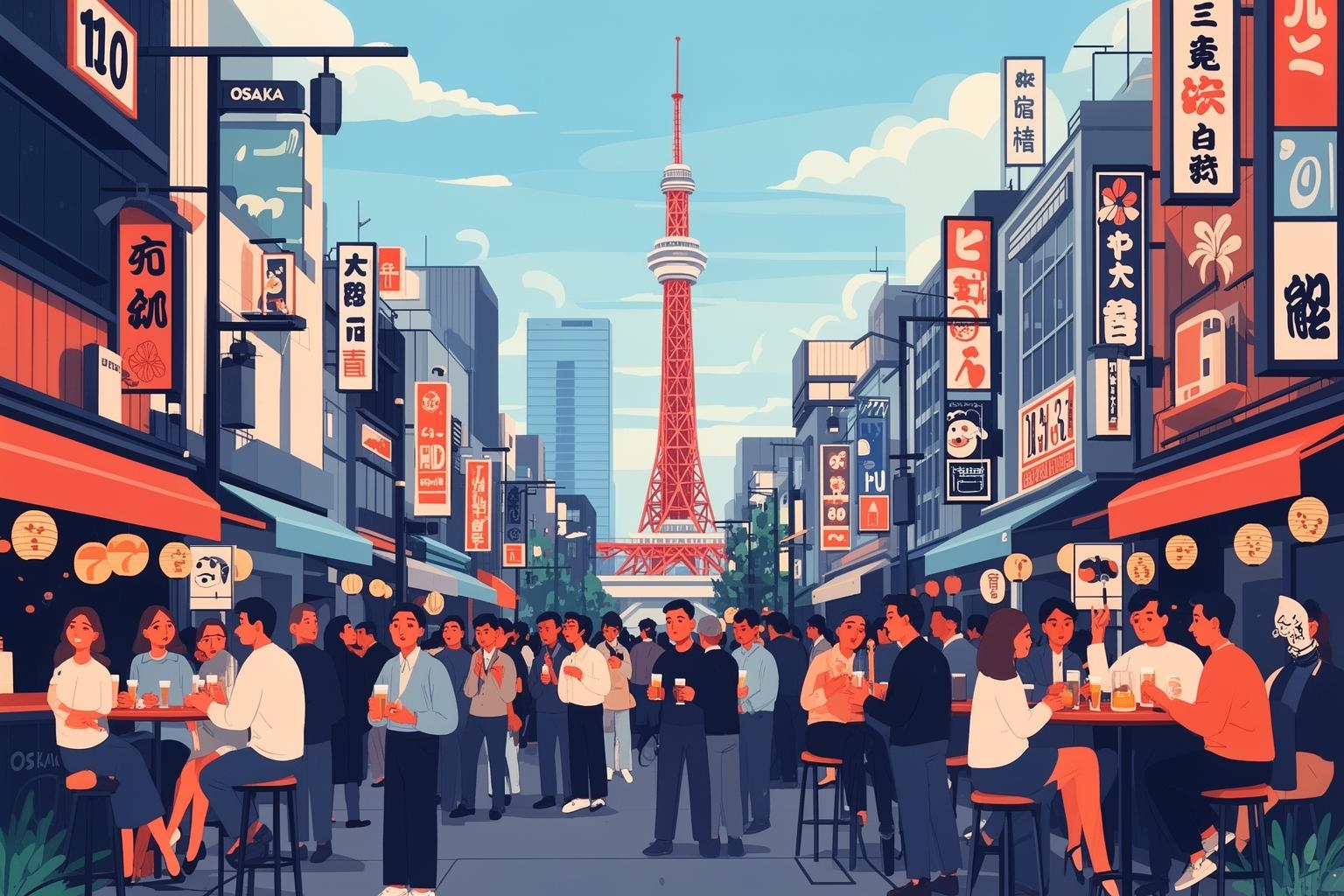
The lessons learned within the confines of a standing bar extend well beyond a single evening. The tachinomi serves as a microcosm of Osaka itself, and the social skills honed there translate directly to everyday life in the city. It offers a crash course in the local mindset, providing insights into how Osakans approach everything from business to friendship. Understanding the tachinomi is akin to understanding the city’s operating system.
The Value of “Kibun” (Mood/Vibe)
In a tachinomi, everyone subconsciously strives to maintain the ‘kibun,’ the overall mood and energy of the space. A good time is regarded as a shared responsibility. When the vibe is positive, everyone benefits. This principle extends throughout Osaka. People are more attuned to the social atmosphere around them. The clerk at the convenience store is more likely to joke with you. The elderly lady at the bus stop might start a conversation about the weather. There’s less of a strict boundary between public transaction and private interaction. This can be surprising for those used to the anonymity of larger cities, but it embodies Osaka’s community spirit. The aim is to make shared spaces more welcoming, more human, and more enjoyable, with everyone expected to contribute in small ways.
“Honesty” as a Virtue: The Tatemae/Honne Divide
The Japanese concepts of ‘tatemae’ (the public facade) and ‘honne’ (one’s true feelings) are well-known. In many parts of Japan, maintaining ‘tatemae’ is an essential social skill. In Osaka, especially in a tachinomi, the gap between the two is much smaller. The ‘tatemae’ is almost transparent. People openly complain about their bosses, passionately lament the failures of the Hanshin Tigers baseball team, and express opinions directly without the layers of polite ambiguity found elsewhere. This doesn’t mean they’re rude; rather, they prioritize a different kind of social harmony—one rooted in authenticity and straightforwardness rather than carefully managed appearances. For foreigners living in Osaka, this can be a refreshing change. There’s less time spent decoding subtle cues and more time engaged in honest conversation. What you see is generally what you get.
Building Your “Third Place”
Sociologists emphasize the importance of a “third place”—a location that is neither home (the first place) nor work (the second place). This third place is where community is formed, social bonds develop, and a sense of belonging grows. For many in Osaka, their local tachinomi serves as this essential third place. It’s where they catch neighborhood gossip, learn about job openings, seek advice on fixing bicycles, or simply vent after a long day to a sympathetic listener. For foreigners trying to establish roots and build genuine social circles beyond the expat bubble, finding a regular tachinomi can be transformative. Becoming a regular, a ‘joren-san,’ is a process that requires time and repeated visits. But once acknowledged by the Taisho and other regulars, you’re no longer just a customer—you become part of a community. It offers the fastest and most authentic route to integration, providing a real, tangible connection to the fabric of daily life in the city.
A Final Round: The True Taste of Osaka
The steam rising from a pot of simmering beef tendon, the sharp crack of a beer bottle opening, the roar of laughter from a shared joke—this is the symphony of the Osaka tachinomi. From the outside, it may appear intimidating, a chaotic blur of mysterious customs. But to write it off as merely a spot for a cheap, quick drink is to miss its essence entirely. These standing bars embody the living soul of the city. They serve as archives of local history, incubators of friendship, and nightly celebrations of the Osakan spirit: loud, direct, unpretentious, communal, and deeply, wonderfully human. To truly understand Osaka, you must understand its people. And to understand its people, you have to stand beside them, share a drink, and listen to their stories. So, next time you pass by one of these glowing doorways, don’t just glance in. Take a deep breath, push aside the noren curtain, and step inside. Find a spot at the counter. Order a beer. Catch someone’s eye and give a nod. You’ll discover more about this city in that one hour than in a lifetime of guidebooks. You might savor some of the best food of your life. You might even make a new friend. And that, above all, is the true flavor of Osaka.