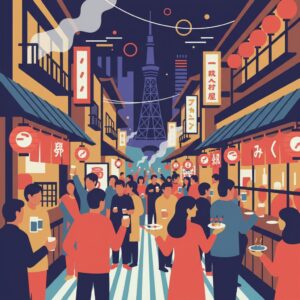
Walk out of Tenma Station, turn away from the broad, sensible main street, and take a deep breath. You’re about to dive in. The air, thick with the scent of grilled offal, cheap beer, and a century of late-night laughter, is your first clue. This isn’t the curated, polished nightlife you might find in a Tokyo high-rise or a Kyoto geisha district. This is Osaka, raw and unfiltered, crammed into a labyrinth of back alleys so narrow you can touch both walls without fully extending your arms. Welcome to the heartland of ‘hashigo-zake’, the sacred Osaka ritual of bar-hopping. For the uninitiated, it looks like chaos. Tiny, smoke-filled establishments spill their patrons onto the cobblestones. Red lanterns (‘akachochin’) glow like embers in the twilight, promising potent sake and sizzling skewers. There are no velvet ropes, no reservations, no dress codes. There is only the squeeze.
Foreigners living here often ask me the same question, their faces a mixture of fascination and bewilderment: “Why? Why cram into these tiny places, shoulder-to-shoulder with strangers, when there are perfectly good, spacious restaurants just a block away?” The question itself reveals a fundamental misunderstanding of the Osaka mindset. In Tokyo, social life often revolves around preserving personal space, avoiding inconvenience to others (‘meiwaku’), and adhering to a certain elegant, unspoken order. Social gatherings are planned, reserved, and contained. Here, in the boisterous corridors of Tenma and its grittier cousin, Kyobashi, the opposite is true. The goal isn’t to create a private bubble; it’s to burst it. ‘Hashigo-zake’ isn’t just about drinking. It’s a dynamic, fluid, and intensely social sport. It’s a practical expression of Osaka’s core values: cost-performance, efficiency, and a deep, abiding belief that a stranger is just a friend you haven’t shared a highball with yet. This isn’t a refined tasting tour; it’s a full-contact cultural immersion. Forget what you know about personal space. Let go of the need for a plan. The only itinerary you need is the next glowing lantern that catches your eye. This is how you learn the city’s true rhythm, one tiny, packed bar at a time.
To truly master the art of ‘hashigo-zake’, it helps to first understand the foundational culture of Osaka’s ‘tachinomi’ scene.
The Unspoken Rules of the Tenma Labyrinth

Exploring Tenma for the first time feels like stepping into a human pinball machine. The alleys bombard your senses with a mix of clinking glasses, sizzling grills, and the booming laughter that defines Osaka’s unique soundtrack. There are rules here, but none are posted on signs. Instead, they are woven into the very essence of the place, understood instinctively by the salarymen, shopkeepers, and students who treat these alleys as their second home. Learning these unspoken rules turns you from a mere spectator into an active participant in the nightly drama.
Personal Space is a Privilege, Not a Given
The first and most striking lesson in Tenma is the complete redefinition of personal space. In most Western societies, and even much of Japan, bumping into someone without apologizing is a minor social offense. Here, it’s simply part of getting a drink. The most popular establishments, the ones with the best food and liveliest vibes, are invariably the most cramped. You might find yourself in a bar meant for ten people but packed with twenty-five. Your backpack won’t rest on the floor—because there isn’t one—it will sit on your lap. Your coat won’t hang on a hook; it’ll drape over the back of your stool, likely sharing space with the coat of the person pressed against you.
This closeness is not rude or unpleasant; it’s central to the experience. Physical proximity acts as a social catalyst, breaking down the barriers found in more formal settings. You cannot ignore the person whose elbow nearly dips into your bowl of ‘doteyaki’ (stewed beef sinew). This shared discomfort, this mutual acceptance of close quarters, forges an immediate, unspoken connection. It’s a tangible expression of the communal Osaka spirit. A Tokyo resident might see this as a stressful invasion of personal space, a textbook example of ‘meiwaku’ (nuisance). But an Osakan considers it an efficient use of space and a chance to connect. To get by, you learn the Tenma shuffle: a subtle, sideways crab-walk to reach the restroom. You say “Sumimasen, chotto torimasu” (“Excuse me, just passing through”) with a confident nod, not a hesitant whisper. In return, people don’t just move aside—they actively help, pulling in chairs, raising their beers, and guiding you through the crowded maze. They’re not bothered; they’re aiding a fellow player in the same game.
‘Toriaezu Biru’ and the Art of Swift Ordering
Time flows differently in a ‘hashigo-zake’ bar crawl. You’re not here for a leisurely three-hour meal. You’re a hummingbird, zipping from one flower to the next, sampling the nectar before moving on. The pace is brisk, and so is the ordering process. When you finally snag a spot at the counter, the bartender or server will expect you to decide quickly. This is not the moment to study the menu for ten minutes.
The magic phrase is “Toriaezu biru,” which means “Beer for now” or “Let’s start with a beer.” It serves as a universal icebreaker and a conversational default. It gives you a moment to glance at the menu while signalling that you understand the pace of the place. It gets things rolling. While sipping your first ‘nama chū’ (medium draft beer), you make your next choice. The menus are often handwritten strips of paper stuck on the wall, sometimes without prices and almost never translated into English. Don’t worry. This is a chance, not a hurdle.
Point at what the person next to you is eating and ask, “Sore, nan desu ka?” (“What is that?”). This usually sparks a friendly, detailed explanation, and maybe even an offer to share a taste. Alternatively, you can trust the staff by asking for their “osusume” (recommendation). This shows trust and is usually rewarded with the freshest, best dish of the day. The key is decisiveness. Order a drink and one or two food items. The kitchen operates like a whirlwind, and the only real misstep is holding up the line by hesitating. You eat, drink, pay, and move on. This quick turnover is Tenma’s economic engine. Every seat is prime real estate, and by keeping the flow steady, the bars manage to keep prices remarkably low.
The Currency of Conversation: Talking to Strangers
If physical closeness forms Tenma’s framework, spontaneous conversation is its lifeblood. In Tokyo, you might sit next to someone at a bar for a year without speaking, and starting a conversation could even feel intrusive. In Tenma, it’s unusual if you don’t. The communal vibe isn’t just a result of tight spaces; it’s a conscious social design. Osakans are natural merchants, and their culture thrives on quick connections, friendly banter, and instant rapport.
This isn’t about deep philosophical discussions. The talk is light, easy, often revolving around a few familiar topics. The Food: “Oishii desu ne!” (“This is delicious!”). The Drink: “That sake looks good, where is it from?”. The Hanshin Tigers: When Osaka’s perennial underdog baseball team is playing, the whole bar becomes a cheering, groaning collective. You don’t need expertise; a simple comment opens the door. You’ll be asked where you’re from, what you do, and your thoughts on Osaka. These aren’t invasive questions; they’re bridges. The elderly man beside you isn’t interrogating; he’s inviting you into his world for the next twenty minutes.
This can feel intimidating for foreigners used to more reserved interactions or even Japanese from other regions. The key is to relax and engage. A smile and a straightforward answer are enough. This conversational currency is rooted in Osaka’s history as Japan’s commercial hub. For centuries, merchants had to quickly build trust and relationships to close deals. That same transactional yet warm energy permeates Tenma’s bars. Every exchange is a small, pleasant bargain—you share a bit of your story, they share some of theirs, and everyone leaves a little richer. It’s a powerful antidote to the anonymity of modern city life.
Kyobashi’s Grit: A Grittier, More Local Flavor
If Tenma represents the chaotic, somewhat trendy theater of Osaka’s bar-hopping scene, then Kyobashi acts as its backstage dressing room. Just a few stops away on the JR Loop Line, Kyobashi provides a similar experience but without any hint of trendiness. It’s rougher, distinctly working-class, and in many ways, feels more genuine. This is where you come to witness the raw, unfiltered spirit of the city after a long day’s work. The alleys here are broader, yet the atmosphere remains just as intense, filled with grizzled salarymen, construction workers, and office ladies loosening their ties and kicking off their heels.
Standing Bars (‘Tachinomi’) and the Working-Class Soul
Kyobashi reigns supreme as the hub of the ‘tachinomi,’ or standing bar. The concept is straightforward and highly efficient: no chairs. You stand at a tall counter, or occasionally at a repurposed beer crate, place your order, and drink. While the lack of seating might seem odd or uncomfortable to a newcomer, it fulfills several key functions fundamental to the Osaka spirit. First, it’s quick. With no place to settle in comfortably, the natural urge is to have a drink or two and move along. This boosts turnover and keeps customers flowing steadily. Second, it’s affordable. By cutting out the space and service costs associated with seating, ‘tachinomi’ can offer drinks and food at rock-bottom prices—a beer might be a hundred yen cheaper than in a seated bar nearby. For regular drinkers, this makes a real difference. Third, and most importantly, it’s social. Standing puts everyone on equal footing, literally. It encourages mingling and makes it easy to start conversations with strangers. The vibe is less like a restaurant and more like an ongoing, informal cocktail party. You’ll find groups of coworkers relaxing, old friends reconnecting, and solo drinkers soon absorbed into the lively chatter. The TV in the corner usually airs a baseball game or horse race, constantly providing a shared source of cheers, groans, and commentary. This forms the heartbeat of Osaka’s social life, far away from any tourist paths.
Cost Performance (‘Cospa’) as a Moral Imperative
In Tokyo, people might pay extra for ambiance, exclusivity, or a famous name. In Osaka, the ultimate value lies in ‘cospa’—cost performance. Getting a good deal isn’t just a perk; it’s a moral triumph and a deep source of pride. This principle shines brightly in Kyobashi. Signs proudly advertise a “senbero” set—a word blending “sen” (one thousand) and “berobero” (drunk). For just a single 1000-yen coin (around $7 USD), you can enjoy a combination of drinks and snacks enough to get comfortably tipsy. It’s a challenge, a game, and a promise all at once.
This fixation on value is often wrongly seen by outsiders as stinginess. But that’s a fundamental misunderstanding. The Osaka merchant spirit insists you should never pay more than something’s true worth. It’s about being a shrewd, discerning consumer—not a miser. Osakans will willingly spend on quality, but they demand fairness and high value. They loathe pretension and inflated prices. In a Kyobashi bar, if you compliment the taste of your grilled skewers, the person beside you is just as likely to agree and then mention another spot three alleys down serving an even better version for 20 yen less. This isn’t criticism of the current place; it’s sharing essential, hard-earned knowledge. This ongoing, shared pursuit of the best ‘cospa’ fuels an intensely competitive and impressively high-quality food and drink scene. Every bar owner knows they must deliver maximum value—or customers will simply vote with their feet and head for the next red lantern.
Deconstructing the ‘Hashigo-zake’ Mindset

To truly understand what’s happening in the busy alleys of Tenma and Kyobashi, you need to look beyond simply drinking. ‘Hashigo-zake’ is a philosophy—one that rejects stagnation in favor of movement, variety, and serendipity. It’s a ritual that perfectly embodies Osaka’s restless, pragmatic, and deeply humanistic spirit. To grasp why someone would choose to visit five different bars in three hours instead of settling comfortably in one chair is to understand the city itself.
Why Not Just Stay in One Place?
A friend from Kyoto once asked me this, genuinely puzzled. In her city of refined aesthetics and long-established traditions, an ideal evening might involve a multi-course ‘kaiseki’ meal savored over several hours in a single beautiful spot. The idea of rushing between noisy, cramped bars seemed stressful and pointless. But for the Osaka ‘hashigo’ enthusiast, staying put misses the point completely. The ‘hashigo’ (ladder) is a metaphor for the evening’s progression. Each bar is a rung on that ladder, a new experience, a distinct flavor.
It’s a form of culinary curation. You don’t go to one place for everything. You begin at a ‘tachinomi’ for a cheap beer and some quick pickles to whet your appetite. Then you move on to a specialist yakitori joint where the master has grilled chicken skewers over charcoal for thirty years. Next, perhaps a spot known for incredibly fresh sashimi, sliced to order. After that, a quiet bar with an extensive sake selection to sample regional brews. Each stop is intentional and focused on one or two signature items. This way, everything you consume is the best it can be—a distributed, deconstructed meal, a tasting menu of the entire neighborhood. This constant movement also keeps energy high. There’s no time for the conversation to stall or boredom to creep in. The thrill lies in the chase—in finding the next great spot and feeling that the perfect dish is always just one alley away.
The Social Ladder: Climbing from Stranger to ‘Nakama’
‘Hashigo’ is not only a culinary ladder but also a social one. Each bar you visit is a step up in social intimacy, fueled by alcohol and the unique chemistry of the environment. Think of it as a three-act play repeated throughout the night. Act I: The first bar. You arrive a bit stiff and sober, an outsider. You focus on the menu, order your drink, and keep to yourself or your small group, observing the scene and taking stock. Act II: The second or third bar. The buzz of alcohol kicks in. You’re more relaxed. The crowd’s closeness feels less intrusive and more like a warm embrace. You might exchange a nod with the bartender or smile at the couple next to you. The barrier begins to dissolve. Act III: The fourth or fifth bar. You’re part of the flow now. Laughing louder, talking freely. When a new group squeezes in, you’re the one pulling in your stool, helping them find a spot. You might share food with a stranger or have a passionate, broken-English-and-Japanese debate about baseball. In this moment, you’re no longer a stranger—you’ve become ‘nakama’: a comrade, a buddy, part of the bar’s temporary tribe that night.
This fleeting yet powerful sense of belonging is the ultimate reward of ‘hashigo-zake.’ It’s a microcosm of how Osaka society works. From the outside, it may seem loud, chaotic, and intrusive, but once inside, you’re accepted quickly and without hesitation. This city doesn’t stand on ceremony; it values participation over polite observation. The ladder of bars is a journey from anonymity to community, accomplished in just a few hours and a few highballs.
What Foreigners Get Wrong: “Friendly” vs. “Frank”
The most common cliché about Osaka is that its people are “friendly.” While not untrue, it’s a simplistic and often misleading label. It suggests polite smiles and gentle helpfulness, which doesn’t quite capture Osaka’s social texture. A more fitting description might be frank, direct, or inquisitive. Osakans’ friendliness is active, engaging, and sometimes startlingly blunt. In a Tenma bar, an old woman might turn to you and, without preamble, ask, “Nani shiten no?” (“What do you do?”). Or a man might comment on your plate, “You’re holding your chopsticks wrong, but your Japanese is good!” To someone from a more reserved culture, including other parts of Japan, this could feel abrasive or rude. A foreigner might wonder, “Why are they asking personal questions? Why point out my mistakes?” This is the key misunderstanding. Their directness isn’t criticism or an invasion of privacy—it’s a shortcut to intimacy. By skipping formal pleasantries, they treat you not as a delicate foreign guest but as an equal, a potential ‘nakama’ who can handle teasing and straight talk. The ‘obachan’ (auntie) who corrects your chopsticks is also the one who makes sure your glass never empties and fiercely defends you if anyone causes trouble. This frankness is a practical, no-nonsense form of affection. It’s the city’s way of saying, “We see you. We’re interested. Now, let’s talk.”
A Practical Guide to Your First ‘Hashigo’
Theory is one thing, but embarking on your first solo journey into the Tenma labyrinth demands some practical knowledge. Think of it not as a strict set of rules, but as a flexible framework to help you embrace the chaos. The true aim is to get lost, make mistakes, and thoroughly enjoy the process. Still, a few tips can boost your confidence as you navigate the initial learning curve.
Reading the Room: How to Choose a Bar
Your first challenge is picking a starting point from hundreds of options. Don’t let the abundance overwhelm you. The charm of ‘hashigo-zake’ lies in the fact that if you end up at a bad spot, you’re only there for about 30 minutes. Here are some visual hints to guide you: The Red Lantern (‘Akachochin’): This iconic sign universally marks an ‘izakaya’ (Japanese-style pub) and serves as a glowing beacon at night. The Crowd: Is the place packed and spilling out the door? That’s almost always a positive indicator. Osakans have an infallible instinct for good food and value. Don’t be daunted by a crowd; a full house usually means lively atmosphere and fresh, quickly turned-over food. A half-empty bar on a Friday at 8 PM is a warning sign. The Noren Curtain: The short fabric hanging in the entrance offers a tempting, partial view inside. Peek through—does it feel inviting? Is the master behind the counter actively engaged with customers? Handwritten Menus: Menus scribbled on paper taped to walls or blackboards outside hint at a daily-changing selection based on fresh market ingredients, signaling a place that truly values its food. Ultimately, trust your instincts. If a spot piques your interest, jump in. The worst outcome is a mediocre beer before moving on. The best is finding a new favorite hangout.
The Izakaya Lingo
While you can manage by just pointing and smiling, learning a handful of key phrases can greatly enrich your experience. It shows respect and eagerness to engage—qualities that Osakans highly appreciate. Essentials include: “Haitte mo ii desu ka?” (“Is it okay to come in?”)—a polite way to check if there’s room. Alternatively, hold up your group size with your fingers. “Nama chū futatsu, onegaishimasu!” (“Two medium draft beers, please!”)—be clear and confident. Switch “futatsu” (two) for “hitotsu” (one) or “mittsu” (three) as needed. “Kore, kudasai.” (“This one, please.”)—the universal phrase when pointing to something on the menu or a neighbor’s plate. “Osusume wa nan desu ka?” (“What do you recommend?”)—your secret weapon, putting you in expert hands and often leading to tasty discoveries. “Okanjo, onegaishimasu.” (“The bill, please.”)—cross your index fingers to make an ‘X’, the universal check gesture. “Gochisousama deshita. Oishikatta desu!” (“Thank you for the meal. It was delicious!”)—saying this upon leaving is essential; it’s the highest compliment to the staff and shows deep appreciation.
The Exit Strategy: Knowing When to Move On
Mastering the art of the graceful exit is the toughest part of ‘hashigo-zake.’ How do you know when it’s time to move to the next bar? There are several signs. The Rule of Thumb: Typically, one or two drinks and one to three small dishes per place. Once you’ve tasted their specialty and finished your drink, the clock starts ticking. The Lull: Has the initial lively conversation with new bar friends begun to fade? Has the energy dipped? That’s your cue. Leaving on a high note is better than overstaying. Payment: Many traditional spots accept cash only. Don’t get caught off guard. When in a group, having one person pay the whole bill and collecting reimbursements usually goes smoother. Splitting the bill (‘betsu-betsu’) can be tricky for a busy bartender. The ‘Shime’: The last stop on a true ‘hashigo’ night isn’t another bar but a carb-rich dish to “shime” (finish) the evening—often ramen, udon, or ochazuke (rice with tea). This tradition helps soak up the alcohol and brings the culinary adventure to a satisfying close. Finding the perfect ‘shime’ ramen is a quest in itself, and a story for another time.
To wander through Tenma and Kyobashi is to witness Osaka’s spirit laid bare. These are not polished tourist spots; they are noisy, messy, and beautifully human places where the city’s true life unfolds. The cramped seating, candid conversations, relentless search for value—they all reflect a culture shaped by commerce, one that prizes practicality over pomp and human connection over formal politeness. An evening of ‘hashigo-zake’ is more than just a night out. It’s a hands-on lesson in the city’s social code. It encourages you to let go of inhibitions, engage with your surroundings, and find comfort in some degree of chaos. It’s in the narrow space between your stool and the next, in shared laughter over a spilled drink with a stranger, that you stop merely visiting Osaka and start truly understanding it.