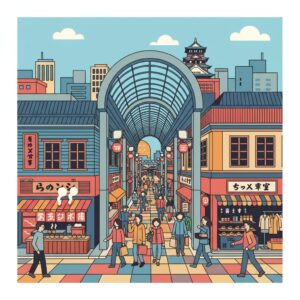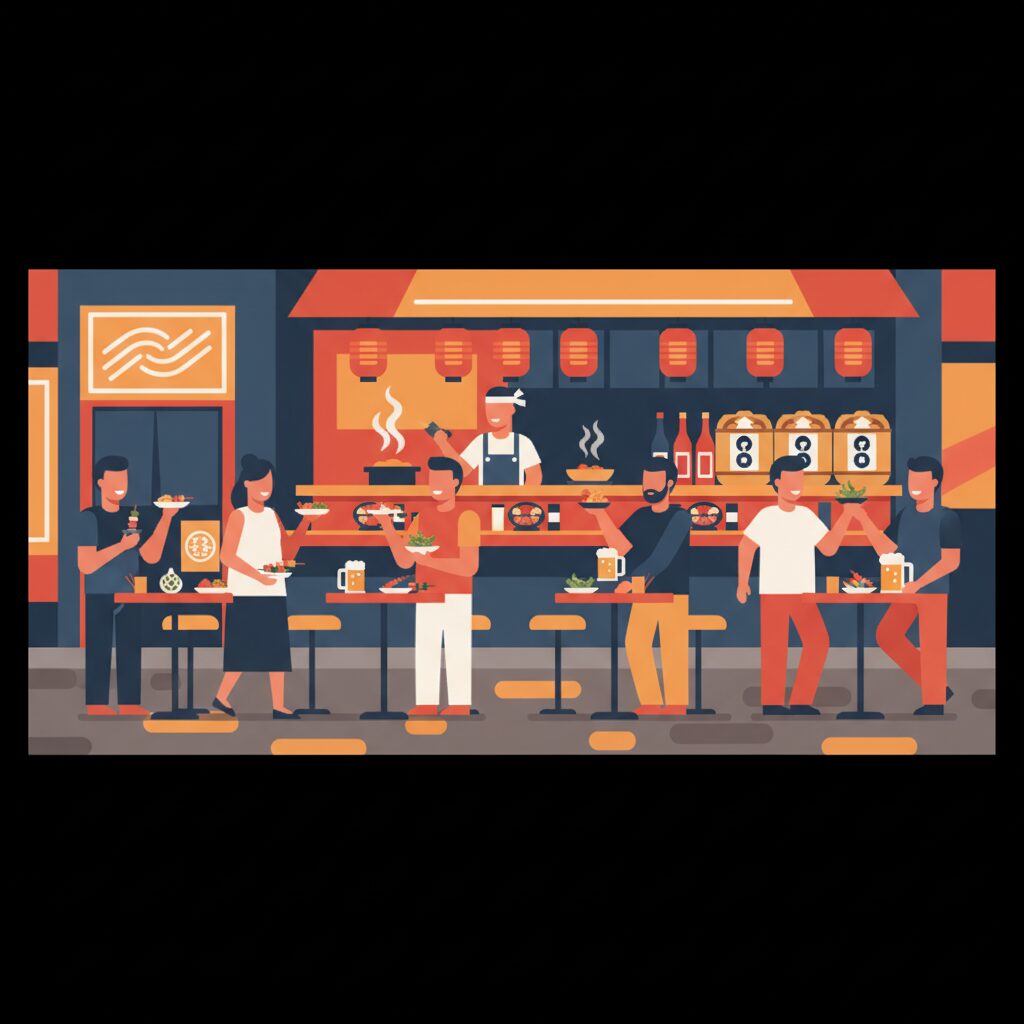
The first time you see it, it doesn’t quite compute. You’re walking down a narrow shotengai, one of those covered shopping arcades that feel like the city’s arteries, just as the sky turns a bruised purple. The workday is ending. And there, spilling out onto the pavement, is a small, brightly lit box of a place. It’s packed. People are standing shoulder-to-shoulder, wedged against a wooden counter, their faces illuminated by the glow of a single beer tap and the steam rising from simmering pots. It looks like a bar, it smells like a kitchen, but the energy is something else entirely. It’s not the slow, languid pace of a pub, nor the formal buzz of a restaurant. It’s a high-energy, purposeful hum. This is the tachinomi, the standing bar, and in Osaka, it’s a cultural institution that serves as so much more than a place for a quick drink. It’s the city’s unofficial dining room, its decompression chamber, and a living testament to the Osakan philosophy of life: get the best, get it fast, get it cheap, and don’t waste time with unnecessary pleasantries like chairs.
For a foreigner, especially one accustomed to the clear lines drawn between a bar, a café, and a restaurant, the tachinomi is a puzzle. Are these people having dinner? Or are they just starting a long night of drinking? The answer, I’ve learned, is a uniquely Osaka blend of both and neither. They are fueling up, winding down, and connecting with their city in the most efficient and unpretentious way possible. This isn’t about pageantry; it’s about pragmatism. It’s where you see the real, unvarnished rhythm of daily life in a city that prides itself on being straightforward. Forget what you think you know about Japanese dining etiquette and formal service. The tachinomi operates on a different set of rules, ones written by generations of merchants, factory workers, and office staff who needed a good meal without the ceremony. To understand the tachinomi is to understand the soul of Osaka itself—a city that never stands on ceremony, but is very particular about what’s on its plate.
To truly grasp this unique social and culinary phenomenon, you can delve deeper into the unspoken rules of Osaka’s tachinomi culture.
Deconstructing the Tachinomi: It’s Not What You Think
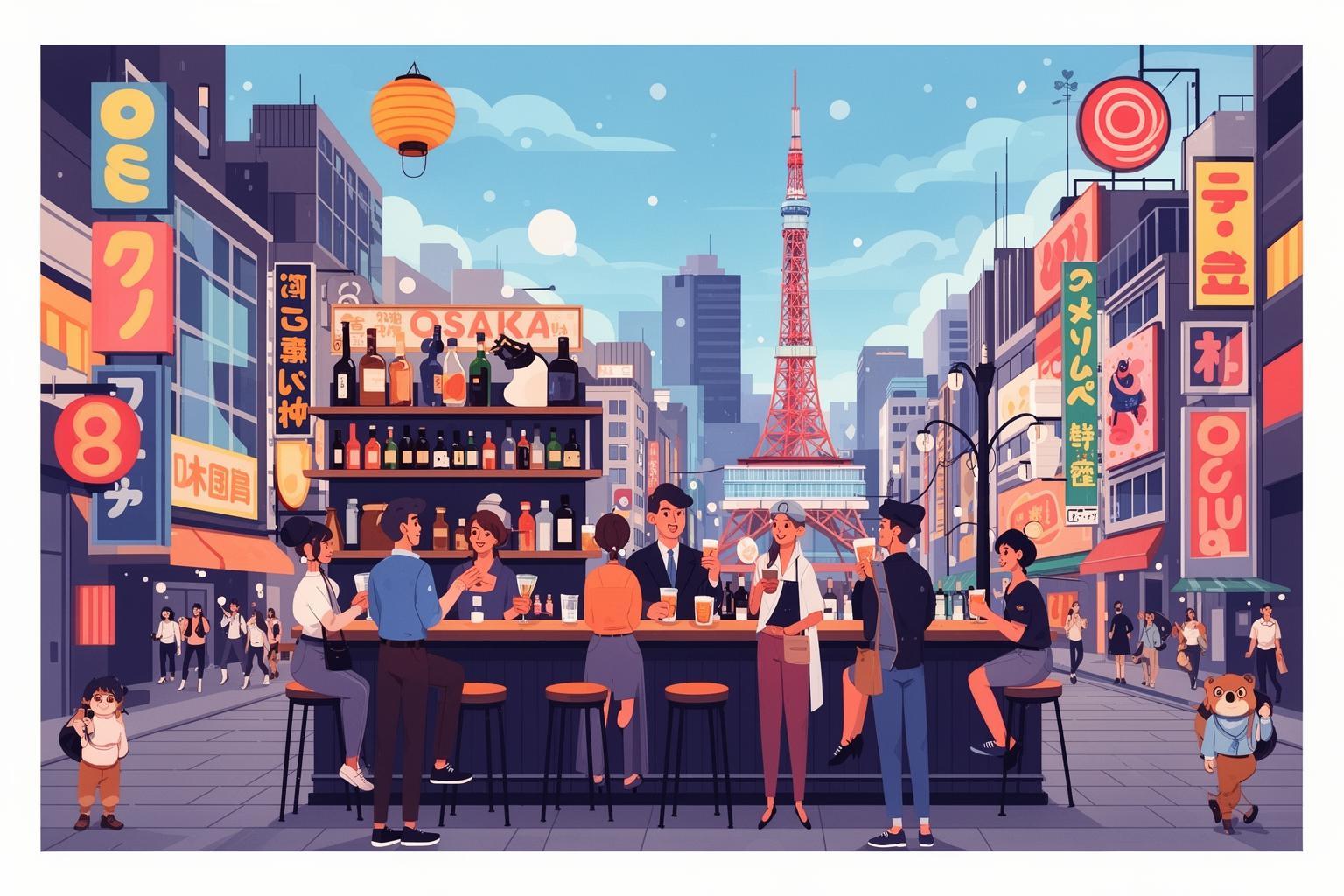
To someone unfamiliar, a standing bar might appear as a novelty, a somewhat uncomfortable way to enjoy a beer. However, in Osaka, it’s a highly developed system designed for optimal efficiency and satisfaction. This concept has been honed over decades to fulfill a specific purpose: offering a high-quality, affordable meal and drink during the brief window between finishing work and catching the train home. It intentionally rejects the leisurely dining experience, optimizing every aspect for speed and value.
The Anatomy of a Standing Bar
First, consider the space. Tachinomi are almost always tiny. Some consist merely of a counter carved into a wall, open to the street like a food stall. Others are narrow rooms where it’s barely possible to pass those standing at the bar. The key feature, naturally, is the lack of chairs. This isn’t an oversight or merely a cost-saving tactic, though it does help with both. It’s central to the philosophy. Standing applies a subtle but constant pressure to keep things moving. You’re not settling in for the night; you’re making a quick stop. The décor is minimal: a wooden counter worn smooth from countless elbows, walls covered with handwritten menus on strips of paper, a small TV in the corner showing a baseball game or news. The atmosphere arises not from interior design, but from the people, the sizzle of the grill, and the clatter of plates.
Next comes the menu, where the true brilliance of the tachinomi shines through. Visitors might expect simple bar snacks—peanuts, edamame, maybe some fried chicken. But a genuine Osaka tachinomi offers a full culinary experience. This includes fresh sashimi, sometimes featuring cuts of tuna or bonito that would command high prices at seated restaurants. There are yakitori skewers glazed in sauce and grilled to perfection. You’ll find bubbling pots of oden, with daikon radish, tofu, and fish cakes simmering in a delicate dashi broth. A signature dish at many Osaka tachinomi is doteyaki—beef sinew stewed for hours in a rich, sweet miso sauce until meltingly tender. Tempura, fried to a light crisp, and a rotating selection of seasonal specials based on the day’s market haul also appear. This food isn’t meant just to soak up alcohol; it’s the main attraction. Dinner is served in three-to-five-bite portions.
The pricing model completes this ingenious puzzle. The philosophy of ‘senbero,’ meaning ‘getting tipsy for 1,000 yen,’ is frequently linked to these establishments. And it holds true. A draft beer might cost 300 yen, a plate of sashimi 350 yen, and a couple of yakitori skewers 250 yen. You can enjoy a beer and two or three substantial, delicious dishes for less than a fancy coffee in Tokyo. This remarkable value, or ‘cospa’ as it’s known locally, isn’t just a bonus; it is the essence. It makes this daily ritual accessible to everyone, from a young office worker to a retired pensioner.
The Tachinomi as a Time-Saving Machine
The act of standing is fundamental to the tachinomi experience. It subtly governs the rhythm of your visit. Standing increases your awareness of time passing. You’re less likely to get lost in your phone or engage in lengthy conversations. The flow is natural: arrive, find a spot, order, eat, drink, pay, and leave. The entire process may take as little as twenty minutes. For the average Osaka worker with a long commute, this is a blessing. It offers a moment for yourself, a buffer between work stresses and family duties, without committing to a two-hour meal.
This commitment to speed and efficiency is quintessentially Osaka. The city was founded by merchants, and the spirit of ‘hayai, yasui, umai’ (fast, cheap, delicious) is embedded in its DNA. It’s the same principle behind fast food icons like instant ramen and conveyor belt sushi. Osakans are famously impatient, not out of rudeness but from a deep respect for time—both theirs and others’. In a tachinomi, you see this approach in practice. The owner moves with fluid, practiced economy. Orders are taken, cooked, and served astonishingly fast. Customers eat with focused appreciation. There is no lingering.
Compare this to a typical izakaya. Once seated, you enter a different social contract. You are expected to stay longer. You receive an ‘otoshi,’ a small appetizer that doubles as a seating charge. The pace is slower, encouraging group conversation. The tachinomi discards all of this. There is no seating charge and no expectation of a drawn-out visit. It is the most transactional—and thus the most liberating—dining format. You are a free agent, able to drop in for a single plate and drink or embark on a multi-stop ‘hashigo-zake’ (bar-hopping) tour, crafting your own progressive dinner one standing bar at a time.
The Social Fabric Woven at the Counter
While the tachinomi exemplifies efficiency, it would be wrong to view it as a cold or impersonal experience. On the contrary, these small spaces serve as vibrant social hubs, creating a unique temporary community each night. The close quarters and shared counter dissolve the usual social barriers found in more formal venues, fostering an atmosphere that is both communal and respectful of individual autonomy.
The Unspoken Rules of Engagement
Like any Japanese social environment, the tachinomi has its own unspoken code. Learning these rules is essential to fully enjoying the experience. Upon arrival, you don’t wait to be seated; instead, you look for an open spot at the counter, catch the eye of the owner or staff, and ask, ‘Ii desu ka?’ (Is it okay?). Then, you slide into the space, making yourself as small as possible. This is the tachinomi shuffle, a subtle dance of accommodation. You keep your bag at your feet or hang it on a small hook, and remain mindful of your elbows. Personal space is shared, and everyone is expected to be considerate.
Ordering is straightforward and direct. Frequently, the first words someone utters are ‘Toriaezu, nama,’ meaning ‘For now, a draft beer.’ It’s the standard opener. After that, you can point to the handwritten menus on the wall or, if feeling adventurous, look at what the person next to you is eating and say, ‘Are, onegaishimasu’ (That one, please). Payment is usually handled through a ‘cash on delivery’ system. You receive a small tray or basket into which you place the cash for each dish as it arrives. This simplifies leaving; when ready, there’s no need to call someone for the bill. You simply gather your belongings, give a slight nod with a ‘Gochisousama’ (Thanks for the meal), and head out.
The key rule is to respect the flow. Don’t occupy a counter spot for hours nursing a single drink. The unspoken understanding is that you’re there to eat and drink. Once finished, it’s courteous to make room for the next person waiting. This self-regulating system enables these tiny bars to serve many customers each night. It’s a collective effort, a shared understanding that keeps everything running smoothly.
The Accidental Community
Step into a tachinomi on any weeknight, and you’ll witness a perfect cross-section of Osaka society. There’s a group of salarymen in matching dark suits, ties loosened, laughing heartily. Nearby, a young woman reads a book while enjoying tempura. Further down, two elderly gentlemen debate the Hanshin Tigers’ chances this season. The counter acts as a great equalizer. Job titles and income don’t matter here; everyone stands side by side, sharing a meal.
This creates a unique and wonderful social dynamic. It is simultaneously anonymous and intimate. You can stand for thirty minutes, eat your fill, and not say a word—with no one thinking it odd. Or, you can easily strike up a conversation with your neighbor. The shared experience and proximity naturally invite interaction. A simple remark about the food—‘That looks delicious’—can spark a ten-minute chat with a stranger. Osakans tend to be more direct and open than their Tokyo counterparts, and the tachinomi atmosphere enhances this trait. They are curious and often happy to talk with a foreigner who has wandered into their local watering hole.
This stands in stark contrast to the social isolation often felt in a big city like Tokyo. While Tokyo has its standing bars, the vibe is usually more reserved and functional. In Osaka, the tachinomi feels like an extension of the public square—a place where social friction nearly disappears. The barrier to entry, both financially and socially, is remarkably low. There’s no need for a reservation or a companion. All you need is a few hundred yen and the willingness to stand for a while. It’s a genuinely democratic dining experience.
Tachinomi vs. Tokyo: A Tale of Two Cities’ After-Work Rituals
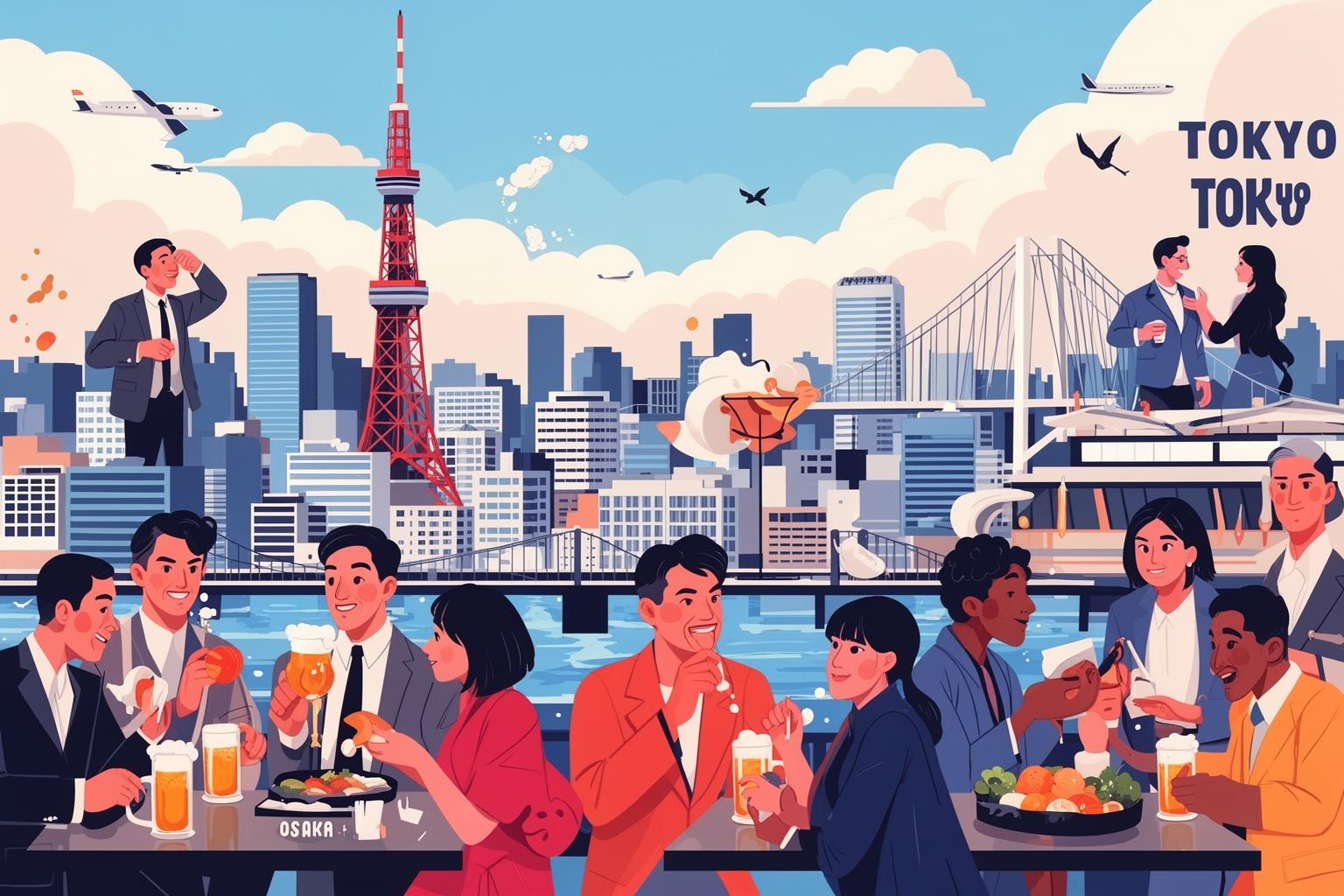
To fully understand the significance of tachinomi in Osaka, it is helpful to compare it with Tokyo’s after-work practices. While both cities share a strong culture of drinking and dining with colleagues, their underlying philosophies differ greatly. Osaka’s tachinomi embodies spontaneity, individuality, and straightforward value, whereas Tokyo’s customs tend to be more structured, group-focused, and concerned with image.
The Philosophy of the Quick Stop
In Tokyo, the predominant after-work social event is the ‘nomikai,’ a prearranged drinking party with coworkers. These gatherings are often quasi-mandatory and involve complex customs regarding seating arrangements, who pours drinks for whom, and acceptable conversation topics. Usually held at seated izakaya, these events can last hours and often include multiple rounds (‘nijikai,’ ‘sanjikai’) at various venues. Although enjoyable, they can also feel like an extension of the workday—a performance of social obligation.
Osaka’s tachinomi stands in stark contrast. It is seldom a planned group outing; more often, it is a spontaneous choice made by an individual on their way home. It represents a moment of personal freedom, not corporate responsibility. You visit because you want to, not because your boss expects it. You might stay for 15 minutes or 45. You can chat with strangers or stand silently in thought. This focus on individual autonomy mirrors the Osakan spirit, historically more entrepreneurial and less constrained by the rigid hierarchies characteristic of corporate Tokyo.
For Osaka’s workers, the tachinomi serves as both a practical and emotional buffer. It provides a space to shift from ’employee’ to ‘self’ before heading home. It’s a quick, satisfying, and affordable way to mark the end of the day, washing away stress with a cold beer and hot food, free from social pressures. In its own way, it is a form of self-care, carried out with the efficiency typical of Osaka.
Cost Performance (‘Cospa’) as a Moral Imperative
The contrast between Osaka and Tokyo is perhaps most evident in their attitudes toward money and value. Tokyo emphasizes prestige, branding, and ambiance, with people willing to pay more for a meal in a stylish restaurant in a trendy area. In Osaka, the key measure of success is ‘cospa’—cost performance. It is a passionate city-wide obsession. An Osakan will proudly share a discovery of incredible sushi offered at a remarkably low price. This isn’t about frugality; it’s about intelligence—a deep-rooted cultural appreciation for good value, a legacy of Osaka’s history as Japan’s merchant capital.
The tachinomi embodies ‘cospa.’ Its business model is centered on delivering the best quality at the lowest cost. Owners are experts at sourcing the finest ingredients at the best prices from local markets. Low overheads—no chairs, minimal staff, small spaces—allow these savings to be passed directly to customers. A tachinomi that charges too much or serves mediocre food won’t last long in Osaka, as public opinion is swift and harsh.
This mindset may be misinterpreted by outsiders as a lack of sophistication, but that misses the point entirely. For Osakans, the charm lies not in elaborate décor or attentive service, but in the intrinsic quality and honesty of the food. A plate of freshly caught, expertly sliced octopus for 300 yen is considered far more impressive than a mediocre pasta dish for 2,000 yen served on a tablecloth. The tachinomi celebrates substance over style, daily affirming that in Osaka, what truly matters is what’s on your plate and how much remains in your wallet.
The Tachinomi as a Culinary Proving Ground
It’s easy to assume that a place where you eat standing up, surrounded by strangers, and pay very little for your food would compromise on quality. This is perhaps the biggest misconception about tachinomi. In reality, these establishments are often culinary powerhouses, serving dishes that are fresher and more skillfully prepared than those in many mid-range restaurants. The format itself requires a high level of quality and expertise.
Where Quality Meets Speed
The business model of a tachinomi depends on high volume and rapid turnover, serving many customers in a short time. This directly and positively affects the freshness of the ingredients. The owner can’t afford to have food sitting around; they buy only what’s needed for the day, and once it’s gone, it’s gone. That’s why menus are often handwritten, changing daily based on the best available produce and seafood from the local market. The fish in the sashimi you’re eating at 6 p.m. was likely swimming in the ocean or auctioned at the market just a few hours earlier.
Consider the logistics. A small kitchen with limited storage can’t rely on frozen or pre-packaged ingredients. Everything must be fresh and move quickly. The doteyaki simmers slowly all day to reach perfect tenderness. The tempura batter is mixed in small batches to keep it light and crispy. The yakitori is skewered and grilled to order. This is fast food in the literal sense—served quickly—but it’s the opposite of junk food. It’s honest, ingredient-driven cooking, prepared with care and served without pretension.
The Masters of the Counter
At the heart of this operation is the ‘taisho,’ the owner or master of the bar. Often seasoned chefs, they choose the tachinomi format for its directness and low overhead. Watching a taisho work during peak hours is like witnessing culinary ballet. In a space no larger than a walk-in closet, they simultaneously take orders, pour drinks, grill skewers, slice fish, collect payments, and chat with regulars. It’s a masterclass in efficiency and multitasking.
Their personality is the soul of the establishment. Some are gruff and silent, communicating through nods and grunts, focusing solely on the food. Others are outgoing and talkative, treating customers like old friends. They are the gatekeepers of tachinomi’s unique culture, and a good taisho knows their regulars by name and drink order. This personal connection—this sense of being in ‘their’ place—is a huge part of the appeal. You are not just a customer; you are a guest at their counter. This direct relationship between producer and consumer is often lost in larger, more impersonal dining spots. At a tachinomi, the person who cooked your food stands right before you, fostering a sense of trust and appreciation.
Navigating Your First Tachinomi: A Practical Guide for the Uninitiated

Visiting a tachinomi for the first time can feel intimidating. It’s a crowded, fast-moving space with its own unique cultural customs. But with some basic knowledge and the right mindset, it can be a truly rewarding experience. The key is to stay observant, polite, and adaptable.
Reading the Room
Your initial task is picking a spot. The best signs of a good tachinomi are universal: follow the crowd. If a place is full of locals around 6:30 p.m. on a Tuesday, it’s likely worth trying. Look for red lanterns (‘akachochin’) outside, a traditional marker of an affordable drinking spot. Peek inside. Does it feel inviting? Is the menu visible, even if you don’t understand it? Trust your instincts.
Once you’ve picked your place, the entrance becomes your next challenge. Avoid lingering awkwardly in the doorway. Step inside confidently, make eye contact with the taisho, and give a slight nod. If there’s an open spot, you can point and ask, ‘Koko, ii desu ka?’ (Is this okay?). If it’s packed, you might need to wait a few minutes for a place to free up. Be patient. Turnover is quick. When you find your slice of counter space, settle in neatly. Hang your coat and bag on the hooks or place them on the floor, out of others’ way. The goal is to slot smoothly into the existing human puzzle.
The Language of Ordering
If you don’t speak Japanese, don’t worry. Tachinomi is an excellent place to practice non-verbal communication. Start with the universal opener: ‘Nama, hitotsu’ (One draft beer). This gives you time to observe. Notice what others are eating. If something looks good, just point and say, ‘Sumimasen, are o onegaishimasu’ (Excuse me, that one please). Most taisho are accustomed to this and happy to assist.
Many dishes are displayed in glass cases on the counter, making pointing straightforward. You can also learn a few key words for common items: ‘sashimi’ (raw fish), ‘yakitori’ (grilled chicken skewers), ‘karaage’ (fried chicken), ‘edamame’ (soybeans). Don’t be shy about trying to pronounce words. Your effort will be appreciated. Remember how the payment system works. Keep cash and coins ready in the tray on the counter. It’s a system based on trust and convenience. Attempting to use a credit card will likely be met with a confused shake of the head.
The most important thing to bring is an open mind. You might try something unfamiliar. You could have a short, broken conversation with a friendly salaryman. You might simply stand back and soak in the lively atmosphere. All of these are worthwhile experiences. The tachinomi isn’t just about eating and drinking; it’s about briefly immersing yourself in the real, unpolished daily life of Osaka.
In the end, the standing bar perfectly reflects Osaka itself. It’s a bit rough around the edges, pragmatic, and unconcerned with appearances. But it’s also warm, efficient, remarkably generous, and offers great rewards to those who step inside and engage on its terms. It’s where you’ll find some of the city’s best food and get a genuine taste of its people’s character. It’s a place that knows that sometimes the best conversations happen, the best meals are enjoyed, and the strongest sense of community is found, all while standing, ready for whatever the night may bring next.