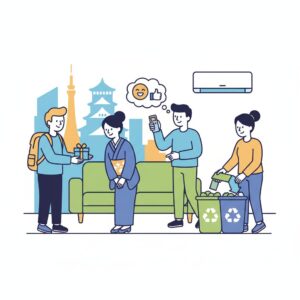
So you’ve made it to Osaka. You found an apartment, you’ve navigated the train system, and you’ve even figured out that “`maido`” is more than just a greeting; it’s a rhythm, a pulse that keeps the city moving. You’re feeling good. You’re starting to feel like a local. Then comes the first real test, the one that no guidebook prepares you for. It’s not about ordering at a crowded `tachinomi` bar or understanding the nuances of Kansai-ben. It’s about taking out the trash.
Sounds simple, right? You’ve seen the charts from the city office with their color-coded categories: burnables on Monday and Thursday, plastics on Wednesday, cans and bottles on Friday. You bought the official city-designated garbage bags. You’ve dutifully rinsed your PET bottles and separated your newspapers. You place your bag neatly at the designated collection point, the “Gomi Station,” a cage-like enclosure or a specific spot on the corner marked by a net. You’ve followed the rules. You walk away, proud of your civic diligence. The next day, you find a small, handwritten note taped to your apartment door. Or worse, your bag has been opened, the offending item placed on top for all to see, a silent, public shaming. Suddenly, you realize the official rules were just the beginning. Welcome to the deep, unspoken world of the neighborhood Gomi Station, the true social heart of daily life in Osaka. This isn’t just about waste management; it’s about community, unspoken agreements, and the pragmatic, no-nonsense attitude that defines this city. Understanding this space is understanding Osaka itself.
To truly grasp these unspoken community dynamics, it’s essential to explore other local institutions like Osaka’s neighborhood community centers.
The Two Sets of Rules: The City’s and The Street’s
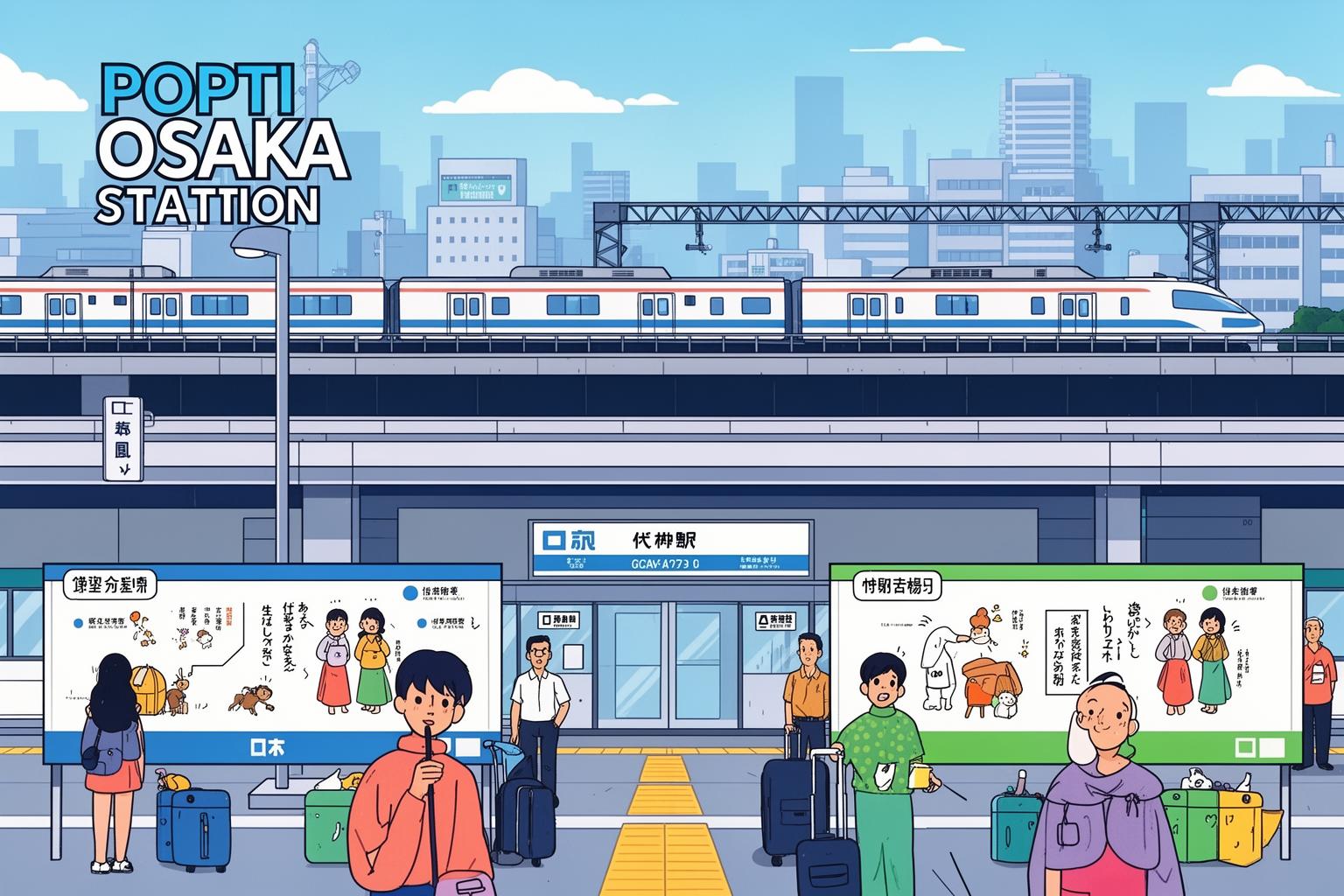
Every resident of Osaka follows two legal systems regarding garbage disposal. The first is the official municipal code: logical, standardized, and accessible online in several languages. This is the foundational guideline. However, the second system—the one that truly matters—is the unwritten set of rules specific to your building, your block, or your `chounaikai` (neighborhood association). This local code is flexible, enforced by your neighbors, and understood only through observation and occasional gentle (or not-so-gentle) corrections. Ignoring this second system is what usually causes problems.
The Official Blueprint: The City’s Instructions
Let’s cover the straightforward part first. The city of Osaka, like other Japanese municipalities, has a highly organized system divided into categories:
- Burnable (`Moeru Gomi`): Kitchen waste, paper scraps, wood, and other organic materials go into designated transparent or semi-transparent bags. Collection days are fixed, usually twice weekly.
- Plastics and Packaging (`Yoki Hoso Purasuchikku`): This includes supermarket `bento` trays, snack wrappers, styrofoam, and plastic bottles for items like shampoo or detergent. These must be rinsed thoroughly with no food residue—a common stumbling block for newcomers.
- Cans, Glass Bottles, and PET Bottles (`Aki-kan, Aki-bin, Petto Botoru`): Usually collected on the same day but sorted into separate containers or bags at the collection point. Again, thorough rinsing is required. PET bottle lids and labels often go with plastics. Yes, it’s that detailed.
- Used Paper and Clothing (`Koshi / Furugi`): Newspapers, magazines, cardboard, and old clothes must be neatly bundled with string—not placed in bags.
- Large-sized Garbage (`Sodai Gomi`): Items like microwaves or bookshelves require a separate process involving calling the city, purchasing special stickers from convenience stores, and scheduling a specific pickup day.
This is the basic framework—the skeleton. But the essence, the part causing confusion and anxiety, is the neighborhood overlay.
The Neighborhood Overlay: Where Real Life Unfolds
Living in a dense urban setting like Osaka demands a strong sense of mutual consideration. The Gomi Station is the stage for this daily social performance. Your neighborhood’s rules are designed to minimize inconvenience for everyone.
The Art of the Crow Net (`Karasu Netto`)
In many neighborhoods, especially those with low-rise buildings, the Gomi Station isn’t a metal cage but a designated sidewalk spot covered by a large, weighted yellow or blue net. This net is the first defense against the city’s crafty crows. These birds aren’t merely pests; they are cunning, destructive agents that will rip open any improperly sealed bag in seconds, scattering your week-old kitchen waste across the pavement. The net is a shared tool, governed by strict, unspoken rules. Who puts it out each morning? Who folds it neatly after collection? Some buildings have a rotation system, the `gomi-tōban` duty, while others rely on whoever puts their garbage out first to unfold the net and whoever notices last to fold it back up. The worst offense is leaving your bag next to a neatly folded net without taking the 30 seconds to cover it or tossing it on top carelessly, exposing a corner. If a crow attack happens under your watch, you’ve let down the community and created a mess that usually an older, conscientious resident must clean. This is not seen as laziness but as a serious lack of consideration and a fundamental social failing.
The Geometry of Placement
You might assume the goal is simply to get the bag beneath the net or inside the cage. It’s not. There’s a precise way the bags must be arranged. The day’s first bags go to the back, leaving room for others. Bags should be stacked neatly—not haphazardly piled—and must not block the cage’s entrance or hinder the next person’s placing. Why? Because Osaka values practicality. A neat station is an efficient one, making things easier for neighbors and, crucially, the sanitation workers who clear hundreds of stations before noon. Making their job harder violates this pragmatic code. You’ll often see older residents carefully rearranging bags to create a stable, efficient stack. This isn’t an obsessive habit; it’s a practical lesson in managing public space.
The Unspoken Time Window
The city instructs, “Put out your garbage before 8:30 AM on collection days.” The neighborhood adds a much more specific rule: don’t put garbage out the night before. This isn’t just about crows; it’s about odor and appearance. Leaving trash out overnight is considered unclean and disrespectful to the shared environment, lowering the block’s standards. There’s also a morning etiquette—putting out noisy bottles and cans at 5 AM is a major faux pas in many quiet residential areas, as it disturbs light sleepers like Mrs. Sato on the first floor. The acceptable window is often an unspoken agreement—perhaps between 7 AM and 8 AM—early enough for collection but late enough to respect quiet. How do you learn these norms? By watching, listening, and observing your street’s rhythm in the days before your first disposal.
The Gomi Station as a Social Theater
Beyond practical matters, the Gomi Station serves as a stage where social hierarchies, community values, and interpersonal dynamics unfold every single day. The actors are your neighbors, and the script is one you’re expected to learn on the spot.
The Guardians of the Garbage
In nearly every neighborhood, there is a guardian—often an older, retired person, a woman (`obachan`) or a man (`ojichan`), who has lived on that street for decades. They see the Gomi Station as an extension of their own home. It is their duty, their `ikigai` (reason for being), to maintain order. They are the keepers of the unwritten rules. They will re-sort your improperly separated plastics. They will fold the crow net with military precision. And they will correct you when you make a mistake.
This is where a major cultural difference, especially between Osaka and Tokyo, becomes evident. In Tokyo, corrections are often delivered passively and anonymously. You might find a pre-printed, extremely polite note from the management company, or a sticker placed on your bag indicating a rule violation. The aim is to correct the behavior while avoiding direct confrontation and preserving surface harmony (`tatemae`).
Osaka is different. Osaka is direct. The guardian of the Gomi Station in your Osaka neighborhood is far more likely to approach you personally, just as you’re about to set your bag down. “`Chotto, chotto!`” (Hey, wait a minute!), they might say, pointing at your bag. “`Sore, purasuchikku no hi chau de.`” (That’s not for plastics day.) To a foreigner used to less direct communication, it can feel blunt or even aggressive. But it’s important to grasp the intent. This isn’t about scolding you. It’s about efficiency. There’s a problem, and the quickest way to fix it is to address it immediately. It’s a form of practical kindness. They’re teaching you the rules so you don’t repeat the mistake. They’re integrating you into the community by holding you accountable to its standards. The right response is not to become defensive. Instead, show surprise, apologize sincerely (“`Ah, sumimasen!`”), thank them for the lesson (“`Oshiete kurete arigatou gozaimasu!`”), and promptly correct your error. Doing this means you’ve not only learned a rule but also shown respect and passed a crucial social test. You’ve demonstrated your willingness to be part of the team.
Reading the Non-Verbal Cues
Sometimes, the lessons come silently. One of the most common—and embarrassing—experiences for a new resident is the “public dissection.” You might return home to find your garbage bag placed beside the Gomi Station rather than inside it, with a single offending item displayed on top. For instance, a small metal bottle cap resting on a bag of burnable trash. This silent but powerful message says: “This is not acceptable. Learn the rules.” It’s a form of public accountability. Your trash isn’t anonymous. It reflects on you and, by extension, on the entire community. A disorganized Gomi Station suggests a careless, inconsiderate community—something no self-respecting Osaka neighborhood will tolerate.
The Gomi Station often doubles as the community bulletin board, the `keijiban`. Here, you’ll find official notices from the neighborhood association about upcoming festivals or cleaning days. But you’ll also see laminated, handwritten signs that serve as monuments to past transgressions. “PLEASE RINSE YOUR PLASTIC CONTAINERS! THEY ARE ATTRACTING PESTS!” or “DO NOT PUT OUT YOUR TRASH THE NIGHT BEFORE!” These signs, frequently written in bold calligraphy, are the scars of previous battles—reminders to the community of the standards that must be maintained.
What Your Trash Reveals About You
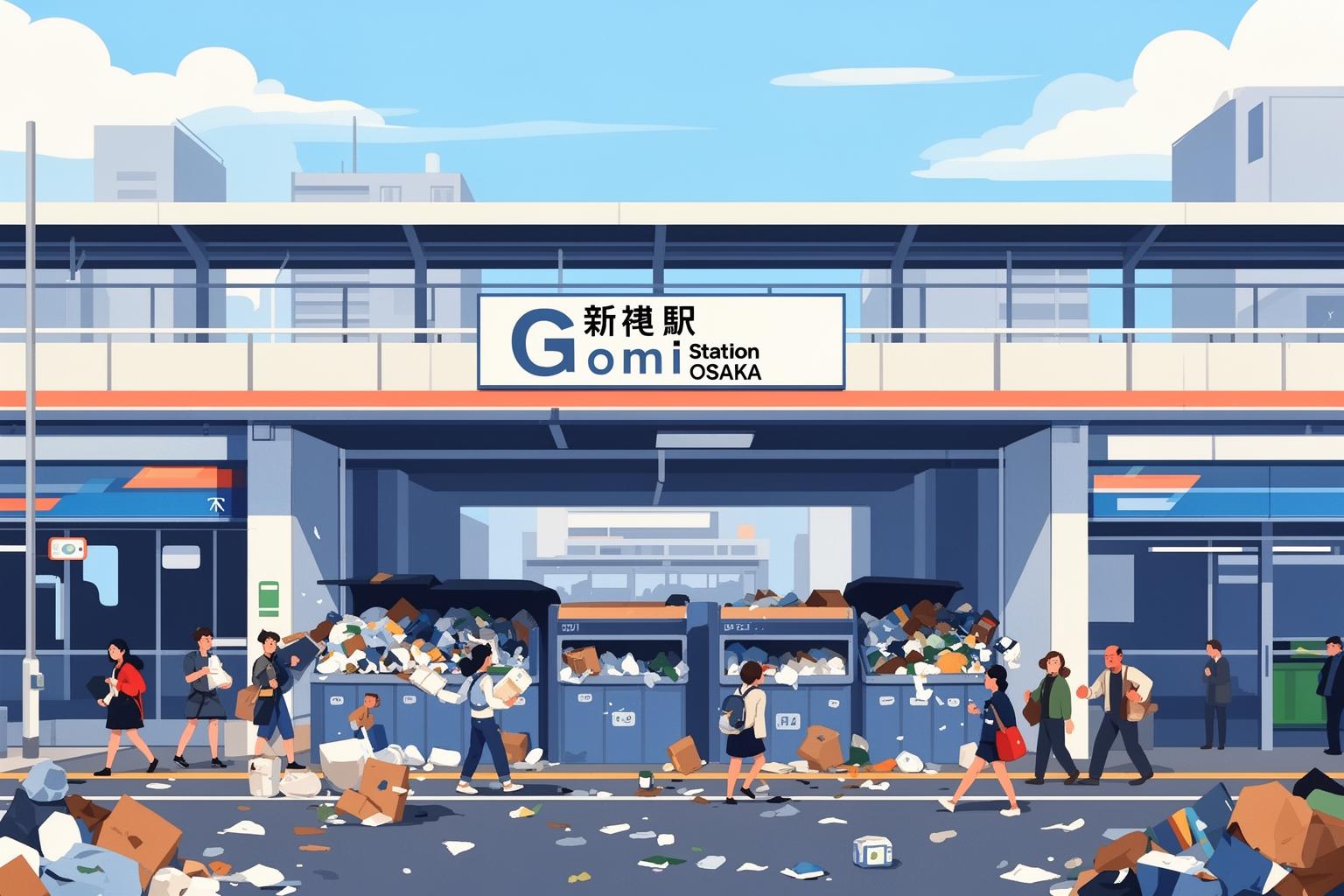
In many Western cultures, garbage is considered a strictly private matter. Once it’s bagged and placed on the curb, it’s quickly forgotten. In Japan, especially in Osaka, it serves as a public statement. The use of semi-transparent bags means your consumption habits are somewhat visible to others.
The Transparent Bag and Social Pressure
Your neighbors can spot the heap of empty instant noodle cups, the stack of beer cans, and the number of supermarket `bento` containers. Is anyone actively judging you? Probably not—people in Osaka generally have more important things to focus on. Yet this visibility generates a subtle, ongoing social pressure, encouraging a degree of conformity and self-awareness. You know your choices aren’t completely private. Although this system isn’t intended for surveillance, it effectively functions that way. It reinforces the idea that your individual actions contribute to a larger community. Disposing of a large, perfectly good piece of furniture might trigger whispers: “Are the Tanakas moving? I hope everything is okay.” Your waste tells a story, and in a close-knit neighborhood, people are paying attention.
This is why proper sorting is crucial. It’s not just about obeying rules; it’s about presenting yourself as a capable, considerate member of society. A perfectly sorted bag signals that you are `chanto shiteru`—that you have your life in order and take responsibility. It’s the Japanese equivalent of maintaining a well-kept lawn.
`Sodai Gomi`: The Final Boss of Garbage Disposal
If regular garbage is a daily quiz, dealing with large items, or `Sodai Gomi`, is the final exam. This is a multi-step, highly ritualized process. Suppose you want to discard an old microwave.
First, you can’t simply leave it out. You must call the city’s `Sodai Gomi` center or apply online, providing the item and its dimensions. They will inform you of the fee—say, 400 yen—and the specific date for collection, which might be two weeks later.
Next, you must purchase a `Sodai Gomi` processing sticker (`shori tesuryo ken`) for the exact fee at a designated convenience store or post office. It’s like buying a ticket for your trash.
After that, you fill out the sticker with your name or confirmation number and affix it clearly on the item.
Finally, on the designated morning—and only that morning—you place the item in the designated spot. Not the regular Gomi Station, but a specific location for large items. Leaving it there a day early is a cardinal sin; it’s an eyesore and considered `jama` (in the way), a term often heard in practical-minded Osaka. Your neighbors will see your old, sticker-adorned microwave sitting out. The sticker with your name proves you followed the proper procedure and took responsibility for your waste. Trying to dump it secretly in the middle of the night is one of the most anti-social acts imaginable, and you can be sure the neighborhood guardians will be watching.
The Why: Pragmatism, Crows, and Community
It may be easy to see these rules as mere obsession with tidiness for its own sake. However, this is a misconception. The complex choreography around the Gomi Station is grounded in deeply practical concerns that align with Osaka’s spirit.
The Practical Logic of Efficiency
Osaka was established by merchants. It’s a city that prizes common sense, efficiency, and straightforwardness. At their core, the garbage rules aim to keep a complicated, densely populated system running smoothly. When everyone sorts correctly, the collection process becomes extremely quick. Workers can move efficiently, recycling facilities operate effectively, and costs stay low. Tossing a plastic bottle into burnable trash isn’t just breaking a rule; it disrupts a finely tuned system. It creates extra work for someone later on. In a city that honors diligence and pragmatism, this is viewed as disrespectful.
The War Against the Crows
Never underestimate the significance of the `karasu`. They are a real nuisance. A single poorly managed Gomi Station can lead to a filthy, unhygienic mess that someone has to clean up. Rules about not placing trash out the night before, using nets properly, and sealing bags tightly are frontline tactics in an ongoing urban battle. It’s a collective defense agreement. Ignoring these rules weakens the neighborhood’s overall protection.
The `Chounaikai` and Communal Responsibility
In many areas, the Gomi Station is maintained by residents through the neighborhood association, the `chounaikai`. This often includes a rotating cleaning duty, the `gomi-tōban`, where a different household takes responsibility each week for sweeping and ensuring cleanliness after collection. Opting out of this duty is essentially stepping away from community membership. Taking part builds trust and social capital. It provides a chance to briefly chat with neighbors and learn who lives on your street. It’s a small but regular ritual that weaves the neighborhood’s social fabric together. The Gomi Station is communal property, and how you treat it directly reflects your dedication to the community.
A Survival Guide for the Osaka Newcomer
Navigating this intricate social system can feel daunting, but it’s certainly achievable. It just demands a shift in perspective from prioritizing personal convenience to considering the community as a whole.
Your First Steps: Observe and Ask
- Be a Watchful Observer: During your first week in the new area, avoid putting out any garbage. Instead, pay close attention. Notice when your neighbors take out their trash. Observe how they fold the net. Watch how the bags are arranged. Take in the local routine.
- Request Guidance: Locate your building manager (`kanrinin`) or a neighbor who seems approachable and ask them directly. Showing a bit of vulnerability can go a long way. Saying, “I’m new here and want to make sure I’m doing this right. Am I following the correct procedure?” will almost always receive a positive and helpful reply. In Osaka, people value straightforwardness and a willingness to learn. They prefer teaching you upfront rather than correcting you later.
- Obtain the Proper Supplies: Don’t try to use a black plastic bag from your home country. Visit the nearest supermarket or convenience store to purchase the official, city-approved bags. Using an incorrect bag is the most basic error and immediately signals that you haven’t made an effort.
How to Handle a Correction
At some point, you will likely slip up. When corrected—whether verbally by a neighbor or with a note on your door—resist the urge to become defensive. Avoid explaining your reasoning, as this can come off as arrogance.
- The Right Response: The ideal approach is a quick apology, gratitude for the correction, and a commitment to improve. Saying “`Sumimasen!`” (I’m sorry!), followed by “`Ki o tsukemasu`” (I’ll be more careful), and “`Arigatou gozaimasu`” (Thank you) completes the interaction. You demonstrate humility and respect for local customs. The person correcting you will then likely view you as a responsible newcomer, not a nuisance.
- View It as a Gift: A correction is vital cultural insight. It’s a free lesson on how to live here. It’s an act of inclusion rather than exclusion. They share the rules because they expect you to become part of the community. If they doubted your ability to learn, they’d simply ignore you.
Ultimately, the Gomi Station is more than just a place to discard your trash. It’s a daily reflection of the neighborhood’s well-being. It’s where the idea of “community” turns into a concrete, shared obligation. While it can be stressful for foreigners, it’s also one of the earliest and most crucial chances to earn respect. Mastering the unwritten rules of the Gomi Station—demonstrating consideration, attentiveness, and adaptability—is a strong message to your neighbors. It tells them you’re not just a passing visitor in their city but a resident, a team member who understands that in Osaka, even something as ordinary as taking out the trash is an act of connection.