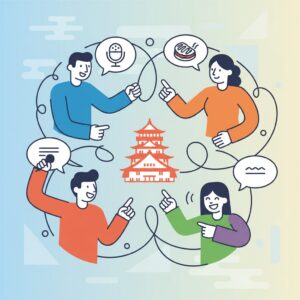
Step into an office in Osaka, and you feel it almost immediately. It’s a subtle shift in the air, a different frequency. The low, respectful hum you might expect from a Japanese workplace is often replaced by something more energetic, more audible. You’ll hear bursts of laughter, spirited debates that sound almost like arguments, and a pace that feels less like a marathon and more like a series of sprints. If you’ve come from Tokyo or have a picture of corporate Japan painted by media, this can be disorienting. It begs the question: Why does working in Osaka feel so fundamentally different? The answer isn’t in a modern business manual; it’s etched into the city’s soul. It’s called ‘Akindo Spirit’ (商人魂, shōnin-damashii), the spirit of the merchant, and it’s the invisible software running almost every professional interaction in this city.
This isn’t just a quaint historical footnote. For centuries, while Tokyo was the seat of samurai and political power, Osaka was the bustling, no-nonsense commercial hub of Japan, famously known as the ‘Tenka no Daidokoro’ or the ‘Nation’s Kitchen.’ It was here that rice brokers invented the world’s first futures market, and where fortunes were made not by birthright, but by wit, speed, and the ability to forge a good deal. This legacy didn’t vanish with the samurai; it simply put on a business suit. The Akindo Spirit is a pragmatic, results-driven philosophy centered on rationality, resourcefulness, and the cultivation of human relationships as the ultimate currency. Understanding this mindset is the single most important key to not just surviving, but thriving, in the vibrant, and sometimes bewildering, world of work in Osaka.
This pragmatic, results-driven mindset continues to shape the region’s modern business landscape, as seen in the ongoing Kansai’s economic boom driven by tourism and future projects.
More Than Just “Moukari Makka?”: The Core Tenets of the Akindo Mindset
The quintessential Osaka greeting, “Moukari makka?” (“Are you making a profit?”), is often misinterpreted by outsiders as coarse or money-obsessed. However, understanding its true meaning reveals the foundational principle of the Akindo Spirit. It’s not merely about money; it’s a warm, almost playful inquiry that means, “Is business going well? Are things prospering?” It acknowledges that prosperity is the goal, and there is no shame in pursuing it openly. This philosophy rests on several key pillars that are evident daily in the workplace.
Pragmatism Over Polish: Getting Things Done
In many corporate cultures, especially in the more formal environment of Tokyo, process takes precedence. The ‘nemawashi’ (根回し), the careful, behind-the-scenes consensus-building, is regarded as an art form. Meetings often serve to confirm decisions that have already been informally agreed upon. In Osaka, this approach is often viewed as inefficient. The focus isn’t on creating the most polished process; it’s on getting the job done well and quickly. This fosters a culture of deep pragmatism.
Ideas are evaluated based on their merit, not the rank of the person presenting them. A junior staff member with a brilliant, cost-saving solution often receives more attention than a senior manager advocating for a complicated, traditional method. The guiding logic is simple: what is the most rational way to achieve the best outcome? This can feel incredibly refreshing. I once attended a project meeting where a young designer, instead of delivering a lengthy presentation, simply held up a prototype and said, “The old method takes three weeks and costs this much. The new way takes one week, costs half, and the client will prefer it. We should do this.” After a moment of silence, the manager nodded and said, “Okay, do it.” There was no deference to seniority or adherence to the original plan for consistency’s sake. Better logic won immediately. This exemplifies the Akindo Spirit. It values substance over ceremony and results over routine.
The Art of the Deal: Negotiation is a Way of Life
In Osaka, a price tag is often viewed as the start of a conversation, not a final figure. This is not about being cheap; it’s about the shared pursuit of value. The Akindo Spirit holds that a good deal is one where both sides feel victorious. This attitude permeates the professional world in surprising ways. Budgets, timelines, project scopes, and vendor contracts all undergo a healthy back-and-forth. It’s a negotiation dance.
A supplier presenting a quote fully expects it to be challenged. Asking, “Is this really your best price?” is not an insult but an anticipated part of the interaction. The aim is to reach a reasonable and sustainable agreement for everyone. Outsiders might see this as confrontational or distrustful. In truth, it signifies engagement. Silence is more worrisome. Quickly accepting a proposal without question might be seen as a lack of serious thought. By probing and questioning, you demonstrate that you take the business seriously. Merchants believe a relationship built on a fair, negotiated basis is stronger than one founded on blind acceptance. It’s about forming a partnership, and partnerships begin with honest discussions about value.
Speed is Everything: The “Pari-Pari” Pace
There’s a distinct sense of urgency in Osaka’s business world. The onomatopoeic term ‘pari-pari’ (パリパリ) is often used to describe someone who works swiftly and efficiently, a trait highly prized. The mindset is that time equals money, and opportunities are fleeting. A slow decision means a missed chance. This translates into a workplace culture that prizes responsiveness and quick thinking.
If you send an important email, you can often expect a reply within the hour, if not sooner. The phrase “Kangaetoku wa” (考えておくわ), literally “I’ll think about it,” is famously understood in Osaka as a polite way of saying no. A genuine yes is followed by immediate action or a clear next step. This urgency is visible in the city’s streets. Watch the flow of people through Umeda station’s underground tunnels during rush hour; it’s a flood of purposeful movement. This isn’t aimless rushing; it’s a collective drive to reach the next task, to make the next move. For newcomers, this pace can be intense. The expectation to always be alert and ready to adapt can be exhausting, but it also creates an exhilarating atmosphere where progress is palpable each day.
The Osaka Office: A Different Kind of Ecosystem
The theoretical principles of the Akindo Spirit shape a very distinct and concrete workplace atmosphere. The physical environment, communication style, and social dynamics all embody this merchant DNA, forming an office ecosystem governed by its own unique set of rules.
Communication: Direct, Humorous, and Sometimes Loud
Forget the stereotype of the quiet, nodding office. Workplaces in Osaka are often lively and noisy. People talk, laugh, and express their opinions frankly. The communication style favors honesty over harmony. While in other parts of Japan feedback may be softened and given indirectly to avoid offense, an Osakan colleague is more likely to say, “That won’t work; the client will hate it. Try this instead.” This directness isn’t meant to be rude but to be efficient. It saves time and prevents misunderstandings later on. It shows respect through straightforwardness.
Humor is the key element that makes this directness effective. Osaka is, after all, the birthplace of Japanese comedy, and this extends beyond the stage. The ‘boke’ (funny fool) and ‘tsukkomi’ (straight man) dynamic is fundamental in social interaction. In a meeting, a manager might make an exaggerated statement (boke), and a subordinate quickly responds with a witty correction (tsukkomi). This isn’t insubordination; it’s a way to build rapport, ease tension, and make a point memorably. A well-timed joke can be more impactful than a formal reprimand. Appreciating and engaging in this banter is essential for fitting into an Osaka team.
Relationships First, Business Second (But They’re the Same Thing)
Business in Japan is famously relationship-driven, but Osaka brings its own distinct twist. Trust here feels more personal and less hierarchical. It’s less about your university or department and more about who you are as a person. Can you be trusted? Are you reasonable to work with? Do you have a good sense of humor? These questions are often answered outside the office.
The ‘nomikai’ (after-work drinking party) is a staple in Japan, but in Osaka, it often feels less like a strict obligation and more like a genuine chance to connect. Over plates of ‘okonomiyaki’ and glasses of beer, true opinions emerge, ideas are exchanged, and personal bonds are built. This is where you prove you belong to the team. The Akindo logic is that business is conducted with people you know, like, and trust. A contract is just paper; the real agreement is the human connection. Investing time in these relationships isn’t optional; it’s central to doing business here. It’s a long-term approach, building a network of people who will support you in a pinch because you’d do the same for them.
The Customer is King, but the Merchant is Clever
The saying “Okyaku-sama wa kamisama desu” (“The customer is a god”) often describes Japanese customer service. In Osaka, this is true but with an important caveat: the merchant is no fool. The aim isn’t to blindly grant every customer whim but to offer such exceptional value, service, and quality that the customer gladly pays a fair price. It’s a partnership, not servitude.
This mindset drives a culture of intense customer focus and creative problem-solving in the workplace. The key question is always, “What does the customer truly need, and how can we deliver it in a way that works for our business?” This breeds a culture of constant improvement and practical innovation. There is little tolerance for solutions that are elegant but impractical or lack clear customer benefit. Every action, process, and product feature is implicitly judged by the Akindo standard: does this offer real, tangible value to the paying customer? This unwavering focus on the end user has kept Osaka’s businesses competitive and resilient for centuries.
Navigating the Akindo Workplace: A Foreigner’s Survival Guide
Adapting to the Akindo Spirit can be challenging, but it is certainly achievable. It demands a shift in mindset—moving away from traditional views of Japanese work culture and embracing a fresh, more dynamic approach. For foreigners aiming to establish a career here, a few essential strategies can make a significant difference.
Embrace Directness and Don’t Take It Personally
When your boss or a coworker bluntly points out a flaw in your idea, your first reaction may be to feel criticized or embarrassed. Instead, try to see this feedback differently. It’s not a personal attack but a measure to improve efficiency. They are helping you avoid wasting time on a dead end. This straightforward feedback indicates they regard you as a capable professional who can handle honesty and shares the same goal: achieving the best possible result. The right response is not defensiveness but curiosity. Ask questions like, “You’re right, I understand now. What do you suggest?” or, “Which part of the client’s brief am I missing?” This shows you are collaborative and solution-oriented—qualities highly valued in Akindo culture.
Develop Your Sense of Humor
You don’t have to be a comedian, but making an effort to understand and appreciate the local style of humor is essential. Laughter is the social glue in Osaka’s workplace. Being able to laugh off a minor mistake or gently tease a colleague in a friendly manner shows that you aren’t overly formal or sensitive. It signals that you are approachable and human. If you’re always the ‘serious foreigner’ who never smiles, it will be much harder to build the personal trust that is critical for professional success here. Pay attention to the flow of banter, observe how people tease one another, and don’t hesitate to join in when it feels appropriate. This is one of the quickest ways to be accepted as part of the team.
Think in Terms of Value, Not Just Price
Whether selling a product, proposing a project, or negotiating your salary, always frame your case in terms of value. The Akindo mindset is constantly weighing cost against benefit. Don’t just present a feature; explain its advantage. Don’t merely state a cost; justify it with the return on investment. For instance, rather than saying, “We should buy this new software; it costs X yen,” say, “Investing X yen in this software will save each team member five hours a week, allowing us to handle more client work and increase profits by Y yen within six months.” This kind of language resonates deeply here. Show that you’re not just a spender but an investor who understands how to create value. This practical, results-driven thinking lies at the core of the merchant’s spirit.
Be Ready to Move Fast
In this culture, responsiveness signifies competence. When given a task, begin it promptly. When a decision is made, act on it immediately. Demonstrating a sense of urgency and keeping pace with your colleagues’ ‘pari-pari’ speed builds tremendous trust. Someone who commits to a task and completes it right away is seen as reliable and professional. In contrast, someone who must be continually chased for updates quickly loses credibility. The business environment moves forward rapidly; you either swim with the current or get left behind. Showing that you are energetic and proactive will earn you respect far faster than quiet, slow perfectionism.
Is the Akindo Spirit Right for You?
Living and working in Osaka offers an immersive experience in a culture that is unabashedly commercial, human, and vibrant. However, its distinct professional environment may not suit everyone. Considering whether your personality and work style resonate with the Akindo Spirit is an essential step for anyone thinking about relocating.
Who Thrives in Osaka?
Typically, those who thrive here are self-starters comfortable with ambiguity and change. If you prioritize results and prefer to be evaluated based on your output rather than strict adherence to formal procedures, you will likely feel at ease. Entrepreneurs, salespeople, and anyone with a practical, problem-solving approach will find the culture energizing. Enjoying authentic relationships with colleagues, valuing direct communication, and believing that a little laughter enhances the workday means Osaka’s professional atmosphere could be an exceptionally rewarding place to develop your career.
Who Might Struggle?
On the other hand, individuals who need significant structure, formality, and predictability might find the Osaka workplace stressful or chaotic. If negotiation feels uncomfortable, direct criticism is unwelcome, or you favor subtle, indirect communication, adapting here may be challenging. Those who prefer quiet, individual work over lively, collaborative settings might find the constant interaction and fast pace overwhelming. This culture rewards social agility and quick thinking, which may not suit everyone.
In the end, Osaka’s work culture isn’t inherently ‘better’ or ‘worse’ than Tokyo’s; it’s simply a different system shaped by a unique history. To outsiders, it may appear loud, abrupt, and relentless. But understanding its core—the Akindo Spirit—reveals a foundation built on rationality, efficiency, and a profound belief in the power of human connection. It is a culture forged in the marketplace, where success depends on being sharp, fast, and trustworthy. Cracking this code unveils not only a business method but also the dynamic, pragmatic, and deeply human heart of Osaka itself.