It happens when you least expect it. You’re standing on a crowded platform at Umeda Station, feeling the collective sigh of the city as the express train to Kobe pulls away. Or perhaps you’re navigating the glorious, chaotic aisles of a Super Tamade, trying to decide between three different brands of ponzu sauce. It could be anywhere, really. A quiet park bench in Tennoji, a queue for a takoyaki stand in Namba, the slow, rumbling journey of a city bus through the residential backstreets of Abeno. Suddenly, you feel a gentle tap on your arm. You turn, and a woman of a certain age—her hair a magnificent, gravity-defying shade of purple, her blouse a vibrant pattern that would make a jungle cat blush—is holding something out to you. It’s small, wrapped in crinkly plastic, gleaming like a tiny jewel in her palm. It’s a piece of candy. She smiles, a crinkle of laugh lines around her eyes, and says, “Ame-chan, douzo.” Here you go, a little candy.
For the uninitiated, the foreigner freshly arrived from the pristine, ordered silence of Tokyo or the polite reserve of a Western metropolis, this moment is a system shock. Your internal monologue screams a dozen questions. Who is this woman? Why is she giving me candy? Is it safe? Is this a trick? What does she want from me? You’ve been conditioned to believe that unsolicited interactions with strangers in a massive city are, at best, a sales pitch and, at worst, a threat. But here, in Osaka, you’ve just had your first encounter with one of the city’s most fundamental and misunderstood social rituals: the philosophy of ‘ame-chan.’ This small, sweet offering is not just a piece of confectionery. It is a key that unlocks the entire social operating system of Osaka. It is a gesture that explains more about the soul of this city than any guidebook ever could. It’s the starting point of a conversation, a momentary alliance against the anonymity of urban life, and the primary tool of the city’s true power brokers: the Osaka Obachan. To understand this candy is to begin to understand the vibrant, baffling, and deeply human rhythm of life in Japan’s magnificent second city.
This philosophy of connection and exchange is deeply intertwined with the city’s unique merchant spirit, which has shaped its social and economic character for centuries.
Decoding the ‘Ame-chan’: More Than Just a Piece of Sugar
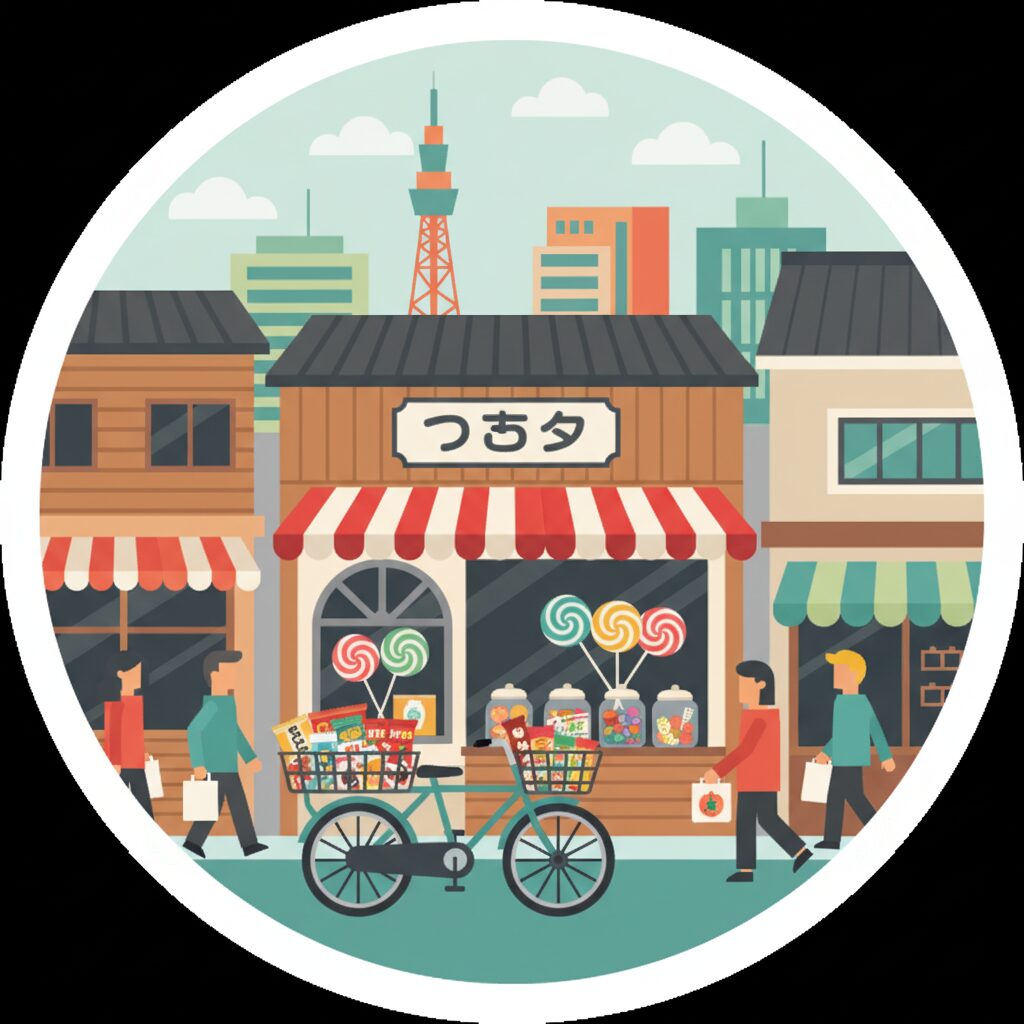
To truly understand the core of Osaka’s social fabric, we must first conduct a linguistic and cultural examination of this seemingly straightforward object. In standard Japanese, candy is called ‘ame’ (飴), but in Osaka, it is almost always referred to as ‘ame-chan’ (飴ちゃん). The suffix ‘-chan’ is the key element here. It is a diminutive typically reserved for children, pets, or close friends—a term conveying endearment, familiarity, and affection. By adding ‘-chan,’ the candy transforms from a mere inanimate object into a small, personified symbol of goodwill. It ceases to be just sugar exchanged; it becomes a tiny gift, a small treat, a gesture imbued with personal warmth.
The Language of Candy: Why ‘Ame’ Becomes ‘Ame-chan’
The use of ‘-chan’ exemplifies the Osaka dialect’s tendency to soften language and quickly establish rapport. While Tokyo Japanese may value formality and clear social distance, Osaka’s language aims to bridge that gap immediately. Calling it ‘ame-chan’ sets the tone for the entire interaction, indicating, “This is not a formal exchange between strangers; this is one person sharing a small kindness with another.” It dispenses with ceremony. This linguistic shortcut fosters intimacy, signaling that for this brief moment, normal social barriers are lowered. This is crucial for foreigners to recognize. The offer is intentional, a deliberate act of social inclusion, with the very name of the candy reflecting that. The Obachan isn’t merely handing you candy; she is offering you a ‘little sweetie,’ a small token of casual friendship.
The Arsenal of the Obachan: What’s in the Handbag?
If you could look inside the handbag of a typical Osaka Obachan, you’d find an intricately curated collection prepared for any social situation. Alongside her wallet, keys, and perhaps a small folding fan for humid summers, you’d find an apparently endless supply of ame-chan. This isn’t a forgotten packet from last week; it is a carefully stocked arsenal. The candies serve as her social ammunition, her diplomatic toolkit. Individually wrapped—a vital detail for hygiene and convenience—they are ready to be offered at a moment’s notice.
There might be a special pouch dedicated to them, adorned with bright floral patterns or cartoon characters. The variety is impressive. Classic fruit drops, soothing herbal lozenges, creamy hard candies, and the revered ‘kuro-ame’ (black sugar candy) are all common. It’s not merely about having a candy, but having the right candy for each occasion. A coughing child on the train? She has a mentholated one. A glum teenager bored? A sweet, fruity candy might be just the thing. A fellow Obachan lamenting the weather? Sharing a familiar ‘kuro-ame’ creates a bond of mutual understanding. The handbag is essentially a mobile community support kit, with ame-chan as its primary resource.
A Taxonomy of Ame-chan: From Kuro-ame to Botan-ame
The candies themselves tell a story. Rarely are they fancy chocolates or gourmet delicacies; instead, they are humble, accessible, and nostalgic. The crown jewel is ‘Kuro-ame’ from Kasugai or similar brands. Made from Okinawan black sugar, it boasts a deep, rich, slightly molasses-like flavor that evokes nostalgic Japanese comfort. Then there are ‘sakuma-shiki’ drops, multi-flavored fruit candies popularized by the film Grave of the Fireflies, often found in distinctive tins. Milky candies like Pine’s ‘Ananatsu Ame’ (pineapple) or the classic Botan Rice Candy, which includes an edible rice-paper wrapper, are also favorites. Each candy is a small, inexpensive, mass-produced item whose value lies not in its price, but in its shared cultural significance. When an Obachan offers one, she is reaching into collective memory and sharing a simple, communal pleasure.
The Guardian of the Social Glue: Meet the Osaka Obachan
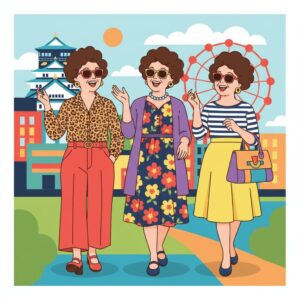
The dispenser of the ame-chan is just as important as the candy itself. The Osaka Obachan is a legendary figure, often reduced to a stereotype of leopard-print clothing, a tight perm, and a loud, grating voice. While these visual markers are not entirely fictional—leopard print is indeed a cherished neutral here, symbolizing a fierce and unapologetic presence—the stereotype completely misses the point. The Obachan is not a source of amusement; she is the matriarch of public space, the CEO of the neighborhood, and the guardian of the unwritten social code.
The Stereotype and the Reality: Beyond Leopard Print and Perms
In a city like Tokyo, social order is maintained through collective silence and mutual non-interference. In Osaka, it is upheld by the active, vocal, and constant involvement of the Obachan. She serves as the neighborhood’s surveillance system, public address system, and welfare department combined. She will tell a teenager to give up his seat on the train for an elderly person. She will loudly point out a deal on daikon radish to the entire supermarket aisle. She will ask you, a complete stranger, if you’re eating well because you look a bit thin. This isn’t nosiness in the Western sense; it’s a deep sense of collective responsibility. Her business is everybody’s business because, in her view, the community’s well-being is a shared project. The flamboyant fashion is part of this—it’s not about vanity but visibility. It declares her presence, her confidence, and her refusal to become an invisible old woman. It says, “I am here, and I am paying attention.”
The Art of the Approach: Unsolicited Advice and Unfiltered Kindness
Her directness can be startling. A Tokyoite would rather die than comment on a stranger’s appearance. An Osaka Obachan sees it as her civic duty. This direct communication style is a hallmark of Osaka, a city built by merchants where haggling, straightforward talk, and forming quick personal connections were vital for business. There is a practical belief that beating around the bush wastes time. The ame-chan perfectly embodies this. It bypasses formal introductions and serves as a direct physical expression of the desire to connect.
The unsolicited advice that often follows the candy is part of the package. “You should wear a hat in this sun!” “That bag looks heavy, are you okay?” “You speak Japanese well, but you should use this word instead.” For a foreigner, this can feel like criticism, though it’s almost always meant as care. It’s a verbal form of the ame-chan, a small offering intended to help you, to include you, and to ensure you’re doing well in her city. She asserts her role as caretaker of the communal space you both temporarily share.
Public Space as a Living Room
The fundamental difference in philosophy lies in the perception of public space. In many large cities, public space is a neutral, transactional zone to move through from one private space (home) to another (work). In Osaka, largely thanks to the Obachan, public space often functions as a vast, shared living room. The bus stop becomes a place for chatting. The supermarket queue offers a chance to compare prices. The train carriage serves as a forum for brief commentary. The ame-chan is the catalyst for these changes. It’s an invitation that says, “For the next few moments, let’s treat this anonymous public space as our shared neighborhood porch.” It’s a powerful and uniquely Osakan social technology.
The Unspoken Rules of the Candy Exchange
Like any significant cultural ritual, the ame-chan exchange follows an unspoken script—a set of implicit rules that guide the interaction. Understanding this script is essential for smoothly integrating into the daily life of the city. It’s a simple dance but one with clearly defined steps.
The Offer: How to Identify a Social Opening
The offer is seldom silent and is usually accompanied by a phrase such as “Ame-chan, iru?” (Want a candy?), “Kore, tabe” (Here, eat this), or the slightly more polite “Douzo” (Go ahead). The tone is casual, friendly, and expectant. The Obachan often makes direct eye contact, signaling that the offer is personal and intentional. Sometimes the reason is obvious—your child may be fussy, and the ame-chan is offered as a magical pacifier, or you might be coughing and receive a soothing lozenge. But often, there is no particular reason at all; it is simply an act of spontaneous connection, a desire to break the silence and acknowledge a fellow human being.
The Acceptance: Your Part in the Ritual
Accepting the ame-chan is almost always the right social move. Refusing can appear cold, distrustful, or distant, much like rejecting a handshake. Acceptance completes the social circuit. The key is to receive it with a slight bow of the head and a warm expression. The verbal response matters as well. A simple “Arigatou gozaimasu” (Thank you very much) is fine. However, to demonstrate deeper cultural understanding—especially in Osaka—many people say “Sumimasen.” In this context, ‘sumimasen’ doesn’t mean “I’m sorry.” Instead, it conveys a nuanced gratitude akin to, “Thank you for going to the trouble,” or “I’m sorry to bother you, but thank you.” It acknowledges the giver’s effort and kindness. Using “sumimasen” or a combination like “A, sumimasen, arigatou gozaimasu!” will earn you an appreciative nod, showing you grasp the social significance of the gesture. Once you have the candy, don’t just put it away. It’s polite to open it and eat it, or at least acknowledge it with another smile and a comment like “Itadakimasu” (I will humbly receive it) before eating.
The Conversation: From the Weather to Your Life Story in 60 Seconds
The ame-chan is not the end of the interaction; it marks the beginning. It serves as the ticket to a conversation that will likely be rapid-fire and surprisingly personal. Questions like: Where are you from? How long have you been in Japan? Are you married? Do you have children? Can you use chopsticks? Is it hot in your country? This barrage of inquiries isn’t an interrogation but an expression of genuine curiosity. It’s an attempt to place you, understand you, and connect during the limited time available. The right approach is to be open, friendly, and willing to share. This is the Osakan way of assessing people—not through detached observation but warm, direct engagement. Respond with a smile, and often the conversation will end with a hearty laugh and a “Ganbatte ne!” (Do your best!/Good luck!).
What Happens If You Refuse?
While acceptance is the norm, there are valid reasons to decline, such as dietary restrictions. If you must refuse, it’s important to do so gracefully and with ample apology. A simple “Iie, kekkou desu” (No, I’m fine) said coldly will halt the interaction and could cause slight offense. A better way is to smile, bow your head slightly, wave your hand apologetically in front of your face, and say something like, “A, sumimasen, ima wa chotto…” (Oh, I’m sorry, right now it’s a bit…). This softens the refusal and shows appreciation for the offer despite not accepting it. The Obachan will likely understand and respond with, “Ah, sou? Jaa, shaanai na” (Oh, really? Well, it can’t be helped then), and move on. The goal is to decline the candy, not the social connection it represents.
Osaka vs. Tokyo: A Tale of Two Social Contracts
The ame-chan philosophy highlights the profound contrasts between Osaka and Tokyo. Living in or visiting both cities reveals two fundamentally different approaches to urban life, two distinct social contracts governing millions. The ame-chan concept is unimaginable in one city, yet commonplace in the other.
Anonymity in the Metropolis: Tokyo’s Norm
Tokyo functions on a principle of refined, elegant anonymity. The city’s efficiency and order arise from its residents’ mastery of coexisting without interaction. Public spaces serve transit, not conversation. The unspoken rule on a Tokyo train is to minimize your presence: stay quiet, take up minimal space, and avoid eye contact. This isn’t coldness; it’s a form of civic courtesy. In a densely packed city, preserving personal space and non-interference fosters social harmony. A stranger suddenly speaking to you—or offering candy—would break this contract, causing alarm and suspicion. Is it a cult? A scam? A prank? The default assumption is that there’s an ulterior motive, as spontaneous kindness between strangers isn’t part of the public script.
Engagement in the Merchant City: Osaka’s Approach
Osaka’s social contract is entirely distinct. Founded on trade, where quickly building rapport, haggling, joking, and assessing character through direct interaction are essential, this legacy remains embedded in the city’s spirit. Anonymity is not the goal; engagement is. Silence in public is not peaceful but a vacuum waiting to be filled by connection. The logic is straightforward: we’re all here together—in this train car, in this shop—so why not talk? This mindset values warmth (ninjo) and pragmatic nosiness over distant formality. The ame-chan is an ideal tool here: a simple, low-risk way to initiate contact and gauge willingness to engage. It acts as a social probe, conversation starter, and gesture of solidarity all at once.
The Train Test: Comparing Commuter Dynamics
Take the Yamanote Line in Tokyo during rush hour. Surrounded by hundreds, you’ll encounter near-cathedral silence, broken only by announcements. People focus on phones, books, or staring into space. Now board the Osaka Loop Line or Midosuji subway. The ambient noise rises immediately. Friends laugh, colleagues exchange stories, and the lively chatter of a group of Obachan stands out. Here, an ame-chan exchange can flourish. An Obachan might spot someone looking tired and offer candy, sparking a conversation that draws in nearby passengers. Within minutes, a small and temporary community forms. This would be a rare social event in Tokyo; in Osaka, it’s just another typical Tuesday.
For the Foreign Resident: Navigating Your First ‘Ame-chan’ Encounter
For a foreigner trying to establish a life in Osaka, learning to navigate the ame-chan ritual is a crucial rite of passage. It represents a small but meaningful step from being a distant observer to becoming an engaged participant in the city’s everyday life. It involves unlearning some deep-rooted cultural instincts and adopting a new set of social assumptions.
First Contact: Overcoming Suspicion
The initial challenge is to overcome your natural mistrust of strangers. Your mind, shaped by stories of urban crime and scams, will urge caution. You must deliberately tell it to relax. Keep in mind the context: you are in one of the safest countries globally, and this is a widely accepted, harmless cultural tradition. The Obachan is not trying to sell you anything, convert you, or harm you. She is, in her own way, welcoming you. She has recognized you as part of her immediate surroundings and has chosen to include you. View it not as an intrusion, but as an honor. You’ve been noticed. You’ve been considered worthy of a small gesture of kindness.
The Practical Toolkit: Phrases and Gestures
Equip yourself with the basic skills to handle the situation gracefully. Mastering a few essential phrases and gestures will make all the difference.
- The Smile: Your most important tool. A sincere, warm smile conveys that you understand the friendly intention.
- The Head Nod/Small Bow: A simple, respectful expression of gratitude.
- The Accepting Hand: Take the candy with one or both hands, a sign of respect.
- The Magic Words:
- “Ah, doumo!” (Oh, thanks!) – Casual and friendly.
- “Arigatou gozaimasu!” (Thank you very much!) – Polite and standard.
- “Sumimasen, itadakimasu.” (Thank you for the trouble, I will humbly receive it.) – Advanced level, demonstrating deep cultural insight.
Practice these in front of a mirror. Being prepared will help you respond naturally and positively when the moment comes. The Obachan will be pleased and impressed by your understanding of the local custom.
Becoming Part of the Fabric: From Recipient to Participant
The final phase of your ame-chan journey is shifting from a simple recipient to an active participant. This shows a genuine grasp of the philosophy. Begin carrying a few individually wrapped candies in your bag or pocket. You don’t have to be an Obachan to take part. Look for chances to offer your own small acts of kindness. See a child starting to cry on the bus? After a nod to the parent, offer an ame-chan. Sit beside an elderly person who seems tired? Offer one. By doing so, you’re not merely imitating a local custom. You’re actively contributing to the city’s distinctive atmosphere of communal warmth. You’re helping to weave the very social fabric that makes Osaka unique. You’re paying it forward, one piece of candy at a time. This is the moment you stop being just a resident and begin truly becoming an Osakan.
Beyond the Candy: What ‘Ame-chan’ Really Teaches Us About Osaka
The modest ame-chan serves as a lens through which one can grasp the entire character of Osaka. It symbolizes a city that values the human over the procedural, spontaneity over planning, and the communal over the individual. The philosophy it embodies is interwoven into the very essence of the city, accounting for its vibrant energy, commercial spirit, and profound warmth.
A Philosophy of Mutual Support
At its heart, the ame-chan culture reflects a deeply rooted philosophy of mutual support. It represents a small-scale, everyday expression of the idea that we are all connected. Life in a dense urban setting can feel isolating, but these brief interactions serve as constant reminders of our shared humanity. They are tiny doses of community, reinforcing the notion that you are not alone. The Obachan who offers you candy today might be the same person who helps you find your way when you’re lost tomorrow or watches your shopping cart for a moment while you chase a wayward receipt. It’s all part of the same seamless web of casual, reciprocal care.
The Economy of Small Favors
Osaka has always been a city of merchants, and its social exchanges are often grounded in a distinctive emotional economy. The ame-chan acts as the smallest unit of currency in this economy of small favors. It costs almost nothing but generates considerable social capital. It creates a small goodwill debt, a positive emotional balance that smooths all other social interactions. This is why Osakans are frequently described as “friendly.” It’s not a vague, passive state but an active, ongoing process of fostering connections through countless small, positive exchanges. The city hums with this constant, low-level buzz of shared pleasantries, jokes, and, naturally, candies.
Pragmatism, Warmth, and the Human Connection
In the end, the ame-chan embodies a pragmatic approach to human connection. It acknowledges a fundamental truth: that people value small, unexpected acts of kindness. It’s a simple, effective, and infinitely scalable solution to the challenge of urban loneliness. It cuts through social awkwardness, language barriers, and cultural differences with remarkable ease. It requires no elaborate planning, no major expense—just a pocketful of candy and a willingness to see the person beside you as a neighbor, not a stranger.
So the next time someone extends a hand toward you on a crowded Osaka street, offering a small, sweet gift, you’ll know what it means. You’ll realize you’re not just being handed a piece of sugar. You’re being invited—an invitation to engage in a conversation, to join a community, to experience the warm, beating heart of this extraordinary city. Accept it with a smile. It’s the sweetest deal you’ll ever receive.