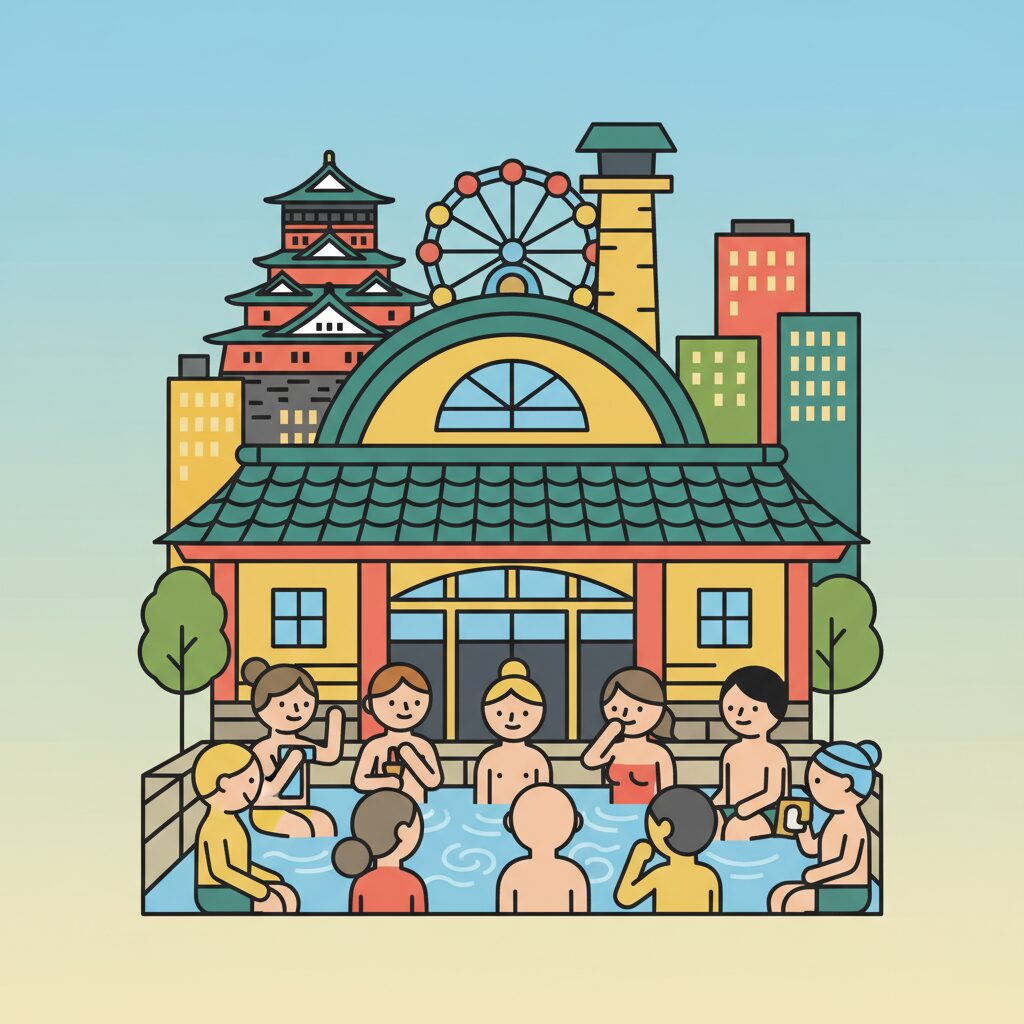
Forget what you know about Japanese bathing. Erase the serene images of snow-dusted hinoki tubs overlooking majestic mountains. Banish the thought of luxurious ryokan where bathing is a meticulously choreographed performance, a highlight of a weekend getaway. That’s the world of the onsen, the hot spring, a destination for special occasions. It’s beautiful, it’s restorative, but it’s not the daily pulse of the city. To understand the rhythm of Osaka, to truly get under its skin, you need to go to the sento. The public bathhouse. It’s not a tourist attraction. It’s a utility. It’s a living room. In the dense, gritty, and fiercely proud neighborhoods of working-class Osaka, the sento is nothing less than the beating heart of the community.
Imagine stepping off a narrow street, maybe in Nishinari or Taisho, where the air is thick with the smell of grilling takoyaki and the rumble of the Loop Line. You push aside a heavy noren curtain, faded from decades of sun and steam, and the world outside instantly vanishes. You’re hit by a wave of warm, humid air that smells of soap, damp wood, and something vaguely medicinal. The sounds are a symphony of the mundane: the clatter of plastic stools on tiled floors, the steady rush of water from chrome faucets, the echo of voices bouncing off the high ceiling, and the muffled drone of a baseball game playing on a small television in the changing room. This isn’t a place of silent contemplation. It’s a place of life, raw and unfiltered. It’s where grandfathers teach their grandsons how to withstand the electric bath, where mothers trade gossip while scrubbing their children’s backs, where factory workers wash away the day’s grime next to shop owners tallying their receipts in their heads. This is the real Osaka, stripped bare—literally and figuratively. It’s in these temples of steam and tile that the city’s unpretentious, pragmatic, and deeply communal soul is most purely expressed. It’s not just about getting clean; it’s about staying connected.
This communal spirit extends beyond the bathhouse and into the city’s business culture, where forging connections over a meal is just as vital, as seen in how an Osaka business meeting often resembles a shared dinner.
The Sento Isn’t for Tourists, It’s for Tuesdays
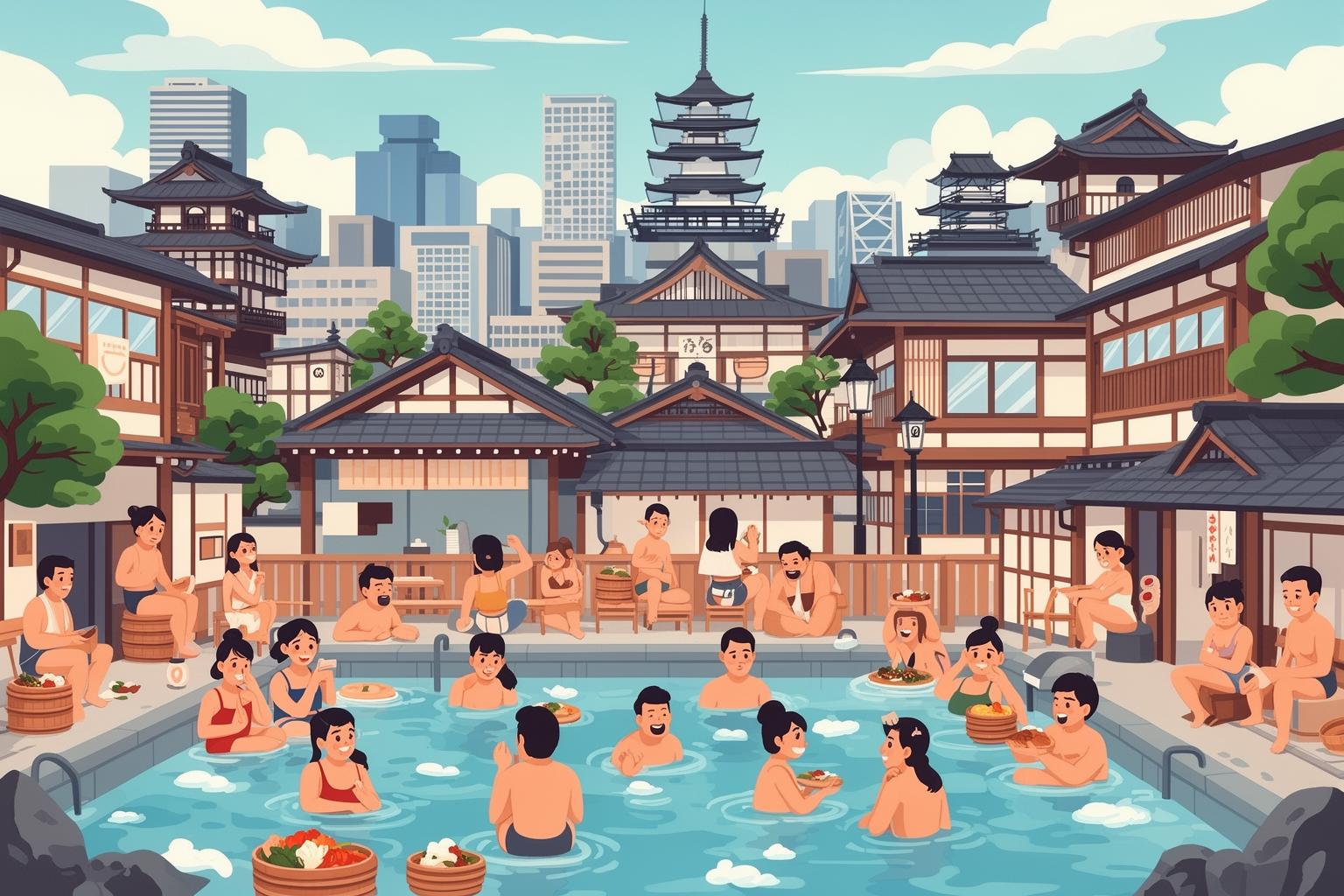
The fundamental distinction between an onsen and a sento lies in their purpose. An onsen is a destination; a sento is part of a routine. Consider it this way: an onsen is like a fine dining restaurant you visit for a special anniversary, while a sento is the corner diner where you have breakfast three times a week. This difference is crucial. For many Osakans, especially among older generations and in neighborhoods with pre-war housing, going to the sento is not a luxury. It’s a vital part of the weekly or even daily rhythm, nestled between errands like grocery shopping and walking the dog. It’s a chore, but one steeped in deep social meaning.
This routine stems from practicality. Throughout much of the 20th century, having a private bathroom—an uchiburo—was a rarity. Entire neighborhoods of tightly packed wooden homes were built without individual bathing facilities. The sento wasn’t merely an option; it was the sole choice. This historical necessity fostered a communal bathing culture that endures long after most houses were equipped with their own tubs. Why? Because the habit evolved into a ritual, and the ritual brought a greater benefit: community. The sento shifted from a matter of necessity to a place of connection. Even today, if you enter a neighborhood sento around 6 PM, you witness this tradition alive. You’ll see the regulars, the joren, who have been coming for forty, fifty, even sixty years. They arrive on squeaky mamachari bicycles, their personal bathing kits—a small bucket with soap, shampoo, and a nylon washcloth—nestled in the front basket. They greet the owner at the front counter, the bandai, and move with practiced efficiency born of countless visits.
Inside, the atmosphere feels comfortably lived-in. There’s no fussiness here. Tiles may be cracked, grout discolored with age. Plastic stools bear the marks of long use. Chrome faucets might be peeling. None of that matters. What matters is the water, always steaming hot, and the familiar company. You’ll spot a man finishing a shift at a local factory, grease still on his arms, sighing as he sinks into the main tub. You’ll see a group of elderly women, their backs bent from age, helping each other scrub hard-to-reach spots. Children splash in the shallower, cooler tub, their laughter ringing through the steamy air, met by gentle, grumbled scolding from an old-timer. The price for this entire experience? Less than a bowl of ramen. In Osaka, a city obsessed with value for money (kosupa, or cost performance), the sento is the ultimate bargain. For about 500 yen, you gain access to large baths, a sauna, sometimes even a cold plunge pool, and hours of socializing. Compared to the cost of heating a small, cramped tub at home, this is unbeatable logic. It’s not about indulgence; it’s about smart, practical living—a core principle of the Osaka mindset.
The Unspoken Rules of the ‘Naked Social Club’
There’s a Japanese phrase, hadaka no tsukiai, which literally means “naked fellowship” or “naked communication.” Often romanticized, this concept is, in the Osaka sento, a living, breathing reality. The idea is straightforward: when you remove your clothes, you also shed the markers of status, wealth, and profession. In the bath, the CEO and the carpenter stand as equals. Their bodies endure the same scalding water and the same biting cold of the plunge pool. This enforced equality creates a distinct social space where communication becomes more direct, honest, and far less hierarchical than in the outside world.
This is where the difference between Osaka and Tokyo becomes strikingly clear. In a Tokyo sento, a similar scene might unfold, but the atmosphere tends toward quiet, individual reflection. People keep to themselves, maintaining a polite, invisible barrier. In Osaka, that barrier melts away in the steam. Silence can feel awkward, even unfriendly. There is an underlying expectation of low-level social engagement. It’s not about deep, personal conversations; it’s about sharing the space in a vocal, communal manner. The chatter serves as the sento’s background music.
What does this sound like in practice? It’s an old man holding court from the depths of the hottest tub, loudly breaking down the previous night’s Hanshin Tigers baseball game, his statements met with grunts of agreement or derisive snorts from fellow bathers. It’s two women in their fifties, hair wrapped in small towels, comparing the price of daikon radishes at nearby supermarkets while vigorously scrubbing each other’s backs. It’s someone noticing you’re waiting for a washing station and saying, “Aniki, koko oku de” (“Hey pal, this one’s open”), sliding their stool over without hesitation. It’s the collective groan of pleasure as a dozen people sink into the water simultaneously. These micro-interactions weave the neighborhood together. It’s a kind of social grooming, reinforcing bonds through casual, everyday contact.
A common worry for foreigners is the nudity. Is it strange? Will people stare? In an Osaka sento, the answer is a definitive no. People are not there to look at you; they are there to bathe, relax, and talk. Everyone shares the same state of vulnerability, fostering camaraderie rather than judgment. In fact, the most awkward thing you can do is act awkward. Covering yourself excessively or avoiding eye contact marks you as an outsider—not because of your nationality, but because you’re breaking the unspoken code of casual acceptance. The local way is to move with purpose: wash, bathe, relax. A simple nod or a quiet “Otsukaresama desu” (a versatile greeting meaning something like “thanks for your hard work”) to someone leaving the tub is enough to join the club. You’re not an observer; you’re a participant in a daily ritual honed smooth over generations. The nakedness is merely the uniform.
More Than Water: The Anatomy of a Neighborhood Hub
To view the sento merely as a place to bathe is to entirely miss its essence. It functions as a multi-purpose community center, a complex ecosystem with distinct areas, each fulfilling a social role. The experience begins even before you glimpse the water. The architecture and design of a traditional sento are a masterclass in social engineering, crafted to promote lingering and interaction at every stage.
First, you encounter the getabako, the shoe lockers by the entrance. Here, you exchange your street shoes for a wooden key, a symbolic gesture of leaving the outside world behind. Then you pass under the noren curtains into the core of the space: the datsuijo, or changing room. This is the sento’s genuine social lounge. Overseeing everything is often the bandai, a raised platform where the owner or attendant sits, collecting fees and keeping watch over both the male and female sections (in older sento with traditional layouts). The person at the bandai acts as the neighborhood’s memory keeper. They know who is ill, whose daughter recently married, and who is job hunting. They serve as the central hub of local information.
The changing room itself is a museum of everyday life. The lockers are usually old, wooden, and secured with simple, satisfyingly clunky keys attached to elastic wristbands. Against one wall stands a large, analog scale, the type where you slide the weight to measure your weight. Weighing yourself before and after the bath is a cherished ritual. Nearby, there is nearly always a hefty, coin-operated massage chair that grumbles and vibrates with mechanical intensity. A vintage clock, often a donation from a local business decades ago, hangs on the wall. The air is suffused with the scent of talcum powder and the sound of an old television, permanently tuned to a baseball game or a lively variety show. This is where the real conversations occur. Neighbors, still damp from their bath and draped only in towels, stand chatting for twenty minutes. They catch up on the week’s news, grumble about the weather, and make weekend plans, all while fanning themselves with an uchiwa fan.
The final, essential element of the sento ritual happens here: the post-bath drink. Every sento boasts a vintage glass-front refrigerator, quietly humming in the corner, stocked with an unchanging selection of beverages in iconic glass bottles. The holy trinity consists of milk, coffee milk, and fruit milk. Drinking a cold bottle of milk—propping one hand on your hip is the classic stance—after a hot bath is regarded as one of life’s simple, perfect pleasures. It serves as the punctuation at the end of the experience. For others, it may be a bottle of Ramune, the marble-sealed soda, or an old-school sports drink like Pocari Sweat. This shared moment of refreshment is the sento’s equivalent of a post-work pint at the pub. It’s when the relaxation from the bath truly settles in and social bonds are sealed. You sit on a worn wooden bench, the cool bottle in hand, the TV’s drone in your ear, and feel a sense of belonging that is rare to find anywhere else in the modern city.
Osaka vs. The World: Why Sento Culture Thrives Here
Public bathhouses are vanishing throughout Japan. Confronted with an aging population, rising fuel expenses, and the widespread availability of modern bathrooms, thousands have permanently shut down. Yet in Osaka, the sento persists with remarkable resilience. This durability stems from the city’s distinctive cultural DNA—a unique blend of pragmatism, community orientation, and a deep-rooted disdain for pretense.
At the core is Osaka’s famed pragmatism. The city’s residents are merchants and artisans by nature, possessing an innate sense of value. The question is always: “Is it otoku?” Is it a good bargain? For many, the sento remains an unbeatable option. Why heat your own gas and water to fill a tiny, cramped unit bath when, for the price of a coffee, you can relax in a spacious tub, use a sauna, and enjoy what amounts to a free social club membership? It simply makes sense. This isn’t about nostalgia; it’s a sound economic choice. This practical outlook ensures a steady flow of patrons, providing the essential financial support these bathhouses need to stay open.
Next is the city’s social fabric. Tokyo is a sprawling, vertical metropolis where life is often anonymous, defined by careers and train lines. Conversely, Osaka is a horizontal city—a mosaic of distinct, ground-level neighborhoods known as shitamachi (“low city”). Here, community is tangible and immediate. Your neighbors aren’t strangers to be avoided in elevators; they’re the people you meet at the local shotengai shopping street, whose children attend the same school as yours, and who gather at the sento. The sento serves as crucial social infrastructure, a spot for informal check-ins. It’s where you might notice that old Mr. Tanaka has been absent for several days and feel compelled to check on him. In an aging society, this role is especially vital.
Lastly, there’s the essence of Osaka’s character. Pretension is notably absent here. Formality can be viewed with suspicion, while straightforward, honest communication is highly valued. The culture of hadaka no tsukiai perfectly fits this mindset. In a city that treasures good humor and directness, the idea of stripping down—both physically and socially—is not only accepted but cherished. This stands in stark contrast to the more reserved, face-conscious cultures found elsewhere in Japan. Outsiders often misinterpret this. They might glance at an old, somewhat worn sento building and write it off as outdated. But they fail to see that the building is merely a vessel. The real value lies in the invisible web of relationships and the strong community spirit it nurtures. It’s not about appearances; it’s about purpose. And in Osaka, the sento continues to serve its role wonderfully.
The Changing Tide: The Future of Osaka’s Sento
Portraying the sento as merely a nostalgic institution stuck in time would be misleading. Although the traditional, family-run neighborhood bathhouse is indeed a vanishing breed, a new chapter is unfolding. The story of the Osaka sento is not simply one of decline; it’s also one of adaptation and revitalization. A new generation, recognizing the unique cultural significance of these spaces, is stepping in to rejuvenate them, securing their place in the 21st century.
This revival takes many forms. Some older sento have been taken over by younger entrepreneurs who carefully restore the charming, retro features—the intricate tile work, classic wooden lockers, and grand murals of Mount Fuji—while modernizing the facilities. They might introduce amenities like carbonated springs or high-powered jet baths. They realize that today’s customers, who have baths at home, seek an experience beyond what their own tub can offer. They are selling not just hot water, but a distinctive mix of nostalgia and comfort.
Others are reimagining what a sento can be. They transform these spaces into vibrant cultural hubs. You might find a sento featuring a craft beer taproom in the lobby, encouraging guests to socialize long after their bath. Some host live music performances, turning the changing room into an impromptu concert venue. Others partner with local artists to create gallery spaces, displaying artwork on their walls. These “Sento 2.0” venues attract a fresh crowd: students, artists, young professionals, and curious tourists. They come not only for the bath but for the atmosphere, the community, and the feeling of being part of something authentically local yet refreshingly new.
This evolution is vital. It shows that the sento is not just a relic to be preserved unchanged. It is a living tradition, capable of evolving with the times. The core purpose—offering a place for community and relaxation—remains intact, but the presentation is being refreshed. This blending of old and new is quintessentially Osaka, a city known for innovating while staying true to its essence. The sento’s survival depends on this delicate balance—serving lifelong regulars while welcoming newcomers who are discovering its simple, profound appeal for the first time. The tide may be shifting, but the deep community currents the sento generates continue to run strong.
Your First Trip to the Neighborhood Tub
Reading about the sento is one thing; experiencing it is quite another. For any foreigner living in Osaka, incorporating the local sento into your routine is one of the quickest ways to feel truly connected to your neighborhood. Initial hesitation is normal, but the rewards are enormous. Here is a straightforward, practical guide to your first visit.
What to Bring
Locals usually have their own personalized sento kits, but for your first visit, you can keep it simple. You’ll need two towels: a small one for washing your body and for modesty while walking around, and a larger one for drying off afterward. You’ll also need your own soap, shampoo, and other toiletries. Don’t worry if you forget anything—almost every sento sells or rents these items for a small fee. Bringing a plastic bag for your wet towel is a smart tip. Cash is essential since most neighborhood sento operate on a cash-only basis.
The Process Step-by-Step
- Shoes: Upon entering, you’ll find lockers for your shoes. Remove them, place them inside, and take the wooden key.
- Payment: Head to the front desk or vending machine. A standard bath fee usually costs around 500 yen. Pay the fee and give your ticket to the attendant if you used a machine.
- The Correct Door: This is important. Look for the signs or noren curtains. 男 (otoko) indicates men, and 女 (onna) indicates women. Enter through the appropriate door into the changing room.
- Get Ready: Find an empty locker or basket. Get completely undressed and store all your clothes and large towel inside. The only things you bring into the bathing area are your small towel and washing supplies.
- The Cardinal Rule: Wash First! This is the most important sento etiquette rule. Before entering the tubs, thoroughly wash your entire body. Find an open washing station, consisting of a stool, bucket, and faucet with a shower hose. Sit on the stool (never stand while showering, as it splashes others) and scrub yourself from head to toe. Rinse off all soap carefully when finished.
- Enjoy the Tubs: Now you’re ready for the main feature. There will likely be several tubs with different temperatures and features. Enter slowly. The main tub is usually very hot. You might find a jet bath (jetto-buro) for back massage or an electric bath (denki-buro), which sends a low-voltage current through the water—approach this one cautiously! Your small towel should never go into the bath water; most people fold it and place it on their head or set it on the edge of the tub.
- Drying Off: When you finish bathing, head back to the changing room. Before entering, use your small damp towel to wipe off as much water from your body as possible, a key courtesy to keep the floor dry.
- The Afterglow: Back in the changing room, dry yourself completely with the large towel, get dressed, and take time to relax. This is the perfect moment to try a post-bath bottle of milk. Find a bench, cool down, and soak in the atmosphere—you’ve earned it.
Don’t overthink it or feel intimidated. The sento is a welcoming space. The other patrons aren’t there to judge you—they’re there for the same reason you are: to enjoy a good hot bath. A simple nod and smile go a long way. Embrace the experience, and you’ll discover a side of Osaka no guidebook can show you.