I remember my first week in Osaka, feeling utterly baffled. I was standing at a tiny, steaming takoyaki stand near Tenma station, trying to order. The vendor, a cheerful woman with a perm that defied gravity, scooped up eight sizzling octopus balls, dusted them with bonito flakes, and drizzled them with sauce. “Here you go,” she said, handing me the boat-shaped container. “That’ll be one million yen.” I froze. My Japanese was still shaky, but I was pretty sure I knew the word for “million.” I must have looked terrified, because her face cracked into a massive grin, and the old man waiting behind me let out a hearty laugh. “Just kidding, sweetheart,” she cackled. “It’s 500 yen.” The old man patted my shoulder. “Welcome to Osaka,” he said, still chuckling. In Tokyo, a transaction like that would have been silent, efficient, and polite. Here, it was a performance. It was my first, jarring lesson in the city’s native language: comedy. This wasn’t just a joke; it was an invitation. It was the fundamental rhythm of Osaka life, a conversational dance known as ‘Boke’ and ‘Tsukkomi.’ Understanding this dynamic is more important than knowing your way around the subway system. It’s the key to unlocking the city’s true personality, the software running behind the neon signs and endless storefronts. This is how Osaka talks, breathes, and connects.
Osaka’s playful banter goes hand in hand with its rapid embrace of futuristic trends, as highlighted by global travel boom and AI innovations that are redefining visitor experiences worldwide.
So, What Exactly Are ‘Boke’ and ‘Tsukkomi’?
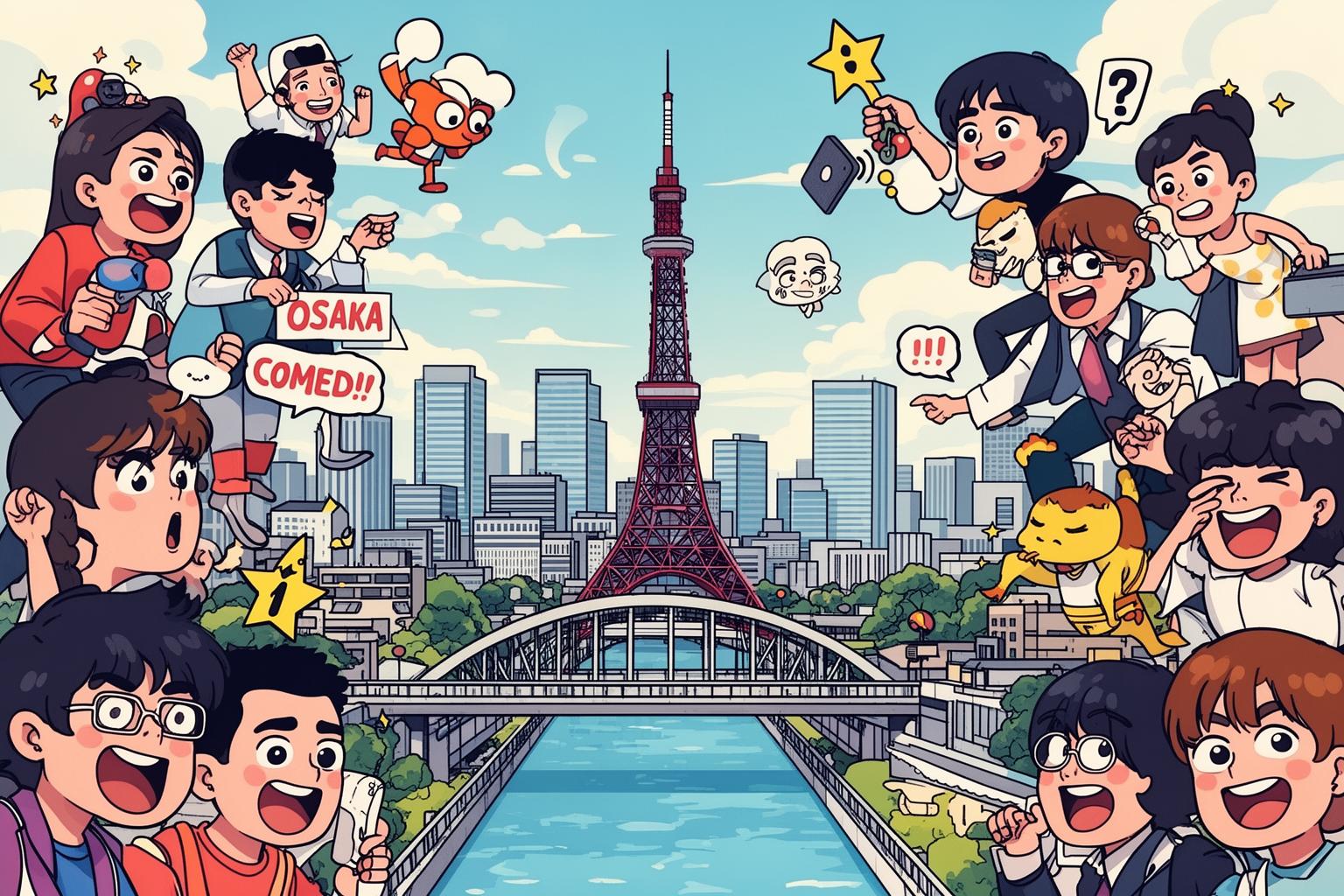
Before you can speak the language, you need to understand the alphabet. In Osaka’s style of conversational comedy, the alphabet consists of two letters: Boke and Tsukkomi. These terms originate from manzai, a traditional form of Japanese stand-up comedy famously linked to Osaka. Think of it like a classic comedy duo: Abbott and Costello, Laurel and Hardy—the straight man and the funny man. It’s a partnership based on a specific, rhythmic exchange.
The Boke
The ‘Boke’ (ボケ) is the funny character, the fool, the airhead. The term comes from ‘bokeru,’ meaning to be senile, dazed, or to play dumb. The Boke’s role is to say or do something absurd, illogical, or simply wrong. They create a conversational gap, a moment of ridiculousness that lingers, inviting a response. The takoyaki lady claiming her food cost a million yen? A perfect example of a Boke. She wasn’t trying to deceive me; she was setting up a joke. She was tossing the ball, waiting for someone to catch it.
The Boke can be subtle or outrageous. It might be a friend looking at a downpour and saying, “Great day for a picnic.” Or a shopkeeper, when asked if they sell batteries, pointing to a bunch of carrots and asking, “Will these do?” The Boke deliberately derails a normal conversation to add humor. It’s a creative act, a spark of chaos designed to make the ordinary interesting.
The Tsukkomi
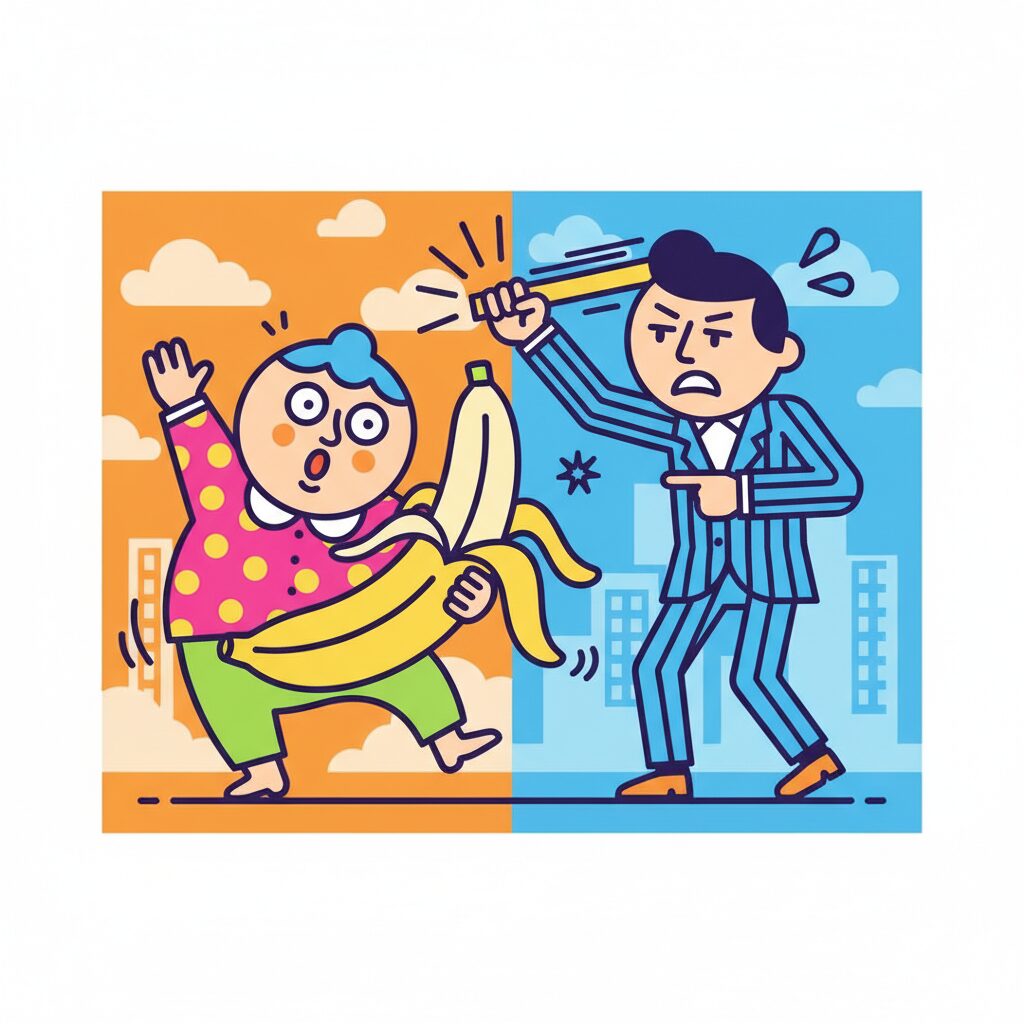
The ‘Tsukkomi’ (ツッコミ) is the straight man, the one who lands the joke. The word derives from ‘tsukkomu,’ meaning to thrust or poke into. The Tsukkomi’s job is to spot the absurdity created by the Boke and correct it, sharply and wittily. They serve as the voice of reason, the reality check. When they point out the Boke’s foolishness, that’s when the laugh happens. The Tsukkomi delivers the punchline.
In my takoyaki experience, the old man laughing was a form of Tsukkomi, and the vendor’s own admission of “just kidding” was a self-Tsukkomi. A more traditional Tsukkomi would have been someone yelling, “A million yen for octopus balls? What are they, made of gold?” The most famous Tsukkomi phrase, heard daily across Osaka, is “Nande ya nen!” It roughly translates to “Why the heck?!” or “What the hell are you talking about?!” It’s the ultimate expression of comedic frustration.
A Tsukkomi without a Boke is simply a grumpy person. A Boke without a Tsukkomi is just a weirdo. Together, they form a complete comedic circuit. It’s a call and response, the conversational heartbeat that fuels the city.
From Stage to Street: How Comedy Shapes Osaka Life
In most places, comedy is something you watch. In Osaka, it’s something you participate in. The Boke and Tsukkomi dynamic extends beyond the Namba Grand Kagetsu theater; it’s the default mode of social interaction. It’s found in bakeries, bike shops, train platforms, and office breakrooms. This is perhaps the most noticeable cultural difference between Osaka and Tokyo.
Tokyo operates on precision and politeness. Conversations tend to be transactional, aimed at conveying information with minimal fuss. There’s a quiet, efficient elegance to it. Osaka, by contrast, treats every interaction as an opportunity for entertainment. A conversation isn’t just about exchanging information; it’s about forming a connection, sharing a laugh, and making a stranger a temporary co-star in a small, improvised play.
Let’s explore a typical day in Osaka and see this in action.
Morning Coffee at the Kissaten
You enter a small, old-school coffee shop. The master, a serious-looking man in his sixties, is wiping down the counter. You order a morning set. He brings you the coffee and toast.
You: “This looks delicious, thank you.”
Master (Boke): He glances at the simple plate of toast and sighs dramatically. “It’s terrible. I burnt it again. I should probably just close up shop.”
He’s not seeking sympathy. He’s setting you up. A response from Tokyo would be confusion or awkward reassurance: “Oh, no, it looks fine!” In Osaka, the Tsukkomi response would be:
You (Tsukkomi): “Good, then it’s free, right?” or “Stop lying! You know you make the best toast in the neighborhood.”
His face will instantly light up with a smile. You’ve passed the test. You completed the circuit. You’re no longer just a customer; you’re part of the scene.
Shopping in the Shotengai
You’re in a covered shopping arcade, the lifeblood of any Osaka neighborhood. You stop at a vegetable stall to buy some daikon radish.
Vendor (Boke): You pick up a nice, plump daikon. The vendor, an energetic grandmother, snatches it from you. “Not that one! That’s my pillow for tonight. Pick another one.”
She’s playing. The Tsukkomi here is to join in the fun, calling her out on the silliness.
You (Tsukkomi): “Your pillow? Isn’t that a bit hard? You’ll hurt your neck!”
She laughs, lightly slaps your arm, and bags the daikon for you. This back-and-forth is a form of customer service. It’s how trust and familiarity are created. It’s far more meaningful than a polite, sterile transaction.
After-Work Drinks at an Izakaya
You’re out with colleagues. One of them, Tanaka-san, is telling a story. He reaches the end and delivers what he thinks is a hilarious punchline, but it falls flat. The table falls silent.
Someone else (Boke): A colleague looks at Tanaka-san with a deadpan face and says, “So… when does the funny part start?”
Tanaka-san (accepting his failure, also a Boke): “It already passed! You guys are just too slow to get my high-level humor.”
Everyone (Tsukkomi): The table erupts in a chorus of “Nande ya nen!” and playful insults. The awkward moment is saved by turning the failure itself into a new joke. The Boke/Tsukkomi structure acts as a social safety net, allowing teasing, failure, and connection without real malice or hurt feelings.
This is the texture of daily life here. It’s a constant, low-level hum of playful banter that makes the city feel alive and deeply human.
The Unspoken Rules of the Game
Like any language, Osaka’s comedy-speak has its own unique grammar and etiquette. Jumping in without understanding these rules can lead to confusion. For foreigners, what seems like a simple joke can feel like a complex maze of social cues. Here are the core principles you need to grasp.
It’s All About the ‘Ma’ (間) – The Sacred Pause
Timing is crucial. In manzai, the pause between the Boke’s absurd statement and the Tsukkomi’s retort is called the ‘ma.’ It’s a moment of tension where the audience is held in suspense, waiting for the release. The same applies in conversation. A good Tsukkomi is quick and sharp. A response that comes five seconds too late just feels awkward. You have to be truly attentive and present in the conversation to catch the Boke as it happens and respond promptly. This rhythm comes naturally to Osakans, but it can be learned by tuning into the cadence of their speech.
Read the Air (空気を読む – Kuuki wo Yomu)
This is an essential skill throughout Japan, but it has a special significance in Osaka. You need to know when it’s appropriate to engage in Boke/Tsukkomi and when it’s not. Serious business negotiations or heartfelt apologies are not the moments for jokes. However, the range of acceptable situations is much broader here than elsewhere in Japan. Casual service encounters, neighborly chats, friendly get-togethers—these are all fair game. The key is to gauge the other person’s mood. If there’s a playful sparkle in their eye, they’re probably ready to join in. If they seem stressed or hurried, it’s best to stick with standard polite Japanese.
A Tsukkomi Is a Sign of Affection, Not Aggression
This is the most important rule for foreigners to understand. A sharp, loud Tsukkomi can sound like an insult. Someone shouting “You’re an idiot!” (Aho ka!) or “What are you talking about?!” (Nani yutten nen!) can seem very rude. But within this comedic exchange, it’s the opposite. It’s a sign of engagement and affection. It means, “I hear you, I see your joke, and I like you enough to play along.”
The real cold shoulder in Osaka isn’t a sharp retort; it’s polite silence. If you deliver a Boke and the other person only smiles weakly and nods, it means they either didn’t get it or don’t want to engage on that level. A good, strong Tsukkomi, even if it seems harsh, is a verbal hug. It confirms you’re on the same wavelength.
The Physical Tsukkomi
While less common in daily life with strangers, you’ll definitely see this among friends and on TV. The Tsukkomi often gives the Boke a light smack on the back of the head or shoulder. This is the physical punctuation to the verbal punchline. It’s almost always done with a flat palm and is more about sound than force. Don’t go around hitting people, obviously, but if a friend gives you a gentle tap after something silly you said, understand it as part of the affectionate Tsukkomi ritual.
Why Osaka? The Soul of a Merchant City
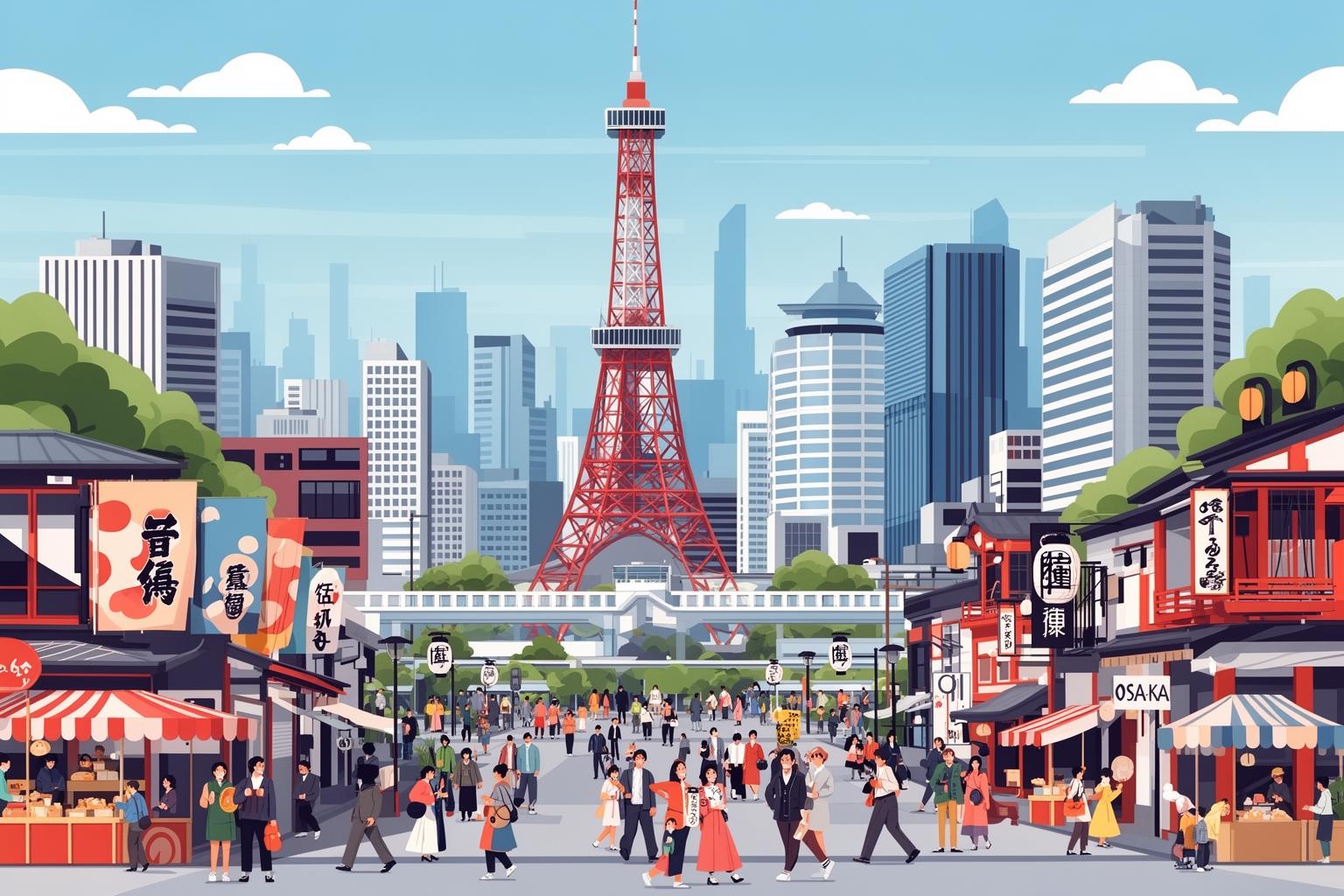
This distinctive communication style didn’t just emerge spontaneously. It is deeply grounded in Osaka’s history as Japan’s kitchen and leading merchant city (shōnin no machi). While Tokyo (formerly Edo) was the austere capital of samurai and bureaucrats, Osaka was a lively commercial center. Success and survival here relied not on strict hierarchies but on quick thinking, charm, and the ability to forge relationships swiftly.
Merchants had to be adept negotiators. Humor served as a vital tool to break the ice, bargain over prices, and win customers’ trust. A witty, entertaining conversation often built more loyalty than lower prices. This fostered a culture that prized speed, efficiency, and directness, all wrapped in an entertaining package. The Boke/Tsukkomi dynamic was ideal for this: it’s quick, engaging, and instantly creates rapport.
This sharply contrasts with Tokyo’s samurai culture, where speech was more formal, indirect, and governed by rules. In that setting, a slip in wording could have serious repercussions. In Osaka’s merchant world, a clever joke might seal a deal. That core difference in historical DNA remains evident today. Tokyo emphasizes order and formality; Osaka values wit and substance, even if it’s a bit chaotic. This background explains why Osakans are often seen as more direct, pragmatic, and expressive than their peers in the capital.
Your Role as a Foreigner: To Boke, Tsukkomi, or Just Laugh?
So, you’re living in Osaka and suddenly find yourself in the midst of one of these conversational performances. What do you do? You have several options, each offering different levels of challenge and reward.
Level 1: The Appreciative Audience
This is the simplest and safest place to start. You don’t have to join in directly. When the takoyaki vendor delivers a Boke, and another customer responds with a Tsukkomi, your role is just to laugh. A genuine laugh shows that you understand the exchange and appreciate the humor. You’re acknowledging the performance and validating their effort. This is a perfectly acceptable role, and people will value you for being a good audience. You’re in on the joke, and often, that’s all it takes.
Level 2: Attempting the Tsukkomi
This is the next step toward true integration. The world is full of Boke; they’re always tossing out opportunities. Your job is to learn how to hit the ball they throw. You don’t need complicated Japanese phrases. When a shopkeeper says something ridiculous, a simple, well-timed response in English or basic Japanese can work wonders.
- Vendor (Boke): “This umbrella is so strong, it will stop a typhoon!”
- You (Tsukkomi): “Really?” (with a skeptical grin). Or “Uso!” (“Liar!”). Or even a playful, “I don’t believe you!”
This is a big step. By returning the serve, you show that you’re not just a passive observer; you’re an active participant in the culture. The first time you deliver a successful Tsukkomi and get a genuinely surprised laugh from an Osakan, you’ll feel like you’ve been handed a key to the city. It’s a powerful moment of connection.
Level 3: The Final Boss – Becoming the Boke
This is the toughest and riskiest move. To be the Boke, you must initiate the joke. This demands a much deeper understanding of cultural context, social norms, and the specific situation you’re in. A Boke that misses the mark doesn’t just fall flat; it can make you seem odd, or even rude. It’s the difference between being a charming fool and just a fool.
However, if you feel confident, you can try a simple, low-risk Boke. For example, when the cashier tells you your total is 800 yen, you could start counting out 8 yen in coins with a very serious expression. This is a classic, nearly universally recognized Boke. The cashier will almost certainly reply with a perfect Tsukkomi like, “Hey! You’re missing a few zeros there!” or “You trying to bankrupt me?”
Successfully playing the Boke is the ultimate sign that you don’t just live in Osaka—you get Osaka. But take your time. Master the laugh, then master the Tsukkomi. The Boke will come when you’re truly ready.
Beyond the Laughs: What This All Means
It’s easy to write all of this off as mere joking, but the Boke and Tsukkomi culture offers a glimpse into the heart of Osaka. It’s more than a communication quirk; it’s a way of life.
It expresses a profound belief that human connection matters more than strict formality. It favors warmth and engagement over cold efficiency. When someone teases you in Osaka, they’re actively trying to close the gap between you, breaking down the barriers that usually separate strangers.
This interaction also nurtures impressive social resilience. Life is tough. Work can be stressful. Yet in Osaka, there’s a shared understanding to find humor in everyday cracks. The Boke/Tsukkomi exchange acts as a small rebellion against the ordinary. It says, “Yes, this is just a normal transaction at a convenience store, but for these thirty seconds, we can turn it into something more. We can share a moment of fun.”
So when people say clichés like “Osaka people are so friendly,” this is what they truly mean. The friendliness isn’t passive; it’s an active, continual invitation to join in. The Boke is the question: “Are you one of us? Do you want to play?” And the Tsukkomi is the answer: “Yes. I am. And I do.” Learning to recognize that question and respond to it is the real key to feeling at home here.