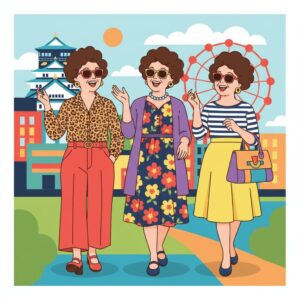
Yo, step into Osaka, and you feel it right away. It’s a city that thumps with a different kind of beat. It’s not just the neon glow of Dotonbori or the historic weight of Osaka Castle. It’s the people. And if you really want to plug into the city’s live-wire energy, you’ve gotta understand a core component of its social circuitry: the Osaka ‘Obachan’. Forget what you think you know about politeness in Japan, that delicate dance of indirect phrasing and reserved smiles. Here, in the nation’s kitchen, communication is served up hot, fresh, and straight from the heart, and the head chefs of this conversational feast are the city’s legendary middle-aged women. They are the vibrant, leopard-print-clad, candy-dispensing matriarchs who are, in many ways, the living, breathing soul of Osaka. To navigate this city is to interact with them, and to understand them is to unlock a deeper, more authentic layer of Japanese culture that you simply won’t find in any travel guide. They are not just a stereotype; they are a cultural institution, a social phenomenon, and your potential best friend, whether you know it yet or not. They are the guardians of Osaka’s boisterous, friendly, and unapologetically human spirit. This isn’t just about a communication style; it’s about a philosophy of life, one that values connection over ceremony, and warmth over withholding. Get ready to decode the wonderful world of the Obachan, because your Osaka adventure truly begins when you have your first memorable encounter.
To truly connect with the city’s unvarnished spirit, consider experiencing the local culture firsthand by visiting a neighborhood sento, where the communal bathhouse tradition fosters a unique sense of community.
Who Are the Real Osaka Obachan?
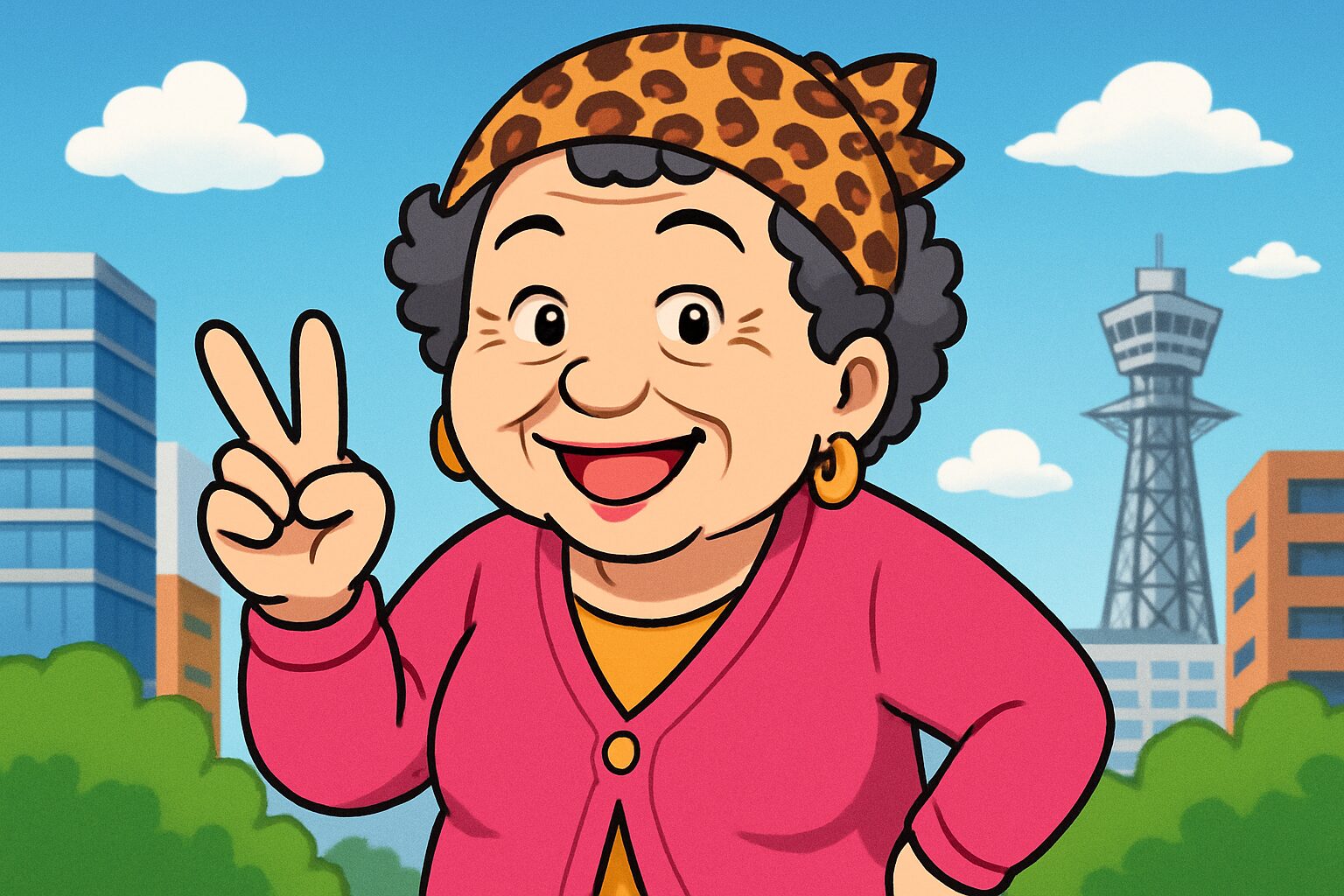
So, let’s get this clear from the start. The word ‘Obachan’ (おばちゃん) literally means ‘auntie’ or ‘middle-aged woman’. It’s a familiar term, slightly more casual than the formal ‘obasan’. But in Osaka, it holds a whole world of meaning. The pop-culture stereotype is a woman with a tight perm, dressed in animal print, possibly wearing a sparkly visor, riding a bicycle with a basket full of leeks, and a voice that cuts through the noise of a busy market. And yes, you will undoubtedly encounter this woman. She is real, and she is magnificent. Yet, she represents only the vibrant cover of a much deeper story. To settle for the stereotype is to miss the full picture. The Osaka Obachan is the foundation of the community. She’s the neighborhood watch, the keeper of local traditions, the unofficial guide to where to find the freshest mackerel, and the one who knows which child on the street needs extra care. Often, she is the matriarch not just of her family, but of the entire block. In a city shaped by merchants, where pragmatism, strong community bonds, and a keen sense of value are ingrained, the Obachan acts as the chief operating officer of daily life. She has witnessed the city’s changes, raised families in its busy neighborhoods, and nurtured the social ties that turn a cluster of buildings into a true community. Her straightforwardness is not rudeness; it comes from a life where there’s no time for nonsense, and where honest, immediate connection is the best way to get things done and build trust. She embodies the saying ‘kuchi wa wazawai no moto’ (the mouth is the source of disaster) flipped on its head; for her, the mouth is the source of connection, community, and care. She is a powerhouse of social energy, a walking encyclopaedia of practical wisdom, and the kind of person who will, without hesitation, stop you on the street to let you know your shoelace is untied because, for that moment, your well-being matters to her.
The Language of Connection: Osaka-ben and Unfiltered Honesty
One of the first things that captures your attention about Osaka is the sound. It’s a city that speaks with a different cadence and rhythm. This is Osaka-ben, the local dialect, and the Obachan are its most fluent and expressive speakers. It’s a dialect that’s more melodic, more direct, and arguably more emotional than the standard Japanese you might learn from a textbook. Forget the subtle hints and the need to read the air (‘kuuki wo yomu’) that so famously defines communication elsewhere in Japan. An Osaka Obachan doesn’t have time for that. She practices what you might call ‘reading the situation and then telling you exactly what it is.’ If you’re browsing shirts in a shop, she might walk by and say, “Sore, anata ni wa chotto hade ya na!” (“That one’s a bit flashy for you, eh!”). This isn’t an insult; it’s an honest opinion, offered freely, from one person to another. It’s a shortcut to intimacy. In her mind, why let you buy something that doesn’t suit you? That wouldn’t be kind. This directness is a form of service. You’ll hear it often in the market. “Neesan, kono daikon mizu-mizushii de!” (“Miss, this daikon radish is super fresh!”). Or if you hesitate, “Honma ni oishii kara, damasareta omote tabete mina!” (“It’s truly delicious, so just trust me and try it!”). The phrase ‘damasareta omote’ literally means ‘think you’ve been tricked,’ but it’s used to mean ‘just take a leap of faith on my recommendation.’ It’s a charming, convincing endorsement that’s almost impossible to refuse. The vocabulary itself is full of warmth. ‘Arigato’ becomes ‘Okini,’ a softer, more rhythmic thank you. ‘Hontou ni’ (really) turns into ‘Honma ni.’ ‘Sugoi’ (amazing) becomes the much stronger ‘Meccha!’ An Obachan’s speech is scattered with these expressions. And then there’s the famous ‘Akan!’ It means ‘No way!’ or ‘That’s no good!’ and can be delivered with a range of tones, from playful scolding to firm declaration. Hearing an Obachan shout “Akan, akan!” as she bargains with a fishmonger is like witnessing a piece of living theater. This isn’t rudeness; it’s a linguistic ecosystem built on the assumption of mutual goodwill. The directness works because it’s buffered by fundamental warmth and an unspoken understanding that ‘we’re all in this together.’ It’s a communication style that might be startling at first for those used to more reserved interactions, but once you attune your ears to its underlying rhythm, you realize it’s not noise; it’s music. It’s the sound of a community that talks, engages, and doesn’t hide behind formalities. It’s honest, efficient, and deeply, wonderfully human.
The Sacred Offering: Understanding ‘Ame-chan’
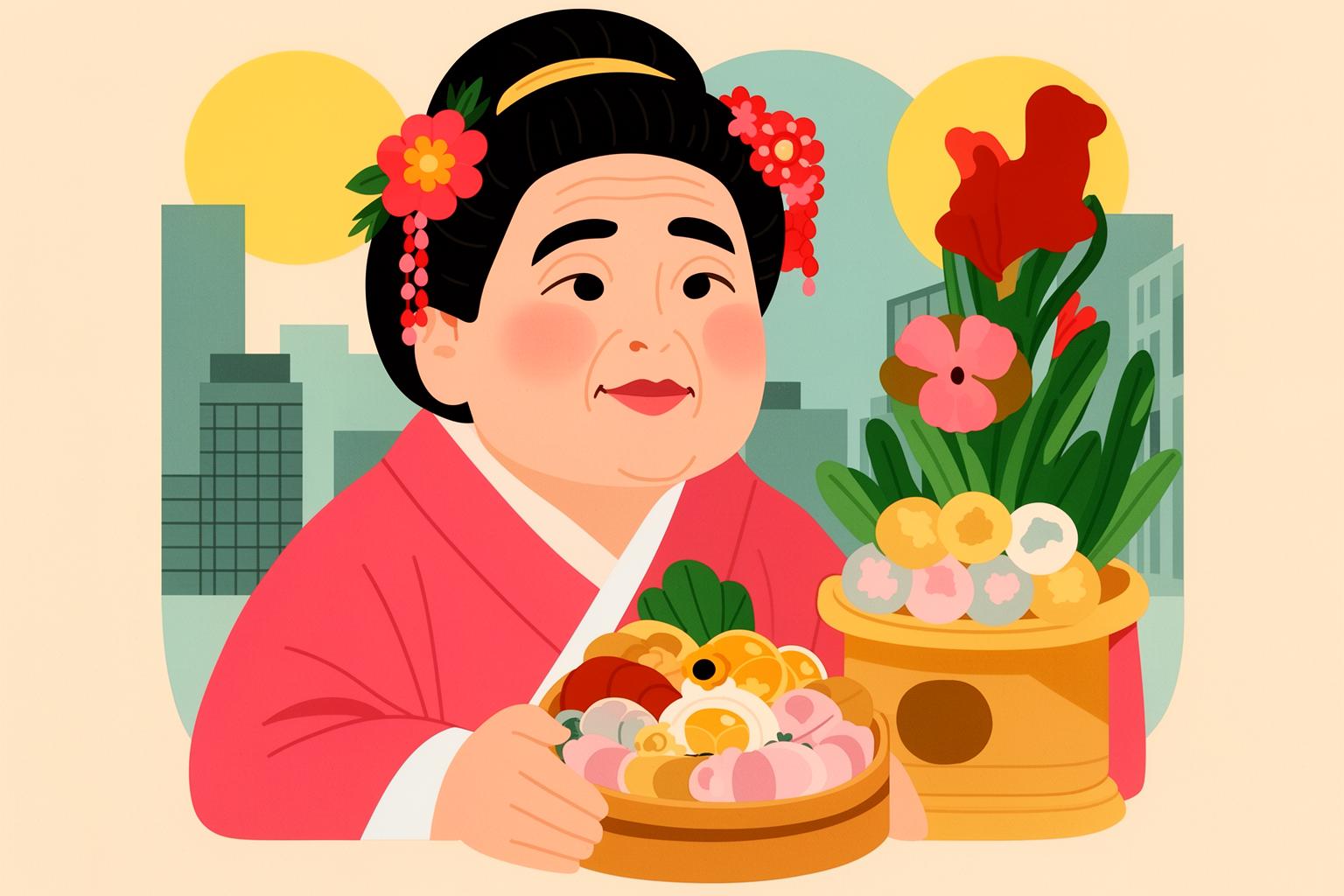
In Osaka, there is a ritual—a small yet meaningful exchange that you will almost certainly encounter if you spend enough time here. It revolves around a simple piece of hard candy and holds the key to everything. This is the culture of ‘ame-chan.’ ‘Ame’ means candy, and ‘-chan’ is a cute, affectionate suffix. The revered keepers of this tradition are, naturally, the Obachan. Deep inside an Obachan’s spacious handbag, tucked between her wallet, a foldable fan, and a packet of tissues, lies what seems an endless supply of candies. These might be butterscotch, fruit drops, milk candies, or the well-known Kuro-ame (black sugar candy). These candies aren’t for her—they’re for you. For the child crying on the train, the weary cashier, the lost foreigner, or the person sitting next to her at the bus stop. Giving an ame-chan is a gesture that transcends words. I remember my first time clearly. Standing in the vast Tenjinbashisuji Shotengai, overwhelmed by the sights and sounds, unsure which takoyaki stand to try, an older woman with a striking purple perm and leopard-print blouse noticed my confused expression. She hurried over, spoke in rapid Osaka-ben that I couldn’t understand, then smiled gently, opened her bag, and pressed a small, wrapped candy into my palm. “Hai, douzo,” she said. “Here you go.” Then she disappeared back into the crowd. That simple gesture was incredibly disarming—a tiny, sweet hand grenade of kindness that instantly dissolved my feelings of being an outsider. It said, “I see you. You’re welcome here.” The ame-chan is an icebreaker, a social lubricant, a pocket-sized peace offering. It’s a way of saying, “Let’s be friends,” without any awkwardness. It’s a micro-dose of ‘omotenashi,’ the renowned Japanese spirit of hospitality, stripped of all ceremony and offered with genuine, grassroots warmth. To receive an ame-chan is to be momentarily embraced by the great, warm, bustling family of Osaka. The cardinal rule for any visitor is simple: if an Obachan offers you a candy, you accept it. Smile, bow your head slightly, say “Okini,” and take the gesture for what it truly is—a pure, unvarnished moment of human connection.
The Natural Habitat: Spotting the Obachan in the Wild
While the spirit of the Obachan is woven throughout all of Osaka, there are particular settings where it thrives with exceptional vitality. These places serve as the stages where the everyday drama of Osaka life plays out, offering the best opportunities to observe and engage with these cultural icons. Think of it as a welcoming urban safari.
The Shotengai: The Center of Activity
The ‘shotengai’, or covered shopping arcade, is the quintessential domain of the Obachan. These are far from sterile, modern malls; they are vibrant, living arteries of neighborhood life. The undisputed champion is the Tenjinbashisuji Shotengai. Spanning an impressive 2.6 kilometers, it’s the longest in Japan, a true symphony of Osakan energy. Here, the Obachan are in their natural habitat. You’ll see them skillfully weaving through the crowds on their ‘mamachari’ bicycles, baskets brimming with groceries. The constant, friendly banter between them and the shopkeepers they’ve known for decades fills the air. They don’t simply shop; they seek advice. “Kyou no sanma, abura notteru?” (“Is the saury fatty today?”). Their haggling is a theatrical blend of sport and social ritual. Neighborhood gossip flows freely at a stand-up counter selling croquettes. This is where community life truly reveals itself. But don’t limit yourself to the famous ones. Every neighborhood boasts its own smaller, cozier shotengai, where the authentic local flavor is found. Places like Karahori Shotengai, with its preserved old-world charm, or the lively arcades near local train stations. It’s in these spots, off the main tourist paths, that you’re most likely to be ‘adopted’ by a curious Obachan eager to learn where you’re from and what brings you to her part of town.
Public Transport: The Moving Community Hub
Forget calm, impersonal commutes. Osaka’s subway and bus networks often feel like a traveling community hall, largely thanks to the Obachan. They command the public transport environment. They know exactly where to stand on the platform for perfect door alignment and won’t hesitate to gently (or not so gently) remind a youngster to give up their seat for someone who needs it more. Beyond that, they are connectors. It’s common to see two Obachan who have never met before strike up a deep conversation between stops, bonding over vegetable prices or the latest exploits of their grandchildren. They may turn to you, a stranger, to share a comment about the weather or ask where you’re headed. If you look puzzled at the route map, chances are an Obachan will appear at your side to offer unsolicited, yet always well-meaning and usually accurate, directions. They treat the shared space of a train car not as an anonymous capsule, but as a temporary neighborhood where the usual rules of engaging with strangers are happily relaxed.
The Sento: Where All Boundaries Fade
For the truly adventurous wishing to witness the Obachan in her purest form, there is the ‘sento’, the local public bath. It’s not for the shy, but it provides an unmatched cultural immersion. In the steam and warm water of the sento, all social barriers and pretenses dissolve. Here, in this space of shared vulnerability, the Obachan reign supreme. The changing room buzzes with chatter and laughter. They’ll talk to anyone and everyone, comment on your shampoo, inquire about your day, or offer a slice of fruit they’ve brought from home for a post-bath treat. Don’t be surprised if they give you tips on proper washing or point out which bath has the best healing properties. It’s a place of remarkable openness and camaraderie. You’re no longer a foreigner or a stranger; you become simply another person there to soak and unwind. Experiencing sento culture is to grasp the Obachan spirit at its core: stripped of all artifice, it’s about shared humanity, communal well-being, and heaps of friendly, naked honesty.
The Unofficial Uniform: Leopard Print and Purposeful Style
Let’s talk about the leopard print. You can’t discuss the Osaka Obachan without mentioning her iconic fashion sense. The love for bold animal prints is genuine and has become a cherished symbol of the city’s character. But why is that? There are various theories. Some believe it’s a nod to the city’s flashy merchant-class roots—a wish to be a bit daring, a bit glamorous, and to stand out. Others interpret it as a reflection of the strong, untamable spirit of the women themselves. A tiger or a leopard represents strength, confidence, and unapologetic boldness—traits the Osaka Obachan embodies fully. It’s a visual statement of a personality that refuses to blend into the background. Yet, focusing solely on the leopard print overlooks the brilliance of the entire Obachan style, which is founded on one magnificent principle: radical practicality. This is a look designed for a life on the move. Take note of the footwear: almost always comfortable and sensible shoes, ideal for walking miles through shopping arcades. The handbag is never a small, decorative clutch; it’s a large, sturdy tote, ready to carry groceries, an umbrella, a water bottle, and, naturally, the essential stash of ame-chan. In the summer, the sun visor is an indispensable accessory—a formidable bit of personal architecture made for maximum shade. The bicycle, often electric-assisted, is another crucial part of the ensemble, a practical tool for efficiently navigating the city. Every detail of her style has a purpose. It’s a head-to-toe reflection of a pragmatic worldview. She dresses for the demands of daily life, and her “uniform” is the perfect outfit for her role as the commander-in-chief of the urban jungle. It’s a look that declares, “I have places to go, things to do, and people to meet, and I’ll be comfortable—and a little fabulous—while doing it.”
A Foreigner’s Field Guide to Interaction
So, you’re ready to engage. You notice an Obachan approaching. What do you do? Here’s a simple guide to ensure a positive and memorable interaction. First and foremost, lower your guard. The hallmark of an Obachan encounter is its spontaneity. It won’t be planned. It will happen when you least expect it, so the best approach is to remain open and receptive. A warm smile is the universal key. It signals that you are friendly and approachable, inviting conversation. If an Obachan starts talking to you, even if you don’t understand a word of her rapid Osaka-ben, don’t panic. Just listen, nod, smile, and keep eye contact. She’s probably not asking a difficult question but simply making an observation or offering goodwill. A simple “Sou desu ne” (“That’s right, isn’t it”) or “Arigato gozaimasu” (“Thank you very much”) can work wonders. As mentioned, if the sacred ame-chan is offered, accept it graciously. Treat it like the small treasure it is. Trying a few words of the local dialect will earn you instant bonus points. Swap your “arigato” for “okini.” If you eat something delicious, exclaim “Meccha oishii!” with genuine enthusiasm. This shows you’re not just a passive tourist but someone actively trying to connect with the local culture. They will be absolutely delighted. The most important advice is to reframe how you view directness. If an Obachan touches your arm to get your attention, rearranges your scarf because it’s crooked, or tells you to buy another brand of soy sauce because it’s better value, don’t see this as an invasion of personal space or criticism. See it as what it really is: a gesture of inclusion. She treats you not as a fragile stranger to be handled with formal distance but as a temporary neighbor, a fellow human who could benefit from her vast practical wisdom. Embrace the directness, accept the candy, and smile. You’ll not only survive the encounter—you’ll come away richer for it.
More Than a Character: The Obachan as Cultural Custodian
It’s easy to romanticize the Osaka Obachan, viewing her as a quirky, lovable figure—and she certainly is. However, her role in the city’s ecosystem goes far beyond that. In a world swiftly globalizing and becoming more uniform, and in a country grappling with an aging population and the decline of traditional communities, the Obachan serves as a vital guardian of local culture. She is a living archive of oral history. She recalls what the neighborhood looked like before the new station was constructed. She can share the story of the family that has operated the tofu shop for three generations. She preserves culinary traditions, passing down recipes for local dishes that are prepared by feel and taste rather than by written measurements. She is one of the key reasons the vibrant Osaka-ben dialect continues to flourish, spoken with its full spectrum of color and emotion in everyday life, resisting the standardizing influence of standard Japanese. Through her daily interactions—the haggling, the gossip, the unsolicited advice—she actively enacts and sustains the social fabric that makes Osaka distinct. She drives the neighborhood economy, favoring local shops over large, impersonal corporations. Her presence ensures that the shotengai remains a community hub, not just a commercial zone. In essence, she is a community activist without a formal political agenda. Her activism lies simply in living her life in a way that champions human connection. She is the glue that holds everything together, the force that transforms a mere physical space into a place with soul. To appreciate the Obachan is to value the profound significance of community, the worth of shared knowledge, and the lasting impact of a kind word, a frank opinion, and, of course, a piece of candy.
The Heartbeat of the City
To truly understand Osaka, you must do more than just visit its famous landmarks. You need to attune yourself to its unique frequency, its distinct human rhythm. This rhythm is carried day after day by the city’s remarkable Obachan. They are not a mere sideshow; they are the main attraction. They hold the city’s irrepressible spirit—a spirit defined by warmth, humor, pragmatism, and a steadfast belief in looking out for one another. They will challenge your assumptions about Japanese culture and offer you a richer, more vibrant, and far more captivating reality. So, as you explore this incredible city, keep your eyes, ears, and heart open. Don’t remain a passive observer. Allow yourself to be drawn into their world. Welcome conversations at the bus stop, accept advice at the market, and cherish the ame-chan when it’s given. Because when you connect with an Osaka Obachan, you’re not simply talking with a middle-aged woman—you’re shaking hands with the very soul of Osaka itself.