Moving to a new city is always a trip. You land, you find your apartment, you figure out the trains. But then comes the hard part, the real part: figuring out the people. And if that new city is Osaka, you’re in for a ride. I came here from Tokyo, a place that runs on crisp schedules and polite distance. Osaka runs on something else entirely. It runs on a kind of messy, loud, in-your-face humanity. And nowhere, absolutely nowhere, is this more obvious, more raw, and more real than in a place you might never think to look: the humble neighborhood sento, the public bathhouse.
You’ve probably seen them. The traditional curved-tile roof, the short cloth noren curtain over the door, the tell-tale chimney puffing steam into the evening air. To a newcomer, they can seem intimidating. A relic from a bygone era, a private club with rules you don’t know. But the sento in Osaka is not a museum piece. It’s not just a place to wash. It’s the city’s living room, its confession booth, and its wrestling ring, all rolled into one steamy, tile-lined package. It’s the beating heart of a concept that defines this city: ‘hadaka no tsukiai,’ or ‘naked socializing.’ This isn’t just about being physically unclothed. It’s about stripping away everything else—your job title, your social status, your carefully constructed public persona—and connecting on a purely human level. It’s about being real. And in Osaka, being real is everything. Forget your guidebooks for a minute. If you really want to understand what makes this city tick, you need to grab a small towel, take a deep breath, and slide open the door to a neighborhood sento.
This authentic, community-focused spirit is also what makes exploring the local shotengai such a rewarding way to connect with daily life in Osaka.
The Sento as Osaka’s Living Room
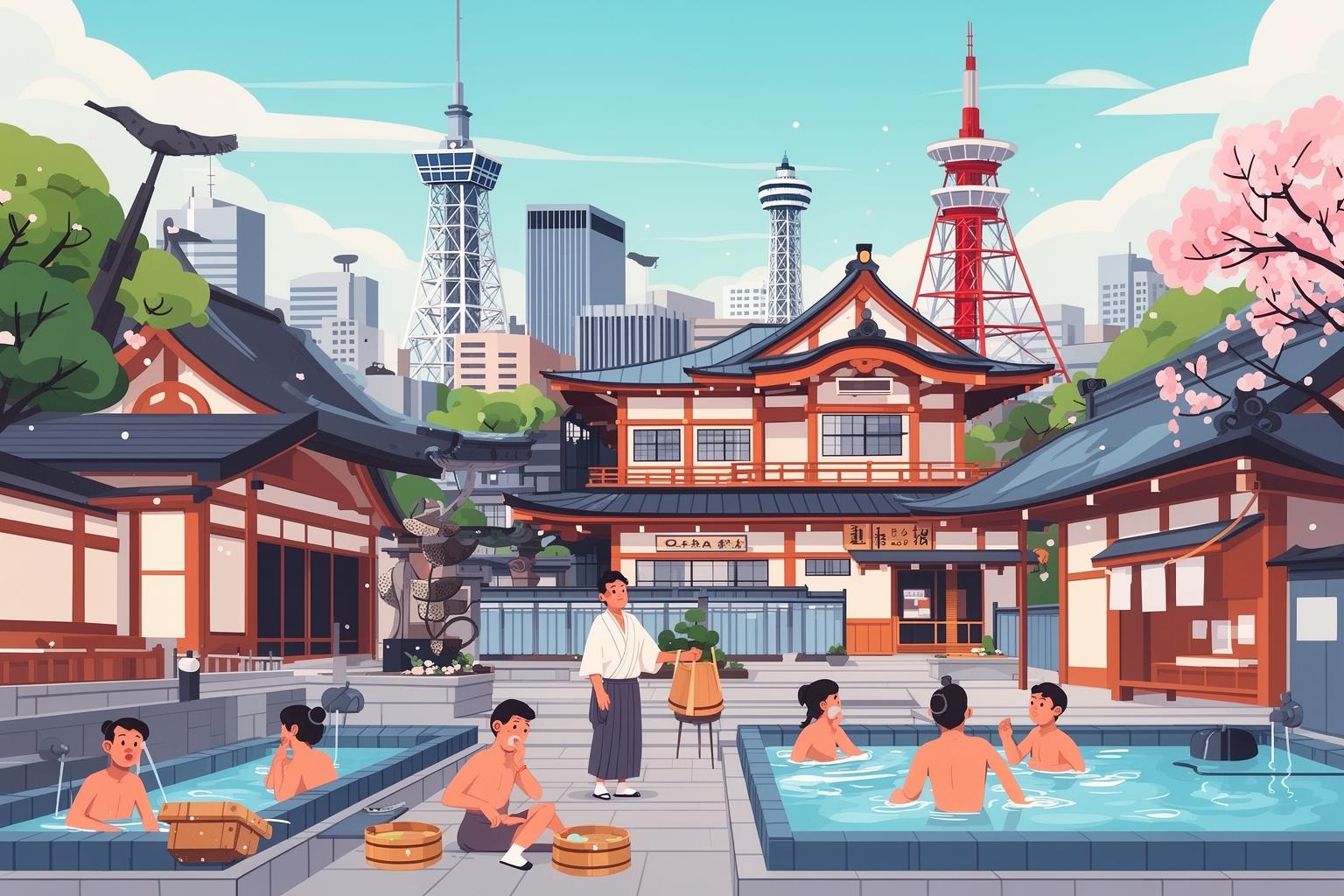
In Tokyo, space is at a premium. Apartments are small, walls thin, and life is often lived in quiet, respectful isolation. Public areas serve mainly for transit, not lingering. A Tokyo sento, particularly the newer and more stylish ones, often reflects this ethos. It’s a place for personal wellness, a quiet escape, a solitary ritual of self-care. You go in, wash, and leave. The atmosphere is serene, almost meditative. In stark contrast, an Osaka sento greets you with a wall of sound the moment you enter. It’s not noise; it’s life—the clatter of yellow plastic washbowls on tile floors, booming voices echoing under the high, steam-filled ceiling, the groan of an old man easing into the hot water, kids cannonballing into the lukewarm tub, and the constant, friendly chatter of regulars.
Beyond Hygiene: The Social Role of the Bathhouse
The layout of a traditional Osaka sento reveals its social purpose. Upon entrance, you slide your shoes into a small wooden locker and take the wooden key-tag with you. Then you approach the ‘bandai,’ a high, throne-like perch where the owner—often a grandmotherly ‘obachan’ or a gruff ‘ojisan’—oversees both men’s and women’s sides. They’re more than just cashiers; they act as gatekeepers, moderators, and central points in the neighborhood’s information network. They know who just had a baby, whose shop is closing, and who’s feeling under the weather. Paying around 500 yen grants you entry into this world.
In the changing room, called the ‘datsuijo,’ it’s immediately clear this isn’t a sterile locker room. There are old wicker baskets for clothes, a vintage, heavy-duty scale that requires sliding weights by hand, a TV usually showing a baseball game or variety show bolted to the wall, and a few worn vinyl benches. This is where socializing begins. Older men toweling off argue passionately about the Hanshin Tigers’ latest game. Mothers exchange gossip while dressing their children. It’s a space designed for lingering, conversation, and decompression before and after bathing.
This area functions as what sociologists call the ‘third place’—neither the intense pressure of home nor the formal hierarchy of work. It’s neutral ground and a social equalizer. The local factory owner and the unemployed pensioner are both just half-dressed men complaining about the humidity. This role is vital in a society that can feel rigid and stratified. In Tokyo, social life often revolves around curated groups—work colleagues, university friends, hobby circles. In an Osaka neighborhood, the sento mixes everyone in a delightfully chaotic blend. It’s not about who you are on paper, but how you carry yourself here and now. The sento serves as a constant, low-stakes social forum that helps keep the neighborhood fabric intact. It’s where you casually check in on elderly neighbors without intruding and where the community literally washes away the day’s stresses together.
The Unspoken Rules of Engagement
For foreigners, this environment might feel like a social minefield. Yet the rules are simpler than they appear, grounded in common sense and mutual respect. The first rule is hygiene. You enter the bathing area with your small towel and washing supplies. Before touching the main bathwater, you find a vacant stool and shower station and wash yourself thoroughly—soap, shampoo, the whole process. This is non-negotiable. The main tubs are for soaking, not cleaning. The biggest, most unforgivable mistake a sento novice can make is entering the tub while still soapy or dirty. Regulars will notice and issue a sharp, corrective shout from an old-timer. It’s not personal; you’re simply contaminating the communal water.
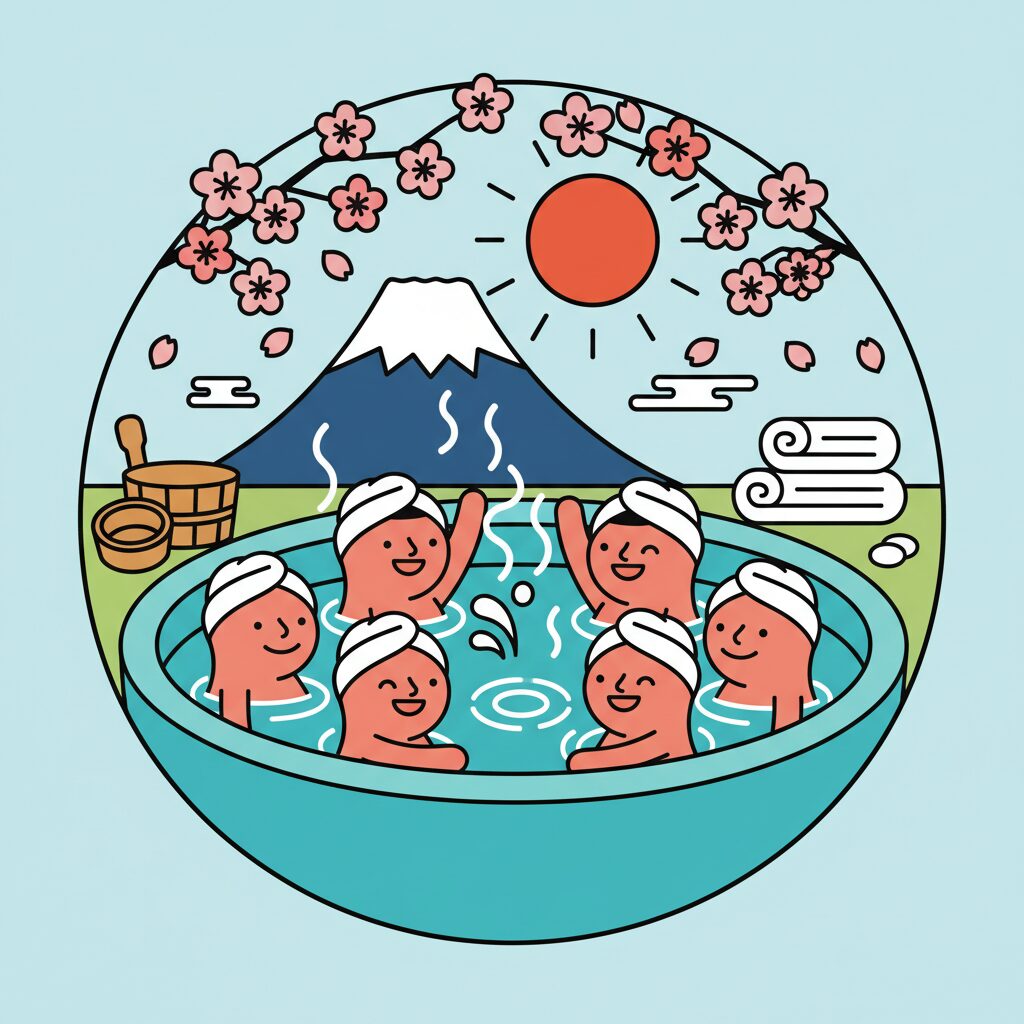
After cleaning, you perform a ‘kakeyu’—using a basin to scoop hot water from a trough or the tub itself, splashing it over your body to acclimate. Then you’re ready. Entering the tub with a small nod or a quiet ‘shitsurei shimasu’ (excuse me) to those already bathing is polite. Your small towel, used for washing and modesty, should never enter the water. Most fold it and place it on their head, which also helps prevent dizziness from the heat. Or they leave it on the tub’s edge. Just don’t let it touch the water.
Social rules are more flexible. Contrary to the stereotype of quiet and reserved Japanese, Osakans in the sento are often talkative. But silence is perfectly acceptable. Soaking quietly will not be seen as rude. However, the atmosphere often invites connection. Conversations may start with simple remarks like ‘Kyo wa atsui na’ (It’s hot today, isn’t it?), or compliments about the bath: ‘Koko no denki-buro, you kiku wa’ (The electric bath here really works well).
This marks a core difference from Tokyo. In a Tokyo sento, striking up a conversation with a stranger might be viewed as intrusive—a breach of personal time. In Osaka, it’s a natural part of the experience, a recognition of shared space and humanity. The unspoken rule is: be open, respectful, and don’t hesitate to engage if someone reaches out. The sento is where social barriers soften, and a little vulnerability goes a long way.
Decoding ‘Hadaka no Tsukiai’: What It Really Means
The phrase ‘hadaka no tsukiai’ is often mentioned but frequently misunderstood. It doesn’t mean being friends while naked; rather, it refers to a relationship stripped of all external status symbols. It’s a friendship of the soul, not one defined by business cards. This idea forms the philosophical foundation of the Osaka sento.
Stripping Away the Labels
Despite Japan’s modernization, society remains deeply hierarchical. Your identity is tied to your company, your job title, your school, and your family background. The language itself reflects this, with intricate levels of politeness (‘keigo’) that help navigate these social layers. This is especially true in Tokyo, the hub of corporate and political power, where everything revolves around presentation and maintaining your ‘tatemae’ (public persona). You might be a manager at Mitsubishi, a student at Waseda University, or a resident of the upscale Minato ward. These labels precede you.
In the sento, all those distinctions disappear. When you undress, you shed your uniform, your expensive salaryman suit, your construction gear, or your trendy streetwear. Tattoos aside, everyone appears much the same: a vulnerable, unadorned human being. The CEO and the part-time convenience store clerk soak in the same 42-degree Celsius water, their skin flushed from the heat. Here, the president cannot assert his rank or demand respect through his title. Instead, he must earn it the old-fashioned way—by being a decent, engaging person to converse with.
This is deeply liberating and perfectly matches Osaka’s historical character. Osaka was never a city of samurai and shoguns; it was a city of merchants (‘akindo’). In old Osaka’s merchant culture, what mattered wasn’t noble lineage but shrewdness, reliability, and character. This pragmatic, egalitarian spirit contrasted with the rigid feudal order of Edo (old Tokyo). That spirit persists in the sento, where people are judged not by résumés but by their ‘honne’ (true feelings and intentions). You can’t hide your true self when sitting naked beside someone. Your body language, tone of voice, and ability to laugh at yourself are what resonate. I once witnessed a lively yet friendly debate in a sauna between a man who clearly exuded the authority of a high-powered executive and a much younger guy with bleached hair and piercings. They argued about the best way to make takoyaki. Outside, in everyday life, these two might never cross paths, divided by age, class, and occupation. Here, they were simply two guys passionate about octopus balls. That, in essence, is ‘hadaka no tsukiai.’
The Language of the Bath: Osaka-ben in its Natural Habitat
If you’re learning Japanese in a classroom, you’re most likely studying ‘hyojungo,’ the standard dialect based on Tokyo speech. It’s polite, formal, and used in national news broadcasts. The sento is where you hear the true language of Osaka: ‘Osaka-ben.’ To the untrained ear, it can sound like a completely different language—faster, more musical, and more direct. Its grammar, vocabulary, and intonation form a lively rollercoaster.
You’ll hear quintessential Osaka expressions. Instead of the standard ‘arigato gozaimasu’ (thank you), you’ll hear a quick, friendly ‘ookini.’ Instead of ‘ikura desu ka?’ (how much is it?), it’s ‘nanbo?’. The common ‘dame’ (no good, impossible) becomes ‘akan.’ But it’s not just the words; it’s the whole attitude. People finish each other’s sentences and engage in rapid-fire banter called ‘manzai,’ the foundation of Japanese stand-up comedy. One person makes a slightly absurd comment (the ‘boke’), and the other immediately counters with a witty retort (the ‘tsukkomi’).
For instance, someone stepping out of the intensely hot bath might exclaim, ‘Atsu sugite, yakeru wa!’ (It’s so hot, I’m gonna get cooked!). A friend might reply, ‘Omae, motto yaitara oishiku naru kamo shirehen de’ (If you cooked a bit more, you might actually taste good!). Though it sounds harsh on paper, in context it’s a sign of affection—a playful verbal sparring that shows closeness and sharp wit. This kind of raw, unfiltered communication is rare in Tokyo’s more reserved public spaces. In the Osaka sento, it’s the norm. It’s the sound of a community comfortable with itself, a place where people don’t constantly worry about offending others with a careless word. They can simply talk, laugh, and argue like family. Listening to Osaka-ben’s rhythms in a sento feels like receiving a direct dose of the city’s soul.
The Sento Experience: A Foreigner’s Field Guide
Alright, so you’re convinced and want to give it a try. But the anxiety is real. What will locals think about a foreigner showing up at their neighborhood spot? How do you avoid being ‘that guy’ who ruins the vibe? Relax. Navigating the sento is simpler than you might expect, especially if you grasp the local mindset.
Breaking Through the ‘Gaijin Bubble’
Let’s confront the obvious: being a foreigner (‘gaijin’). Yes, people might stare. In a close-knit neighborhood sento, a new face stands out, and a non-Japanese face does so even more. But it’s important to understand the nature of those stares. In Tokyo, a stare can often feel cold, a silent judgment. In Osaka, it’s almost always pure, unfiltered curiosity. An Osaka ‘obachan’ won’t just glance; she’ll likely approach you and ask, ‘Nii-chan, doko kara kitan?’ (Hey, kid, where are you from?). Her bluntness may catch you off guard, but it’s not unfriendly. It’s an invitation. She’s genuinely curious. She views you not as an outsider to ignore, but as a new character stepping onto the stage. How you respond sets the tone. A timid mumble will likely end the conversation quickly. But a confident, friendly reply—even in imperfect Japanese—will open the floodgates. Suddenly, you’ll be answering questions about your country, your job, and whether you enjoy natto. You’re no longer just an anonymous foreigner; you’re ‘that American guy who lives down the street.’
Tattoos are trickier. Traditionally, tattoos in Japan are strongly linked to the ‘yakuza,’ or organized crime. Because of this, many onsen (hot springs) and large spas enforce a strict ‘no tattoos’ policy. Neighborhood sento tend to be more lenient, but it’s a gray area. A small, discreet ‘fashion’ tattoo will probably be overlooked. A full sleeve or back piece is another matter; you could be politely refused entry. There’s no universal rule, and often it depends on the owner’s discretion. The safest bet is to check for signs at the entrance. If none are posted, you might ask, or just enter and see. The worst outcome is being turned away. Some younger or more ‘art-focused’ sento openly welcome tattoos, but your average traditional spot remains a gamble. It’s a frustrating reality, but part of the cultural landscape.
The best way to burst the ‘gaijin bubble’ is with some effort. Learn a few key phrases, especially in Osaka-ben. A simple ‘Eeyu desu na’ (This is a nice bath, huh?) tossed to a fellow bather can work wonders. It signals that you’re not just a tourist checking off a list; you’re someone eager to join in the local culture. Osakans value effort and sincerity. Show them that, and they’ll welcome you warmly.
What to Expect Inside: A Sensory Journey
No two sento are identical, but they share a common set of features. When you enter the bathing area, you’re met with a symphony of water elements. There’s the main tub, the ‘shuhuro,’ usually maintained at a hot 41-43 degrees Celsius. This is the social hub of the bath. Then you have specialty baths. You’ll almost always find a ‘jetto-basu,’ or jet bath, featuring powerful underwater jets to massage your back and legs. It’s a favorite among manual laborers and office workers with stiff shoulders.
Then there’s the uniquely Japanese—and often surprising—‘denki-buro’—the electric bath. This small tub has two metal plates on opposite sides that emit a low-voltage electrical current into the water. The first time you step in, it’s a strange and startling sensation. Your muscles twitch in a pulsing rhythm. It feels like thousands of tiny needles pricking your skin. Foreigners often yelp and jump out immediately, much to the amusement of regulars. But for those in the know, it’s a beloved remedy for muscle pain and poor circulation. There’s a certain pride in enduring the strongest setting. Watching a grizzled old man relax in the ‘denki-buro’ with a blissful expression is quite the sight.
To complete the circuit, you’ll often find a ‘mizuburo’ (cold water plunge) next to the sauna. The ritual of sweating it out in the sauna and then plunging into icy water is a national passion. It’s said to boost circulation and mental clarity. The initial cold shock is intense, but the sensation afterward—a tingling, euphoric lightness called ‘totonou’—is what keeps people coming back.
The experience doesn’t end when you leave the water. The post-bath ritual is just as vital. In the changing room, people meticulously groom themselves, share communal hair dryers (often requiring a 20-yen coin for three minutes), and weigh themselves. Then comes the final, glorious stage: the lobby. There, vintage vending machines offer glass bottles of milk—plain, coffee, or fruit-flavored. Nothing is more satisfying after a hot bath than downing an ice-cold bottle of fruit milk. For many Japanese, it’s a taste of childhood. Others choose a cold beer. You’ll see groups of friends or solo bathers sitting on benches, sipping drinks, watching TV, and letting the day’s stress melt away. This is the ‘cool down’ period, where bath conversations continue in a relaxed setting. It’s the final act of the sento’s social theater.
Why the Sento is the Soul of Osaka (And Why It’s Disappearing)
To truly grasp the essence of Osaka, one must understand its sento. It is more than just a quaint tradition; it is a vibrant, living institution that embodies the city’s very identity. This is the place where the unspoken rules of Osaka society unfold every day.
A Microcosm of Osaka Culture
The sento perfectly encapsulates Osakan values. It is practical: for just a few hundred yen, you gain access to unlimited hot water, a sauna, and a social gathering spot. In a city driven by business and the pursuit of good value (‘cost-performance,’ as locals say), the sento offers unbeatable worth. It builds community: amid a vast metropolis, the sento generates a village-like feeling, connecting people across generations and social classes. It embraces directness: ‘hadaka no tsukiai’ represents the ultimate dismissal of polite pretenses and social masks common elsewhere in Japan. This is a place devoted to ‘honne,’ where honesty and straightforwardness reign. It also brims with humor: the ongoing teasing, and the ‘boke’ and ‘tsukkomi’ banter, act as social glue keeping the community harmonious.
This contrasts sharply with Tokyo’s cultural norms. Tokyo tends to prioritize privacy, individualism, and maintaining a polished public façade. Social interactions are often planned and deliberate—you meet friends in stylish cafés or quiet izakayas. The idea of spontaneous, boisterous, and bare-naked socializing with a diverse mix of neighbors feels foreign and even uncomfortable to many Tokyoites. The sento exemplifies Osaka’s fondness for the messy, communal, and unpretentious. It is a tangible reflection of the city’s grounded, ‘get real’ mindset. While Tokyoites might indulge in a luxurious spa day for ‘self-care,’ Osakans head to the local sento for a form of ‘community-care.’ It’s less about pampering oneself and more about reaffirming one’s role within the collective.
The Fading Glow of the Lantern
Despite its cultural importance, the neighborhood sento faces decline. Hundreds close annually across Japan. The causes are clear. Nearly every home now has its own bath and shower, turning the sento from a necessity into a luxury. Owners are aging, and their children often lack interest in inheriting the demanding, low-profit family business. Rising fuel costs to heat large boilers are cutting further into already slim margins.
With each sento that takes down its ‘noren’ curtain for the last time, a neighborhood loses more than just a place to bathe. It loses its main social center. It loses the spot where elderly residents living alone find daily conversation and a warm reception. It loses neutral territory where disputes are resolved and friendships formed. The closure of a sento sends ripples through the community, leaving a void hard to replace. Convenience stores, supermarkets, and train stations cannot offer the same opportunities for deep, unhurried human connection.
Yet there is hope on the horizon. A new wave of younger owners and advocates aims to preserve and reinvent the sento. Some renovate old bathhouses with modern designs to draw new patrons. Others host events—live music, art exhibits, even pop-up bars in lobbies. ‘Sento running’ clubs have emerged, where participants follow a route ending in a local sento for a post-run soak. These efforts are valiant but face daunting demographic and economic challenges. The danger remains that the sento may come to be seen as a novelty, a retro-chic attraction, while its original role as the unglamorous, essential heart of working-class neighborhoods fades away into history.
Final Thoughts: Soaking It All In
If you live in Osaka, or are even just considering it, the local sento is more than a cultural curiosity to watch from afar. It’s an invitation—an entryway to unlocking the complex, frustrating, and ultimately beautiful spirit of the city. It offers a practical lesson in a different way of life, one that values raw honesty over polished perfection, and community bonds over individual isolation.
Don’t be daunted by unfamiliar rituals or the lively regulars. View it as an opportunity. The sento is one of the rare places in Japan where being a foreigner can work to your advantage. Your outsider status allows you to ask questions freely, be a little awkward, and break the ice in ways that might be tougher for a Japanese person from elsewhere. Your sincere curiosity will almost always be met with genuine kindness.
So go ahead. Find the sento in your area. Bring a small towel, some soap, and a few coins. Step through the ‘noren’ curtain. Let the steam envelop you. Listen to the candid chatter in a language you might not fully grasp, but a human tone you can’t mistake. Try the electric bath, even if it intimidates you. Take the plunge into the cold water. Then, sit in the lobby and sip that ridiculously sweet fruit milk. As you stroll home down the quiet streets, your skin tingling and warm, your mind calm, you’ll feel it. You’ll sense the rhythm of the neighborhood. You’ll feel connected, belonging. And you’ll understand, in a way no book or blog post can truly capture, what it means to live in Osaka.