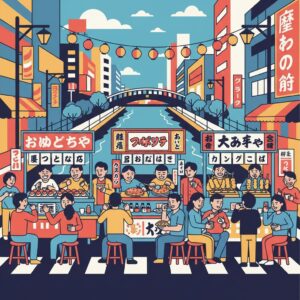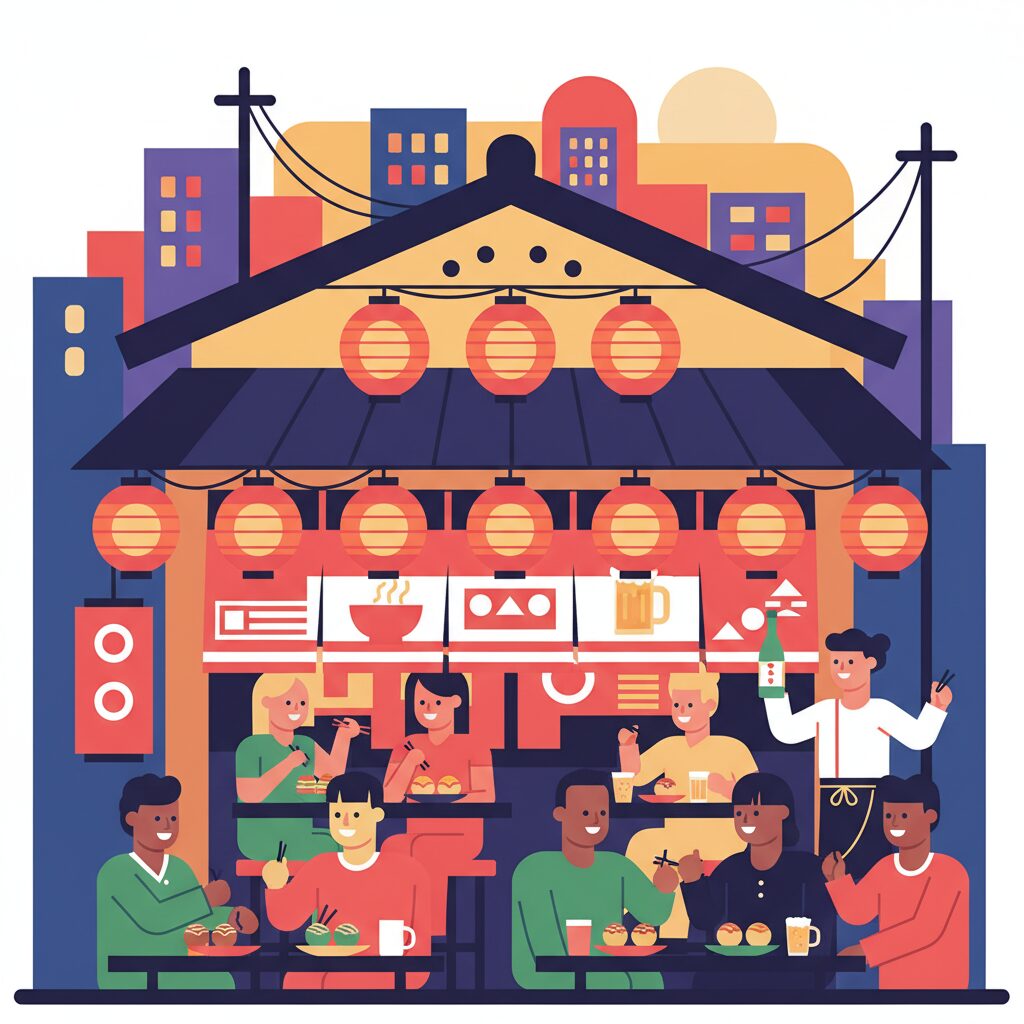
Step out of the train at JR Tenma Station, and the air changes. It’s not just the temperature, but the texture of the atmosphere itself. In Tokyo, the air outside a busy station is a clean, humming current of purpose. People surge from the gates with a destination in their eyes, a silent, coordinated ballet of urban efficiency. Here in Tenma, the air is thick, greasy, and joyous. It’s a chaotic cocktail of grilled meat, stale beer, cheap perfume, and the rumbling bassline of a thousand conversations happening all at once. It clings to you. It gets in your hair. And it’s the most authentic welcome to Osaka you could ever ask for. As a curator from Tokyo, my world is often one of calculated aesthetics and refined spaces. I’m used to the quiet reverence of a gallery, the polite distance of a Ginza cocktail bar. Tenma is the antithesis of all that. It’s a sprawling, messy, glorious, open-air museum of life, and its primary exhibit is the Osakan soul at its most unguarded.
People talk about Namba or Shinsaibashi as the heart of Osaka, but those are the city’s public-facing stages, designed for tourists and grand commerce. Tenma is the city’s cluttered, raucous living room. It’s a dense labyrinth of covered shopping arcades, or shotengai, branching into a capillary network of impossibly narrow side streets, each one crammed with tiny eateries, standing bars, and smoky grills. Forget what you know about curated drinking alleys like Shinjuku’s Omoide Yokocho, which, for all its charm, feels increasingly like a well-preserved theme park for tourists. Tenma is not a theme. It is a vital organ, pulsing with the unfiltered energy of everyday people letting loose after a long day. This is the spiritual home of hashigo-zake, the art of izakaya hopping, a ritual that in Osaka transcends mere bar-crawling and becomes a form of social communion. To understand Tenma is to understand the core operating system of Osaka: a relentless pursuit of good value, a deep suspicion of pretension, and an unshakeable belief that a conversation with a stranger is always just one drink away. This guide isn’t about a checklist of places to visit. It’s a Rosetta Stone for deciphering the beautiful, bewildering language of Osaka’s greatest foodie paradise.
To truly appreciate the dense labyrinth of covered shopping arcades, or shotengai, that define Tenma, it’s worth exploring why Osaka’s shotengai are so much more than just tourist spots.
The Tenma Mindset: Unpacking “Kitanai kedo Umai” (Dirty but Delicious)
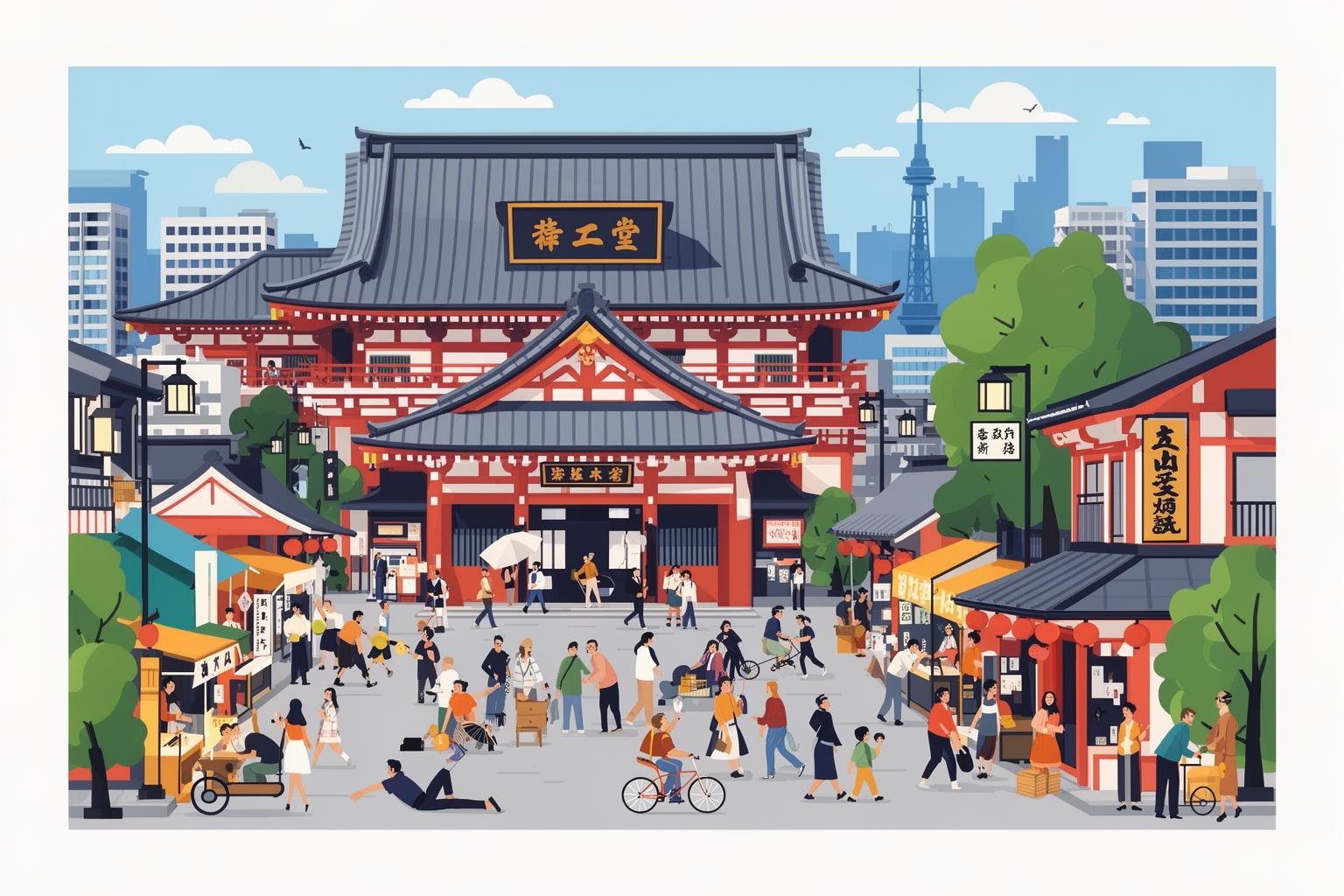
In Osaka, there’s a phrase that perfectly captures the Tenma aesthetic—a philosophy sure to unsettle any Tokyo restaurateur obsessed with branding and minimalist design. The phrase is “Kitanai kedo Umai,” meaning “It’s dirty, but it’s delicious.” This is not a confession or an apology; rather, it’s a proud proclamation of values. It serves as a badge of honor worn by the neighborhood’s most beloved eateries, a secret handshake between owner and customer that says, “Here, we focus on what truly matters.”
The Aesthetic of the Unpolished
First, let’s clarify the meaning of “kitanai” in this context. It doesn’t suggest poor hygiene—Japan, including Osaka, enforces strict health regulations. Instead, “kitanai” refers to a magnificent lack of polish. It stands in direct contrast to the meticulously curated, Instagram-perfect interiors that dominate Tokyo’s food scene. In Tenma, beauty lies in the wear and utility of things. It’s the vinyl seats patched with duct tape, walls yellowed by decades of kitchen smoke and laughter, handwritten menus on faded paper strips, their corners soft and greasy from countless touches. It’s the often-slick floor, a mix of spilled beer and condensation, where you learn to shuffle carefully. It’s the cramped counter, barely wide enough for your plate, where your shoulder brushes against a construction worker on one side and an office clerk on the other, creating an immediate, unavoidable intimacy.
This aesthetic reflects the practical Osakan mindset, rooted in pragmatism and skepticism toward superficial appearances. In Tokyo, ambiance is part of the product—you pay for elegant lighting, designer chairs, and carefully chosen playlists. The experience is holistic, with visuals paramount; a beautiful restaurant is assumed to serve exceptional food. Tenma turns this on its head. A slick, overly polished place may invite suspicion—is the owner masking something? Are they spending on decor instead of fresh fish? A venue slightly rough around the edges feels authentic, signaling that the owner’s priorities lie in sourcing top ingredients and offering them at the lowest price. The chipped bowls, mismatched glasses, bare light bulbs—they aren’t flaws but testaments to businesses thriving for years on food quality and personality alone. This visual language communicates authenticity: this is a place for eating, drinking, and connecting, not posing or performing. It’s a profoundly different way of valuing experience, often puzzling foreigners and many Tokyoites at first. Initial discomfort fades after your first bite of perfectly grilled fish costing less than a cup of coffee, and the beauty of the unpolished aesthetic becomes clear.
The Philosophy of “Yasukute Umai” (Cheap and Delicious)
If “Kitanai kedo Umai” embodies Tenma’s aesthetic, then “Yasukute Umai” is its soul. This mantra, “Cheap and Delicious,” underpins Osaka’s entire culinary and commercial culture. It goes beyond finding a bargain; it’s a deeply rooted philosophy of value, a near-religious creed born from centuries of merchant tradition. In Osaka, spending lots doesn’t earn respect—finding something amazing at minimal cost does. Tenma is the grand cathedral of this belief.
Prices on chalk-written menus can be astonishing: a generous portion of fresh sashimi for 380 yen; a huge steaming bowl of motsu-nabe (offal hotpot) for 500 yen per person; a whiskey highball brimming with fizz for 200 yen. Your Tokyo-honed mind struggles to grasp how this is possible. The answer lies within Tenma’s ecosystem. Anchored by the sprawling Tenma Wholesale Market (Osaka Tenma Oroshiuri Ichiba), a professional market supplying the city’s restaurants, the nearby izakayas have direct access to incredibly fresh seafood, meat, and produce at prices that eliminate many middlemen. This geographical advantage forms the first pillar of the “Yasukute Umai” economy.
The second pillar is a business model centered on high volume and low margins. Tiny shops are designed for quick turnover; seats are close, service brisk, and the atmosphere encourages you to eat, drink, and move along. Profits don’t come from upselling a few wealthy patrons but from serving hundreds of regulars nightly. This fosters a beautifully democratic dining scene. In Tokyo, a world-class sushi meal often costs tens of thousands of yen, a special treat for most. In Tenma, you can stand at a counter and enjoy sushi of astonishing quality for less than a movie ticket’s price. It demystifies and reclaims high-quality food for the masses.
This obsession with “kosupa” (cost performance) marks a significant contrast between Osaka and Tokyo consumers. In Tokyo, price often signals quality, status, and experience—an expensive tag promises high-end service, ambiance, and exclusivity. Osakans, however, prize value hunters proudly recounting a 500-yen lunch that outshines a 3,000-yen meal elsewhere. This isn’t stinginess but shrewdness; it’s a game, and winning it brings deep satisfaction. In Tenma, the experience is not handed to you by the restaurant but created by you. The value lies not in decor or deferential service, but in the food on your plate, the drink in your hand, and the shared, lively energy of the room. This is Osaka’s merchant spirit at its purest: delivering an undeniably excellent product at an almost unbelievably fair price. Everything else is just background noise.
Navigating the Labyrinth: The Unspoken Rules of Tenma Hashigo-zake
To the untrained eye, Tenma can seem like pure chaos—a swirling mix of people, noise, and smells without any apparent order. However, beneath this disorder lies an elegant, unwritten code of conduct. Grasping this social choreography is essential to truly savor hashigo-zake like a local. It’s a dance of timing, spatial awareness, and social intuition that guides the rhythm of the entire neighborhood. Mastery of it transforms you from a passive observer into an engaged participant in Tenma’s nightly celebration.
The Art of Quick Entry, Quick Exit
The core principle of hashigo-zake is movement. Unlike a Western bar crawl, which can be slow and cumbersome, the Tenma hop is lively and swift. You don’t anchor yourself in one spot all evening. The aim is to sample the distinct offerings of several venues, creating a multi-course meal that stretches across the neighborhood. The ideal pace at each stop—especially the popular, crowded ones—is to have one or two drinks along with one or two signature dishes (meibutsu). Settle in, order their famed item, enjoy it, and then make a graceful exit.
This practice isn’t about rushing or being discourteous; it’s about honoring a communal, unspoken agreement. The tiny bars and eateries in Tenma—particularly the tachinomi (standing bars)—have limited space. By keeping your visit brief, you show consideration for those waiting outside to take your place. You also respect the owner, whose business thrives on a steady flow of customers. Lingering over a single drink for an hour in a packed tachinomi is a cardinal sin—it disrupts both the social and economic pulse of the spot. Osakans have a sixth sense for this. They know when their group’s energy has peaked and when it’s time to settle the bill (o-kaikei!) and drift back into the vibrant alleyways in search of the next gem.
How to gauge the proper pace? Watch and listen. Observe the locals. Are they ordering quickly and efficiently? Is there a queue forming outside? Does the menu cater to quick, simple dishes rather than elaborate meals? Standing bars are almost always designed for brief stops. Venues with more comfortable seating might allow for a slightly longer stay, but the principle holds. The charm of this system is that it enables you to experience a broad spectrum of culinary styles in a single night. You might start with fresh oysters and white wine at a standing seafood bar, move to smoky yakitori and a cold beer at a grill, then savor a rich beef stew with a shochu highball, and finish with surprisingly authentic pizza and a glass of red. Each stop writes a new chapter in the evening’s story. It’s a progressive dinner for the commitment-shy, a fluid and spontaneous way to eat and drink that feels completely liberating.
“Tonari no Kyaku”: The Neighbor at the Counter
This is perhaps the most vital—and for many non-Japanese—the most daunting part of the Tenma experience. In the densely packed, elbow-to-elbow setting of a Tenma izakaya, your personal space essentially vanishes. Your “neighbor at the counter” (tonari no kyaku) is more than someone sitting beside you; they become an active participant in your night, planned or not. This is where the cultural divide between Osaka and Tokyo becomes a chasm.
In most Tokyo bars, an invisible, polite barrier separates strangers. You might exchange a slight nod, but engaging in a full conversation is rare and can even be viewed as an intrusion on private time. Tokyo people often go to bars to be alone together, decompressing in public anonymity. Osaka, however, operates on a very different social wavelength. Here, close proximity is an invitation. The shared delight in discovering a great dish or laughing at the owner’s antics acts as a powerful social glue, breaking down the walls that typically separate strangers in urban Japan.
Don’t be surprised if the person next to you leans in and asks, “What’s that you’re eating? Is it good?” They might then turn to the chef and say, “Master, give him one of those too!” Before long, you’re swapping food tips, sharing stories about your favorite Hanshin Tigers players, or receiving a detailed, unsolicited lesson on how to properly enjoy sake. This isn’t the superficial “friendliness” touted in travel guides. It’s a more direct, occasionally nosy—but always warm-hearted—form of engagement born from genuine curiosity and the belief that shared experiences are richer experiences.
I remember one night, squeezed into a tiny oden shop, a perfectly coiffed grandmother in her seventies beside me watched as I struggled to identify items in my bowl. Without a word, she reached over with her chopsticks, pointed to a specific fish cake, and declared, “This one is the best. You must eat it while it’s hot.” For the next half hour, she became my personal oden tutor, explaining the history of each ingredient. Her husband, a quiet man nursing his hot sake, eventually joined in, and we ended up chatting about everything from art to politics. This kind of spontaneous, cross-generational connection is the magic of Tenma. To thrive here, you must be open, lower your guard, and be ready to engage. Your neighbor at the counter isn’t just a random stranger—they’re a potential friend, guide, storyteller, and an essential part of the Tenma experience.
The Role of the Taisho: Master, Entertainer, and Grump
At the heart of every Tenma izakaya is the taisho, or master. This figure—usually owner, chef, and primary server all rolled into one—is far more than just a cook. They orchestrate the room’s energy, curate the evening’s vibe, and serve as the main actor in the nightly drama unfolding around their counter. Knowing how to understand and interact with the taisho is key to navigating Osaka’s social scene.
Taisho come in several archetypes. There’s the Silent Craftsman, who barely speaks, focusing entirely on the precise movements of his hands as he slices fish or flips skewers. His skill is his language, commanding respect through sheer excellence. Then there’s the Jokester Showman, who holds court behind the counter, bantering loudly with regulars, telling off-color jokes, and keeping everyone’s glass full. He thrives on the crowd’s energy and single-handedly creates a party atmosphere. A personal favorite is the Lovable Grump, who might scowl when you order, sigh dramatically if you ask a question, and generally seem annoyed by your presence. But this is usually a performance—a form of Osakan theater. Regulars know that beneath the crusty exterior lies a warm heart, and grumpiness is a form of affection. A key part of the fun is coaxing a smile from him.
Interacting with the taisho is a subtle art, quite different from the rest of Japan. In a formal Tokyo restaurant, dealings with the chef are reverent and distant. In Tenma, it’s often a dialogue. You can ask questions, compliment dishes directly, and even engage in friendly teasing. This is the world of boke and tsukkomi—the Abbott and Costello-style comedic duo that underpins Osaka humor. The customer might make a silly comment (boke), and the taisho responds with a witty retort or mock insult (tsukkomi). Joining in this playful banter, even as a foreigner, shows you understand the local communication style—valuing directness, humor, and an absence of hierarchy. Don’t hesitate to engage, but read the room. Watch how regulars interact with the master and follow their lead. Winning the taisho’s approval is like unlocking a new level in the game. He might pour you a generous glass, offer something off-menu, or share a rare, genuine smile. The taisho isn’t just serving food; they’re sharing their space, craft, and personality. They are the heart and soul of Tenma.
A Symphony of Senses: What to Eat and Drink in Tenma
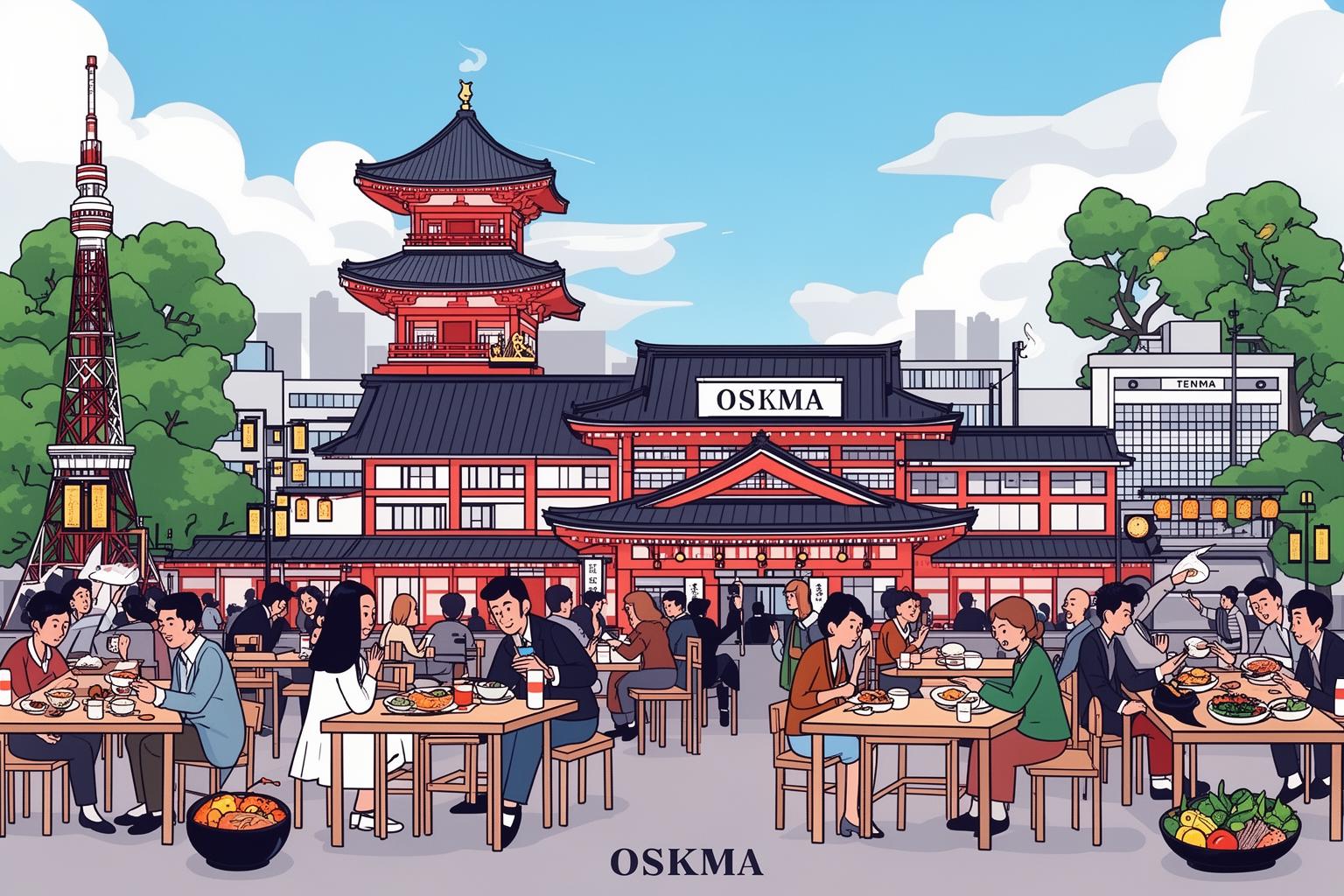
Although this is a cultural guide rather than a food blog, it’s impossible to discuss Tenma without celebrating the dishes that form the core of its identity. The food here is more than sustenance; it’s a language. Each plate tells a story about Osaka’s history, merchant-class ingenuity, and straightforward approach to enjoyment. When ordering in Tenma, it’s not about navigating a complex menu but about embracing a philosophy of dining that emphasizes freshness, simplicity, and shared joy.
The Holy Trinity: Sushi, Kushikatsu, and Doteyaki
Despite Tenma’s wide culinary variety, three staples of the local food scene are essential for every visitor. They capture the quintessential flavors and spirit of Osaka.
First is the sushi, particularly tachigui-sushi (standing sushi). Forget the quiet, reverent atmosphere of an upscale Ginza sushiya, with its hush and intimidating prices. Tenma sushi is the punk rock counterpart: fast, noisy, and remarkably democratic. You squeeze up to a high counter, shout your order piece by piece to the chef, and moments later, the sushi arrives on a simple plate or bamboo leaf. The quality often surprises, thanks to proximity to the central market. The fish is fresh, the rice perfectly seasoned, but all ceremony is stripped away. This is sushi as everyday fare—a quick snack between meetings or the first stop on a drinking night. It’s Osaka’s ultimate expression of turning an often elitist dish into something accessible and fun for everyone.
Next is kushikatsu, considered Osaka’s soul food. The concept is straightforward: various ingredients—meat, seafood, vegetables—are skewered, coated in panko breadcrumbs, and deep-fried to golden perfection. They’re enjoyed piping hot, dipped in a communal trough of sweet and savory tonkatsu-style sauce. Here you encounter the most sacred and strictly enforced rule of Osaka dining: “Nidozuke kinshi!”—”No double-dipping!” Once a skewer touches your mouth, you cannot dip it back into the sauce. This rule isn’t merely a suggestion but a social contract—a pact of trust and hygiene among strangers. It perfectly reflects Osaka’s social fabric: simple, practical rules enabling a diverse crowd to share a communal experience harmoniously. The variety of kushikatsu is impressive, ranging from classic beef and onion to adventurous choices like cheese, quail eggs, and even ice cream.
Finally, there’s doteyaki, a dish that showcases Osaka’s talent for transforming humble ingredients into something extraordinary. It’s a rich, hearty stew made from beef sinew (suji), konjac, and daikon radish, slow-simmered for hours in a sweet and savory miso broth. The lengthy cooking process breaks down the sinew until it becomes tender and melts in your mouth. Doteyaki is a tribute to the pragmatism and patience of the merchant class—a dish born from the desire to waste nothing and create deep flavor from inexpensive meat cuts. It’s the ultimate comfort food, often bubbling away in a large pot at the bar’s front, its irresistible aroma drawing customers from the street. A small bowl of doteyaki paired with a cold beer offers one of Tenma’s most perfect, soul-satisfying combinations.
Beyond the Obvious: Exploring Tenma’s Nooks and Crannies
While the holy trinity offers a great introduction, Tenma’s true charm lies in its incredible diversity and the excitement of discovery. This isn’t a static museum of traditional Japanese food but a living culinary ecosystem where new and unexpected flavors thrive, all filtered through the essential Tenma values of quality and value.
Wander down a side alley, and you might find a tiny, family-run Italian restaurant. It has no fancy decor—just a few wooden tables and a handwritten menu—but the pasta, crafted by an old oji-san who fell for Italian cuisine fifty years ago, may be more soulful and delicious than anything in a trendy Tokyo suburb, and cost only a fraction of the price. Turn another corner, and you might find a standing Spanish bar, its counter piled with glistening jamón ibérico and plates of garlic shrimp, served with affordable, quaffable Spanish wine. The owner may not speak Spanish, but he has mastered the essence of tapas culture: small, delicious bites that encourage conversation and drinking.
This reflects a key part of Osaka’s identity. As Japan’s historic merchant capital and major port, it has always been more receptive to outside influences than the more tradition-bound Kyoto or politically centered Tokyo. Osakans are pragmatists; they don’t care where ideas originate, only whether they work. If a foreign cuisine fits the “Yasukute Umai” (cheap and delicious) philosophy, it’s embraced wholeheartedly. Recently, this is evident in the rise of craft beer bars, natural wine shops, and authentic Thai and Vietnamese street food stalls. Yet all adapt to the local environment. You won’t find large expensive pints of craft beer—instead, smaller, affordable glasses encourage sampling multiple styles. Wine bars offer high-quality, interesting wines by the glass at reasonable prices, stripping away wine snobbery. This is the “Tenma-fication” of global trends—a process that renders everything more accessible, affordable, and fun.
The Drink Situation: More than Just Beer
Of course, food is only half the story. Tenma’s drinking culture is just as important and reflects the same values of accessibility and lack of pretense. While a frosty mug of draft beer (nama biiru) is the standard, the true stars of a Tenma evening are the highball, chuhai, and shochu.
The highball—Japanese whisky mixed with highly carbonated soda—is king. Its clean, refreshing flavor cuts through the richness of fried and grilled dishes perfectly. In Tenma, highballs are often surprisingly cheap and served without fuss in simple, unbranded glasses. The chuhai, a shochu-based highball mixed with various fruit-flavored sodas, is another popular choice, offered in flavors ranging from lemon and grapefruit to exotic ones like calamansi or shiso. Shochu, Japan’s versatile distilled spirit, can be enjoyed on the rocks (rokku), or diluted with hot (oyu-wari) or cold water (mizu-wari). It’s the people’s drink—much more affordable than premium sake or whisky—and forms the backbone of the local drinking scene.
That’s not to say good sake is absent. Many izakayas take pride in their selection of jizake (local craft sake), often sourced from small breweries. But the approach is different. Instead of a sommelier presenting a leather-bound menu, the taisho might simply point to a few bottles lined up on the counter and say, “This one’s good today.” It’s about trust and simplicity. The goal isn’t to intellectualize drinking but to enjoy it. Like the food menu, the beverage list aims to foster a good time without breaking the bank, ensuring that conversation and laughter flow freely all night.
Tenma vs. The World: Why This Place Could Only Exist in Osaka
Having examined Tenma’s mindset, rules, and flavors, a fundamental question arises: why here? Why does this chaotic, vibrant, and utterly unique neighborhood feel so distinctly Osakan? The answer lies in the fact that Tenma is not merely a product of its geography or its proximity to a market; it embodies Osaka’s cultural DNA, standing in stark and proud contrast to the prevailing trends of modern urban development.
The Anti-Branding Statement
In an era of globalized aesthetics, where cities from New York to Tokyo increasingly share a common visual language of minimalist cafes, industrial-chic restaurants, and carefully curated “experiences,” Tenma represents a radical act of defiance. It is the ultimate anti-branding statement. There are no marketing agencies behind it, no focus groups, no deliberate attempts to craft a marketable identity. Tenma’s brand is defined by its complete absence of a brand. Its power stems from its raw, unfiltered authenticity.
Compare it, for example, to Shinjuku’s Golden Gai. While undeniably a fantastic and historically important place to drink, Golden Gai has, over time, become a well-known international tourist destination. It is heavily photographed, blogged about, and featured in guidebooks to such an extent that it sometimes feels like a beautifully preserved museum exhibit, a “Showa-era theme park.” The experience can seem curated, the chaos contained. Tenma, however, remains stubbornly and chaotically local. Although it has surely gained fame and attracts more visitors today, its core identity remains intact. It hasn’t been sanitized or made more appealing for tourists. This is because the local community—the hundreds of thousands of Osakans who consider it their nightly canteen—simply won’t allow that. Tenma’s economic and social immune system is remarkably strong. If a place becomes too expensive, pretentious, or style-driven at the expense of substance, it is quickly rejected by locals and likely to fail. This grassroots pressure keeps Tenma genuine.
This resistance to commodification is a deeply ingrained Osakan trait. Osaka is a city built by merchants, not samurai or aristocrats. Its culture is therefore more grounded, practical, and deeply skeptical of anything that reeks of empty formalism or style over substance. Tenma is the architectural expression of this worldview. It has evolved organically over decades, shaped not by urban planners or designers, but by the daily needs and desires of working-class people. It is a triumphant celebration of the messy, imperfect, and profoundly human.
The Human Network
Ultimately, what makes Tenma so unique and so quintessentially Osakan is that it is not just a collection of restaurants and bars, but a dense, interconnected, and deeply human network. The taisho of one shop is a regular customer at another. The suppliers from the market drink alongside the chefs they supply. Regulars move in fluid groups, their migration patterns guided by word-of-mouth recommendations passed over counters: “You should go to Tanaka-san’s place next—his grilled oysters are amazing tonight.”
This creates a social dynamic fundamentally different from the more atomized and planned social life typical of a city like Tokyo. In Tokyo, a night out often requires reservations made weeks in advance for a specific restaurant with a set group of friends; it is a planned affair. In Osaka, a common and perfectly acceptable Friday-night plan is simply to “go to Tenma.” You show up, perhaps alone or with a friend, and let the neighborhood decide what comes next. You wander until a certain smell or a lively crowd pulls you in. You are almost certain to run into someone you know, or if not initially, you will by the end of the night. It is a more spontaneous, organic, and serendipitous way of socializing, relying on the community as a whole to provide the evening’s entertainment.
For a foreigner considering life in Japan, this distinction is crucial. It directly answers the question, “Is Osaka a good place to live?” The answer depends entirely on your personality. If you thrive on structure, value privacy and polite distance, and prefer planned social encounters, the constant, unsolicited engagement found in places like Tenma might feel intrusive or exhausting. The Osakan style of direct, humorous, and sometimes nosy communication could be overwhelming. However, if you crave spontaneous connection, enjoy the energy of a crowd, believe that the best conversations happen with strangers over cheap drinks, and want to feel part of a living, breathing community, then Osaka—and neighborhoods like Tenma—will feel like home. It offers a level of social warmth and accessibility increasingly rare in major global cities.
A Final Word: Finding Your Own Tenma
Ending this guide with a neat summary or a list of recommendations would do a disservice. It would contradict the very essence of Tenma. The best advice anyone can offer about this place is to forget all advice and simply get lost. Put your phone away, slip your map into your pocket, and let your senses be your guide. Follow the most tempting aroma. Duck into the alley that looks the most daunting. Squeeze into the bar that seems impossibly crowded. Your most memorable experience in Tenma won’t be in a spot you read about online; it will be somewhere you discover on your own.
The true lesson of Tenma goes far beyond its food and drink. It is a lesson in letting go. Letting go of preconceived ideas about what a “good” restaurant should be. Letting go of social inhibitions that keep us from engaging with strangers. Letting go of the need to have a plan and embracing the joy of spontaneity. It teaches you to trust your instincts, remain open to the unexpected, and appreciate the beauty found in the unpolished and imperfect.
Having spent much of my life in the refined, orderly world of Tokyo’s art scene, my nights in Tenma have been revelatory. They have reshaped my understanding of value, community, and communication. This place reminds you that the most unforgettable experiences are rarely the most expensive or elegant; they are the most genuine. Tenma is a vibrant, living testament that beneath Japan’s sleek, modern exterior—a country often perceived as monolithic and uniform—powerful regional identities and deeply different ways of life continue to thrive. It is not merely a place to eat and drink. It is a masterclass in the joyful, pragmatic, and resilient spirit of Osaka.