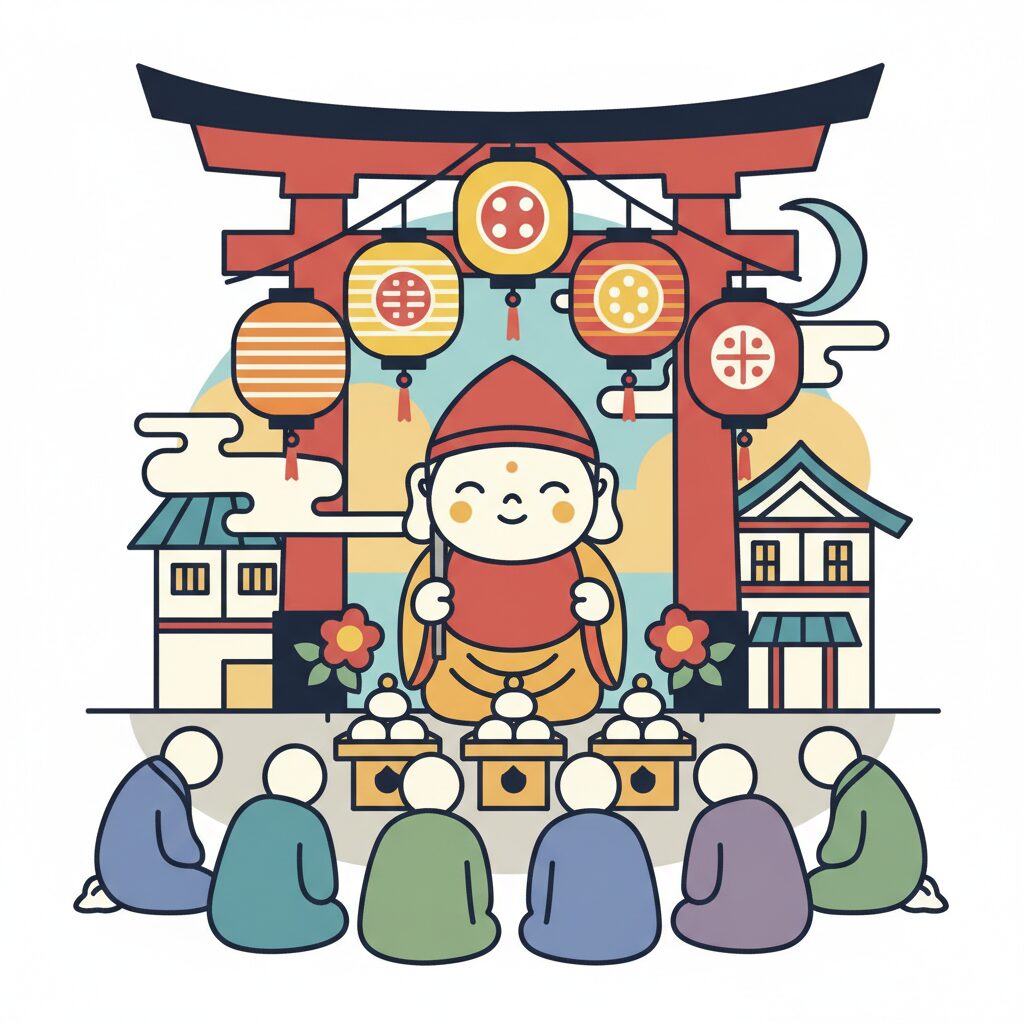
I remember my first August in Osaka like it was yesterday. The heat was a living thing, a thick, wet blanket that never left. I’d just moved into my apartment in a quiet, residential part of the city, a maze of narrow streets and low-slung houses. One sweltering Saturday afternoon, I was walking back from the supermarket when I heard it – the faint sound of children’s laughter and tinny, cheerful music echoing from a small alley I usually ignored. Curiosity, my constant companion in this new life, pulled me in. What I found was a scene that wasn’t in any of my guidebooks. A tiny, cordoned-off section of the street was buzzing with life. Red and white paper lanterns were strung between telephone poles, kids were crowded around tubs of water, scooping for bouncy balls, and a group of impossibly energetic elderly women were handing out plastic bags bulging with snacks. At the center of it all was a small stone statue wearing a little red bib. It felt like I had stumbled into someone’s private backyard party. I felt a pang of awkwardness, the classic foreigner feeling of being an intruder. But then, one of the women, her face a roadmap of smile lines, caught my eye, gave a huge grin, and waved me closer. That was my introduction to Jizo Bon, and my first real lesson in what it means to live in Osaka. This isn’t a grand, performative festival for tourists; it’s the city’s heartbeat, found on the neighborhood block, revealing a layer of community that is deeply, fundamentally Osaka. It’s the key to understanding the city’s social software, the unspoken code that makes life here so different from anywhere else in Japan.
This intimate, neighborhood-level connection is similar to the role that local sentō play as vital community hubs in Osaka.
What Even Is a Jizo? Unpacking the Little Stone Guardians
Before you can truly grasp the celebration, you first need to understand its guest of honor. Jizo statues are found all over Japan, but in Osaka, they feel less like sacred icons and more like cherished family members. Known affectionately as O-Jizo-san, these small stone figures often feature serene, childlike faces and can be seen everywhere—nestled in a parking lot corner, standing guard at a hazardous intersection, or resting at the base of an ancient tree. Silent sentinels, they are woven into the very fabric of the urban environment.
More Than Just a Statue
Jizo is technically a Bodhisattva in Mahayana Buddhism, known as Kṣitigarbha. His primary role is to protect children—especially the souls of those who have passed away young—and travelers. That’s why they are often dressed in clothing intended to keep them warm. The most common sight is a small red bib paired with a matching hat. These are offerings from parents, given either in gratitude for their child’s health or in remembrance of a lost child. Occasionally, you’ll also see other offerings: a small can of juice, a few candies, or a pinwheel spinning in the breeze. These aren’t grand ceremonies in distant temples but small, intimate acts of care and memory made by people right in their own neighborhoods. Jizo isn’t a remote deity but a constant, tangible presence in daily life—seeing children off to school in the morning and watching them come home. He serves as a landmark, a meeting place, and a spiritual anchor for the community.
The Neighborhood’s Protector
The bond Osaka residents share with their local Jizo is deeply personal. It’s not just a Jizo statue; it’s uchi no O-Jizo-san—our Jizo. This sense of ownership is essential. Each statue is tended to by the local community. Neighbors take turns cleaning it, replacing the bib when it fades, and maintaining the surrounding area. This shared responsibility fosters a strong sense of collective space, turning an ordinary street corner into a place of significance. It embodies the community’s commitment to caring for one another, especially its youngest members. In a vast, modern city, the local Jizo grounds the neighborhood, reminding everyone that this small corner is a village united in caring. It’s a quiet yet powerful declaration: “We look after our own here.”
The Anatomy of a Jizo Bon Festival
So, what actually takes place at this hyper-local party? Jizo Bon, usually held on a weekend in late August, is essentially a thank-you celebration for the local Jizo statue, which has watched over the neighborhood’s children throughout the past year. In practice, however, it’s almost entirely a festival dedicated to delighting kids before the long summer vacation ends. It’s a beautiful, chaotic, and utterly charming glimpse into life in Osaka.
It’s All About the Kids (and the Snacks)
From the moment you arrive, it’s clear who the stars are. The entire event is designed from a child’s perspective. The games are delightfully simple and nostalgic. You’ll find a ring toss, or wanage, where kids try to throw plastic rings over rows of inexpensive, colorful toys and snacks. There’s almost always a super ball scooping station—a large tub filled with hundreds of colorful bouncy balls that children scoop with a fragile paper net. The tension and inevitable heartbreak when the paper breaks is a rite of passage. There might also be a simple lottery, or fukubiki, where turning a crank releases a colored ball that corresponds to a prize. The prizes themselves are trivial—plastic trinkets, small fireworks, animal-shaped erasers. The thrill isn’t in the prize but in the excitement of participating and experiencing a small, personal victory.
Then there are the snacks. Oh, the snacks. The distribution of pre-packaged goodie bags, or okashi, is the main event. Neighborhood aunties, the obachan, spend days preparing these. Each bag is a treasure chest of classic Japanese childhood treats: crunchy senbei rice crackers, the puffy corn snack Umaibo in a variety of quirky flavors, sweet Ramune soda with its distinctive marble stopper, along with an assortment of hard candies and chocolates. Watching a child receive their bag is pure magic—their eyes widen as they clutch it, feeling its weight and already planning how they will savor the treats. It’s a moment of pure, unfiltered joy, created entirely by the community for its youngest members.
The Rituals: More Community Than Religion
While the mood is overwhelmingly festive, there are a few simple rituals that ground the event. Earlier in the day, a few dedicated neighbors perform a ceremonial cleaning of the Jizo statue. They gently pour water over its head and scrub it with a soft brush—a loving gesture of care and respect. It’s done with casual reverence, often accompanied by chatting and laughter. Later on, a Buddhist monk from a local temple might be invited to chant a short sutra. This is usually a brief ceremony. The monk’s resonant chanting fills the air, scented with incense, bringing a brief moment of calm. But it’s neither somber nor overly solemn. The children may keep playing in the background while adults stand respectfully but informally. The religious element is a flavoring, not the main dish. The heart of the event is community.
One of the most visually and audibly captivating rituals is the Juzu-mawashi. A massive Buddhist rosary, sometimes several meters long, is brought out. Children and adults sit in a large circle, passing the enormous beads from person to person as the monk chants. It’s believed that touching the beads brings health and good fortune. The practice is often charmingly chaotic, with kids struggling to lift the heavy beads while the circle moves in a rhythmic, communal flow. It’s less a solemn prayer and more a communal bonding experience—a physical gesture of connection that unites the group.
The Unspoken Rules for Foreigners
As a foreigner, your instinct might be to keep your distance, assuming the event is private. That’s the wrong approach in Osaka. If you live in the neighborhood, you are, by default, welcome. Here’s the simple etiquette: just show up. Bring your children if you have them—they are your golden ticket. Smile, nod, and offer a simple Konnichiwa. The organizers, usually the obachan mentioned earlier, will likely be delighted to see you. They’ll probably fuss over your kids, making sure they get their snack bag and a turn at all the games. You don’t need to bring a gift, but you might notice a small wooden box labeled gokifu (donation). Quietly dropping in a 500 or 1,000 yen coin is a thoughtful gesture. It says, “Thank you, I’m part of this community too.” It’s not compulsory, but it’s deeply appreciated. This is your chance to break the ice and connect with the people who share your corner of the city—don’t miss it.
Why Jizo Bon Explains the “Real” Osaka (and why it’s different from Tokyo)
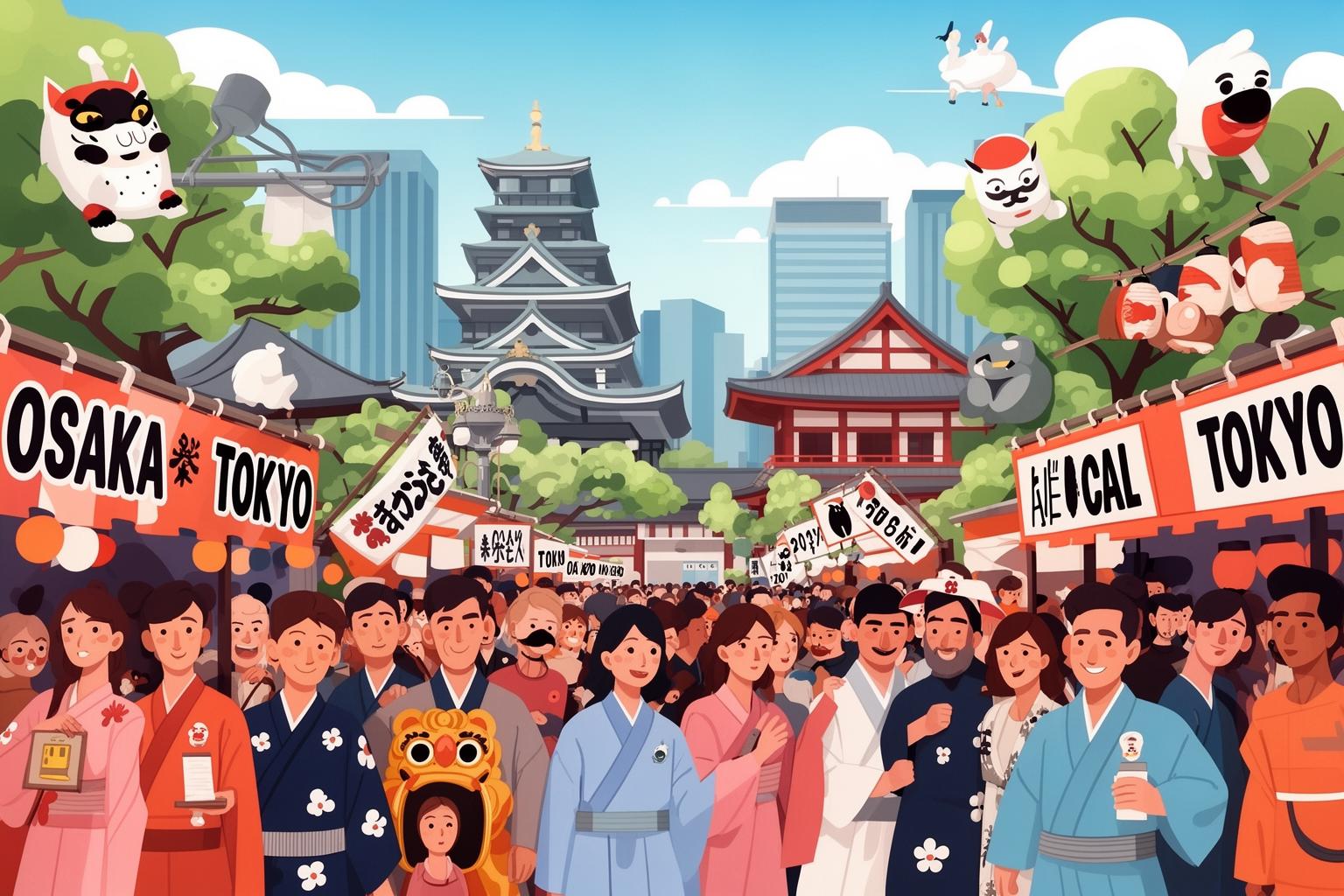
Jizo Bon isn’t just an adorable children’s celebration; it’s a living map of Osaka’s social fabric. It reveals the city’s well-known traits of friendliness, curiosity, pragmatism, and strong local pride. It’s through these small-scale interactions that the greatest distinctions between life in Osaka and life in Tokyo become clear.
The Influence of the Chonaikai (Neighborhood Association)
The entire event is organized, funded, and carried out by the chonaikai, the neighborhood association. While these associations exist in Tokyo, they often feel more formal, distant, or bureaucratic. Meetings take place, notices get posted, but personal connections are often scarce. In many parts of Tokyo, anonymity is standard. In Osaka, however, the chonaikai tends to be a lively, personality-driven group led by a few dedicated, often outspoken, long-term residents. It’s the realm of local matriarchs and patriarchs. They act as the social glue. They don’t just manage the festival; they take care of the neighborhood. They know who recently had a baby, whose elderly parent isn’t well, and which children are struggling. This is the source of Osaka’s famous nosiness—it isn’t malicious gossip but rather the product of a closely-knit community where people genuinely care about one another’s lives. Jizo Bon serves as the chonaikai’s yearly showcase, highlighting its ability to rally the community and bring joy with just a few donations and a lot of volunteer effort.
“Uchi” vs. “Soto” on a Smaller Scale
Understanding the Japanese ideas of uchi (inside-group) and soto (outside-group) is key to grasping social interactions. Jizo Bon is a perfect example of an uchi event. It’s meant for us, the local residents. It’s not promoted to outsiders and isn’t a tourist attraction. Yet, Osaka generally has a more flexible and inclusive sense of who belongs to the uchi group than Tokyo does. In Tokyo, you could live next door for years without knowing your neighbor’s name, with the boundaries between apartments feeling more rigid. In Osaka, living on the block means you’re part of the team. Your presence is recognized, and participation is encouraged. Jizo Bon physically pulls people out of their private homes into shared public space, temporarily dissolving the boundaries between them. For that afternoon, the street belongs to everyone. This difference highlights urban life distinctly: in Tokyo, you might feel like you live in a city; in Osaka, at events like Jizo Bon, you feel like you live in a neighborhood.
Practicality Over Formality
Take a close look at any Jizo Bon, and you’ll see Osaka’s famous pragmatism in action. Everything is approached with a spirit of shaanai—an Osaka dialect phrase meaning “it can’t be helped” or “let’s just get on with it.” The decorations aren’t polished or professional; they’re homemade and maybe a little uneven. The sound system is a cheap portable speaker with thin sound. Prizes come from the 100-yen shop. Nobody minds. The aim isn’t to produce a flawless, Instagram-ready event but for kids to have fun and neighbors to connect. It’s about function over appearance, heart over aesthetics. This approach is deeply rooted in Osaka culture, where people are straightforward, focused on results, and not overly concerned with formalities. They opt for the cheapest, quickest, and most practical solutions. Jizo Bon perfectly exemplifies this philosophy, achieving significant social impact with very simple means. It’s a festival fueled by genuine community spirit, not by a big budget.
Navigating Your First Jizo Bon: A Foreign Resident’s Guide
So you’re convinced. You want to experience an authentic slice of Osaka life. But how do you find it? And once you’re there, how do you navigate it? It’s easier than you think. You just need to see your own neighborhood in a slightly different way.
Finding Your Local Festival
Forget about looking up online event calendars or tourist websites. This is analog. Your first sign will probably show up in mid-August. You’ll notice paper lanterns, the chochin, suddenly hanging around a particular Jizo statue in your area. You might find a handwritten notice on the local community bulletin board, the keijiban. Or you’ll start hearing the buzz on a Saturday or Sunday. Follow the sound of children’s laughter. This is discovery in its purest form. It’s not about consuming a packaged experience; it’s about being present and observant in your own surroundings. Spotting your local Jizo Bon shows you’re beginning to tune into the subtle rhythms of your neighborhood — transitioning from a resident to a true local.
The Social Script: How to Participate Without Feeling Awkward
Once you locate the festival, the key is to keep a relaxed and open attitude. The organizers are your neighbors. The most important people to acknowledge are the obachan who are almost always running the event. A warm smile and a clear Konnichiwa! is all it takes to break the ice. If you try a phrase like Itsumo osewa ni nattemasu (a wonderfully versatile expression meaning “Thank you for your continuous support/kindness”), you’ll likely brighten their day. Don’t hesitate to let your kids join the games — it’s expected. If someone offers you or your child a snack or drink, the right response is to gratefully accept. In Osaka culture, sharing and accepting generosity is key to building relationships. Politely declining can sometimes be taken as a sign you want to keep your distance. Go with the flow, accept their kindness, and return it with your own smiles. You’ll be surprised how quickly you’ll be embraced by the community.
Common Misunderstandings for Foreigners
There are a few typical misunderstandings foreigners have when experiencing Jizo Bon for the first time. The first is thinking it’s a solemn religious ceremony. While it has spiritual roots, the vibe is 99% festive. Feel free to laugh, chat, and take photos. The second is feeling like an outsider. In a community-oriented culture like Osaka’s, opting out of a neighborhood event can come across as aloof or uninterested. Simply being there, even quietly observing, sends a positive message that you want to be part of the community. The last, and perhaps biggest, mistake is viewing it as a quaint, outdated tradition with no place in modern urban life. This couldn’t be further from the truth. Jizo Bon is the neighborhood’s annual social recharge. It strengthens the invisible bonds that encourage people to look out for each other. It’s why your neighbor might hold a package for you or why an elderly shopkeeper asks about your family. This is not nostalgia — it’s a living, functional part of social infrastructure.
The Future of Jizo Bon in an Evolving Osaka
Like many traditions, Jizo Bon encounters challenges in the 21st century. The world is evolving, and Osaka is evolving alongside it. Yet this small festival remains surprisingly resilient, reflecting its essential role in the city’s culture.
The Challenge of an Aging Population
The most pressing threat to Jizo Bon is demographic. The dedicated obachan and ojisan who have sustained these festivals for decades are aging. In many neighborhoods, there is a genuine struggle to find younger people willing and able to take on the organizational duties of the chonaikai. In newer parts of the city, dominated by large, impersonal high-rise apartment buildings, the tradition of a neighborhood Jizo and its accompanying festival may be absent altogether. These modern structures often promote a Tokyo-style anonymity, where residents prioritize privacy over community involvement. The old social contract is being rewritten, block by block.
A New Generation of Participants
However, there is also cause for optimism. In many older neighborhoods, young families raising their children in the city are rediscovering the value of these traditions. They view Jizo Bon not as an obligation, but as a joyful, free, and safe way for their children to play and for themselves to connect with other parents. Foreign residents play a surprisingly vital role here. When a foreign family participates in Jizo Bon, it sends a powerful message: the appeal of this tradition transcends nationality and language. It validates the organizers’ efforts and injects fresh energy into the event. Your presence is not passive. Simply by attending, you actively contribute to keeping this beautiful, vital piece of Osaka’s spirit alive. You stop being just a temporary resident or outsider; you become part of the neighborhood’s story, an additional thread in its rich, interwoven tapestry. This is how you truly begin to live in Osaka—not merely as a location, but as a community. It is an experience of belonging far more profound and memorable than any famous landmark or celebrated dish. It embodies the real, unfiltered, deeply human heart of the city.