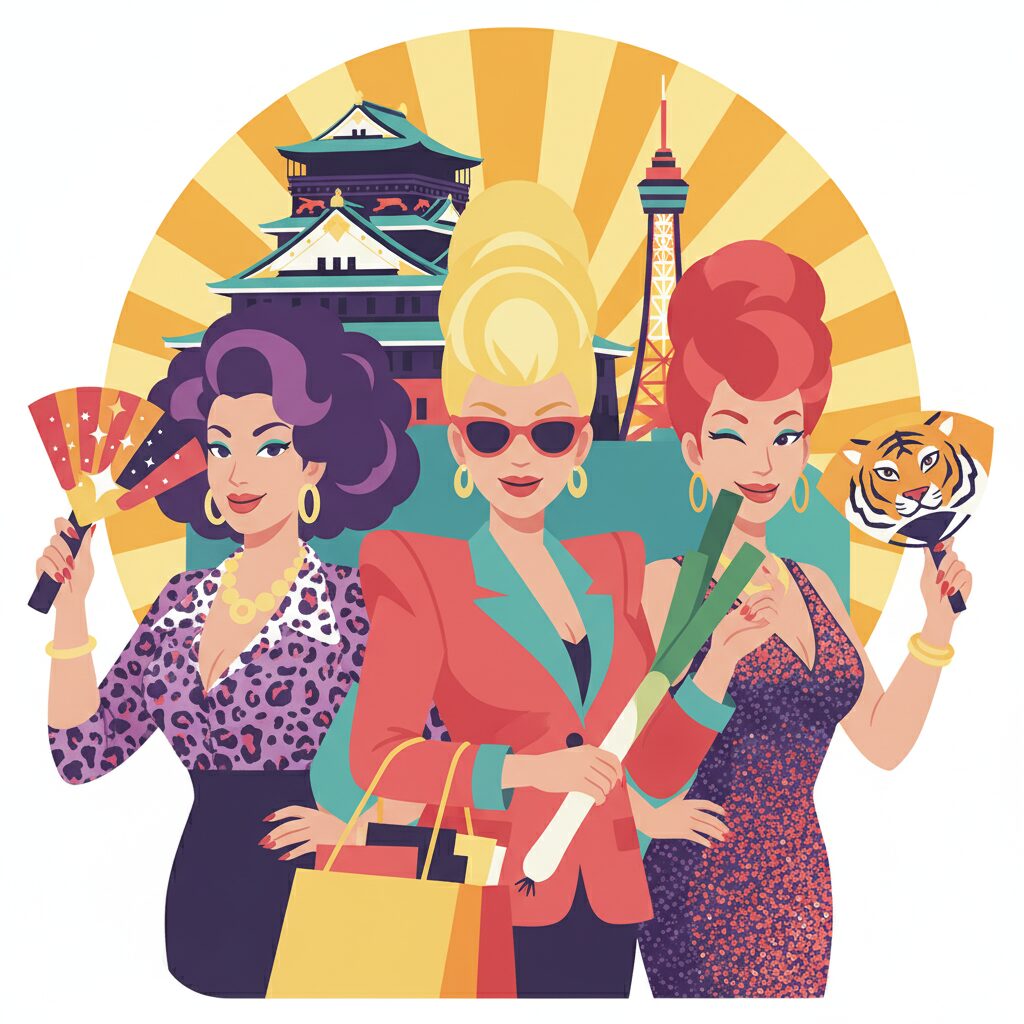
Walk down any shotengai, one of Osaka’s covered shopping arcades, and you’ll feel it. It’s a current of energy, a specific frequency of chatter, laughter, and no-nonsense negotiation that powers the city. At the heart of this dynamo, you’ll almost always find her: the Osaka ‘Okan’. Maybe she’s behind the counter of a vegetable stall, her voice booming as she tells you which daikon is best. Perhaps she’s cycling past you, a wicker basket full of groceries, wearing a dazzlingly bright shirt that defies the subtlety you were told was the Japanese way. She might even stop you, a complete stranger, to fix your collar or hand you a small, hard candy from a seemingly bottomless purse, muttering something about the weather.
For a foreigner new to Osaka, especially one arriving from the polished, quiet corridors of Tokyo, the Okan can be a baffling, intimidating, and utterly fascinating figure. Who is this woman? Is she just a mom? An auntie? A shopkeeper? The answer is yes, and so much more. The ‘Okan’ (おかん) is the Kansai dialect term for ‘mother’ (お母さん, okaasan), but in Osaka, it transcends familial bonds. It’s a title, an archetype, a social role held by the middle-aged and elderly women who are the true matriarchs of their communities. They are the social glue, the keepers of tradition, the enforcers of neighborhood rules, and the purveyors of a very specific, pragmatic brand of kindness. They are not the demure, bowing figures of Japanese stereotypes; they are loud, direct, opinionated, and fiercely protective of their turf. Understanding the Okan is not just a quaint cultural lesson; it is fundamental to understanding the rhythm, the mindset, and the very soul of daily life in Osaka. They are the reason this city feels less like an anonymous metropolis and more like a collection of sprawling, interconnected, and very lively villages.
As Osaka’s lively rhythms, fueled by the charismatic influence of the Okan, continue to shape community life, emerging trends in Kansai hotel promotions are further blending tradition with modern commercial strategy.
Who Exactly is an ‘Okan’?
Before you can grasp their role, you first need to learn how to recognize them. While not every woman over fifty in Osaka fits this stereotype, the archetype endures for a reason. It’s an expression of identity, a uniform signaling a certain social status worn with pride. The visual and auditory clues provide your initial lesson in interpreting the city’s human landscape.
More Than a Mother, It’s a Mindset
Let’s start by clarifying the language. In standard Japanese, ‘okaasan’ is used as a formal or polite term for ‘mother’, while ‘haha’ refers to one’s own mother. ‘Okan’ is pure Kansai-ben. It’s warmer, more familiar, and a bit rough around the edges—just like the women it describes. Yet, you’ll hear it applied to women who aren’t immediate mothers. The manager of your local okonomiyaki restaurant? She’s the Okan. The formidable woman running the public bathhouse with an iron hand? Definitely an Okan. It denotes a woman holding informal authority, someone commanding respect not through titles, but through presence and experience. She has brought up children, managed a household, handled finances, and navigated challenging neighbors. She’s seen it all and isn’t swayed by your excuses. This life experience grants her the social license to be straightforward, to dispense unsolicited advice, and generally take charge from the ground up.
The Field Guide to Spotting an Okan
While sometimes exaggerated, the visual stereotypes are grounded in a strong reality. The most iconic is the ‘panchi pāma’ (punch perm), a tightly curled hairstyle that conveys a classic, no-nonsense glamour. Then there’s the fashion: animal prints, especially leopard, are the unmistakable trademark. But it’s more than that; it’s a love for bold colors, shiny fabrics, and anything that radiates energy. In a culture often valuing subdued, harmonious aesthetics, the Okan’s style is a bold declaration: “I am here, I am not invisible, and you will notice me.” This isn’t a lapse in taste, but a deliberate choice to be vibrant.
Beyond appearance, there’s the sound. Okan are anything but quiet. They speak in full-throated, confident Kansai-ben, a dialect that’s inherently more melodic, expressive, and direct than Tokyo’s flatter standard Japanese. Their conversations are marked by hearty laughter and sharp ‘tsukkomi’—the quick, witty retorts fundamental to Osaka’s comedic culture. And then there’s the ultimate accessory, the secret weapon inside every Okan’s handbag: ‘ame-chan’. ‘Ame’ means candy, and ‘-chan’ is an affectionate suffix. But ‘ame-chan’ is an institution. An Okan will offer you candy for any reason—or none at all. If you look down, if your child is crying, or if you simply exchange a glance on the train. It’s a social lubricant, a gesture that says, “I see you, we’re in this together, now have a butterscotch.” Accepting the ame-chan is a small but essential ritual of acknowledging community.
The Weavers of the Social Fabric
The Okan’s real strength lies not in her appearance, but in her role. In the tightly knit neighborhoods of Osaka, she serves as the human infrastructure that ensures society functions smoothly. She acts as the unofficial neighborhood watch, the village gossip network, and the chief operating officer of everyday local life.
Guardians of the Shotengai
Nowhere is the Okan’s influence more evident than in the shotengai, the covered shopping arcades that are the heart of many Osaka communities. Unlike the sterile, corporate efficiency of a Tokyo supermarket, the shotengai is a stage for human interaction—and the Okan are its leading players. They are both the shopkeepers and the principal customers. They haggle loudly over the price of fish, swap recipes with the vegetable vendor, and catch up on local news while waiting for their tofu to be wrapped. They know who just had a baby, whose son is getting married, and which family recently moved into the apartment building on the corner. This constant flow of information is not idle gossip; it’s the community’s way of keeping itself healthy. It’s how people identify who might need extra support, or who requires a gentle reminder about sorting their trash properly. In Tokyo, you might live next door to someone for years without ever learning their name. In an Osaka neighborhood overseen by the Okan, that’s nearly impossible.
The Fine Art of Meddling with Love
To outsiders, especially from Western cultures that highly value individualism and privacy, the Okan’s approach can feel intrusive. This is the essence of osekkai. It’s often translated as ‘meddling’ or ‘being nosy,’ but that misses the vital nuance. Osekkai is a proactive intervention grounded in a sense of collective responsibility—the belief that your well-being is, in some way, a matter for everyone.
A Practical Guide to ‘Osekkai’
You will encounter osekkai. The Okan who lives downstairs might stop you to warn that your laundry will get wet in the rain. The woman at the butcher shop may ask if you’re eating enough vegetables because you look a bit pale. You could be asked, quite directly, about your age, marital status, and occupation. In Tokyo, such questions from a stranger would be almost unthinkable. In Osaka, they serve to place you within the community’s social fabric. They’re not just gathering information; they’re assessing your situation. These questions often precede offers of help, advice, or at the very least, a piece of candy. The key is to understand the intent. It’s not an invasion of privacy; it’s an expression of care. They treat you not as a temporary tenant but as a member of the neighborhood flock—and they are its shepherds.
The Okan Mindset: Pragmatism, Power, and Purses
Why did this particular archetype of powerful, outspoken woman thrive so strongly in Osaka? The answer, like many things in this city, is connected to its history as a hub of commerce and trade. Osaka was known as the ‘kitchen of the nation,’ where merchants, rather than samurai, held the power. This fostered a culture grounded in pragmatism, negotiation, and a healthy skepticism toward authority.
‘Mottai-nai’ and the Art of the Deal
In a merchant city, value is paramount. The spirit of mottai-nai (a sense of regret over waste) is deeply embedded in the Okan’s character. She is the household budget master, the one who, in traditional Japanese terms, ‘holds the purse strings’ (saifu o nigiru). This financial responsibility cultivates a sharp, practical intelligence. Observe an Okan shopping. She will haggle, not aggressively, but with practiced, almost theatrical finesse. She will ask for a little extra as a ‘service’ (omake), and she will receive it. This isn’t about being cheap; it’s a display of skill and a way to build a rapport with the vendor. It’s a dance of mutual respect grounded in the understanding of a fair deal. This merchant mindset permeates all aspects of life. Problems are approached and solved practically and efficiently, without unnecessary formality or fuss. This contrasts sharply with the often process-driven, hierarchical culture of Tokyo.
A Different Model of Femininity
The traditional ideal of Japanese womanhood is often described as Yamato Nadeshiko—a graceful, modest, and quietly resilient woman who supports her family behind the scenes. The Osaka Okan stands as the opposite of this ideal. Her power is not subtle; it is unmistakable. She is the loud, stable, and unshakable center of the family. Although her husband may be the official head of the household, everyone knows the Okan is truly in charge. Her strength is not regarded as unfeminine or undesirable; rather, it is celebrated as the crucial quality that holds the family and community together. She is tough, resilient, and utterly dependable. This alternative model of female power is one of the most distinctive and refreshing characteristics of Osaka’s social culture.
How to Live in Harmony with the Okan
For any foreigner moving to Osaka, developing a good relationship with the local Okan is not just advisable; it’s crucial for a smooth and enjoyable life. They can become your greatest allies, a valuable source of local knowledge, and your first line of support if you ever face trouble. However, this requires adjusting your own cultural mindset.
Tips for Engagement
Above all, don’t be intimidated by their straightforwardness. When an Okan speaks to you, she isn’t trying to be rude; she’s attempting to connect. A smile, a simple ‘Konnichiwa,’ or even better, the local ‘Maido!‘ (a versatile greeting) can open many doors. If she offers you an ‘ame-chan,’ accept it with a smile and a thank you. It’s a peace offering and an invitation. Don’t hesitate to ask for help. If you’re puzzled by the complicated garbage sorting rules, ask the Okan next door. She’ll almost certainly be happy to provide a detailed, hands-on explanation. They appreciate those who try to adapt to the community’s ways.
Decoding Common Misunderstandings
It’s easy to misread Okan behavior from a foreign perspective. Here are some frequent errors:
- Rudeness vs. Directness: A question like “Why aren’t you married yet?” may feel extremely intrusive to a Westerner. To an Okan, it’s a perfectly normal, if blunt, expression of concern and an attempt to understand your situation. Try to see the warmth behind the question.
- Loudness vs. Passion: The noise level in Osaka is simply higher than in other areas of Japan. Enthusiastic, overlapping conversations filled with laughter are typical. An Okan’s loud voice signals her energy and engagement with her surroundings, not anger or hostility.
- Stereotype vs. Archetype: It’s true not every older woman in Osaka dons leopard print. But the essence of the Okan—that mix of tough practicality, intrusive kindness, and strong community spirit—is a cultural phenomenon that permeates the city. Even younger women are often described as having an ‘Okan-rasshii’ (Okan-like) spirit. It’s an archetype they grow into, a role they are expected to embody one day.
The Unofficial Heartbeat of the City
Ultimately, the Osaka Okan is much more than just a colorful figure. She embodies the very essence of the city’s core values. She represents ninjō, the profound sense of human compassion and duty toward others that softens Osaka’s tough merchant façade. She is the humorous, straightforward spirit that makes this city so distinct from its eastern counterpart.
Tokyo entices with sleek modernity and courteous anonymity. You can blend into its crowds, living a life of seamless, isolated privacy. Osaka, however, offers something entirely different. It offers connection, whether you seek it or not. It offers a community that looks out for you, gives advice, and even shares candy. At the heart of that community stands the Okan, the matriarch who makes sure that no one remains a stranger for long. She is the city’s memory, its conscience, and its pulsating, boldly vibrant heart. To know her is to understand that in Osaka, you are never truly alone. And for anyone striving to build a life here, that makes all the difference in the world.