You’ve seen the pictures. The neon glow of Dotonbori, the giant mechanical crab waving its claws, the Glico Running Man frozen mid-stride over a canal packed with yellow tour boats. You’ve heard the word, a snappy four-syllable mantra that’s become Osaka’s global tagline: kuidaore. It’s usually translated as “eat until you drop” or “eat yourself into ruin,” conjuring images of hedonistic food crawls, of tourists stumbling from one takoyaki stand to the next, bellies full and wallets empty. This is the postcard version of Osaka’s food culture, and it’s not wrong, but it’s a tiny, brightly-lit corner of a much bigger, more interesting picture. What does that word, kuidaore, really mean for the millions of people who actually live here, who navigate these streets on their way to work, not just on a foodie vacation? It’s not a special occasion slogan; it’s the city’s operating system. It’s a deeply ingrained philosophy of value, a relentless pursuit of quality, and a social language that dictates everything from a salaryman’s lunch choice to a grandmother’s weekly grocery run. Forget the tourist trail for a moment. Let’s talk about the real kuidaore, the one that powers the heart of this city, one delicious, well-priced, and honestly made meal at a time.
This philosophy of value and quality is also evident in how the city is evolving, as seen in the recent wave of international investment reshaping Kansai’s luxury hotel scene.
The Kuidaore Misconception: More Than Just Eating Till You Drop
Before you can truly grasp how Osaka eats, you must first discard the tourist misconception of kuidaore. The idea of endlessly gorging on street food is an exaggeration. For locals, kuidaore is a subtle, discerning, and highly practical art. It’s a mindset that carefully judges every food purchase—whether it’s a 100-yen onigiri or a 10,000-yen sushi meal—based on a nuanced balance of flavor, cost, quality, and satisfaction.
From Tourist Slogan to Everyday Philosophy
Step away from the lively Dotonbori canal and venture into the quiet residential alleys of Tenma or the office-lined streets of Honmachi. Here, kuidaore isn’t a show—it’s a quiet, shared wisdom. It’s evident in the way a construction worker selects his bento, thoughtfully weighing the rice-to-protein ratio. It’s in the conversation between two housewives negotiating the price of daikon radishes at their local greengrocer. It’s reflected in the focused glance an office worker casts at a lunch special sign. The core question remains: “Is this worth it?” Not merely in terms of money, but in relation to stomach space. In this city overflowing with choices, every meal is an opportunity, and a bad one feels like a personal failing—a betrayal of the kuidaore spirit.
It’s Not About Overeating, It’s About Value
This is the greatest misconception. Kuidaore isn’t about eating large quantities; it’s about the quality of the experience compared to the cost. The goal isn’t fullness, but satisfaction—the sense that you’ve gotten excellent value. This idea is so ingrained it has its own shorthand: ‘CP’, meaning Cost Performance. An Osakan might proudly say a meal has “good CP” if a 700-yen bowl of ramen offers a rich, complex broth and perfectly chewy noodles that could easily sell for 1,000 yen elsewhere. In contrast, an upscale, pricey restaurant may be criticized for “bad CP” if the taste doesn’t match the price. This isn’t about being cheap; it’s about being a savvy eater in a city that calls itself the “Nation’s Kitchen.” You are expected to be discerning, to know quality, and to reject mediocre food no matter the cost.
The Holy Trinity: Umai, Yasui, Hayai (Delicious, Cheap, Fast)
This phrase serves as the unofficial motto of Osaka’s everyday food culture, rooted in the merchant traditions that shaped the city. For centuries, Osaka was a commercial hub where workers needed meals that were quick, affordable, and satisfying enough to fuel a hard day’s labor. That heritage continues today. The perfect Osakan meal, especially at lunchtime, hits all three marks.
How Speed and Price Never Sacrifice Flavor
In many places, “cheap and fast” usually means bland and forgettable food. Not in Osaka. Here, chefs and shop owners take this challenge with great pride. The competition is fierce; if your food isn’t umai (delicious), you won’t last, regardless of how cheap or fast it is. The standard for quality is remarkably high. Consider the standing udon stalls in train stations. For less than 500 yen, you get a bowl of noodles in a steaming, aromatic dashi broth that surpasses any fast food you’ve tried. The dashi, the heart of Kansai cuisine, is carefully crafted even in the simplest places. Tempura is freshly fried. Noodles are made to order. It’s a complete, satisfying meal served in under three minutes. This is not just about convenience; it exemplifies the kuidaore principle that flavor should never be sacrificed—no matter your budget or time constraints.
The Anatomy of an Osakan’s Food Day
To experience kuidaore in its natural environment, simply follow the pace of an ordinary day. This philosophy reveals itself uniquely at breakfast, lunch, and dinner, adjusting to the moment’s needs while consistently upholding its fundamental principles of value and quality.
The Morning Ritual: Kissaten Culture and the Significance of ‘Service’
While many enjoy a simple breakfast at home, the quintessential Osaka morning takes place in a kissaten, a traditional Japanese coffee shop. Here, a key kuidaore concept comes alive: mōningu sābisu (morning service). When you order a coffee, usually priced around 400 to 500 yen, it comes with a complimentary “service” set. This is no mere token biscuit—it includes a thick slice of toasted shokupan (fluffy milk bread), a hard-boiled egg, and perhaps a small cup of yogurt or a mini salad.
Beyond Toast and Coffee: A Lesson in Reciprocity
The “morning service” embodies the Osaka merchant spirit beautifully. It’s an act of generosity, saying, “Thank you for starting your day with us. Here’s a little extra.” This practice fosters strong customer loyalty. For the customer, it’s a brilliant example of cost performance (CP). You’re not just buying coffee; you’re effectively getting breakfast at the same price. It feels like a win. This culture of expecting and valuing a little bonus, a sign that the business appreciates your patronage, is deeply ingrained in the city’s commerce, setting a savvy tone for the day.
The Midday Battleground: Why Lunch Is Serious Business
By 11:45 AM in business hubs like Umeda, Yodoyabashi, or Honmachi, the tension mounts. Lunch in Osaka isn’t a relaxed break; it’s a strategic mission. Office workers flood the streets, launching the hunt. This is when the kuidaore mindset is sharpest and most relentless.
The 500-Yen Lunch and the Unwritten Rule of ‘CP’ (Cost Performance)
The “one-coin lunch,” a full meal for a single 500-yen coin, is legendary in the Osaka lunch scene. Though inflation has pushed prices up in many places, the spirit endures. Lunch sets, or teishoku, undergo strict scrutiny. A typical salaryman mentally assesses the menu: For 800 yen, am I getting a main dish, rice, miso soup, and one small side dish (kobachi)? Or two? Is rice free to refill? Does it come with coffee afterward? These questions aren’t trivial; they’re vital data points in a rapid CP evaluation. Restaurants that skimp—offering watery miso soup or tiny meat portions—are quickly dismissed. The office grapevine is swift and unforgiving.
Honmachi vs. Shinsaibashi: Lunch Scenes by Neighborhood
Lunch character varies by area. Honmachi, the center of textile and trading firms, hosts straightforward eateries serving consistent, reliable, high-CP lunches for decades. Speed and substance are priorities. Conversely, in Shinsaibashi or Horie, the lunch crowd skews younger and style-conscious. Here, CP calculations might factor in trendy decor or Instagram-worthy presentation, but the essential demand for value never fades. Even the chicest café must deliver flavor, or it disappears fast.
Dinner: The Shotengai, the Supermarket, and Home Cooking
Though dining out is a major part of the culture, the kuidaore spirit thrives equally in how Osakans approach dinner at home. This is where local shotengai (covered shopping arcades) and supermarkets play crucial roles.
The Evening Rush for ‘Hangaku’ Stickers: Smart, Not Stingy
At supermarkets around 7:30 or 8:00 PM, a fascinating ritual unfolds. An employee appears with a roll of stickers, marking down prepared foods—bento boxes, sushi, fried items, and salads. Discounts progress from 20% off, to 30%, and ultimately the coveted hangaku (half-price) sticker. A patient, attentive crowd gathers, not in chaos but calm anticipation. Once the sticker is applied, hands reach out immediately. This isn’t about being cheap; it’s about being savvy. It’s peak kuidaore. Why pay full price for perfectly good sashimi when you can get it for half? It’s a game, and winning feels great. You’re not only saving money but also preventing food waste while scoring a fantastic deal.
The Shotengai as the Community Kitchen
For those who prefer not to cook fully but want better quality than supermarkets offer, the shotengai is the solution. These lively arcades feature small, family-run shops specializing in sozai (prepared side dishes). You’ll find everything from tender simmered daikon and octopus to crispy croquettes and grilled fish. By visiting a few vendors, you can piece together a multi-course, home-style meal. The quality is excellent, often based on recipes handed down through generations. The shotengai acts as an extension of the home kitchen, enabling busy families to eat well and affordably. It’s a system grounded in trust and a shared love of honest, delicious food. Here, you’re not just a customer; you’re a neighbor enjoying a meal made by someone close by.
The Osaka vs. Tokyo Plate: A Tale of Two Food Cities
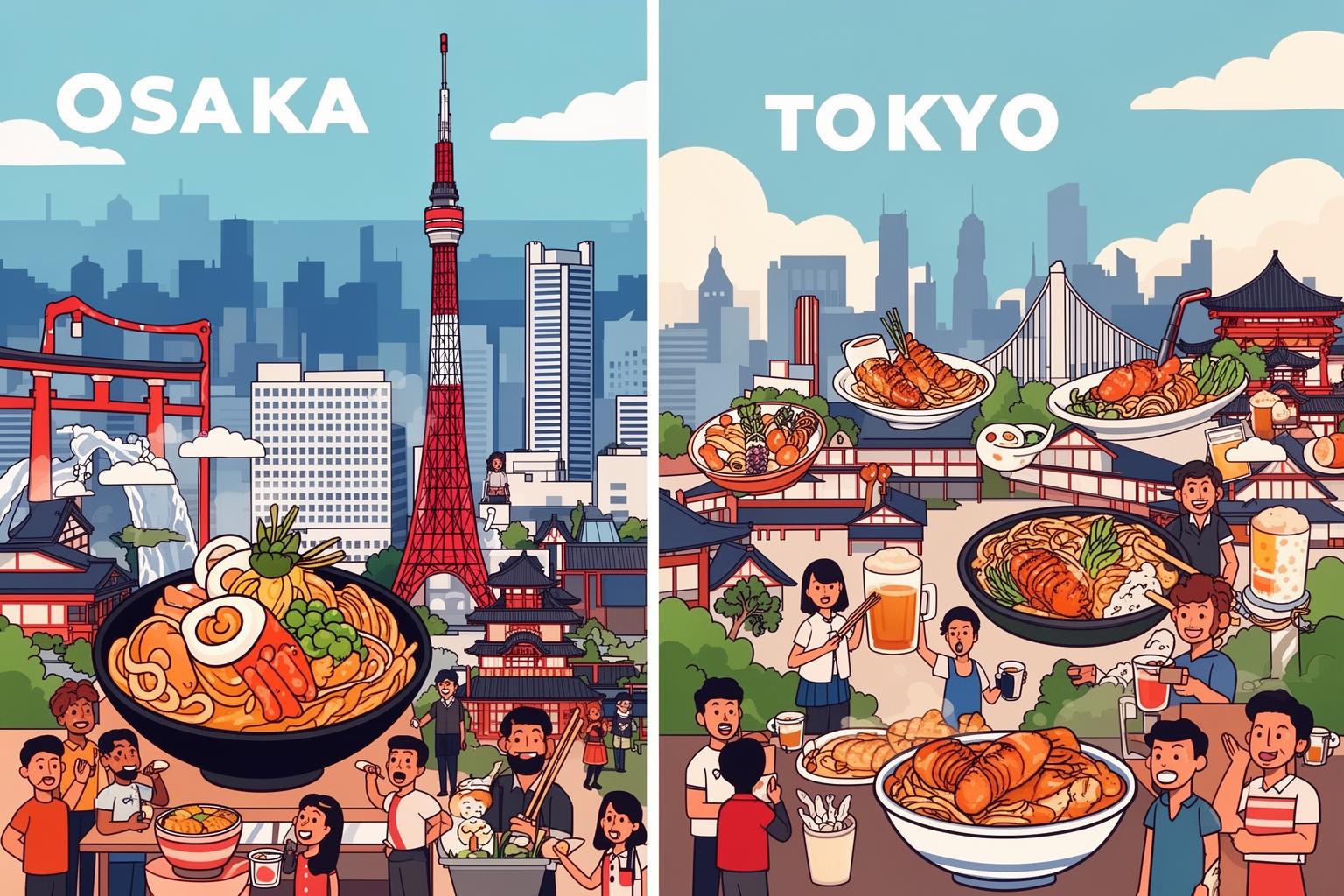
To fully understand Osaka’s culinary identity, it’s useful to compare it with its formidable rival, Tokyo. Both cities are world-renowned food destinations, yet their fundamental philosophies couldn’t be more different. If Tokyo’s dining scene resembles a refined art gallery, Osaka’s is more like a lively street festival. One values perfection and prestige; the other embraces flavor and accessibility.
Prestige vs. Performance: The Michelin Star Contrast
Tokyo has the highest number of Michelin-starred restaurants globally. It’s a city where culinary fame, exclusivity, and steep prices define the fine dining experience. Securing reservations at elite eateries often acts as a form of social currency. In Osaka, though Michelin stars exist, the food culture is far more inclusive. The most lauded restaurants aren’t necessarily the priciest, but those offering an incredible experience at a reasonable cost. An Osakan is more inclined to boast about discovering a fantastic izakaya for 3,000 yen than a 30,000-yen kaiseki meal. Respect here is earned through value and performance, not through media accolades or difficult reservations.
Tokyo’s Artful Presentation, Osaka’s Hearty Soul
This contrast is evident on the plate. Tokyo cuisine, shaped by its history as the shogunate’s seat and the refined samurai palate, often highlights delicate presentations, subtle flavors, and elegant restraint. Picture a flawless, minimalist Edomae-style sushi plate. Osaka’s food, influenced by a vibrant merchant culture, tends to be direct, robust, and generous. It focuses on bold flavors, hearty portions, and a sense of warmth and abundance. Imagine a messy, flavorful okonomiyaki, rich with sauce and sizzling on a griddle. One is culinary high art; the other, communal celebration.
The Flavor Base: Dashi at the Core
Perhaps the most essential difference lies in the flavor foundation. Much of Japanese cuisine relies on dashi, or broth. Kanto-style cuisine (around Tokyo) traditionally uses katsuobushi (bonito flakes) in its dashi and is seasoned with strong, dark soy sauce (koikuchi shoyu). The result is a sharp, salty, and bold flavor. Kansai-style cooking (around Osaka), however, features a more intricate and delicate dashi, often made with premium kombu (kelp). It’s seasoned with a light-colored soy sauce (usukuchi shoyu), which is actually saltier but allows the umami of the dashi to come through. This creates flavors that are softer, more nuanced, and deeply savory. Osakans take immense pride in their dashi tradition, believing it requires greater skill to extract natural flavors than to mask them with heavy sauces—a philosophy of subtle, umami-rich depth that infuses everything from udon soup to takoyaki batter.
Food as Social Currency
In both cities, food is a key conversational topic, but the nature of those conversations differs. In Tokyo, discussions might feel like a display of expertise—talking about the chef’s background, ingredient origins, or the challenge of securing reservations. It can be tied to status. In Osaka, the dialogue is about sharing discoveries. It’s more communal.
In Tokyo, It’s Who You Know. In Osaka, It’s What You Know.
For an Osakan, the greatest social currency isn’t acquaintance with a famous chef, but knowledge of a hidden gem—a tiny, family-run spot with exceptional value that others haven’t found. Sharing this insight is a gift. When an Osakan recommends a restaurant, it’s a sincere, heartfelt gesture. They’re imparting a piece of their hard-earned kuidaore wisdom. Ignoring it, or worse, visiting and calling it merely “okay,” can be a minor social misstep. They’ve entrusted you with a secret, and the unspoken contract is to appreciate the value they have revealed.
Speaking the Language of Food: Unspoken Rules and Local Lingo
To truly live and eat like a local in Osaka, you need to grasp the unspoken language surrounding food. This lexicon of gestures, phrases, and shared values conveys a wealth of information about quality, value, and social connection.
Mastering “CP”: The Ultimate Compliment
As noted, Cost Performance is paramount. Learning to use and recognize this concept is your gateway into the local food scene. It’s the highest compliment you can give a meal that isn’t lavishly priced. Saying a dish is simply oishii (delicious) is fine, but telling the owner, “Kore, CP ee na!” (“Wow, the CP on this is great!”) shows deep understanding. You’re not just praising the taste; you’re acknowledging their skill in sourcing ingredients, managing costs, and providing an experience that exceeds expectations for the price. It’s a compliment to their business savvy as much as their culinary talent, and in merchant-minded Osaka, that means a great deal.
“Kore, CP ee na!” – Breaking Down the Highest Praise
This simple phrase encapsulates an entire worldview. It says, “I am a discerning customer. I recognize both quality and value. You have met my high standards, which reflect those of this city. You have offered not just nourishment, but satisfaction and a triumph over the everyday. Well done.” It’s a powerful message, packed into just five syllables.
The Power of “Kuchi-komi”: The Original Social Network
Long before Google Maps reviews or foodie blogs, there was the Osaka kuchi-komi (word-of-mouth) network. This is the city’s original and still most influential information-sharing system. A new restaurant doesn’t survive on advertising; it thrives on buzz generated in offices, bars, and neighborhood groups.
How a Good Rumor Fills a Restaurant
Here’s how it works: Tanaka-san from accounting tries a new curry udon place for lunch. It’s fantastic—the broth is rich, the noodles chewy, and the CP off the charts. He returns to the office and tells Sato-san. By the next day, five people from their floor have gone to try it. The following week, the whole department knows about it. This is how a place becomes a local legend. This network is built on trust. You trust your colleagues and friends because you know they share your kuidaore values. That’s why personal recommendations carry so much weight here: they’ve been vetted by someone who truly understands.
“Konamon” is Life: Beyond the Street Food Stall
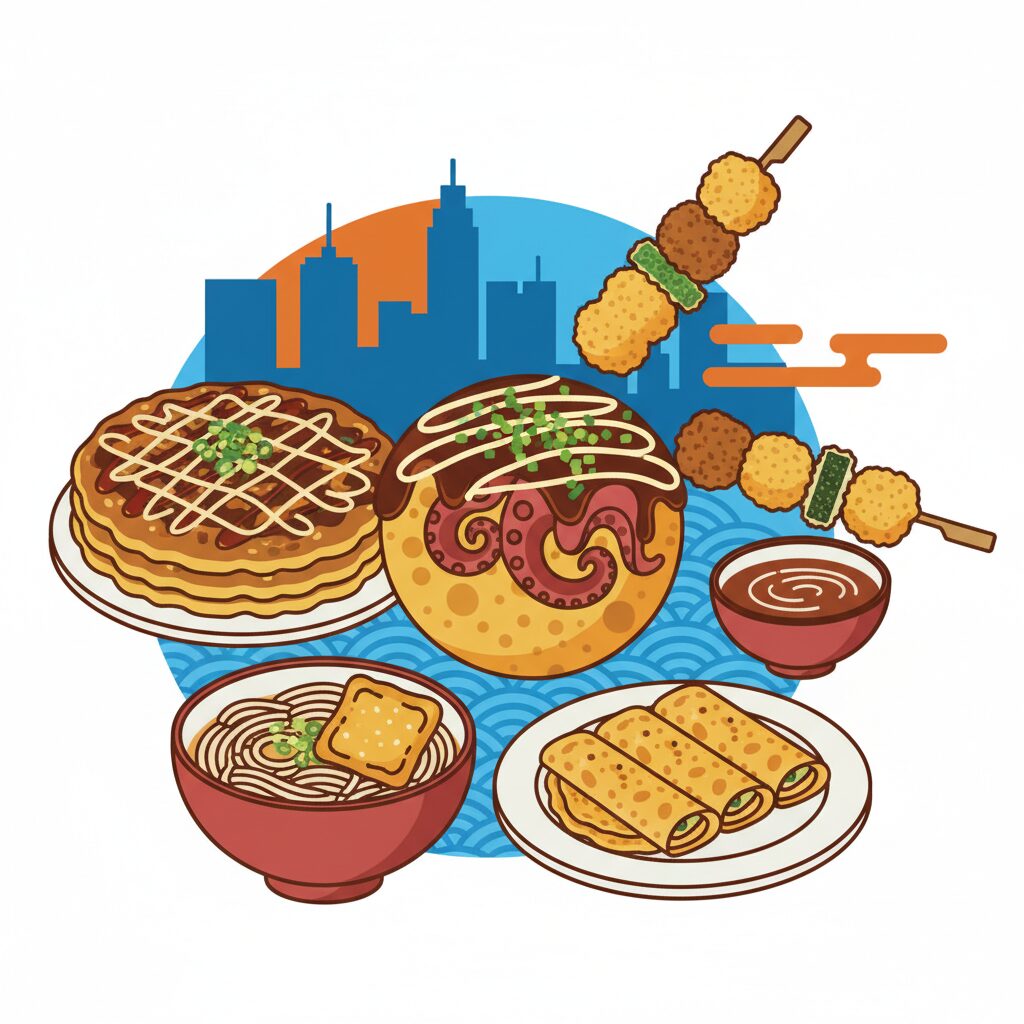
For tourists, konamon—flour-based foods like takoyaki, okonomiyaki, and yakisoba—are fun street snacks. For Osakans, they are a fundamental food group. This isn’t just something to buy from a stall in Dotonbori; it’s a staple of home life and social gatherings.
The Sacred Home Takoyaki Party
Nearly every Osaka household owns a takoyaki plate, a special griddle with hemispherical molds for making the iconic octopus balls. A “takoyaki party,” or takopa, is a classic weekend social event. Friends gather, someone mixes the dashi-infused batter, and everyone joins in grilling, filling, and turning the takoyaki. It’s a casual, collaborative, and immensely enjoyable way to share a meal. This embodies the Osaka spirit: unpretentious, hands-on, and centered on communal enjoyment. Okonomiyaki is similar. Families have their own secret recipes, and lively debates often arise over what ingredients to include (cabbage is essential, but what about tenkasu, beni shoga, or even mochi?) and the best cooking techniques. Konamon isn’t just food; it’s an activity, a tradition, and a core part of the city’s identity.
Living the Kuidaore Life: Practical Tips for New Residents

Grasping the philosophy is one thing; putting it into practice is another. For anyone relocating to Osaka, adopting the kuidaore mindset is the quickest way to feel at home. It means connecting with your community, making smart decisions, and enjoying the daily quest for delicious food.
Navigating the Supermarket Hierarchy: From Ikari to Gyomu
Not all supermarkets are equal, and understanding their roles is essential. At the top, premium stores like Ikari offer high-quality imported items and flawless produce—ideal for special occasions, but not suited for daily shopping if you’re budget-conscious. In the middle are reliable options such as Life, Mandai, and Kansai Supermarket, which provide a good balance of quality and price. These are where you’ll do most of your shopping and search for those evening hangaku discount stickers. Then there are budget favorites like Gyomu Supa (Business Supermarket) and Tamade. Gyomu excels in bulk goods, frozen foods, and spices. Tamade is a unique experience—a chaotic, colorful wonderland with surprisingly low prices and its famously bold yellow-and-red decor. A savvy Osakan knows what to buy at each place, optimizing their grocery trips for maximum value.
Befriend Your Local Shotengai
Don’t depend solely on supermarkets. Locate your nearest shotengai and explore it. These covered shopping arcades are the heartbeat of residential neighborhoods. Initially, they may feel intimidating, with stern-faced shopkeepers and a bewildering variety of unknown products. But take your time. Start by buying one item regularly.
Finding Your Favorite Tofu Shop, Butcher, and Fishmonger
Identify the tofu shop that makes fresh tofu daily. Find the butcher who knows the perfect cut for your recipe. Locate the fishmonger who can tell you what’s freshest that day. As you become a familiar customer, a relationship will develop. They’ll offer tips, perhaps add a little extra green onion to your purchase, or set aside a particularly good piece of fish for you. This is the kuidaore community in action. You’re not just a shopper; you’re part of a local system based on trust, quality, and mutual respect.
Learning to Ask: “O-susume wa nan desu ka?” (What do you recommend?)
In Osaka, pride in one’s products runs deep. Whether you’re at an upscale restaurant or a modest vegetable stall, the person behind the counter is an expert. Tapping into their knowledge is easy and highly rewarding. Asking “What do you recommend?” shows respect for their expertise. The owner of a small izakaya will light up, eager to share the details about the excellent fish they got that morning at the market. The woman at the pickle shop might offer you a taste of a seasonal vegetable she just prepared. Trust their recommendations—they want you to have the best experience possible because their reputation, the foundation of the kuchi-komi network, depends on it.
The Soul of the City on a Plate
Ultimately, kuidaore represents far more than just a food culture. It embodies Osaka’s history, character, and spirit. It is a philosophy born from a practical, commercial port city where value had to be genuine and tangible, not merely perceived. This culture emphasizes substance over style, community over exclusivity, and hearty satisfaction over delicate refinement.
Kuidaore as Community
In a city known for its direct and open nature, food serves as the ultimate social glue. Business deals are closed over okonomiyaki. Friendships are built in lively tachinomi bars. Families connect around a shared hot pot. The acts of sharing a meal, recommending a great spot, or discussing the cost-performance of your lunch—these everyday interactions create the social fabric of the city. Food is a universal language, a constant source of conversation, connection, and shared happiness.
A Resilient Spirit Forged in Commerce
There’s an old saying: people in Kyoto spend their money on kimono, those in Kobe on shoes, and residents of Osaka on food. This reflects the city’s values. Status here doesn’t come from flashy clothes or pricey accessories. It comes from being a savvy, knowledgeable consumer who knows how to enjoy life’s best offerings without excess. The kuidaore spirit is essentially optimistic and resilient. It’s about finding maximum enjoyment in the everyday. It’s a belief that even with a tight budget and schedule, a moment of deliciousness is always within reach. And in Osaka, that belief is proven time and again, meal after meal, every day.