I still remember the first time it happened. I was new to Osaka, fresh off the Shinkansen from Tokyo, my head still buzzing with the capital’s polite hum. I was in a small, family-run fruit shop tucked away in the Tenma market, a glorious labyrinth of sounds and smells. I picked up an apple, a perfect, gleaming ruby of a thing. “Kore, ikura desu ka?” I asked the old woman behind the counter, my Japanese still stiff and formal. She squinted at me, a twinkle in her eye, and declared with a straight face, “San-man en.” Thirty thousand yen. For one apple.
My mind raced. Was this a rare, luxury apple? A magical apple? Did I mishear her? In Tokyo, a response like this would have been unthinkable. It would have been a mistake, a joke in poor taste, or a genuine attempt to swindle a clueless foreigner. My brain, conditioned by the capital’s logic, cycled through the polite responses. “Ah, sou desu ka. Chotto takai desu ne.” (Oh, is that so. It’s a little expensive, isn’t it.) Or maybe just an awkward laugh and a slow retreat. But before I could utter a word, a man next to me buying oranges, a total stranger, whirled around and smacked the old woman lightly on the shoulder. “Nande ya nen!” he roared with a grin. “Bocchi bouri sugiru wa!” (What the heck! That’s way too much of a rip-off!). The old woman cackled, a wonderful, wheezing sound. She looked back at me, her face crinkled with laughter. “Joudan, joudan! Hyaku-en ya.” (Just kidding, just kidding! It’s one hundred yen.)
In that single moment, I felt the tectonic plates of Japanese culture shift beneath my feet. I hadn’t just misunderstood a price; I had stumbled into the middle of a performance. This wasn’t a transaction; it was a conversation, a tiny, impromptu comedy routine played out over a crate of apples. The old woman’s outrageous price was a setup, a boke. The other customer’s retort was the punchline, the tsukkomi. And I, the foreigner, was the bewildered audience who had completely missed his cue. That day, I realized that to understand Osaka, you don’t start with the castle or the food. You start with the laughter. You have to learn the rhythm of manzai, the conversational comedy that powers this city’s heart. It’s a language spoken not just on stage, but in every shop, office, and street corner. And learning to deliver a good tsukkomi is more important than mastering keigo; it’s the key to unlocking the real, vibrant, and deeply human soul of Osaka.
To truly immerse yourself in the daily rhythm of the city, you can start by navigating the vibrant aisles of a local budget supermarket in Osaka.
The Unseen Stage: Deconstructing Boke and Tsukkomi
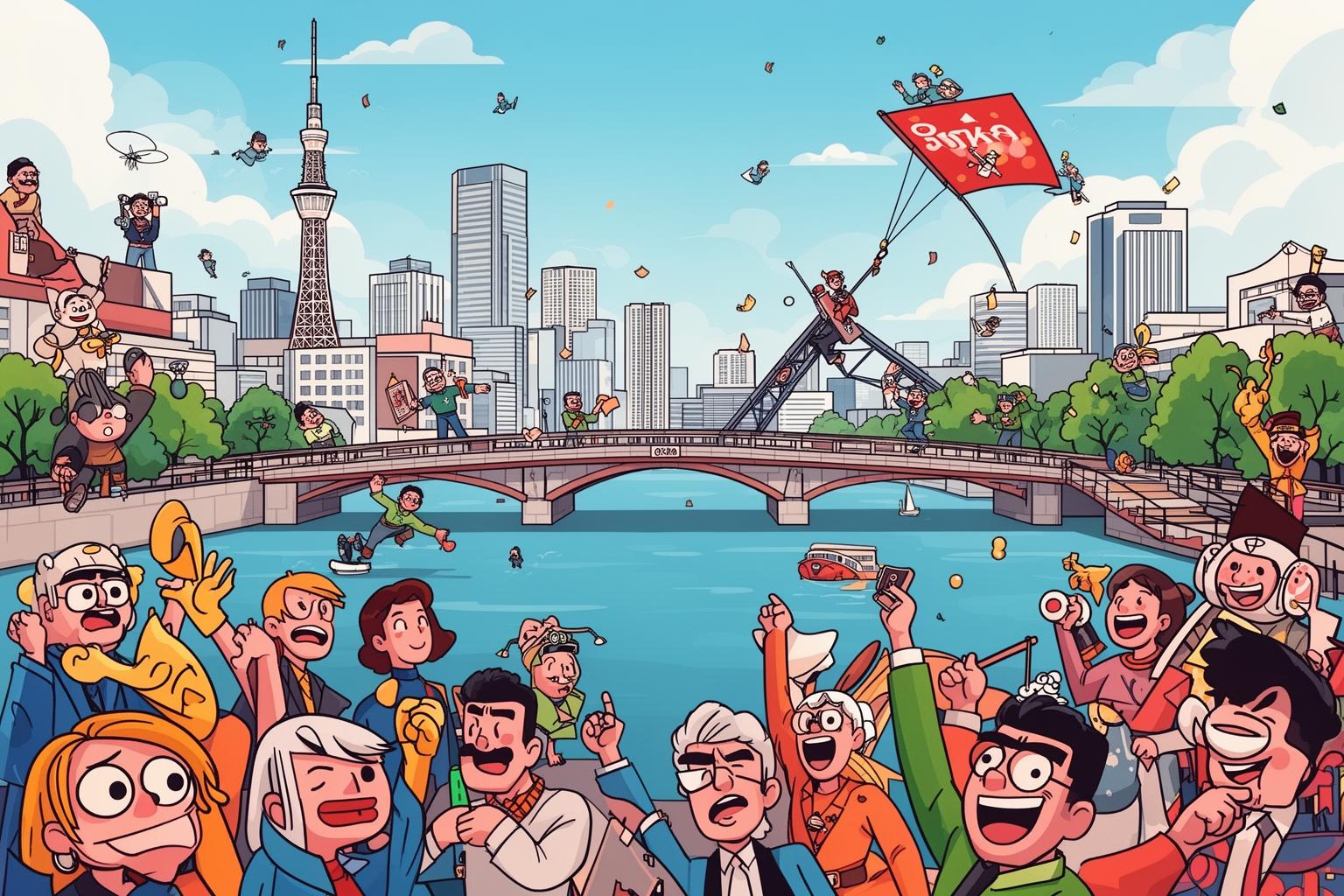
Before joining the dance, you first need to hear the music. In Osaka, that music is the steady, back-and-forth rhythm of manzai. You’ve probably seen it on TV: a comedy duo with one playing the fool and the other correcting them, often with a theatrical slap of a paper fan. That’s the professional form. But to truly understand Osaka, you need to realize this isn’t just a style of entertainment; it’s a fundamental way of communicating. It’s the city’s social operating system.
The two main elements are the boke and the tsukkomi. Think of them as two sides of the same coin—inseparable and essential for sparking humor.
The Boke: The Craft of the Absurd
The boke (ボケ) is the person who says or does something silly, absurd, incorrect, or out of place. The word comes from the verb bokeru, meaning to become senile or fuzzy, like a blurred photograph. The boke intentionally distorts reality for comedic effect. They might make a ridiculous pun, pretend to misunderstand something obvious, or make an outrageous claim. The woman in the fruit shop insisting her apple was worth thirty thousand yen? A perfect, masterful boke. She wasn’t trying to deceive me; she was tossing a conversational ball in the air, seeing who could skillfully hit it back.
A boke is an invitation. It tests your social awareness and your willingness to play. It asks, “Are you paying attention? Are you one of us? Can you handle a bit of fun?” When your Osakan colleague sees you arrive drenched from sudden rain and deadpan asks, “Ah, swimming on your way to work?”—that’s a boke. They know you weren’t swimming. They deliberately misinterpret the situation to create a comedic opening. They’re serving you a straight line on a silver platter.
The Tsukkomi: The Point of the Lance
This is where you come in. The tsukkomi (ツッコミ) is the sharp, witty comeback that brings the absurdity back to reality. The word comes from the verb tsukkomu, meaning to thrust or poke. It’s the verbal lance that bursts the balloon of foolishness created by the boke. The man in the fruit shop shouting, “Nande ya nen!” was the tsukkomi. He pointed out the absurdity, creating laughter and restoring social balance—though humorously. A good tsukkomi relies on timing, precision, and tone. It’s not about being mean or aggressive. It’s a vital act of social engagement. It signals that you understood the joke, you’re on the same wavelength, and you’re actively participating in the conversation.
Ignoring a boke is one of the quickest ways to kill a conversation in Osaka. If your colleague asks if you went swimming and you genuinely reply, “No, of course not, it’s raining heavily today,” you’ve failed the test. The conversational ball they tossed has hit the ground with a dull thud. You responded with logic when they were asking for wit. The right response, the tsukkomi, might be, “Of course! The traffic on the Yodo River was terrible this morning!” or a quick, sharp, “Nande ya nen! I forgot my submarine!” This shows you get the game. You’re playing along. You’re in.
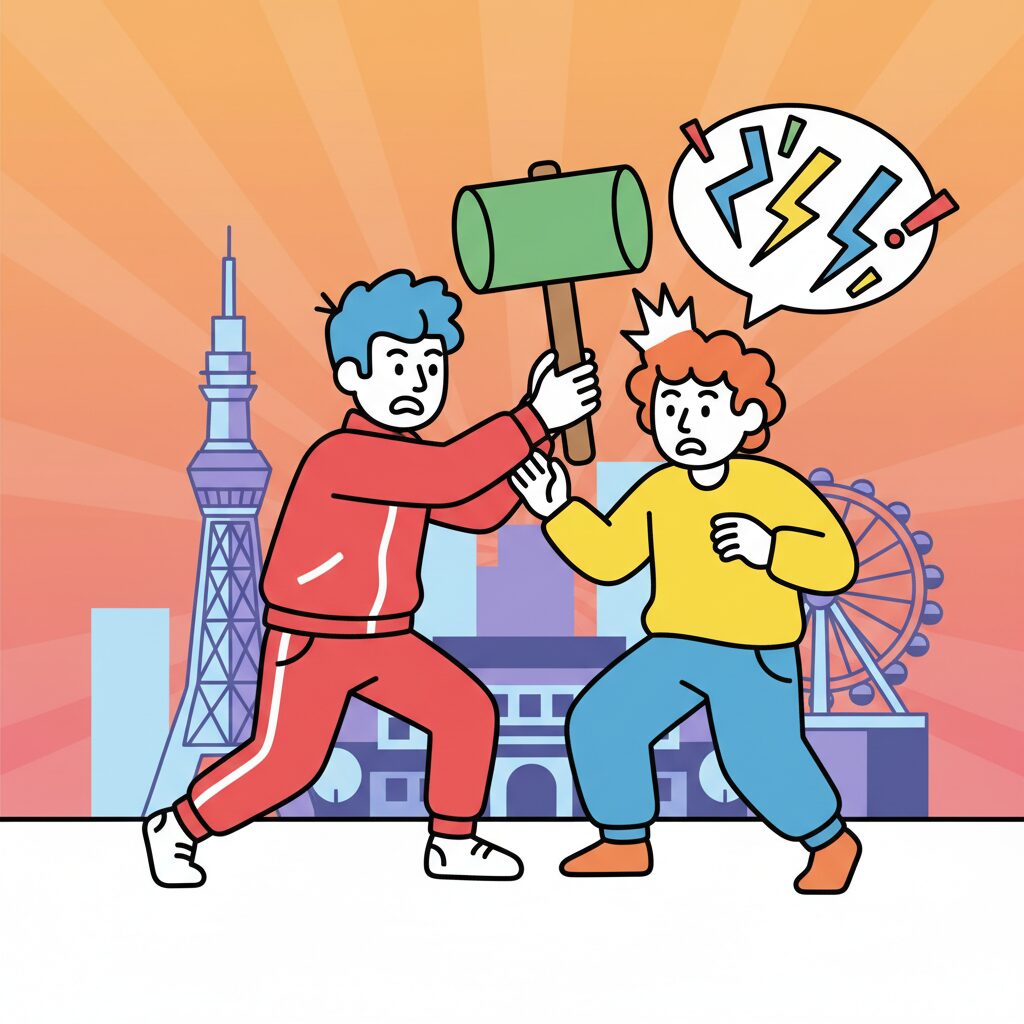
The physical part of tsukkomi—a light smack on the head or shoulder—is common among friends and family, and certainly on stage. But for a foreigner, the verbal tsukkomi is the primary tool. It’s safer, more versatile, and demonstrates a deeper cultural understanding. Mastering this verbal exchange is the first and most important step to speaking fluent Osakan.
The City as a Comedy Club: Manzai in Daily Life
In Tokyo, conversation often resembles a carefully choreographed ballet, governed by rules of politeness, layers of indirectness, and a continuous effort to preserve a smooth, undisturbed surface harmony (wa). In contrast, Osaka’s dialogue feels more like a rapid game of verbal ping-pong, where the aim isn’t just to exchange information but to enjoy the interaction. The boke serves the ball, and the tsukkomi returns it. This dynamic is ubiquitous, and recognizing it is like putting on glasses that reveal the city’s true character.
The Marketplace as a Stage
This is most evident in Osaka’s lively shotengai or shopping arcades. Places like Kuromon Market or Tenjinbashisuji Shotengai aren’t simply shopping destinations; they function as live, interactive theaters. The merchants, especially the older generation, are seasoned comedians, having honed their timing and wit over decades. They encounter hundreds of people daily and use the boke-tsukkomi dynamic to quickly create rapport.
Approach a fishmonger and ask if the tuna is fresh. In Tokyo, you’d receive a polite and sincere reply: “Hai, kesa toreta mono desu.” (Yes, it was caught this morning.) In Osaka, however, you’re more likely to get a boke. The fishmonger might look you straight in the eye and say, “Nah, this one’s from last year. Kept it in the back for a special customer.” He’s waiting, prompting you to respond. A weak reply would be confusion and walking away. A strong tsukkomi comeback might be, “Perfect! I was looking for something vintage!” or the classic, “Honma ka! Makenna!” (Really! Give me a discount then!). Respond that way, and you’re no longer just a customer—you become a participant. You’ll probably get a hearty laugh, a better price, and a little extra in your bag. You’ve passed the audition.
The Office as a Writers’ Room
This culture spills over into the professional sphere, sometimes puzzling those used to more formal workplaces. While a boardroom presentation at a Tokyo headquarters is a serious, solemn event, a similar meeting in an Osaka branch might be lightened by moments of humor unthinkable elsewhere.
Imagine making a small typo on a PowerPoint slide. In a typical Japanese office, your boss might discreetly point it out after the meeting or a colleague might quietly message you. In an Osaka office, however, your boss might stop the presentation and announce to everyone, “Oi, Tanaka! Did you invent a new kanji character? Are you trying to win the Nobel Prize for Literature?” This is a boke—a public tease that’s not mean-spirited. It corrects the mistake while easing tension and preserving a positive group atmosphere through shared laughter. Tanaka’s expected response isn’t shame or a long apology. It’s a sharp tsukkomi like, “My apologies, Bucho! My genius is sometimes uncontrollable!” or “I was just testing if anyone was paying attention!” This shows quick wit, humility, and resilience—traits highly prized in Osaka’s fast-paced merchant culture.
The Neighborhood as a Sitcom
Even routine daily encounters offer chances for a quick comedy routine. Once, when I was struggling to carry too many grocery bags down the street, an old man walking his tiny dog stopped to watch. After I’d passed a few feet, he called out, “Niichan, are you running away from home?” It was so unexpected I almost dropped everything. But by then, I’d learned the rules. I turned around, panting, and replied, “I am! But don’t tell my wife!” He laughed heartily, gave me a thumbs-up, and continued on. We had never met and probably never would again, but for ten seconds, we were a comedy duo. We shared a moment of connection built purely on the grammar of manzai. This is the social glue of Osaka. It’s a constant reminder that we’re all in this absurd thing called life together, so we might as well have a laugh about it.
Your Lines in the Script: How to Wield the Tsukkomi
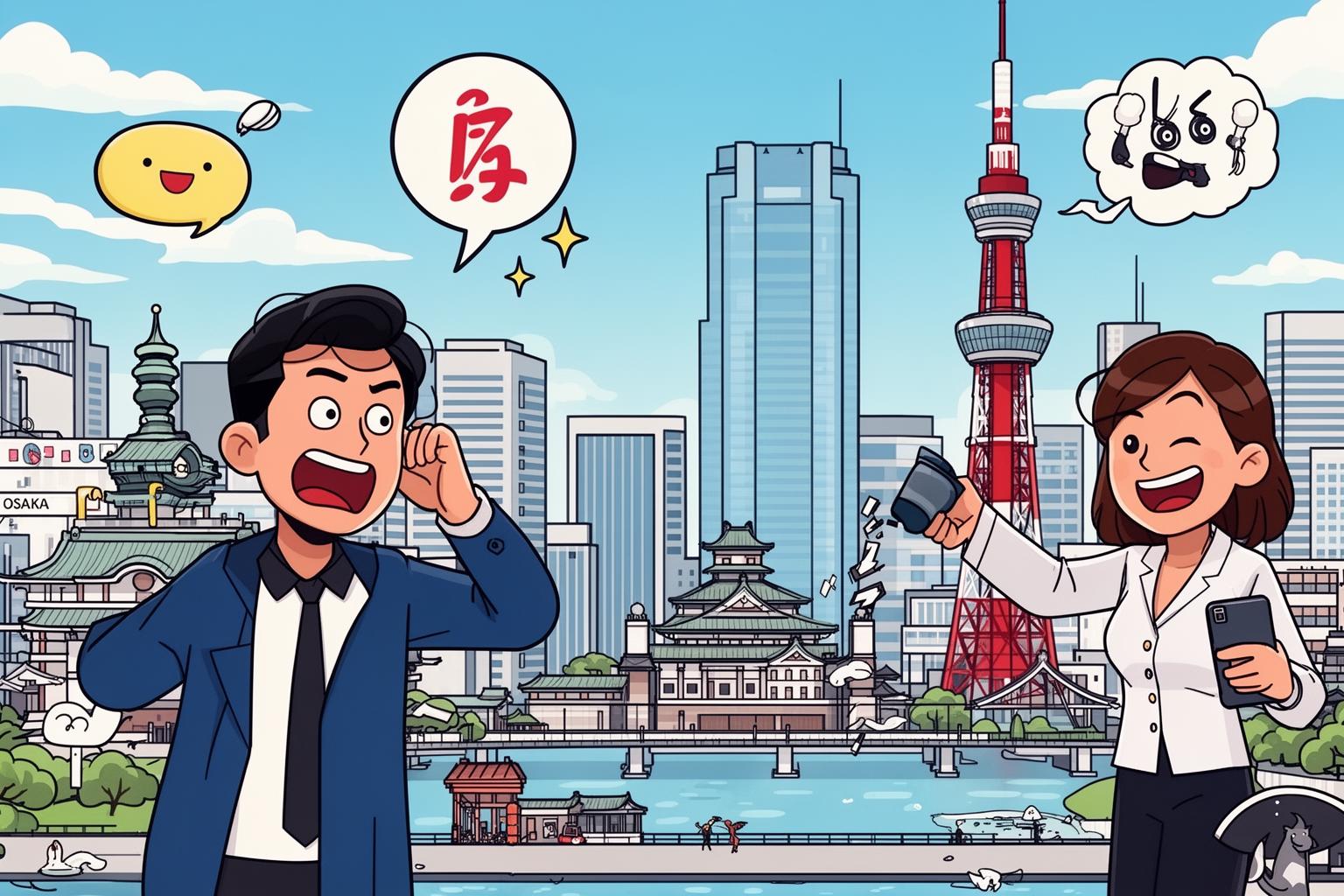
Grasping the concept is one thing; actively engaging is another. For many foreigners, the idea of delivering a sharp, critical-sounding retort to a stranger or superior is intimidating. It contradicts everything we’ve been taught about politeness, especially in a Japanese context. However, in Osaka, a well-timed tsukkomi isn’t rude; it’s a sign of closeness. It shows trust. It means, “I see you, I hear you, and I’m clever enough to play along.” Failing to tsukkomi isn’t polite—it’s distant.
So, how do you do it? You don’t have to be a professional comedian. You just need a few basic conversational tools.
The Swiss Army Knife: “Nande ya nen!”
If you learn only one Osakan phrase, let it be this one. “Nande ya nen!” (なんでやねん!) is the ultimate tsukkomi. Literally, it means “Why?!” but carries much more meaning. It’s “What the heck?!” “You must be kidding!” “That makes no sense!” and “Oh, come on!” all rolled into one. It’s the perfect, all-purpose reply to almost any boke.
- Your friend points to a pigeon and says, “Look, a rare Japanese eagle.” → “Nande ya nen!”
- The shopkeeper tells you a T-shirt costs 50,000 yen. → “Nande ya nen!”
- Your coworker says they’re late because of an alien abduction. → “Nande ya nen!”
Say it with a laugh in your voice and a slightly exasperated tone. You can even add a light, open-palmed gesture as if to say, “What are you talking about?” It’s simple, effective, and immediately signals that you’re in on the joke. Using this phrase properly will earn you instant credit and appreciative smiles.
Building Your Toolkit: Other Essential Tsukkomi Phrases
Once you’re comfortable with the king of phrases, you can start to expand your repertoire. Here are a few other common and effective tsukkomi.
- “Chau wa!” (ちゃうわ!): Literally “It’s different!” or “That’s not it!” This is a direct denial of the boke. It’s sharp, quick, and very common. If someone points at your rusty bicycle and says, “Is that your new Ferrari?” “Chau wa!” is the perfect retort.
- “Honma ka!?” (ほんまか!?): “Really!?” or “Are you serious!?” This expresses exaggerated disbelief. It’s great for responding to outrageous claims. When your friend says they ran a marathon in under an hour, hit them with a loud “Honma ka!?”
- “Muri muri muri!” (無理無理無理!): “Impossible, impossible, impossible!” This rejects ridiculous suggestions. If your boss jokingly says you should finish a month’s work by tomorrow, “Muri muri muri!” with hands waving is the way to go.
- “Aho ka!” (アホか!): “Are you an idiot?!” This one requires caution. Among close friends, it’s a common, affectionate tsukkomi, like a playful slap on the head. But you need a good relationship and the right cheerful tone. Using it with strangers or superiors can be truly offensive. Read the room, but don’t hesitate to use it with trusted people. When used well, it signals genuine friendship.
The Nori-Tsukkomi: The Advanced Technique
After mastering the basics, you may notice a more complex form of humor: the nori-tsukkomi (ノリツッコミ). This two-step move demands sharp comedic timing. First, you pretend to agree with the boke (nori = going along with it), then deliver the tsukkomi.
Recall the colleague who saw you in the rain and asked if you’d been swimming.
- Boke: “Ah, swimming on your way to work?”
- Nori-Tsukkomi (Step 1 – Agree): “Yeah, I was! The water was surprisingly warm this morning.”
- Nori-Tsukkomi (Step 2 – Tsukkomi): “…Nande ya nen! I’m soaked from the rain, can’t you tell?!”
This technique is comedy gold in Osaka. It shows you not only understood the boke but have the creative skill to build on it before breaking it down. Pulling off a good nori-tsukkomi is like hitting a home run. It gets big laughs and marks you as someone who truly understands the local culture.
The Great Divide: Why Tokyo Doesn’t Get the Joke
The clearest way to grasp Osaka’s conversational style is by comparing it to Tokyo’s. The difference goes beyond just accent; it reflects a fundamental contrast in social philosophy, likely shaped by centuries of history. Tokyo, as the former seat of the samurai government, cultivated a culture centered on hierarchy, formality, and maintaining face (tatemae). Communication tends to be indirect, with the main aim of avoiding conflict and preserving a calm exterior.
In contrast, Osaka was the merchant capital. Its culture emerged from the marketplace, where success relied on quick thinking, sharp negotiation, and the ability to instantly establish rapport with strangers. Humor has long been, and remains, a vital tool. It breaks down barriers, gauges a person’s intelligence, and smooths the flow of commerce and community.
This results in dramatically different responses to the same scenario. Take the apple shop example: in Tokyo, if a shopkeeper said an apple cost 30,000 yen, the customer would likely feel flustered and confused, assuming they misheard or there was a serious misunderstanding. The idea that this could be a deliberate joke or an invitation to a verbal sparring match simply isn’t part of the usual social script. The interaction would likely end awkwardly, not with laughter.
This often causes misunderstandings for Osakans who move to Tokyo. They might throw out a casual boke, expecting a tsukkomi, but instead receive blank stares or nervous, literal interpretations. They are seen as unserious, clumsy, or even somewhat foolish. Conversely, Tokyoites in Osaka can come across as cold, dull, or arrogant because they don’t participate in the expected comedic back-and-forth—they don’t “return the serve.”
For a foreigner, this distinction is crucial. Applying Tokyo’s norms of polite distance in Osaka can lead to social isolation. People might not consider you rude, but they’ll likely find you unengaging and assume you don’t want to connect. In Osaka, friendship isn’t built on polite agreement; it’s forged through lively, witty banter. Demonstrating you can take a joke—and, more importantly, dish one out—is how you show you belong.
Common Pitfalls: How Foreigners Miss the Punchline
Navigating this culture is a learning journey, and mistakes are bound to happen. However, being aware of common pitfalls can save you a lot of confusion and help you blend in more easily.
The Literal Interpretation Trap
This is the most frequent mistake. An Osakan friend sees your brand-new, expensive camera and says, “Wow, what a cheap-looking toy!” They aren’t insulting your purchase. They’re throwing you a big, slow-pitch boke. They are practically inviting you to deliver a tsukkomi. The wrong reaction is to get defensive and start listing the camera’s features and price—that’s Tokyo logic. The Osaka way is to fire back, “I know, right? It came free in a cereal box!” or “Still better than that potato you call a smartphone!” This playful teasing shows closeness. If they didn’t like you, they’d simply offer polite compliments, which is much more distant.
The Politeness Paradox
Many of us are taught to be agreeable and polite, especially in a foreign culture. We avoid disagreement and try to be accommodating. In Osaka, this can backfire. If someone gives you a boke, they’re not expecting you to agree. They want a challenge. If you just smile and nod at every ridiculous thing they say, the conversation will stall. You’re not being polite; you’re becoming a conversational dead end. Dare to disagree, challenge, and point out the absurdity. That’s the true form of politeness in Osaka, as it shows your willingness to genuinely engage.
The Fear of Offending
It’s natural to worry that your attempt at a tsukkomi might be awkward or cross a line and become a real insult. This concern is understandable, but often overblown. Osakans are generally very forgiving of foreigners making an effort. A clumsy, poorly timed tsukkomi is far better than no tsukkomi at all. They’ll recognize your intention and appreciate the effort. They might even laugh at your shaky attempt, creating a shared moment of humor. The biggest mistake is not trying. Don’t let fear of imperfection keep you on the sidelines. Jump in—the water’s fine.
Living in Osaka feels like having a backstage pass to the world’s most vibrant, chaotic, and heartwarming comedy show. It’s a city that wears its heart on its sleeve and isn’t afraid to laugh—often at itself. The relentless boke-tsukkomi routine isn’t just noise; it’s the city’s lifeblood. It’s a social ritual that reinforces bonds, eases tension, and makes daily life more bearable. When you stop merely hearing the jokes and start becoming part of the act, you stop being an outsider. You become part of the city’s fabric. So next time a shopkeeper offers you a million-yen cucumber, don’t be confused. Take a deep breath, meet their eyes, and with a grin, deliver your best “Nande ya nen!” You’ll be amazed how quickly a simple exchange can turn into a genuine connection, and how a strange city begins to feel like home.