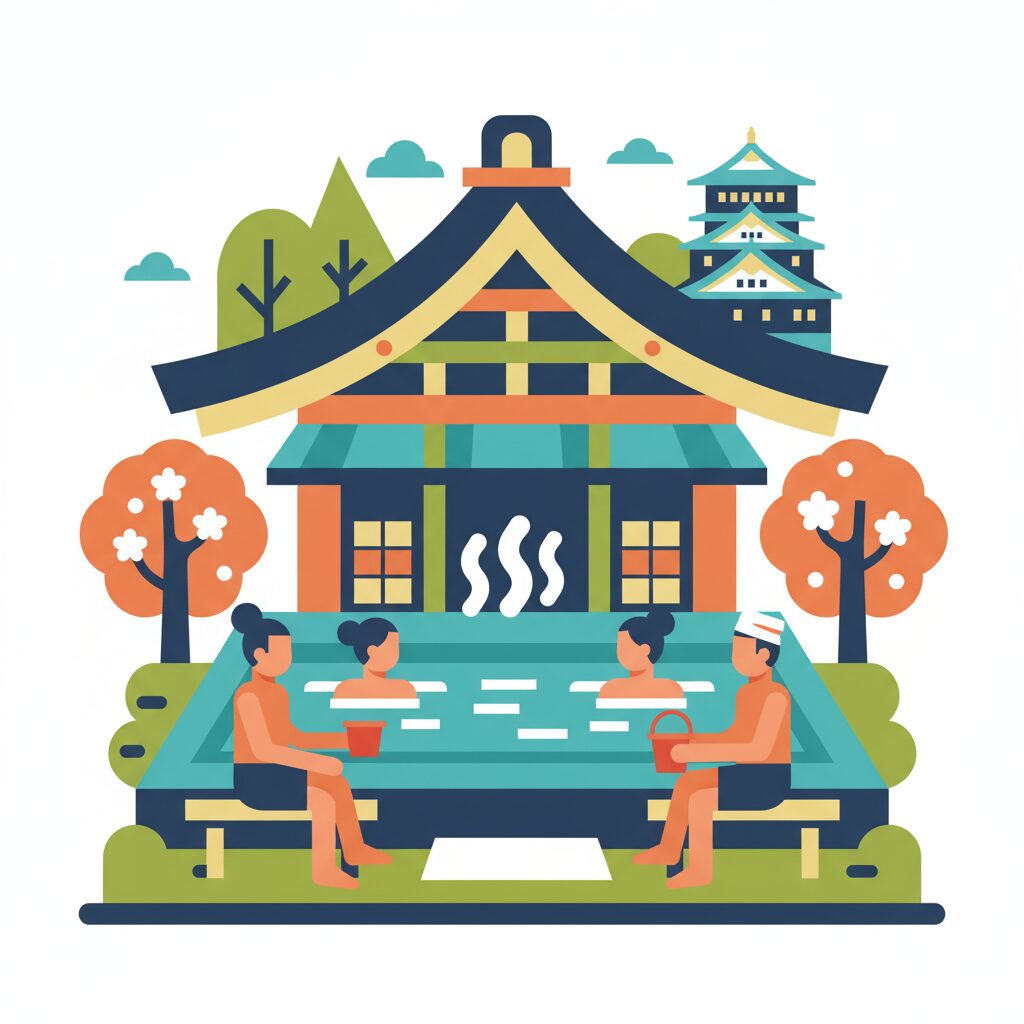
So, you’ve landed in Osaka. You’ve found an apartment, navigated the train system, maybe even conquered the art of ordering from a ticket-machine ramen shop. Your place, like virtually every modern home in Japan, has a bathroom. It’s probably a sleek, prefabricated unit with a deep tub and a shower wand that has a dozen perplexing settings. It’s clean, it’s private, it’s efficient. And yet, down the street, tucked between a greengrocer and a darkened karaoke bar, you see a building with a tall chimney, a dramatic tiled roof, and a short, split curtain hanging over the entrance, bearing the symbol ゆ (yu), the character for hot water. This is a sento, a public bath. And your Japanese neighbor, who has the exact same bathroom unit as you, probably goes there at least once a week. The question isn’t what it is, but why it still exists. Why would anyone pay close to 500 yen to get naked and bathe with a crowd of strangers when a perfectly good, private bath is waiting at home? That question is the key to understanding a huge piece of Osaka’s soul. This isn’t about hygiene. It’s about community, connection, and a specific kind of communication that only happens when you strip away everything—literally. Forget the flashy tourist spots for a moment. If you want to understand how Osaka really works, how its people think and connect, you have to get naked. But let’s be clear from the start: this is not a spa. This is not about serene relaxation with pan-flute music and cucumber water. The sento is a raw, lively, and deeply local experience. It’s a must-try for anyone wanting to immerse themselves in the city’s culture, but it’s absolutely not for the shy or anyone remotely uncomfortable with public nudity. If you can get past that hurdle, you’ll discover a side of Osaka that remains invisible to most outsiders. You’ll find the city’s living room.
For a different kind of local immersion that also reveals the city’s character, consider exploring the unique anime and tech jobs in Den Den Town.
The Sento Is Not a Spa: Deconstructing the Public Bath
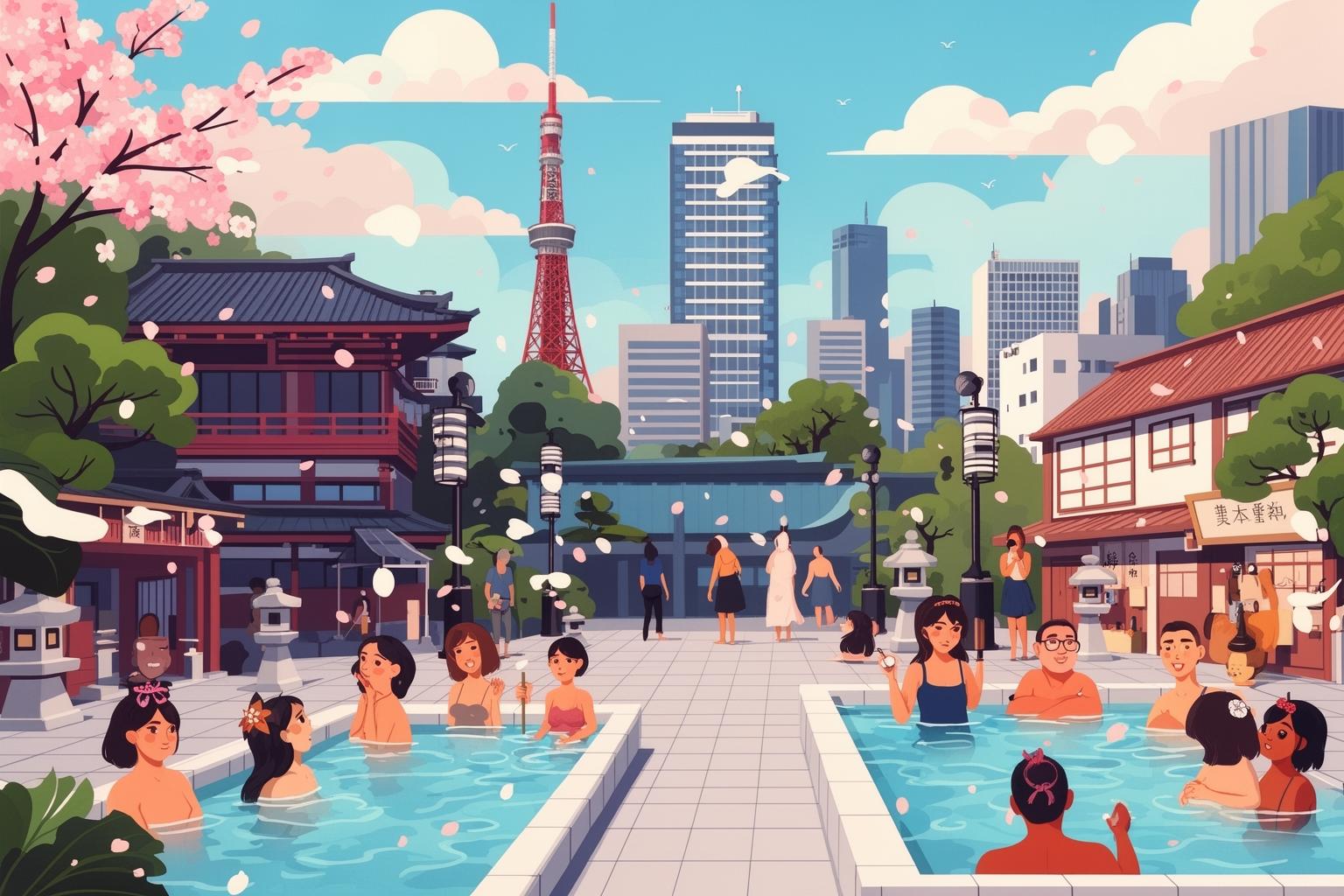
The first and most important shift in mindset is this: a sento is not a luxury—it’s a utility. It serves as social infrastructure, a cultural practice that has endured long after its original function became obsolete. To truly understand the Osaka sento, you must view it not as a place for indulgence, but as a vital element of the neighborhood’s rhythm, just as essential as the local supermarket or post office.
A Living Relic, Not a Tourist Attraction
Recall the post-war era in Japan when cities like Osaka were being rebuilt from scratch. Living spaces were small, and private baths were a luxury few could afford. The sento was a daily necessity. It was where people got clean, yes, but also where neighbors exchanged news, housewives shared gossip, and factory workers washed off the day’s grime together. It was the original social network—a face-to-face community forum. Today, even though every home has a bath, the sento persists for the same reason people go to coffee shops instead of just making coffee at home: it’s about the space, the atmosphere, and the company. In Osaka—a city shaped by close-knit relationships among merchants and artisans within dense neighborhoods—this kind of “third place” is particularly important. While Tokyo can feel like a series of anonymous train stations, Osaka feels like a patchwork of villages, each with its own shotengai (shopping arcade) and its own sento. The sento acts as an anchor, a tangible symbol of the community’s shared history. It’s a spot where generational boundaries fade, where an elderly man who recalls the air raids soaks in the same tub as a stressed university student.
The Anatomy of an Osaka Sento
Entering a sento is like stepping into a time capsule—a highly organized space with its own distinct layout. First, you walk through the noren, the signature split curtains that mark the entrance. Inside, you enter the genkan, a small foyer where you immediately face the getabako, a wall of small wooden lockers for shoes. You slide your shoes into a compartment, take the wooden key, and move forward. This is your first challenge. The entrance to the changing rooms is divided, typically marked by noren as well, one labeled 男 (otoko) for men, the other 女 (onna) for women. Choose carefully. Sitting between the shoe lockers and the changing rooms is the bandai, which is the hub of the operation. Traditionally, it’s a raised platform where the attendant—often an older woman (even on the men’s side, which can be surprising for first-timers)—sits and collects the fee. From this vantage point, she can see both the male and female changing rooms. It’s a role of absolute trust and authority. She functions as cashier, security guard, lost-and-found, and resident therapist all at once. You pay your fee—a price regulated by the prefecture, currently about 490 yen for adults—and proceed to the datsuijo, the changing room. The air is warm and humid here, filled with the scent of soap and the sounds of rattling locker doors and distant splashes. You’ll find old-fashioned wicker baskets for clothes, wooden benches, and occasionally a vintage massage chair that vibrates fiercely for 100 yen. An analog scale, seemingly from a 1950s doctor’s office, may be present as well. Find an empty locker, undress, and store your belongings. Then comes the moment of truth. Naked except for a small washcloth, you head toward the glass doors leading to the bathing area. Inside the bathing room, a cavern of steam and tile, the acoustics carry every splash and cough off the high ceilings. A large mural dominates one wall; while Mount Fuji is the usual cliché, in Osaka you’re just as likely to see a tiled mosaic of Osaka Castle, the neon lights of Dotonbori, or even a tranquil European landscape for some reason. The floor is lined with washing stations, each equipped with a small plastic stool, a bucket, and a faucet with a handheld shower. And then there are the baths themselves, the fune (ships). Typically, there’s a large main tub with scalding hot water, a smaller bubble bath (a jet bath or denki buro—an electric bath sending a mild current through the water, as unusual as it sounds), and often a cold plunge pool.
The Unspoken Rules of Engagement: Your Sento Survival Guide
Entering a sento for the first time can feel like stepping onto a stage without knowing your lines. The rules aren’t written down, but they are strict. Adhering to them shows respect—for the space and for the other bathers—and is essential for a smooth, stress-free experience. Breaking these rules is the fastest way to get a stern lecture from a grumpy grandmother.
Before You Even Touch the Water
Preparation is minimal but necessary. You’ll need two towels: a large one for drying off completely at the end, and a small, thin one (such as a tenugui or small hand towel). This small towel serves many purposes. You can bring your own soap, shampoo, and conditioner, or travel light—most sento sell small packets of all essentials for a few hundred yen. Upon entering, remove your shoes and store them in a getabako, where the wooden key often has a large wooden block attached to prevent loss. Take this key to the bandai or a ticket machine to pay the entrance fee. If it’s a traditional bandai, hand your money directly to the attendant, who will give you a locker key for the changing room, often attached to an elastic wristband. Then, enter the correct changing room. It’s a simple binary choice, but double-checking the kanji is always a good idea.
The Changing Room (Datsuijo) Protocol
This is where you shed any remaining self-consciousness along with your clothes. Find an empty locker matching the number on your key. Everyone is naked. No one cares. People come to cleanse and relax, not to judge. Averted gazes are the norm—not to ignore others, but to grant everyone a comfortable level of privacy in a public space. Neatly fold your clothes and place them in the locker with your large towel. Only take two items into the bathing area: your small towel and your soap/shampoo. Lock the locker and wear the key on your wrist or ankle. The small towel often confuses foreigners: what is it for? First, it’s used for scrubbing your body. Second, as a subtle etiquette point, it provides a sliver of modesty when moving around. It’s not meant to fully cover you, but casually draping it in front signals your understanding of the decorum—a small gesture of social awareness.
The Cardinal Sin: Entering the Tub Dirty
This is the most important rule of the sento. The large bathtubs are for soaking, not washing. Since the water is shared, its cleanliness depends on everyone washing themselves before entering. Jumping into a tub without washing first is the ultimate faux pas. Before approaching the main baths, perform kakeyu. Find a small basin near the bathing area entrance, fill it with hot water from the tap, and splash it over your entire body, starting with your feet and moving upward. This helps you acclimate to the heat and rinses off the initial layer of dirt. After kakeyu, proceed to a washing station. Grab a stool and a bucket. Sit down—do not stand while showering, as this will splash others nearby. This is non-negotiable. While seated, turn on the faucet or shower, wash yourself thoroughly with soap, shampoo your hair, and scrub well. Take your time. Only when completely clean may you approach the soaking tubs.
Tub Etiquette 101
Now comes the reward. You’re clean and ready to soak, but some rules remain. First, your small towel—used for washing—must be rinsed clean and never enter the bath water, a strict hygiene rule. You can place it on the side of the tub or, as the regulars do, fold it neatly and set it on top of your head. It may look odd, but it’s the correct practice. Enter the tub slowly, as the water is often very hot (42–45°C / 108–113°F), and easing in shows consideration by avoiding large waves. Once inside, relax. The sento is a place for quiet reflection or hushed conversation. No horseplay, swimming, or splashing. Respect personal space, even in a crowded bath. When moving between tubs—for example, from hot to cold—it’s polite to quickly rinse off sweat at a washing station before entering the next bath. When you finish soaking, before returning to the changing room, use your small towel to remove as much excess water from your body as possible. This helps prevent dripping on the floor and demonstrates your understanding of sento culture.
Reading the Room: Social Dynamics in an Osaka Sento
Mastering the physical rules is one thing; grasping the social dynamics is quite another. This is where the Osaka sento truly sets itself apart from its Tokyo counterpart and reveals the city’s character. A Tokyo sento often offers a quiet, almost meditative experience, where people keep to themselves, seeking a personal refuge from the city’s hustle. In contrast, an Osaka sento is a performance—a stage for the everyday drama of life.
The Art of “Hadaka no Tsukiai” (Naked Communion)
There is a Japanese concept called hadaka no tsukiai, which means “naked communion” or “naked friendship.” The idea is that by shedding your clothes, you also shed your social status, job title, and wealth. In the sento, the company president and the construction worker stand as equals—just two naked men soaking in hot water. This philosophy is deeply embraced in Osaka. The city’s merchant culture is less hierarchical and more pragmatic than Tokyo’s samurai-influenced society. People value directness and genuine connection over formal titles and pretenses. The sento perfectly embodies this. There’s no space for tatemae (the public facade one shows the world) when you’re naked; it’s all about honne (one’s true feelings). This setting encourages a unique openness. Strangers will strike up conversations about anything and everything. It’s not considered intrusive but perfectly natural.
Overheard at the Sento: The Sound of Daily Osaka Life
You’ll learn more about the real Osaka by listening for ten minutes in a sento than from a week of sightseeing. The conversations are a torrent of unfiltered local culture. You might hear two elderly men loudly debating the Hanshin Tigers’ starting lineup, their voices bouncing off the tiles. A group of women may chat about the rising price of daikon radish at the market and share pickling tips. Someone might complain about their son-in-law, while another boasts about their grandchild. It’s all mundane, and that’s what makes it beautiful—it’s the unvarnished soundtrack of daily life. For language learners, it’s an immersive classroom of the most challenging and authentic kind. You’ll be surrounded by thick, fast, and often humorous Osaka-ben (the local dialect). You might not catch everything, but you’ll feel the rhythm and warmth of the exchange. Don’t be surprised if someone strikes up a conversation. They might ask where you’re from, what you’re doing in Japan, or—a classic old-timer move—offer unsolicited health advice based on the color of your skin. “You look a little pale! You should eat more liver!” It comes from a place of genuine, if slightly nosy, concern.
The “Nushi”: The Masters of the Bath
In every longstanding sento, there are the nushi, the masters or lords of the bath. These are the superfans who have been coming to the same bathhouse at the same time daily for decades. They claim their designated locker, favorite washing station, and specific spot in the hot tub. They embody the sento’s history and guard its unwritten rules. To newcomers, they can seem intimidating. They carry an air of ownership and are quick to correct improper etiquette. If you forget to wash, or let your towel dip into the tub, a nushi will be the first to call it out, often in a gruff but not truly angry tone: “Oi, anata! Taoru!” (“Hey, you! Towel!”). Don’t take it personally. It’s not an attack—it’s a course correction. They’re protecting the sanctity of their space. The key to interacting with the nushi is respect. A simple nod of acknowledgment as you enter their domain goes a long way. Don’t take their favorite spot. Give them space. Show that you understand and respect the customs, and they often warm up, transforming from stern guardians into friendly sources of local knowledge and stories.
The Sento Spectrum: From Neighborhood Joints to “Super Sento”
Not all sento are made alike. Just as Osaka is a city of diverse neighborhoods, its bathing culture offers a broad range of experiences. Finding the right kind of sento for you is part of the adventure. The term “sento” typically refers to the traditional neighborhood public bath, while larger, more modern facilities are usually called “super sento.”
The Classic Corner Sento
This represents the quintessential public bath experience. These are often long-standing, family-operated establishments, housed in charming yet aging buildings featuring traditional shrine-style roofs (miyazukuri) or simpler, utilitarian designs. Inside, it feels as if time stopped around 1970. The tiles may be cracked, and the paint peeling in spots, but the character is immense. The water is often scaldingly hot, drawn from the local city supply but heated to seemingly impossible temperatures. The clientele consists almost entirely of elderly locals from the surrounding area. These are the nushi-run spaces, the genuine community living rooms. For a foreigner, visiting one can be somewhat intimidating. You will likely be the only non-Japanese person there, and your presence will be noticed. Yet it is also the most authentic and rewarding experience. Here you’ll encounter the pure essence of hadaka no tsukiai. Neighborhoods like Nishinari, Taisho, or Juso harbor such raw, unfiltered slices of Osaka life.
The “Designer” Sento
A newer trend is the emergence of the designer sento. These are older bathhouses that have been purchased and renovated by a younger generation, merging traditional sento culture with modern design. The basic layout and rules remain the same, but the style is updated. The lobby might feature minimalist concrete walls, serve craft beer or artisanal coffee, and offer stylish tenugui towels for sale. The changing rooms might play ambient jazz instead of the usual sumo tournament blaring on TV. The baths themselves may be enhanced with new features or unique herbal infusions. These spots attract a younger and more diverse crowd, including students, artists, and young professionals. The atmosphere is less about neighborhood gossip and more about a chic, tranquil escape. They serve as an excellent introduction for beginners, as they are often accustomed to foreign visitors and may have English signage. They represent an effort to preserve sento culture by adapting it to contemporary tastes.
The Super Sento: A Public Bath Theme Park
At the far end of the spectrum is the super sento. These are not typical neighborhood bathhouses; rather, they are expansive, multi-story entertainment complexes centered around bathing. Spa World in Shinsekai is the most famous and flamboyant example in Osaka, with its continent-themed bathing floors, but there are others, such as Nobeha no Yu Tsuruhashi or Solaniwa Onsen at Osaka Bay Tower. A super sento offers a wide variety of baths: indoor, outdoor (rotenburo), carbonated baths, silk baths, saunas of every imaginable temperature and humidity, and steam rooms. But bathing is only part of the experience. They also feature multiple restaurants, extensive manga libraries, massage and spa treatment rooms, TV lounges with reclining chairs, and quiet nap areas. Upon entry, you receive a wristband that acts as your key and wallet, enabling you to pay for everything inside and settle your bill at the end. You can easily spend an entire day and night at one. The super sento experience focuses less on community and more on personal indulgence and entertainment. It’s a fantastic outing but a very different experience from the daily ritual of the neighborhood sento.
What Foreigners Get Wrong (And How to Get It Right)
Though Osaka is welcoming, a foreigner entering a sento steps into a deeply local environment. Cultural misunderstandings can easily lead to mistakes. Being aware of common pitfalls can make your initial visits much smoother.
Myth 1: Everyone is Staring at Me
This is the main source of anxiety for first-timers, but it’s almost entirely in your mind. No one is really staring. Maybe a quick, curious glance—especially in a neighborhood spot where foreigners are rare—but it’s not judgmental. Most people are focused on their own relaxation. The best way to avoid any perceived attention is to act like you belong. Confidently follow the bathing routine and abide by the rules. People will quickly see you respect their culture and will leave you alone, or better yet, welcome you as a fellow bath enthusiast. Tattoos are a common related concern. Japan’s complicated history with tattoos, linked to the yakuza, means many private gyms, pools, and especially onsen (natural hot spring resorts) deny entry to anyone with tattoos. However, city sento are different. Osaka, with its more liberal and laid-back culture, is much more tolerant. Most neighborhood sento in Osaka have a “don’t ask, don’t tell” policy or simply don’t mind tattoos. This reflects the city’s pragmatic attitude. While it’s wise to check a sento’s policy online if uncertain, generally speaking, Osaka sento are among the most tattoo-friendly public baths in Japan.
Myth 2: It’s Unhygienic
People from cultures unfamiliar with public bathing often question whether shared bath water is clean. The answer is a clear yes, thanks to strict etiquette. The entire system relies on everyone washing thoroughly before entering the bath. The water in the tubs is for warming and relaxing, not for cleaning. Additionally, the water is continuously filtered, circulated, and treated. Sento operators are legally required to uphold strict hygiene standards. In fact, a well-maintained sento tub can be cleaner than a private hot tub that isn’t regularly cared for. Hygiene at sento is a matter of collective responsibility and pride.
Myth 3: I Don’t Speak Japanese, So I Can’t Go
While some Japanese language skills enhance your experience, especially for conversations, they are not necessary. The sento routine is largely a physical ritual. You can learn everything by simply watching others: shoes off, pay, undress, wash, soak, rinse, dry, dress, leave. It’s a quiet, graceful dance. A polite nod and a soft “Sumimasen” (excuse me) or “Arigatou” (thank you) help a lot. If an elderly man speaks quickly in Osaka dialect, a smile and nod is perfectly fine. He’s not testing you; he’s just being friendly in his own way. The effort to engage matters most. Osakans appreciate those who try to connect with their culture, even with a language barrier.
The Post-Sento Ritual: The Second Act
The sento experience doesn’t conclude the moment you step out of the tub. The time spent in the changing room after your bath is an essential part of the ritual — a gradual return to the outside world. This is the “cool down” lap, and it’s just as vital as the main event.
The Magic of Fruit Milk in a Glass Bottle
After soaking in near-boiling water, your body feels hot, relaxed, and dehydrated. The perfect remedy awaits in the vintage coolers of the datsuijo or lobby. The ultimate post-sento drink is furutsu gyunyu (fruit milk) or kohi gyunyu (coffee milk), served in a nostalgic glass bottle sealed with a paper cap. There’s a particular way to drink it: standing in just your towel, one hand on your hip, you down the entire bottle in one go. The cold, sweet liquid delivers an instant burst of bliss. It’s a nostalgic flavor for nearly every Japanese person, a fond echo of childhood. This drink is not merely refreshment; it’s the official closing mark of a successful bathing session.
The Datsuijo as a Social Lounge
No one is in a hurry to leave. The changing room turns into a relaxed lounge where people linger. They sit on wooden benches, drying off at a leisurely pace. Many weigh themselves on the large analog scale and chat about the numbers. There’s almost always a television, typically tuned to a baseball game (especially if the Tigers are playing) or a sumo tournament. The bathers’ commentary and groans provide a continuous soundtrack. People might read the day’s newspaper, often provided, or simply sit in a pleasant, heat-induced daze. This lingering is part of the experience. It’s a moment to savor the feeling of being completely, bone-deep clean and relaxed—a state known as sappari. Leaving early would be like walking out before the encore at a great concert.
Extending the Glow: Sento to Izakaya
For many, the sento is the perfect prelude to the evening’s main social event. The ideal Osaka combo is a visit to the sento followed by an outing to a local tachinomi (standing bar) or izakaya (pub). You emerge from the bathhouse at dusk, your skin glowing and your body humming with warmth, then step into a lantern-lit alley for a cold beer and some kushikatsu (deep-fried skewers). Your mind is clear, your body relaxed, and you’re perfectly prepared for good food and conversation. This pairing lifts the sento from a simple routine to the foundation of a perfect evening. Neighborhoods like Tenma, Kyobashi, and Shinsekai are dotted with old-school sento and numerous small, affordable, and friendly bars, making them ideal for this cultural doubleheader.
Why the Sento Explains Osaka
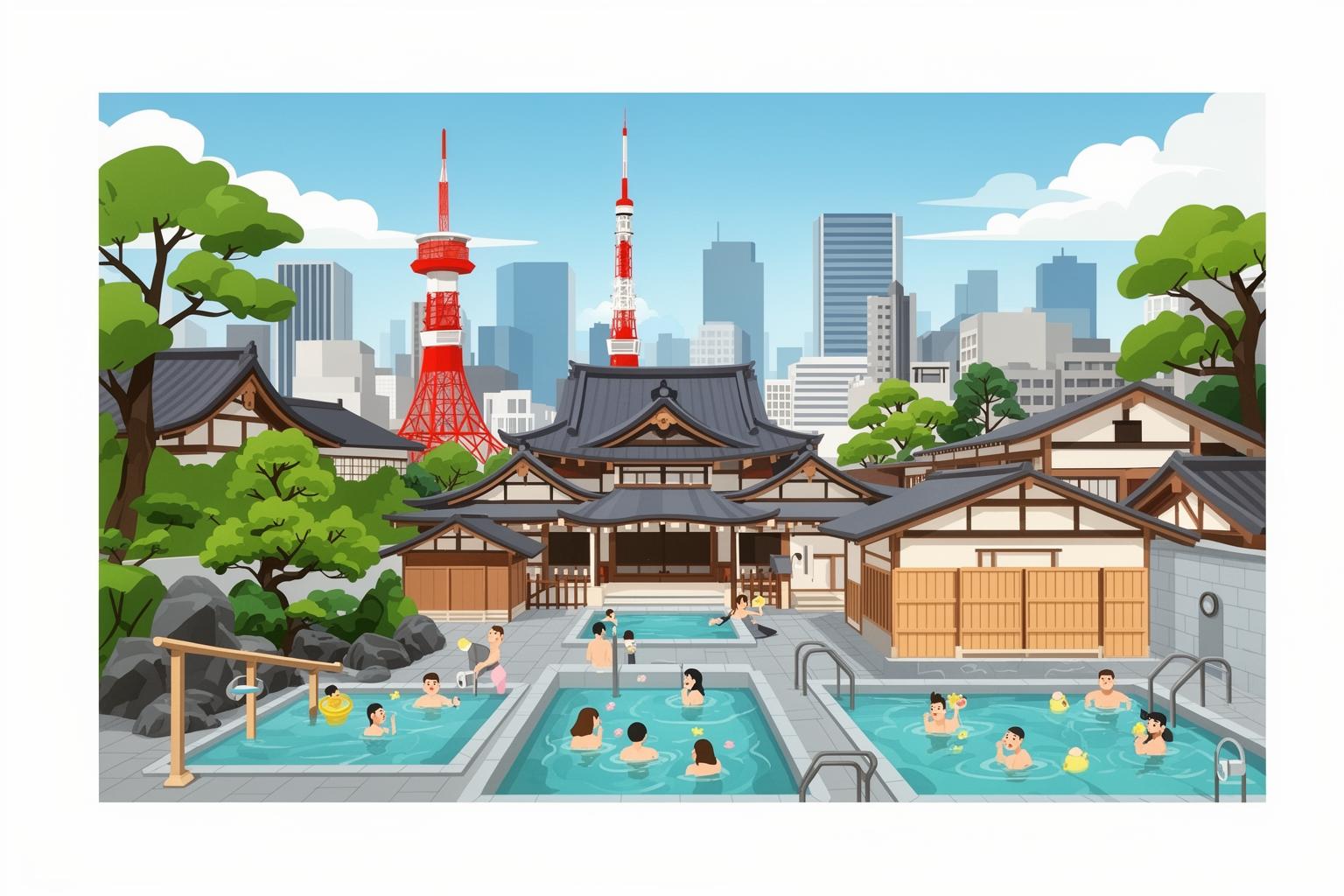
A sento is both a bathhouse and a lens. Through its misty windows, the true essence of Osaka comes into sharp relief. To grasp what drives this city, what distinguishes it from the polished precision of Tokyo, you need to understand the culture of its public baths.
Raw, Unfiltered, and Unpretentious
Osaka prides itself on being straightforward and grounded. It’s a city centered on commerce, not courtly rituals. What you see is what you get. The sento embodies this spirit. The idea of hadaka no tsukiai outright rejects the formality and social hierarchies that often characterize life in Japan. In the bath, there’s no facade. Conversations are candid, humor is boisterous, and emotions are visible. It’s the city with its defenses down—a place where people connect on the most fundamental human level. This raw, unfiltered social exchange lies at the heart of Osaka’s identity.
A Community in Close Quarters
Unlike Tokyo, which constantly tears down and rebuilds itself into a shining vertical metropolis, much of Osaka remains a sprawling, low-rise city with tightly-knit neighborhoods. Residents live close together, their lives intertwined through local shotengai, small parks, and corner sento. The public bath reflects this dense community life. It strengthens the bonds between neighbors. It’s a place where you are responsible to those around you—you must keep it clean, be considerate, and engage in the shared ritual. It’s a constant, tangible reminder that you belong to a collective, not just an isolated individual drifting through the city.
Finding Your “Iki-tsuke no Sento” (Your Go-To Bathhouse)
For any long-term resident, a key milestone in truly settling into Osaka is discovering your iki-tsuke no sento—your regular, go-to bathhouse. It’s the one in your neighborhood where the attendant starts recognizing you, where the nushi greet you with a familiar nod, and where the water temperature is just right. Becoming a regular at a sento is more than a routine. It’s an act of integration. It’s how you embed yourself in the fabric of your local community. It signals that you are not merely a passing visitor but a resident who understands and participates in the city’s daily rhythms. The sento is a key that opens a deeper understanding of Osaka—one that no museum or guidebook can offer. It teaches you etiquette, community, and the art of genuine, unpretentious connection. So grab a small towel, a few hundred yen, and your courage. The soul of the city awaits, in a tub of very, very hot water.