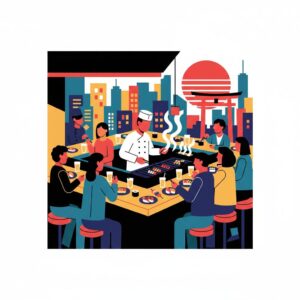
The first time it happened, I was utterly bewildered. I was standing in a small, family-run takoyaki shop near Tennoji, fumbling with my coins. I’d just moved to Osaka, still navigating the city with the wide-eyed caution of a newcomer. I accidentally dropped a 100-yen coin, and it rolled under the counter with a sad little metallic clatter. The shop owner, a cheerful man with a flour-dusted apron and a booming voice, looked at me, looked at the floor, and then, with a huge grin, he bellowed, “NANDE YA NEN!”
My Japanese was still textbook-level. I understood the literal words: “Why?!” or “What the heck?!” My mind raced. Why was he yelling? Was he angry that I’d dropped the coin? Was I being clumsy, a nuisance? Was this the infamous Osaka impatience I’d heard whispers about? I braced myself for a lecture, my face flushing with embarrassment. But then his wife, who was expertly flipping the octopus balls, laughed and gave her husband a light smack on the arm. “Mou, yamenasai!” she chuckled, which means something like, “Oh, stop it!” The man just kept grinning at me, his eyes twinkling. He then grabbed a long pair of tongs, expertly fished out my coin, and dropped it into my hand with a flourish. The tension vanished, replaced by a strange, warm confusion. He wasn’t mad at all. In fact, it felt… friendly?
This was my baptism by fire into the world of Osaka’s most vital, misunderstood, and utterly essential conversational tool: the tsukkomi. That “Nande ya nen!” wasn’t an accusation. It was a verbal hug. It was a way of saying, “I see you, I see your small, human mistake, and it connects us.” It was a performance, a small piece of theater in which my minor fumble became the setup for his playful punchline. In that moment, I realized that understanding Osaka wasn’t about mastering grammar or vocabulary; it was about learning to hear the music behind the words. This city doesn’t just talk; it banters, it riffs, it performs a constant, rolling comedy routine where everyone is invited to join the cast. And the price of admission is learning to appreciate the affectionate, rhythmic slap of a well-timed tsukkomi.
Living here has taught me that this is the fundamental difference between Osaka and the rest of Japan, particularly the polished, reserved elegance of Tokyo. It’s a city built on a different social syntax. To truly thrive here, to connect with its people and understand its soul, you have to learn the art of the friendly retort. You have to understand that in Osaka, a sharp “Why?!” is often the warmest welcome you can receive.
To truly embrace this unique social syntax, you can start by observing the daily conversational routines in Osaka’s local shopping arcades.
The Anatomy of a Punchline: Deconstructing ‘Nande ya nen!’
To truly understand Osaka communication, you need to set aside the dictionary and listen with your intuition. “Nande ya nen!” serves as the city’s unofficial motto, its heartbeat, its chorus. On the surface, it’s a simple question meaning “Why?” but its literal interpretation is likely the least significant aspect. It’s rarely, if ever, an actual request for information. No one is genuinely seeking a logical explanation. Instead, it’s a pure, unfiltered emotional response—a verbal exclamation point expressing a wide range of feelings, from disbelief and mock outrage to playful affection and shared absurdity.
Think of it less as a question and more as a versatile tool. Is your friend wearing a shirt with an absurdly oversized logo? “Nande ya nen!” (That’s crazy, but I love it). Did the train arrive a minute late, something rare in Japan? “Nande ya nen!” (A lighthearted poke at the universe’s small flaw). Did you just tell a story ending in a wildly unbelievable twist? “Nande ya nen!” (I’m fully engaged and can’t believe it!). The phrase acts as a shortcut, a burst of energy that instantly recognizes and reacts to a situation, drawing both speaker and listener into a shared emotional moment.
The way it’s delivered is as important as the words themselves. It’s a rhythmic expression with a unique cadence—not a flat “nan-de-ya-nen,” but a sharp, melodic “nan-DE ya NEN!” with strong emphasis on the second syllable. The intonation rises and falls like a little song, a percussive beat in conversation. This musicality distinguishes it from a genuine question or an angry outburst. It’s performative. An angry “Why?!” is sharp, bitter, and cold. An Osaka “Nande ya nen!” is loud, warm, and theatrical. It’s meant to fill the space, command attention, and invite a response.
In standard Japanese, the equivalent might be a polite “Doushite desu ka?” or a more casual “Nande?” But these expressions lack the punch, personality, and distinct Osaka flavor of “Nande ya nen!” The “ya nen” part is pure Kansai-ben, the regional dialect, adding a touch of folksiness and earthiness. It’s like putting your arm around someone’s shoulder. It softens the bluntness of “Nande” and transforms it from a sterile question into a rich, heartfelt expression of camaraderie. It’s the difference between simply asking for the time and exclaiming, “Can you believe how late it’s gotten?!” One requests information; the other seeks connection.
Foreigners often mistake this directness for aggression. In many cultures, and certainly in other regions of Japan, being loud and emotionally expressive with strangers or acquaintances can be perceived as rude or confrontational. But in Osaka, it’s quite the opposite. It’s a sign of connection and engagement. When the takoyaki shop owner shouted “Nande ya nen!” at me, he was breaking down the formal barrier between customer and vendor. He wasn’t treating me as just a transaction, but as a fellow human sharing in the small, funny dramas of life. He was inviting me into his world, where dropping a coin isn’t an awkward mistake but a chance to share a laugh.
The Conversational Dance: Understanding Boke and Tsukkomi
To truly grasp why “Nande ya nen!” exists, you need to take a step back and examine the structure of an Osaka conversation. It often revolves around a comedic principle called manzai, a traditional style of stand-up comedy featuring two performers: the boke and the tsukkomi.
The Boke: The Lovable Fool
The boke is the funny one, the airhead, the person who says or does something ridiculous, illogical, or simply silly. The term originates from the verb bokeru, which can mean to grow senile or to become fuzzy-minded. The boke sets up the joke. They might wear a pineapple-print suit, assert that cats can fly, or dramatically trip over a flat surface. Their role is to introduce absurdity into the scene. In my takoyaki shop story, my clumsy act of dropping the coin made me the accidental boke.
The Tsukkomi: The Sharp-Witted Straight Man
The tsukkomi is the straight man, the reactor, the one who points out the absurdity. The word comes from the verb tsukkomu, meaning to thrust or poke into something. The tsukkomi’s role is to “poke” the boke’s foolishness with a sharp, witty retort. This is where “Nande ya nen!” fits in. It’s the classic, quintessential tsukkomi line. The shop owner’s loud exclamation pointing out my silly mistake was a perfect example of the tsukkomi role. The tsukkomi restores order, generating laughter and validating the boke’s effort.
Here’s the key point many outsiders overlook: in Osaka, manzai isn’t just stage comedy. It serves as a blueprint for everyday interactions. People often, and sometimes unconsciously, slip into these roles. Conversations become a collaborative effort to create shared humor, not a debate or mere exchange of information. It’s a game.
When a friend tells you they spent the whole weekend trying to teach their cat chess, they are playing the boke. They don’t expect you to believe them or present a scientific argument about feline cognition. Instead, they’re offering you a chance to be the tsukkomi. Your role is to respond with something like, “Aho ka!” (Are you an idiot?!), “Sore de, docchi ga kattan?” (So, who won?), or the classic “Nande ya nen!”
Silence, or a polite, literal response such as, “Oh, that’s interesting, but I don’t think cats understand chess,” is the worst possible reaction. It kills the momentum. It’s a conversational foul. In Osaka’s social fabric, failing to provide a tsukkomi when invited is not polite; it’s seen as cold, distant, or even slightly arrogant. It suggests you’re not willing to play, don’t get the joke, or don’t consider the other person worthy of a playful reply. The real insult in Osaka isn’t a sharp retort—it’s the absence of one.
This dynamic influences everything. From ordering food to chatting with the local grocer, life is a series of small boke moments waiting for a tsukkomi to complete them. It’s a sign of intimacy and trust. To make a tsukkomi means saying, “Our relationship is strong enough for me to be this direct and playful with you.” To receive one means hearing, “You’re part of my circle. I feel comfortable joking with you like this.” It’s a continual, rhythmic reaffirmation of social bonds, all disguised as a comedy routine.
A Tale of Two Capitals: Osaka Banter vs. Tokyo Politesse
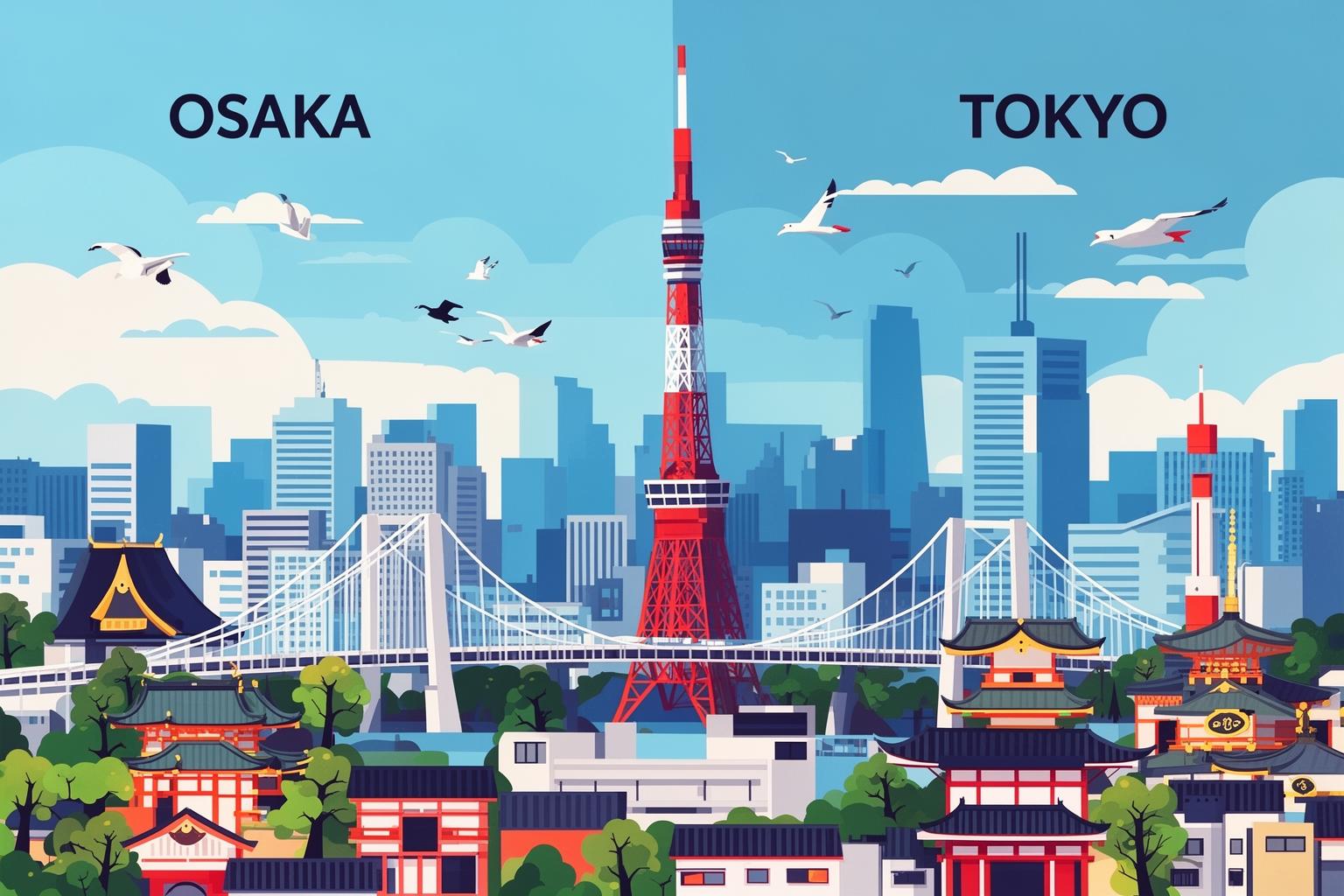
The cultural divide between Osaka and Tokyo represents one of Japan’s most renowned rivalries, and it is most evident in their distinct conversational styles. If Osaka’s communication resembles a comedic game of volleyball—setup (boke), spike (tsukkomi)—then Tokyo’s resembles a meticulously performed tea ceremony. Each style has its own charm and logic, yet they are fundamentally different art forms.
Tokyo, as the political and bureaucratic center for centuries, relies on a linguistic base of harmony, subtlety, and public face, or tatemae. The main objective of a conversation, especially with unfamiliar people, is to be smooth, pleasant, and non-confrontational. Direct opposition is avoided, and ambiguity is often preferred over bluntness. One reads the air (kuuki wo yomu) to grasp what remains unspoken and tailors responses to keep the group’s balance intact. If someone in Tokyo makes a mildly silly remark, the typical reaction would be a gentle, non-committal laugh (a-ha-ha), a polite topic change, or simply letting the comment pass without acknowledgment.
Picture the cat-and-chess scenario in a Tokyo workplace. An Osakan might immediately respond with a loud “No way!” and a barrage of jokes. A Tokyoite, by contrast, might offer a small, tight-lipped smile and say, “Hee, sou desu ka,” a wonderfully ambiguous phrase that can mean anything from “Oh, is that so?” to “I hear you, but I am choosing not to engage with this absurdity.” The aim is to avoid causing ripples. The boke remains unresolved, its comedic potential deliberately defused in the interest of social harmony. To an Osakan, this can feel cold and distancing, as if their attempt at connection was rebuffed.
On the other hand, an Osakan’s tsukkomi-laden remarks can sound harsh and abrasive to an unaccustomed Tokyo ear. What an Osakan means as a friendly tease—“That tie is so loud it’s hurting my eyes!”—might be interpreted in Tokyo as a sincere, and therefore shockingly rude, insult. The idea of playfully criticizing someone as a form of affection is not the default mindset. I have witnessed this in business meetings: an Osaka-based manager jokes at a subordinate’s expense to lighten the mood, and the colleagues from the Tokyo branch shift uneasily, uncertain if they just witnessed a public rebuke.
This contrast is rooted in deep cultural history. Tokyo was the city of the samurai, a strict warrior class where hierarchy, discipline, and protocol were matters of life and death. Words carried great weight, and a misstep could have severe consequences. Osaka, by contrast, was the city of merchants (akindo). Its lifeblood was commerce, negotiation, and the art of the deal. In Osaka’s bustling markets, building rapport rapidly was vital. One needed to be personable, memorable, and quick-witted. Haggling was a performance, a back-and-forth as much about entertainment as price. This merchant spirit, this passion for verbal volleying, remains central to the city’s identity. An Osaka conversation is a negotiation of intimacy, with humor as its currency.
From a non-Japanese viewpoint, particularly coming from a culture like China where regional differences are also pronounced, this Osaka-Tokyo divide feels familiar. It echoes the classic capital-versus-commercial-hub dynamic. Beijing, with its political weight and emphasis on propriety, presents a different rhythm from the fast-talking, business-savvy, and more openly expressive Shanghai. In many respects, Osaka resembles Japan’s Shanghai—a city with a proud, distinct identity, its own dialect, and a sense of playing by its own rules, often defining itself in contrast to the more formal capital.
The Unspoken Rules: Navigating the World of Tsukkomi
While the tsukkomi may appear as a chaotic exchange of friendly insults, it actually follows a sophisticated set of unspoken rules. Mastering these is essential to shift from being a confused onlooker to an active participant in Osaka life. Breaking these rules can turn a warm, funny moment into an awkward or even offensive one.
Rule One: Read the Relationship
This is the most important rule. The intensity, choice of words, and even the physical nature of a tsukkomi depend entirely on your relationship with the other person. With a close friend, an “Aho ka!” (Are you an idiot?!) paired with a light tap on the shoulder is a sign of deep affection—a verbal equivalent of a noogie. Saying the same to your boss, a new acquaintance, or an elderly woman at the bus stop would be social suicide.
The range of tsukkomi is broad. With strangers or service staff, it’s typically limited to gentle, observational humor. The takoyaki vendor’s “Nande ya nen!” was perfect because it targeted the situation (a dropped coin), not me personally. As you become closer with someone, the tsukkomi can grow more personal and direct. A friend might tease you about your questionable fashion sense or terrible singing at karaoke. This signals a strengthening bond—you’ve earned the right to be lovingly mocked and to mock in return. It’s crucial to judge this level carefully. When unsure, err on the side of caution. A mild tsukkomi is better than an overly harsh one.
Rule Two: Timing is Everything
A tsukkomi is instinctive, a reflex. It must be delivered almost immediately after the boke. Its comedic impact lies in the speed of your response. A pause between the setup and punchline is fatal—it shows you had to stop, think, process, and then respond. This analytical delay drains all spontaneity and humor, much like explaining a joke—that moment is lost.
This timing is what makes participation difficult for non-native speakers. By the time we translate the boke in our heads, grasp the absurdity, and try to formulate a grammatically correct tsukkomi, the conversation has moved on. The best way to learn is to observe the rhythm. Notice how people interrupt each other—not to be rude, but to maintain the flow. An Osaka conversation often features a chaotic overlap of voices, with tsukkomi flying back and forth even before sentences finish. The goal isn’t perfect wording but perfect timing.
Rule Three: It’s About Connection, Not Correction
This is perhaps the deepest rule. A tsukkomi isn’t about winning an argument or proving someone wrong. Its aim isn’t to assert logical superiority. The tsukkomi targets the absurdity of the statement, not the intelligence of the person saying it. You’re partners in a comedic exchange, not adversaries in a debate. The goal is to create a shared laugh that strengthens your bond.
When your friend claims they’ll survive on just potato chips, the tsukkomi “Sonna wake nai yaro!” (There’s no way!) isn’t a genuine concern for their nutrition. It’s a way of saying, “That’s ridiculous, and I’m glad you said it because it gives us a playful moment together.” You validate their boke by giving it the tsukkomi it merits. You’re playing your part to make the scene work. This collaborative spirit is what makes the dynamic feel warm and inclusive once you understand it. You’re building something together, one laugh at a time.
A Day in the Life: Tsukkomi in the Wild
Once you attune your senses to the rhythm of boke and tsukkomi, you begin noticing it everywhere. It’s the ambient vibe of everyday life in Osaka. The city acts as a living stage, where every exchange can become a scene.
Picture yourself at a supermarket in Shinsaibashi, buying a solitary, scraggly onion. The cashier, a middle-aged woman with a perfectly styled perm, rings it up and says with a perfectly straight face, “Kore de goukana karē tsukurun?” (Making a fancy curry with this, huh?). This is classic boke. She’s planted a ridiculous idea—that your humble onion is the base for a gourmet dish. Now the spotlight turns to you, offering several choices.
- The Beginner’s Response: A flustered laugh paired with a simple, smiling “Nande ya nen!” This is perfectly fine—it shows you caught the joke and appreciate her effort. Gold star.
- The Intermediate Response: Play along with a self-deprecating boke of your own. “Hai, ichinichibun desu.” (Yep, this is for the whole day’s meals). This elevates the moment, turning it into a two-person act.
- The Advanced Response: A sharp tsukkomi that flips the joke back on her. “Obachan no yoru gohan yori wa mashi ya to omou de.” (I think it’s still better than what you’re having for dinner!). This is high-level banter, requiring confidence and a good read of the other person’s humor. Nail it, and you just might gain a lifelong friend.
Or think about a chat with your neighbor, a friendly obachan who waters her plants every morning. She notices you rushing off to work. “Ara, kyō wa nanka isogashi sou ya na. Warui koto demo shitan?” (Oh, you look busy today. Did you do something wrong?). She’s not seriously accusing you—she’s baiting you. The expected reply isn’t a defensive “No, I’m just late!” but a playful tsukkomi like, “Maa ne! Ginkō gōtō ya!” (Yeah, you know it! Just robbed a bank!). The shared laughter that follows is a small ritual that tightens community ties. It’s a way to check in, to say good morning—with warmth and personality.
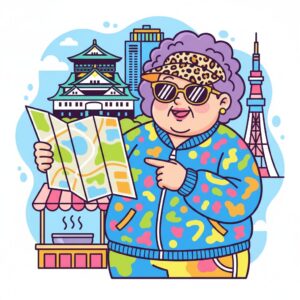
Even the well-known Osaka habit of sporting animal prints (hyou-gara) is part of this culture. It’s a subtle boke—a slightly bold, slightly flashy choice that invites comment. It sparks conversation. Complimenting an obachan’s leopard-print blouse is nice, but playfully saying, “Meccha tsuyosou!” (Wow, you look tough!) is even better. It’s recognizing her performance and joining in. In Osaka, even fashion is a form of dialogue.
Your Turn to Play: A Foreigner’s Guide to the Tsukkomi
So, you’re living in Osaka and eager to join in the fun. The prospect can be intimidating. What if you mess up? What if no one laughs? What if you accidentally offend someone? These concerns are legitimate, but the good news is that Osakans are very forgiving of foreigners who try to engage with their culture. A clumsy attempt is often more charming than staying silent.
Starting Small: The Gateway Phrases
You don’t have to be a comedy expert. Begin with the basics. A well-timed, smiling “Nande ya nen!” is your go-to phrase. It fits almost any situation where something is a bit funny, surprising, or absurd. Practice the intonation. Listen to how locals say it. Record yourself. Get that catchy “nan-DE ya NEN!” rhythm right.
Another handy phrase is “Honma ka?” (Really? / Seriously?). It’s less of a punchline and more of a gentle nudge, inviting the speaker to expand on their funny story. It’s a low-risk way to show you’re engaged and joining in.
The Art of Observation
Before performing, spend time as part of the audience. Listen closely to conversations on the train, in cafes, or at the market. Your first goal is to learn how to identify a boke. It’s usually a statement with a slight exaggeration, a self-mocking comment, or a moment of pretending ignorance. An old man looking at the rain and saying, “What a perfect day for laundry!” is a boke. A friend dramatically sighing, “I’m so popular, it’s exhausting,” is a boke. Recognizing the setup is half the challenge.
The Physical Tsukkomi: Handle with Care
You’ll often see friends, family, and comedy duos emphasize a tsukkomi with a gentle smack—usually on the back, shoulder, or top of the head. This is a key cultural nuance, but it’s definitely expert-level. This physical gesture adds emphasis to the joke and is not violence. However, the line between a friendly tap and an unwanted touch is very subtle, influenced by relationship, gender, age, and context. As a foreigner, my firm advice is: avoid physical tsukkomi. Stick to verbal replies. It’s safer and your effort will be just as appreciated.
Embracing Failure
You will make mistakes. You might deliver a tsukkomi when someone is serious. You might laugh when you should have responded. Your timing may be off. That’s okay. The wonderful thing about Osaka’s culture is that effort is what truly matters. A failed attempt at banter often becomes its own kind of boke, and people will probably find your sincere clumsiness endearing. They’ll laugh with you, not at you. That shared laughter, even about your own social blunder, is still a moment of connection. It shows that you’re trying and want to be part of the conversation. In Osaka, that’s what really counts.
The Soul of a Merchant City
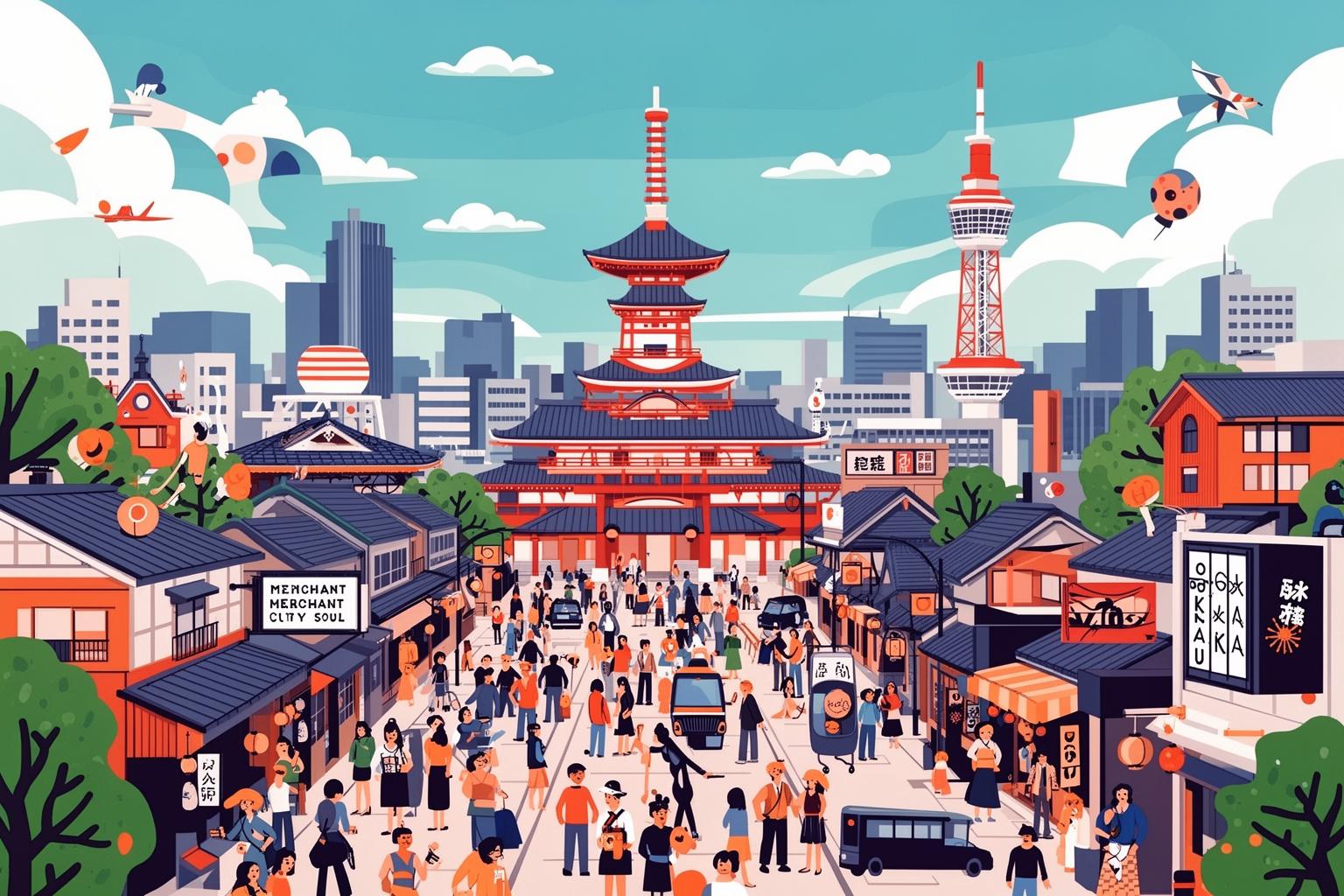
Why here? Why did this distinct conversational style flourish so vividly in Osaka? The explanation lies deeply embedded in the city’s history and its very essence. For centuries, Osaka served as Japan’s kitchen and commercial powerhouse. It was a city shaped not by warriors or nobility, but by merchants, artisans, and entertainers. In this environment, your wit was as prized as your wealth. A sharp sense of humor could close a deal, forge connections, and leave a lasting impression on customers.
This merchant spirit cultivates a pragmatic yet humane approach. There is less focus on strict formality and more on honest, person-to-person interaction. The aim is to quickly find common ground and establish an easy rapport. Humor acts as the ultimate icebreaker. The boke and tsukkomi exchange accelerates intimacy, bypassing polite but distant chit-chat for a more genuine, human connection.
In addition, Osaka is the undisputed heart of Japanese comedy. The entertainment powerhouse Yoshimoto Kogyo, the birthplace of numerous manzai comedians, is based in the lively Namba district. For generations, Osakans have embraced this style of humor as their core cultural export and local pride. The boke/tsukkomi rhythm is more than a habit; it’s a craft, an art form that is celebrated, broadcasted, and deeply woven into the city’s identity. Children learn it on playgrounds, practice it with family, and refine it throughout their lives. To speak boke and tsukkomi is to speak Osaka’s native language in its purest form.
When I try to describe this to friends back home, I notice similarities in other cultures that prize quick wit and playful banter. The fast-paced, self-deprecating humor of the Irish, the sharp, cutting remarks of a New Yorker, or even the performative storytelling of comedians from Northeast China—all share a common thread with Osaka. They represent ways of communicating that prioritize engagement, cleverness, and shared laughter over polite distance. They demonstrate that connecting through humor is a universal human trait, even if it takes on wonderfully unique, localized expressions.
Living in Osaka means seeing the world as a continuous flow of potential setups and punchlines. It means understanding that teasing is often an invitation to friendship. It means recognizing that a loud, raucous conversation in a restaurant isn’t a quarrel, but a celebration of togetherness. That first “Nande ya nen!” at the takoyaki stand wasn’t a rebuke; it was a welcome. It was Osaka, in its uniquely roundabout way, saying, “Welcome. We’re glad you’re here. Now, let’s enjoy ourselves.” Answering that call, learning the rhythm of this lively, chaotic, and heartwarming conversational dance, is the true key to making this city feel like home.