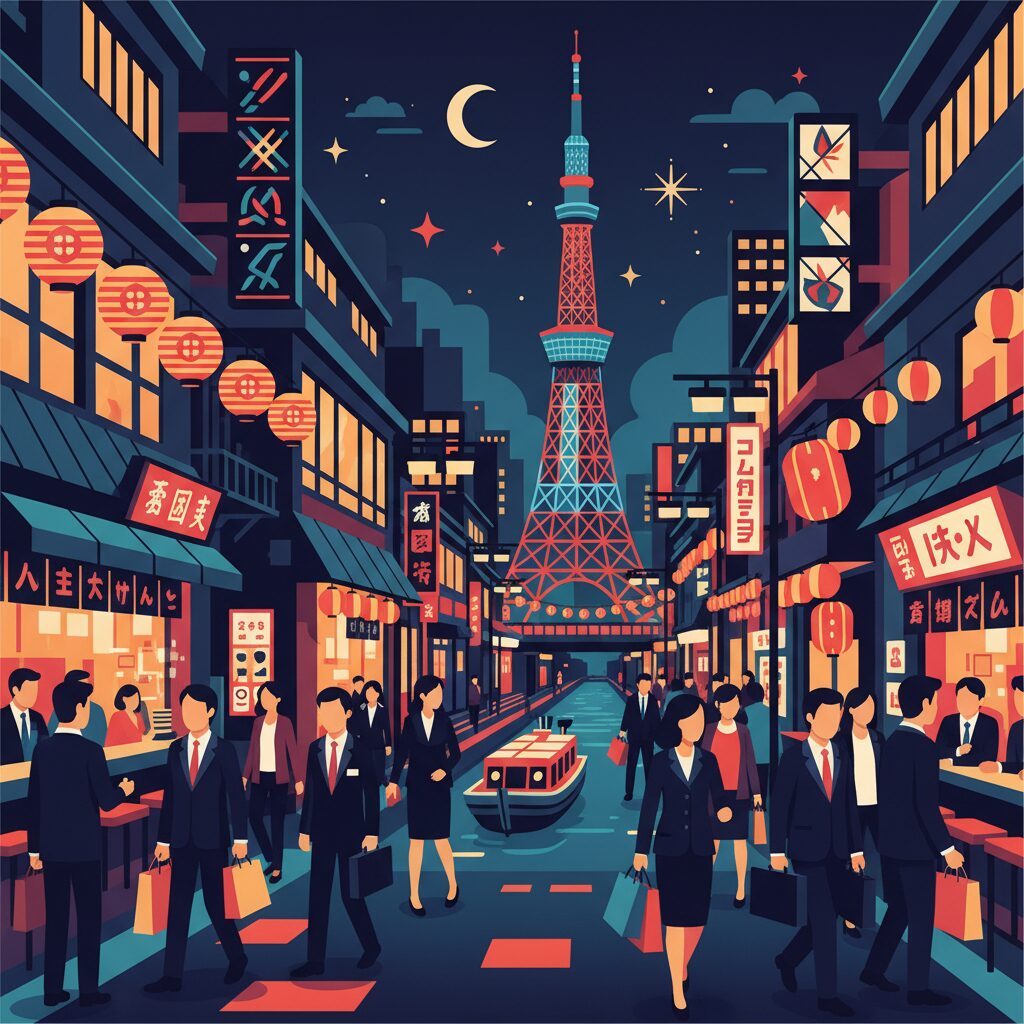
Your first few weeks in an Osaka office can feel like a carefully orchestrated performance. You master the correct angle for your bow, the precise phrasing for emails, and the art of the non-committal yet encouraging nod during meetings. You are functioning within the system, a system known as tatemae, the public-facing facade of harmony and consensus. Then, one evening, your manager turns to you, a broad grin spreading across his face, and utters the five words that will change everything: “Kyo, nomi ni ikimasho ka?” Shall we go for a drink tonight? You might perceive this as a simple, optional social invitation. A chance to unwind. It is so much more than that. This is not a request; it’s an unlocking mechanism. It’s the moment the curtain of tatemae is pulled back, and you are invited into the real, unscripted theater of Osaka life, a world governed by a different principle: honne, the expression of one’s true feelings. Understanding this transition from the fluorescent lights of the office to the warm glow of the izakaya lantern is fundamental to understanding the very soul of this city. This is where relationships are truly built, where hierarchies are dissolved in ice-cold beer, and where the pragmatic, straight-talking spirit of Osaka is laid bare. This is not just a party. It’s a vital professional and social function, and your participation is the key to genuine integration. The city is a sprawling network of these spaces, where the day’s tensions are smoothed over and true communication begins.
As you settle into Osaka’s rhythm, exploring the nuances of Osaka tsukkomi banter can reveal even more about the unspoken social codes that guide every interaction.
Beyond the Clock: The Unspoken Rules of the Izakaya
The moment you slide open the door of the izakaya and are greeted by the aroma of grilled yakitori and the lively chatter, you step into a different world. The space itself signals that the usual rules have shifted. The strict office seating arrangements are replaced by communal tables or close counter seating. Formal language, or keigo, gradually softens with each round of drinks. This environment is carefully managed for a specific purpose: to dismantle the structures that governed the preceding eight hours. It acts as a social pressure-release valve, vital for maintaining a society that places great importance on group harmony and respect for seniority.
Tatemae at the Desk, Honne at the Table
In Japanese workplaces, maintaining surface-level harmony is crucial. Disagreeing with a superior during meetings—especially publicly—is a serious breach of protocol. Ideas are presented, discussed, and consensus is reached through a process that often feels indirect and obscure to Westerners. This is the realm of tatemae, which ensures no one loses face and group cohesion is preserved. Yet, Osakans, with their pragmatic merchant mindset, understand that true progress and innovation require genuine opinions to be voiced. This creates a paradox: how can one express their true thoughts without disturbing harmony? The answer lies in the izakaya.
Here, softened by alcohol and an informal setting, the shift to honne takes place. Suddenly, a junior employee who silently nodded in the afternoon meeting might lean over to their manager and say, “You know, about that new project… I was thinking, and this might be the beer talking, but what if we tried this approach instead?” The phrase “this might be the beer talking” is essential. It offers plausible deniability, allowing a subordinate to suggest a potentially critical or different idea without directly challenging their superior. The manager can then evaluate the idea on its own merits, removed from office hierarchy constraints. This is not viewed as insubordination but as honest, constructive feedback given in the appropriate, sanctioned context.
The Ritual of Pouring: Rebalancing the Power Dynamic
Pay attention to how drinks are handled. It is rare to see someone pour their own beer. Instead, you are expected to monitor your companions’ glasses closely. This practice, known as oshaku, is much more than simple politeness. It is a ritualized expression of mutual care and respect that actively works to flatten the corporate hierarchy for the evening. A junior employee attentively refills their boss’s glass as a clear sign of respect. Crucially, the boss is also expected to reciprocate by pouring for their juniors. When a senior director leans over to fill a new hire’s glass, it sends a strong nonverbal message: “Tonight, in this space, we are not director and employee. We are colleagues. We are a team.” This continual mutual serving creates a network of reciprocal obligation and shared experience, breaking down the physical and psychological barriers hierarchy imposes, making the transition to the more open communication of honne feel natural and well-earned.
Osaka’s Special Flavor: Why ‘Nominication’ Hits Different Here
The concept of after-work drinking, or nominication (a blend of the Japanese word for drink, nomu, and communication), is common throughout Japan. However, in Osaka, it takes on a unique character shaped by the city’s distinctive history as a hub of commerce and entertainment. Rather than being a formal extension of the workplace, it feels more like an open, no-holds-barred workshop on human relationships. It’s livelier, faster-paced, and arguably more effective.
Tokyo Formality vs. Osaka Frankness
To truly understand Osaka, it’s helpful to contrast it with Tokyo. In the capital, after-work drinks often resemble a continuation of the business day. Conversations typically stay work-focused, hierarchical distinctions—though softened—remain apparent, and the primary aim is to reinforce existing client relationships or engage in subtle corporate strategizing. It’s a networking performance, an effort to maintain appropriate connections with the right people.
Osaka’s nominication rests on a different basis. Known as the city of merchants and the kitchen of Japan, success here has long depended not on family name or aristocratic ties, but on the ability to quickly assess character, build trust, and strike deals. Osakans are fundamentally pragmatic. They prize honesty and directness, not out of ideology, but because it’s efficient. Beating around the bush wastes time and money. This merchant mentality is brought straight into the izakaya. The aim is not just to display camaraderie; it’s to truly understand people. What drives them? What are their genuine concerns about the project? Can they be trusted? The evening becomes a data-gathering exercise to forge real, functional relationships that will smooth work and increase profitability tomorrow.
The Merchant’s Mindset at Play
This historical backdrop isn’t merely theoretical; it shapes the pace and tone of the entire evening. An Osaka businessperson wants to reach the honne quickly because that’s where the real insights lie. Small talk is a necessary introduction, but the heart of the interaction is the straightforward exchange of views. Foreigners are often taken aback by the directness of questions they might encounter, about their salary, personal life, or candid opinions of the company. This isn’t meant to be intrusive; it’s an effort to bypass formalities and connect on a human level, to identify shared ground or points of tension hidden within the rigid office structure.
The Role of Laughter and ‘Tsukkomi’
Perhaps the most powerful tool for breaking down hierarchy in an Osaka izakaya is humor. The city is Japan’s comedy capital and the birthplace of Manzai, a stand-up style featuring a boke (the silly, air-headed character) and a tsukkomi (the sharp, straight man who corrects the other). This comedic pattern is deeply ingrained in the local dialect and conversational style. At a drinking party, this dynamic serves as a strong social lubricant.
A manager may make a self-deprecating joke, purposely playing the boke. A junior colleague is not only allowed but often expected to respond with a playful tsukkomi, a witty comeback that highlights the absurdity of the manager’s remark. For instance, if the manager complains, “I’m so old, I can’t drink like I used to,” a quick-witted Osakan subordinate might immediately reply, “What are you talking about? That’s your fifth beer!” This exchange, unimaginable in a Tokyo office, signals intimacy and trust. Engaging in this verbal sparring shows that you belong to the in-group, understand the local rules, and that hierarchy is truly down for the night.
Navigating the Night: A Foreigner’s Practical Guide
For someone who is not a Japanese resident, these events can be fraught with unspoken expectations. Mastering the etiquette of nominication is an essential step toward achieving professional and social success in Osaka. It involves a careful balance of participation and observation, of expressing your thoughts while respecting invisible boundaries.
To Go or Not to Go: The Illusion of Choice
Your boss will always present the invitation as optional. “Please come if you have time,” they will say. This is a classic example of Japanese indirectness. Although you are technically free to decline and having a valid prior commitment is a perfectly acceptable excuse, repeatedly refusing will be noticed. It may be seen not simply as a preference for a quiet evening, but as a rejection of the team itself. You risk being perceived as someone who is not fully committed and who does not value the relationships that underpin the Japanese workplace. The key thing to remember is that your presence matters more than what you consume. No one will pressure you to drink alcohol. Ordering oolong tea or a soft drink all night is completely acceptable. The aim is to be there, to listen, to join the conversation, and to demonstrate that you are making an effort to be part of the group’s inner circle.
Reading the Room: When Honne Goes Too Far
The invitation to share your honne is not a green light for unchecked venting or harsh honesty. The crucial Japanese concept of kuki wo yomu, or “reading the air,” remains very much in play. The skill lies in recognizing the subtle line between constructive, relationship-building honesty and destructive, face-losing criticism. Complaining about a heavy workload is acceptable since it is a shared experience that builds solidarity. Complaining that your manager is incompetent is not. Expressing concerns about a project’s strategy is appropriate; declaring the entire project a foolish idea is not. The honne shared at an izakaya is intended to improve teamwork and understanding, not to be used as a weapon to settle scores. Pay close attention to the subjects others discuss and the tone they use. The boundaries will become clear to the careful observer.
The ‘Bureiko’ Paradox
You may hear the term bureiko announced at the start of the evening. It roughly means “let’s forget our ranks and be informal.” This signals the official suspension of hierarchy. Yet, it is a paradox. Bureiko is a rule-governed event of being unstructured. You are invited to relax and speak your mind, but within an invisible framework of what is socially acceptable. Everyone understands that by 9:00 AM the next day, the formal ranks of manager, section chief, and junior employee will be fully reinstated. The key is to realize that the evening’s events operate under a kind of “izakaya confidentiality.” Complaints aired and jokes exchanged are generally forgotten, or at least not officially acknowledged, once back in the office. However, the positive feelings and stronger relationships built during bureiko definitely carry over, fostering a smoother, more collaborative work environment.
The Morning After: Integrating the Izakaya into Office Life
The true value of nominication reveals itself not during the night itself, but in the days and weeks afterward. The effects are subtle yet meaningful. The quiet colleague from the accounting department, with whom you discovered a shared love for a particular musician, now greets you with a warm smile and a nod in the hallway. Your manager, having overheard your “drunken” idea about the project, might casually drop by your desk to ask you to expand on it, now that it has safely entered the conversation. The barriers to communication are lowered. The office, which once felt like a collection of individuals performing assigned roles, now feels more like a unified team.
This is the ultimate purpose of the after-work drink in Osaka. It is the essential maintenance that keeps the engine of a formal, hierarchical society running smoothly. It reflects the city’s core pragmatism—a recognition that rigid structures need moments of controlled chaos to nurture the human connections essential for any organization to truly thrive. To an outsider, it may appear as a simple office party. But to those who live and work here, it is a vital ritual. It is the place where the real work happens, where colleagues become comrades, and where the true, unfiltered character of this vibrant, straightforward city is revealed, one glass at a time.