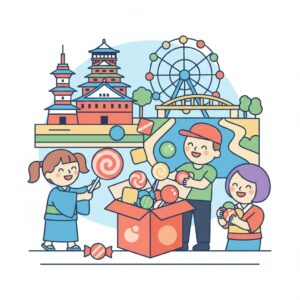
It happens when you least expect it. You’re standing on a crowded Midosuji Line platform, waiting for the train to Umeda, lost in your own world. Or maybe you’re in line at the local supermarket in Tennoji, fumbling with your wallet. Then, a gentle tap on your arm. You turn, and an older woman—an ‘obachan’ with a warm, crinkled smile—is holding out a small, brightly wrapped object. It’s a candy. She says nothing, or maybe just a quick, cheerful “douzo,” and before you can fully process it, she’s turned away, her part in this micro-transaction of humanity complete. The first time this happens, you’re likely to be bewildered. Your Western brain, trained to be wary of strangers offering gifts, cycles through a dozen questions. Is this a trick? What does she want? Is it safe to eat? But here in Osaka, you’ve just had your first encounter with ‘ame-chan,’ and you’ve brushed up against the true, beating heart of the city. This isn’t just candy. It’s a key, a gesture, a piece of a social language that defines life here, setting Osaka apart from the cool reserve of Tokyo and the ancient formalities of Kyoto. It’s a simple act that unpacks a complex and beautiful truth about how people connect in this vibrant, noisy, and deeply human metropolis.
This unique form of connection is just one example of how Osaka’s distinct local culture shapes daily life, much like how the city’s competing private railway networks influence everything from weekend getaways to daily commutes.
What Exactly is ‘Ame-chan’? More Than Just a Sweet Treat
First, let’s analyze the language. In standard Japanese, ‘ame’ (飴) means candy, but in Osaka, it’s almost always called ‘ame-chan’ (アメちゃん). The ‘-chan’ suffix is a diminutive—a term of endearment often used for children, close friends, or pets. Adding it to ‘candy’ immediately transforms the item from a simple sweet into something personal, familiar, and warm. It’s not just ‘a piece of candy’; it’s ‘a little candy,’ handed over with the affection the suffix conveys. This linguistic nuance is the first hint that the gesture is relational, not transactional. It’s a conscious choice of words that softens the edges of a city that can sometimes seem loud and overwhelming. The candy itself is seldom fancy. You won’t be offered artisanal chocolate or imported bonbons. The classic ‘ame-chan’ selection consists of everyday, time-honored sweets—think Kasugai milk candies (Milk no Kuni), simple fruit drops in a tin, tangy lemon sweets, or the ever-popular ‘nodo ame’ (throat lozenges), especially during the dry winter months. The most iconic might be ‘Kuroame’ (黒飴), a dark, rich hard candy made from Okinawan brown sugar. The emphasis isn’t on the brand or quality of the candy, but on its simplicity and accessibility. It’s a humble token, a small gesture without any expectation of obligation. The typical distributors of ‘ame-chan’ are the famed ‘Osaka obachan’—middle-aged and older women who are the undisputed social matriarchs of the city. Their handbags are legendary as treasure troves, packed with everything for any minor urban emergency, and a pouch of ‘ame-chan’ is always standard. Though they are the most frequent givers, the culture is not exclusive to them. Shopkeepers, taxi drivers, and even businessmen might engage in the ritual. And who are the recipients? Absolutely anyone—a child starting to fuss on the bus, a tourist looking lost and confused, a fellow commuter who sneezed, or you, the foreign resident simply standing nearby. The ‘ame-chan’ transcends all social boundaries with a flick of the wrist and the crinkle of a wrapper.
The Unspoken Rules of the ‘Ame-chan’ Exchange
Like many aspects of life in Japan, this seemingly spontaneous act is actually governed by a set of subtle, unspoken rules. It’s a ritual with a clear purpose—a tool to navigate the intricate social fabric of the city. Understanding its role is essential to grasping the mindset of the people who live here. It represents a practical application of a deeply ingrained communication style that values harmony and a direct, though non-verbal, connection.
The Opener: Breaking the Barrier
In a city of millions, creating a moment of connection with a stranger can feel intimidating. The ‘ame-chan’ serves as the perfect icebreaker—a low-risk, high-reward social gesture. Offering a piece of candy is a way of saying, “Hello, I see you, fellow human,” without the need for a full conversation. It punctures the bubble of anonymity that surrounds city dwellers. Imagine a quiet waiting room in a neighborhood clinic. The silence hangs heavy. An ‘obachan’ might pull out her ‘ame-chan’ pouch and offer one to the person next to her. Suddenly, the silence breaks. A soft “arigatou” is exchanged. A small chat might begin about the weather or the long wait. The candy acts as a catalyst, a permission slip to interact. It’s a social lubricant that eases communication, turning a room of strangers into a temporary shared community. It’s a gentle way to acknowledge shared presence, quite different from the averted gazes common on a Tokyo subway, where preserving personal space is the highest social rule.
The Thank You: A Gesture of Appreciation
The ‘ame-chan’ also serves as a casual, immediate expression of gratitude. Elsewhere in Japan, thanking someone for a favor often involves a formal bow or, for greater debts, a carefully chosen gift (‘omiyage’ or ‘temiyage’). This process is deliberate and governed by strict social protocols. Osaka, with its pragmatic merchant-town spirit, often simplifies this. If someone holds an elevator door for you, or a shopkeeper gives you complicated directions, they might press an ‘ame-chan’ into your hand as you part. It’s a way of saying, “Thanks for that small kindness,” in a gesture that is both tangible and fleeting. It doesn’t create an obligation. You don’t need to respond with a grander gesture; you simply accept the candy and the sentiment behind it. This custom highlights a key aspect of Osaka’s character: a focus on immediate, tangible results and relationships rather than rigid formality. A bow is an abstract sign of respect; candy is a real, shareable piece of sweetness that completes a positive interaction on the spot.
The Peacemaker: Diffusing Awkwardness
Life in a dense city is full of minor moments of friction. You accidentally bump someone’s shoulder on a crowded escalator, or your shopping bag brushes against someone’s leg on the train. Across Japan, the usual response is a flurry of “sumimasen” (excuse me/I’m sorry). In Osaka, this apology is often paired with the offering of an ‘ame-chan’. This clever gesture completely reframes the situation. It takes a brief moment of conflict or awkwardness and instantly diffuses it with warmth and a touch of playful humor. The message is, “Oops, my mistake, no hard feelings, let’s be friends.” It’s disarming. Any irritation you might have felt quickly dissolves, replaced by surprise and amusement. This is Osaka’s emotional intelligence at work. Instead of letting a small negative moment linger, it is actively and immediately turned into a positive one. The candy acts as a social balm, smoothing over the minor bumps and scrapes of daily urban life, helping to keep the collective mood light and harmonious.
Osaka vs. Tokyo: A Tale of Two Candies (or Lack Thereof)
To genuinely understand the importance of ‘ame-chan’ culture, you need to compare it with Tokyo. Living in or visiting Tokyo, you quickly realize that public spaces are governed by a profound, unspoken respect for privacy and non-interference. On the Yamanote Line, the world’s busiest train loop, the environment is marked by a deep collective silence. People exist within their own personal bubbles, eyes fixed on phones, books, or the distance ahead. Initiating contact with a stranger is uncommon and can be perceived as intrusive. Offering food to someone unknown to you? It would probably be met with confusion, suspicion, and a polite but firm refusal. It’s not that Tokyoites are cold or unfriendly; instead, their social contract is based on maintaining a respectful distance. The city’s enormous size and density require this psychological buffer. In such a setting, an ‘ame-chan’ would feel like a breach of protocol, an unwelcome intrusion into carefully guarded personal space. Osaka follows a completely different set of social norms. Here, engagement, not distance, is the default. The lines between public and private, stranger and acquaintance, are much more blurred. Life is lived openly—on the streets, in the markets, and on the trains. The ‘ame-chan’ perfectly embodies this attitude. It serves as a tool designed to gently and intentionally burst those personal bubbles. It’s an invitation to connect, if only briefly. While a Tokyoite might show respect by leaving you alone, an Osakan expresses warmth by drawing you into their circle, even momentarily. Foreigners often misinterpret this, viewing Osaka’s directness as brash or unsophisticated compared to Tokyo’s refined reserve. But the ‘ame-chan’ reveals the reality: it’s not about a lack of sophistication, but a difference in social values. In Osaka, even the smallest human connection often takes precedence over an abstract notion of personal space. It is the city’s character made visible—a small, sweet rebellion against urban anonymity.
The Psychology Behind the Pouch: Why Does This Happen Here?
The ‘ame-chan’ tradition is not merely a random custom; it is deeply rooted in Osaka’s distinctive history and cultural identity. Several interconnected factors explain why this practice took hold and thrived here, becoming a symbol of the city’s essence. It reflects the spirit of Osaka, a tradition handed down through generations not through textbooks, but through handbags and pockets.
A Merchant’s Mentality
For centuries, Osaka has been Japan’s commercial center, known as the ‘nation’s kitchen’ (天下の台所) and a city built by merchants (‘shonin’) rather than samurai or aristocrats. This mercantile heritage has instilled a pragmatic and relationship-oriented mindset in its culture. In business, success hinges on building rapport, making customers feel at home, and offering a little extra (‘omake’). A skilled merchant understands that a small, friendly gesture fosters loyalty and encourages repeat visits. The ‘ame-chan’ tradition serves as the social counterpart to this ‘omake’ culture—an investment in the community’s social capital. It’s a way of saying, “I appreciate this encounter, and I want to leave you with a positive impression.” This merchant pragmatism favors direct, effective communication that nurtures goodwill. An ‘ame-chan’ is far more personal and memorable than a formal, stiff greeting; it’s a tiny act of kindness that helps keep the city’s complex social economy functioning smoothly.
The ‘Obachan’ Network: Keepers of the Culture
The ‘ame-chan’ tradition cannot be discussed without recognizing the Osaka ‘obachan’. These women are the pillars of their communities—networkers, information centers, and neighborhood guardians all in one. They embody a spirit of proactive community care. Their constant readiness with an ‘ame-chan’ is part of this role, extending nurturing far beyond their immediate families to the entire neighborhood and even the city. Offering candy to a crying child is more than just pacifying them; it symbolizes communal support for overwhelmed parents. Giving candy to tourists acts as a grassroots form of city ambassadorship. They maintain social harmony, one piece of candy at a time. The ‘ame-chan’ pouch serves as their emblem of office, a tool for weaving the social fabric a little tighter with every exchange. These women are the tradition’s guardians, passing it on through their actions to the next generation.
A Performance of Personality
Everyday life in Osaka contains an element of performance. The city is renowned for its comedy culture (‘owarai’), and its people cherish a good laugh, sharp wit, and friendly banter. Communication here is not just about sharing information; it’s about connecting in an entertaining manner. The ‘ame-chan’ exchange often feels like a mini performance. The classic phrase, spoken in Osaka’s distinctive dialect, is not a timid question but a lively declaration: “Ame-chan taberu?” (“Wanna eat a candy?”) or “Ame-chan ageru wa!” (“I’ll give you a candy!”). It’s delivered with flair and a sparkle in the eye. The giver is not merely handing over candy; they are creating a moment. This performative quality is essential—it’s what makes the interaction uniquely Osakan. It’s kindness expressed with personality and a touch of panache.
A Foreigner’s Guide to Navigating the Sweet Exchange
For a non-Japanese resident, the ‘ame-chan’ exchange can be a charming yet initially puzzling aspect of daily life. Understanding how to respond can help you not only avoid awkwardness but also actively engage in this delightful local tradition. It offers a chance to move beyond simply observing and truly participate in the city’s social rhythm.
Receiving the Offer
If someone offers you an ‘ame-chan’, the basic rule is to accept it. Do so with a smile and a polite “Arigatou gozaimasu” (Thank you very much) or the more casual “Arigatou.” Adding a slight bow or nod of the head is also appropriate. Refusing, unless due to a serious allergy, may be seen as rejecting the social connection being extended and can come across as cold or distrustful—contrary to the intended spirit. Remember, you are accepting the gesture, not just the candy. You don’t need to unwrap and eat it immediately; simply accept it graciously, perhaps slip it into your pocket, and acknowledge the kindness. The exchange is complete once the act of giving and receiving takes place.
To Carry or Not to Carry?
As a foreigner, there is absolutely no expectation for you to carry your own supply of ‘ame-chan’ to hand out. No one will think less of you for not participating as a giver. However, if you genuinely want to immerse yourself in the local culture and connect with people, carrying a small stash can be transformative. It’s a powerful way to bridge cultural gaps. Offering an ‘ame-chan’ to a helpful shopkeeper or a child on the train signals your understanding and appreciation of local customs. It shows you’re not just living in Osaka, but striving to live like an Osakan. Your gesture will often be met with surprise, delight, and laughter. It’s an excellent way to break down barriers and create positive, memorable interactions. If you choose to try this, stick to simple, individually wrapped hard candies—nothing costly or elaborate. The modesty of the candy is part of the charm.
Avoiding Common Misunderstandings
The biggest challenge for many Westerners is the natural wariness of accepting food from strangers—a safety guideline ingrained from childhood. In the context of Osaka’s ‘ame-chan’ tradition, you can and should set this fear aside. The candy is always factory-sealed. The gesture is a well-known, positive social custom, not a prelude to a scam or anything harmful. Viewing this local hospitality through a lens of suspicion is the greatest misunderstanding possible. Recognizing it as a symbol of connection, a token of shared humanity, is essential. Embrace the gesture, enjoy the candy, and cherish the rare and wonderful experience of being part of a city that still finds ways to make millions of strangers feel, even briefly, like neighbors.