
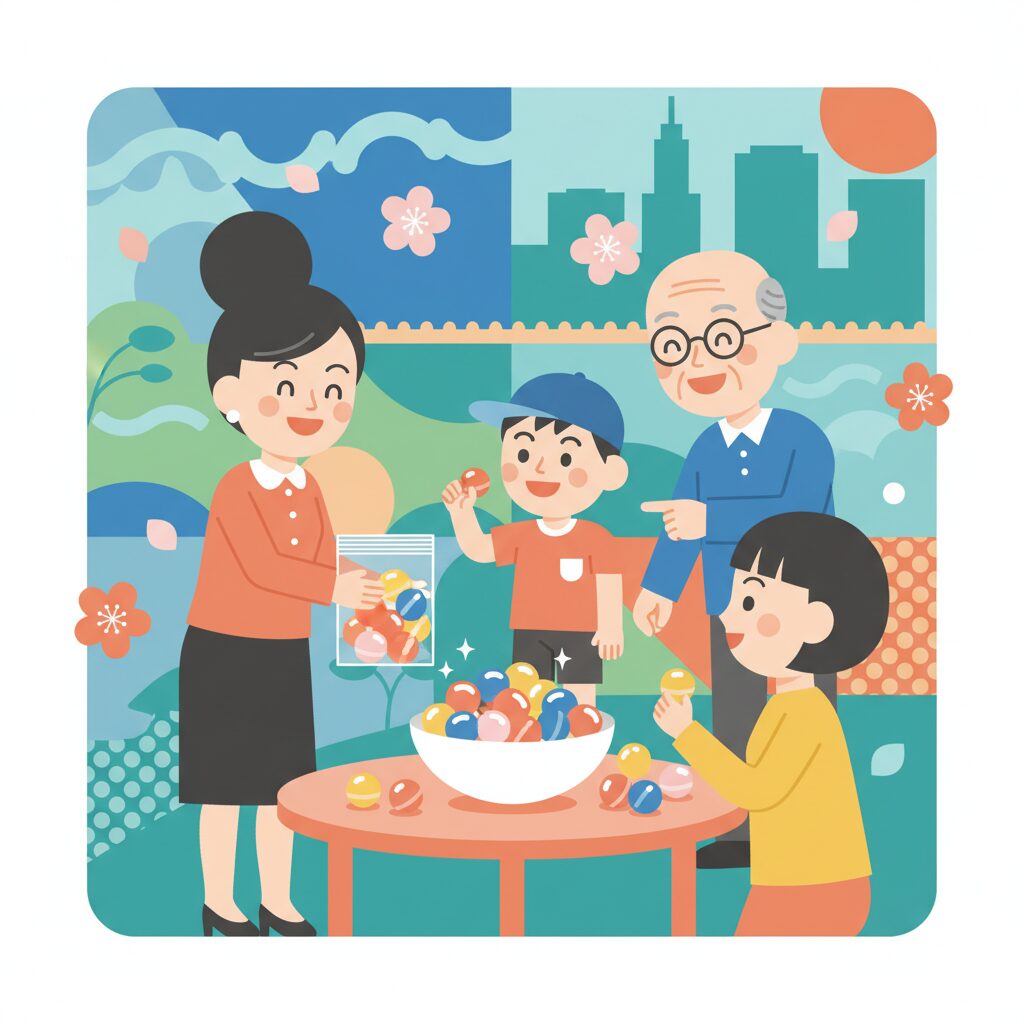
You’re standing on a crowded train, rattling your way from Umeda to Namba, minding your own business. The train lurches, and an elderly woman next to you, a classic Osaka oba-chan with a perm that defies gravity, catches your eye. She rummages in her handbag, a cavernous universe of tissues, train passes, and untold secrets. Her hand emerges, and she presses a small, cellophane-wrapped object into your palm. It’s a hard candy, a simple lemon drop. She gives you a quick, crinkly-eyed smile and a nod before turning back to look out the window. If you’re new to Osaka, your mind races. Is this a test? A trap? A random act of kindness? What does it mean? You’ve just had your first encounter with one of the city’s most fundamental social rituals: the giving of ‘ame-chan.’ This isn’t just about candy. This is a key that unlocks the entire operating system of Osaka’s social life, a system built on a foundation of direct, pragmatic, and heartfelt human connection that feels worlds away from the reserved ballet of Tokyo. To understand the ame-chan, you have to understand the city’s soul.
This thoughtful spirit, evident in the giving of ame-chan, is mirrored by how residents meticulously adhere to their unique garbage sorting schedule as part of their daily routine.
The Unspoken Language of a Single Candy
In most major cities, the default interaction with strangers is a polite, invisible barrier. You avoid eye contact on the subway and don’t strike up conversations while waiting in line at the bank. Osaka, however, operates on a different wavelength. Here, that small piece of candy serves as a full sentence, a paragraph, or even a short story depending on the context. The word itself, ‘ame-chan,’ conveys everything. ‘Ame’ means candy, and the ‘-chan’ suffix is an affectionate diminutive, the same one used for small children. It turns an ordinary item into something personal, familiar, and warm. It’s not just “candy”; it’s “a little sweet something for you.”
A Pocket-Sized Icebreaker
Think of the ame-chan as a social probe, a gentle way to breach the barrier between strangers without being intrusive. Waiting for a delayed train at Tennoji Station can feel tense and silent. But then, someone might offer an ame-chan to the person beside them. Suddenly, the silence is broken. A shared sigh about the delay, a quick comment on the weather, a momentary connection is made. It’s a tool that transforms a group of anonymous people into a temporary micro-community. The candy says, “We’re in this together.” It’s a low-risk, high-reward gesture. The worst outcome is a polite refusal. The best? You make a new friend or at least share a pleasant, human moment amid a hectic day. It acknowledges shared space and experience, quietly saying, “I see you.”
The Social Lubricant
Life is full of small frictions, and in Osaka, ame-chan is the grease that keeps social interactions running smoothly. Imagine a mother on a quiet bus with a fussy toddler. In Tokyo, she might bow her head in silent, pained apology to fellow passengers. In Osaka, she’s just as likely to offer ame-chan to those nearby with a wry smile that says, “Sorry for the noise, kids, am I right?” The gesture isn’t an excuse but a form of camaraderie. It defuses potential annoyance by inviting others into her experience, turning them into allies rather than judges. It’s a brilliant social tool. Likewise, if someone accidentally bumps into you a bit too forcefully, they might offer one as a more heartfelt apology than a quick “sumimasen” (excuse me). It adds genuine remorse and a wish to restore goodwill, turning a negative moment into a positive one.
A Currency of Gratitude
While formal gift-giving in Japan involves complex etiquette, the ame-chan is a small token of thanks. Did someone hold the elevator door for you? Did a shopkeeper go out of their way to find an item in the back? Did a stranger help you pick up dropped groceries? In Osaka, these are prime occasions for ame-chan. Offering a candy here expresses gratitude that feels more personal than words but less formal than a deep bow. It’s a tangible gesture saying, “I appreciate what you’ve done.” It elevates simple courtesy into a memorable, human exchange. This system of goodwill runs alongside the monetary economy, a constant, low-level flow of sweetness that binds the city together.
Osaka vs. Tokyo: The Great Candy Divide
The ame-chan culture vividly exemplifies the profound psychological differences between Osaka and Tokyo. For a foreign resident, navigating these two cities can feel like learning two distinct languages, even when everyone is speaking Japanese. The ame-chan serves as a perfect case study of these contrasting social philosophies.
Tokyo’s Elegant Distance
In Tokyo, social harmony, or ‘wa,’ is often maintained through non-interference. The city operates as a model of smooth, efficient, and impersonal movement. People respect each other’s space, both physically and psychologically. An unsolicited gift from a stranger, even something as small as a piece of candy, would be unusual. It would be unexpected and, for many, somewhat unsettling. The first reaction wouldn’t be, “How nice,” but rather, “What do they want?” or “Is this some kind of scam?” Offering ame-chan on the Yamanote Line would violate this unspoken social contract. It’s not that Tokyoites are cold; they simply follow a different set of rules where politeness means maintaining respectful distance. To interfere, even kindly, can be seen as intrusive.
Osaka’s Engaged Closeness
Osaka’s interpretation of ‘wa’ is achieved through active engagement. The city was founded by merchants, and its culture heavily emphasizes the art of the deal, which requires quickly and directly building rapport. You talk, joke, and find common ground. The ame-chan is a reflection of this merchant spirit. It’s a tool for bridging the gap, not for keeping it. It acts as an opening move in a social negotiation that says, “Let’s be human together for a moment.” The approach isn’t about avoiding imposition; it’s about fostering connection. The risk of a slightly awkward moment is far outweighed by the chance for a friendly exchange. This is why foreigners often find Osaka more “friendly” or “approachable.” It’s not just a vague impression; it’s a clear difference in social strategy, and the ame-chan is its symbol. People here aren’t afraid to get a little involved in your life, and the candy is their way of kindly knocking on the door.
The Practical Guide for the Foreign Resident
Understanding the theory is one thing, but putting it into practice is another. For non-Japanese residents, the ame-chan interaction can cause some anxiety. What are the rules? How do I avoid messing this up? The good news is that the system is very forgiving, but knowing the basics will help you feel less like an outsider and more like a participant.
The Art of Receiving
This is the most important part: simply accept it. Unless you have a serious allergy, refusing an ame-chan is a subtle social rejection. It’s like someone extending their hand for a handshake and being left hanging. The gesture matters more than the candy itself. The proper response is straightforward. Make eye contact, offer a small smile, and give a slight nod or a small bow of your head. Say, “Arigatou gozaimasu” (thank you) or even a simple “Sumimasen,” which here implies, “Oh, you shouldn’t have, thank you.” That’s all. Don’t overthink it. Don’t question the intention. Just accept this small token of connection. You can put it in your pocket to enjoy later; you don’t need to eat it right away. The exchange is complete the moment you accept it.
To Give or Not to Give?
As a foreigner, you aren’t expected to carry ame-chan. No one will judge you for not having a stash of hard candies on hand. However, if you genuinely want to immerse yourself in the local culture, becoming a giver is the next step. It sends a strong message that you’re not just a tourist or temporary resident, but someone who understands and values the local traditions. Carrying a few individually wrapped candies in your bag or pocket can change the game. It lets you initiate these exchanges, show gratitude, and break the ice. It’s an unexpectedly empowering experience.
Choosing Your Arsenal
If you decide to become one of the ame-chan givers, what should you carry? The key is simplicity and practicality. Avoid fancy gourmet chocolates. This is about the gesture, not the price. Classics remain classics for a reason. Look for bags of individually wrapped hard candies at any supermarket or convenience store. Popular options like ‘Pine Ame‘ (pineapple-flavored rings), ‘Kuro Ame’ (rich brown sugar candy), or assorted fruit drops are perfect. Individual wrapping is essential; it’s hygienic and makes sharing easy. Keeping a small, dedicated pouch for them in your bag is the ultimate pro move, honoring the Osaka oba-chan who have perfected this art.
Beyond the Oba-chan: The Modern Evolution of Ame-chan
Although the stereotype of the ame-chan-wielding oba-chan is a strong one, it is incorrect to assume this culture is limited to the elderly. The spirit of the ame-chan continues to thrive across generations, even if its form changes. It has transformed from a specific item into a broader mindset of small, spontaneous giving.
The taxi driver who keeps a basket of candy on his dashboard for passengers is embodying ame-chan culture. The young, fashionable coffee shop owner in Horie who tucks an extra little cookie into your bag with your purchase is doing the same. Your coworker who leaves a small chocolate on your desk after you helped them with a report is expressing the language of ame-chan. It’s about the proactive act of giving something small and unexpected to brighten someone’s day or show appreciation.
This modern evolution demonstrates that ame-chan is not a fading tradition but a core element of Osaka’s cultural identity. It adapts to new settings, yet the fundamental principle remains unchanged: use small tokens to build strong connections. It’s a philosophy that sharply contrasts with the increasing digitalization and anonymity of modern urban life, representing a small but powerful act of analog, human-to-human rebellion.
What Ame-chan Reveals About the Osaka Mindset
Ultimately, that single piece of candy offers a glimpse into the Osakan worldview. It reflects a culture that values pragmatism over formalities. Why engage in complex, indirect politeness rituals when a simple, straightforward gesture accomplishes the same outcome more effectively? It signifies a deeply rooted belief in community, the idea that urban life doesn’t have to be anonymous. In Osaka, you are not isolated. You are part of a vibrant, interconnected, and sometimes noisy ecosystem, and the ame-chan serves as the sign that you belong.
It embodies a form of emotional economics where goodwill acts as the preferred currency. People invest small amounts throughout the day, trusting that the collective social gain will benefit everyone. This isn’t about naivety; it’s a deliberate, time-tested approach to making a vast city feel like a close-knit town. It’s a determination not to let the size of the metropolis overwhelm the scale of human connection.
So the next time you’re on a train and a hand reaches out with a small sweet treat, you’ll know what to do. You’ll realize that you’re not simply receiving a piece of candy. You’re receiving an invitation. You’re being welcomed, in the most Osakan manner, into the lively, warm, and wonderfully direct heart of the city.








