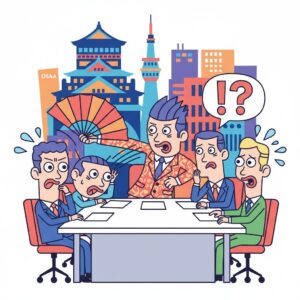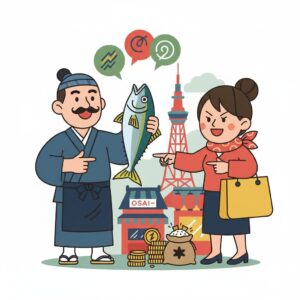
Step onto a bus in Osaka, find a seat in a local clinic’s waiting room, or stand in line at the post office, and you might experience a uniquely Osakan phenomenon. A hand, often belonging to a woman of a certain age, will emerge from a cavernous handbag, rummage for a moment, and then present itself to you, palm open. In it, you’ll find a small, crinkly-wrapped hard candy. There will be a nod, a grin, and a simple phrase like, “Douzo,” (Go ahead) or “Kore, tabe” (Here, eat this). You’ve just been initiated into the world of ‘ame-chan.’ For the uninitiated, especially those accustomed to the polite but palpable distance of Tokyo, this gesture can be confounding. Is it a random act of kindness? A strange local custom? A test? The answer is all of that, and so much more. This isn’t just about a sweet tooth; it’s about a fundamental piece of the city’s social fabric. The offering of a simple candy is a transaction of communication, a gesture that breaks down the invisible walls of urban anonymity and says, in its own sweet way, “Welcome to Osaka. Let’s connect.” This small, seemingly insignificant act is a Rosetta Stone for understanding the city’s soul—a world away from the reserved corridors of the capital. It’s in these moments, repeated thousands of times a day across the city, that the true character of Osaka reveals itself: direct, warm, a little bit nosy, and always ready to share.
To truly understand this unique social custom, you can learn more about the unwritten rules of ame-chan.
The Power in a Name: Demystifying ‘Ame-chan’
To begin understanding this culture, you have to start with the name itself. In standard Japanese, the word for candy is ‘ame’ (飴), a neutral, descriptive noun. But in Osaka, you’ll almost exclusively hear ‘ame-chan’ (飴ちゃん). That suffix, ‘-chan,’ is the key. In Japanese, ‘-chan’ is a diminutive, an affectionate honorific usually attached to the names of children, pets, or very close friends and family. It gives the subject a sense of cuteness, familiarity, and warmth. By calling a simple piece of candy ‘ame-chan,’ Osakans are performing a subtle yet powerful act of linguistic alchemy. They transform an inanimate object, a commodity, into something personal and endearing. It’s no longer just a candy; it’s a little candy, a friendly offering, a pocket-sized friend.
This isn’t merely a dialectal quirk; it’s a window into the local mindset. The language reflects a worldview where potential for connection exists everywhere, even in a piece of confectionery. In Tokyo, the formality of the culture is echoed in its language. Things are what they are. A candy is simply a candy. In Osaka, there is a constant effort to soften edges, humanize the mundane, and create openings for interaction. The ‘chan’ suffix is an invitation. It signals that this object isn’t merely being given; it’s shared with a spirit of playfulness and affection. It’s the difference between a formal handshake and a friendly pat on the back. A newcomer might not immediately grasp the significance, but living here, you begin to feel the weight of that one extra syllable. It’s the sound of a barrier gently lowering, a small, sweet signal that you’re in a place that values warmth over rigid propriety.
The Keepers of the Candy: The ‘Osaka Obachan’ Network
The primary ambassadors of ame-chan culture are undeniably the ‘Osaka no Obachan’—the middle-aged and elderly women of the city. They represent an iconic, almost legendary, demographic. The stereotype, often exaggerated for comedic effect, features a tightly-permed hairstyle (occasionally with a hint of purple), a love for animal prints (leopard being the most classic), and a voice that easily cuts through the noise of a bustling ‘shotengai’ (shopping arcade). But beneath this vivid exterior lies the true social engine of Osaka’s neighborhoods. Their driving force is ame-chan.
For an Osaka obachan, a handbag without a generous supply of ame-chan is like a car without fuel. It’s an indispensable tool for navigating the social landscape. These women are the matriarchs of the public sphere, and the candies are their trade currency. The distribution is far from random; it fulfills a variety of nuanced social roles. First and foremost, it’s a powerful icebreaker. In a city where conversing with strangers is not only accepted but often expected, ame-chan offers the perfect way to initiate contact. It’s a low-stakes, non-committal gesture that requires no lengthy prelude or formal introduction. It’s a simple, physical expression that says, “I see you. Let’s share a moment.”
Think of it as a form of social currency. It’s employed to ease awkward moments. A child starts crying on the Hankyu line? An obachan will often appear, presenting an ame-chan as a peace offering to both child and stressed parent. This small act acknowledges the disruption while framing it with empathy rather than irritation. It’s used to forge temporary connections in everyday situations. Waiting in a long queue at the bank in Namba? Sharing an ame-chan with the person next to you transforms two strangers into a temporary team, united by shared boredom. It’s a way of saying, “We’re in this together.” This gesture strengthens a sense of communal ownership of public space. It serves as a constant, subtle reminder that the city is more than just a collection of individuals, but a community, however fleeting these connections may be.
More Than a Sugar Rush: The True Meaning of the Exchange
A foreigner’s initial reaction to being offered candy by a complete stranger can vary from pleasant surprise to outright suspicion. In many Western cultures, and certainly in other parts of Japan, accepting food from an unknown person is considered a red flag. The key misunderstanding lies in thinking the interaction centers on the candy itself. It does not. The candy simply serves as the vehicle for the real transaction: communication and connection.
Let’s sharply contrast this with Tokyo. Imagine sitting on the Yamanote Line, the city’s busiest loop train. The atmosphere is one of profound public silence. Everyone is immersed in their own world—smartphone, book, or a fixed gaze at the floor. Eye contact is deliberately avoided. To break that silence by offering candy to the person next to you would be a major social breach. It would be regarded as strange, intrusive, and deeply uncomfortable. The unspoken rule in Tokyo is to respect each other’s personal space with absolute deference. Your space is your space, my space is my space, and never the twain shall meet.
Now, picture yourself on the Osaka Loop Line. The ambient noise is noticeably louder. People speak more freely on their phones. Conversations among friends are louder and more lively. The boundaries are simply more permeable. In this setting, an obachan offering an ame-chan feels like a natural extension of the existing social atmosphere. The gesture is a micro-interaction aimed at piercing the bubble of urban anonymity. It’s a probe, a feeler sent out to test if a connection can be made. The expected response isn’t deep gratitude for the candy but acknowledgment of the social overture. A smile, a nod, a quick “arigato,” or even a brief comment about the weather is what’s truly sought. The candy is merely the catalyst for that brief moment of human recognition.
Living in Osaka means readjusting your understanding of public space. It is not a neutral zone to be passed through with minimal interaction. It is a stage for a constant, low-level hum of social activity. The ame-chan is a perfect symbol of this philosophy. It embodies the belief that even a small shared experience is preferable to shared silence. It’s a rejection of the cold efficiency of the anonymous metropolis in favor of something a bit messier, a bit louder, but ultimately much warmer.
Navigating the Sweet Exchange: The Unspoken Rules of Ame-chan
Like any cultural ritual, the ame-chan exchange carries its own set of unspoken rules and etiquette. Mastering this interaction is an essential step toward feeling like a true local rather than a confused visitor. The rules are straightforward but vital for preserving the social harmony that the gesture aims to foster.
On the Receiving End
First and foremost: unless you have a serious allergy or a pressing medical reason, you should always accept the ame-chan. Politely declining can be seen as cold, distant, or a rejection of the giver’s goodwill. It signals that you are not open to connection, which goes against the very spirit of the gesture. The giver doesn’t expect you to be thrilled by the candy itself; they expect you to accept the social meaning behind it.
A simple smile paired with a slight nod of the head is the ideal physical response. Verbally, a warm “Arigato gozaimasu” (Thank you) is always fitting. To sound more like a local, you could say “Sumimasen,” which here acts as a casual, friendly acknowledgment of their kindness, or the distinctly Osakan “Ookini.” You don’t need to unwrap and eat it immediately; simply pocketing it for later is perfectly acceptable. The key part of the exchange is the act of acceptance.
What if you truly can’t eat it? You can accept it graciously and then offer a brief explanation. Saying something like, “Arigato gozaimasu. Chotto, ima wa…” (Thank you. Just, for now…) while vaguely gesturing to your stomach usually conveys your reason without causing offense. The important thing is to acknowledge the kindness behind the offer before declining the candy itself.
On the Giving End
For those wanting to fully integrate, becoming an ame-chan giver is the ultimate step. It’s a bold gesture, especially for non-Japanese residents, and it will almost certainly be met with delighted surprise. This is not commonly done by younger people, so it demonstrates a deep understanding and appreciation of traditional Osaka culture.
To do it properly, carry a small selection of individually wrapped hard candies in your bag or pocket. Classic options that show you know the culture include ‘Kuro-ame‘ (a rich, dark brown sugar candy), ‘Nodo-ame’ (herbal throat lozenges that also symbolize caring for someone’s health), or simple fruit-flavored candies. The important thing is that they are individually wrapped for hygiene and convenience.
Timing matters when giving. You don’t just hand them out randomly. Look for the right moments. A perfect chance is to reciprocate. If someone offers you one, you can respond with “Ah, watashi mo!” (Ah, me too!) and offer one in return. This creates a lovely moment of shared understanding. Other good opportunities include sharing a bench with someone for a while, offering one to a well-behaved child (with a nod to the parent for permission), or breaking a long silence with an elderly person who seems open to conversation. The offering should feel casual and friendly. A simple “Douzo” while extending the candy is all that’s needed.
A Philosophy in a Wrapper: What Ame-chan Reveals About the Osaka Mindset
The modest ame-chan is much more than just a piece of candy; it embodies Osaka’s core identity, shaped by centuries of history as a merchant city. Unlike the samurai-led, hierarchical society of Edo (old Tokyo), Osaka flourished through commerce. In the business world (‘akinai’), success hinges on relationships, networking, and the ability to quickly establish rapport. Strict formality hinders business. You need to engage with people, assess their character, be personable, and build trust. This merchant spirit (‘shonin damashii’) is deeply embedded in the city’s culture.
Within this framework, the ame-chan serves as the ultimate social lubricant—a small, inexpensive gesture with potentially great social payoff. It’s a practical and efficient means of fostering goodwill. Though it costs very little, its impact on making a positive first impression is significant. This mix of pragmatism and generosity is quintessentially Osaka. Why bother with stiff formalities when a simple, sweet gesture can achieve the same effect more smoothly?
Moreover, the culture surrounding ame-chan reflects the Osakan preference for ‘honne’ (true feelings) over ‘tatemae’ (public facade). The straightforward, unsolicited offering cuts through the polite formalities that often govern Japanese social exchanges. It is a sincere, unpretentious act that says, “Let’s skip the pretense and simply share a small kindness.” This bluntness may surprise outsiders, but it springs from a wish for genuine connection.
This wish is matched by the city’s well-known love of humor and playfulness. There is an innate lightness to giving ame-chan, often accompanied by a joke or a witty remark. The interaction is never heavy or serious. It’s a small moment of fun, injecting a bit of joy and humanity into the otherwise impersonal flow of city life. Daily life in Osaka is more interactive. You’re not an invisible figure passing through the cityscape; you are a participant, and the ame-chan is your invitation to join the game. It signals that you are part of the communal rhythm, open to the casual, unpredictable, and often humorous encounters that characterize life in this lively city.
The Future of Sweetness: Is the Ame-chan Culture Evolving?
Like many traditions, questions about its longevity arise. Is the ame-chan culture merely a relic of a past era, doomed to vanish with the generation that now upholds it? The answer is nuanced. While it is true that the practice is most common among older Osakans, it is rare to see university students or young professionals handing out candies on the train. Influenced by global trends and the digital age, younger generations tend to adopt a more restrained, Tokyo-style approach to public behavior.
Yet, declaring the culture dead misses the essence. The spirit of the ame-chan is what truly counts, and that spirit remains vibrant. Though it may take new forms, its core—the emphasis on direct, warm, and informal communication—continues to be a defining feature of Osaka’s identity. A young person in Osaka might not offer candy, but they are still statistically more inclined to start a conversation at a bar, assist someone who appears lost without being prompted, or share a laugh with a stranger over a shared absurdity.
The ame-chan symbolizes a wider social philosophy. While the symbol itself may grow less common, the philosophy it embodies still shapes the city’s social interactions. The culture of approachability and low barriers to casual conversation is not disappearing. The key difference between Osaka and other Japanese cities remains: here, a stranger is often viewed not as a potential threat or nuisance, but as a potential connection, a new audience for a joke, or a future friend.
Perhaps ame-chan will become a cherished piece of folklore, a story younger Osakans share about their grandmothers. Yet the legacy it has etched into the city’s social DNA will persist. The expectation of openness and willingness to engage are woven so deeply into daily life that they will likely manifest in new, more modern expressions. The fundamental kindness and desire to connect, which lie at the heart of ame-chan culture, are timeless.
A Pocketful of Sweetness in a Sprawling City
Living in Osaka means learning a unique language of urban life. It’s a language where a simple candy holds the significance of a formal introduction. The ame-chan is more than just a treat; it’s a symbol, a tool, and a tradition all in one. It embodies a form of community uniquely Osakan—vibrant, sometimes a bit intrusive, but founded on genuine warmth and the belief in the power of small, human connections.
For any foreigner settling here, understanding the ame-chan is essential to grasping the city’s true spirit. It’s a daily reminder that even in a sprawling metropolis of millions, you are not truly unknown. The city notices you, acknowledges you, and from time to time, offers a small token of sweetness to brighten your day.
So, the next time an elderly woman with a leopard-print scarf and a sparkle in her eye hands you a small, hard candy from her handbag, you’ll know what’s happening. You’re not merely receiving a piece of sugar. You’re receiving an invitation—an invitation to take part in the lively, ongoing conversation that is Osaka. Accept it with a smile. You’ve just made a connection. You’re one step closer to becoming a local.