Welcome to the symphony of the streets, the unspoken rhythm that powers Osaka. It’s not the roaring engines of cars or the thunderous echo of the JR Loop Line. No, the true soundtrack of this city is a gentle, persistent, and occasionally frantic click-click-whirrrr of bicycle chains and freewheels. Stand on any street corner for more than a minute, whether you’re in the bustling, neon-soaked labyrinth of Namba or the quiet, residential alleys of Showa-cho, and you’ll witness a relentless, flowing river of humanity on two wheels. You’ll see grandmothers with permed hair and unwavering determination, piloting their electric-assist bikes with a grace that defies their age, their front baskets piled high with groceries. You’ll see young mothers, masters of multitasking, navigating crowded sidewalks with one child on the back, another in the front, and plastic bags from the local Tamade supermarket dangling precariously from each handlebar. You’ll see university students weaving through pedestrians with an almost supernatural awareness, and salarymen in perfectly pressed suits pedaling with an urgency that suggests their entire career depends on it. In Osaka, the bicycle isn’t a hobby. It’s not a weekend activity or a trendy mode of transport for the eco-conscious. It is the default. It’s the lifeblood. It is, for all intents and purposes, the primary vehicle of the common citizen. This reliance on pedal power is born from a culture of extreme practicality, a mindset obsessed with efficiency and value, perfectly suited to the city’s flat terrain. Yet, this cyclist’s paradise is a double-edged sword. It’s a world of glorious freedom and infuriating chaos, a daily ballet of close calls and unspoken rules. To truly understand Osaka—to grasp its unique character, its pragmatic soul, and its stark contrast with the formal, rule-bound world of Tokyo—you must first understand its relationship with the humble bicycle. It’s a story told not in guidebooks, but in the scuffs on a bike frame and the determined look in a rider’s eyes.
The energetic pulse of Osaka’s streets is also reflected in its bustling shotengai community hubs, where tradition and modern life seamlessly converge.
The Mamachari Republic: Why Everyone Rides
Flat City, Short Distances
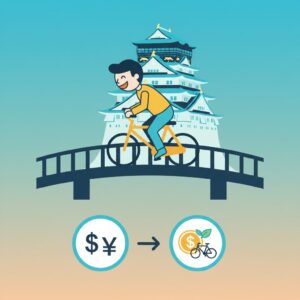
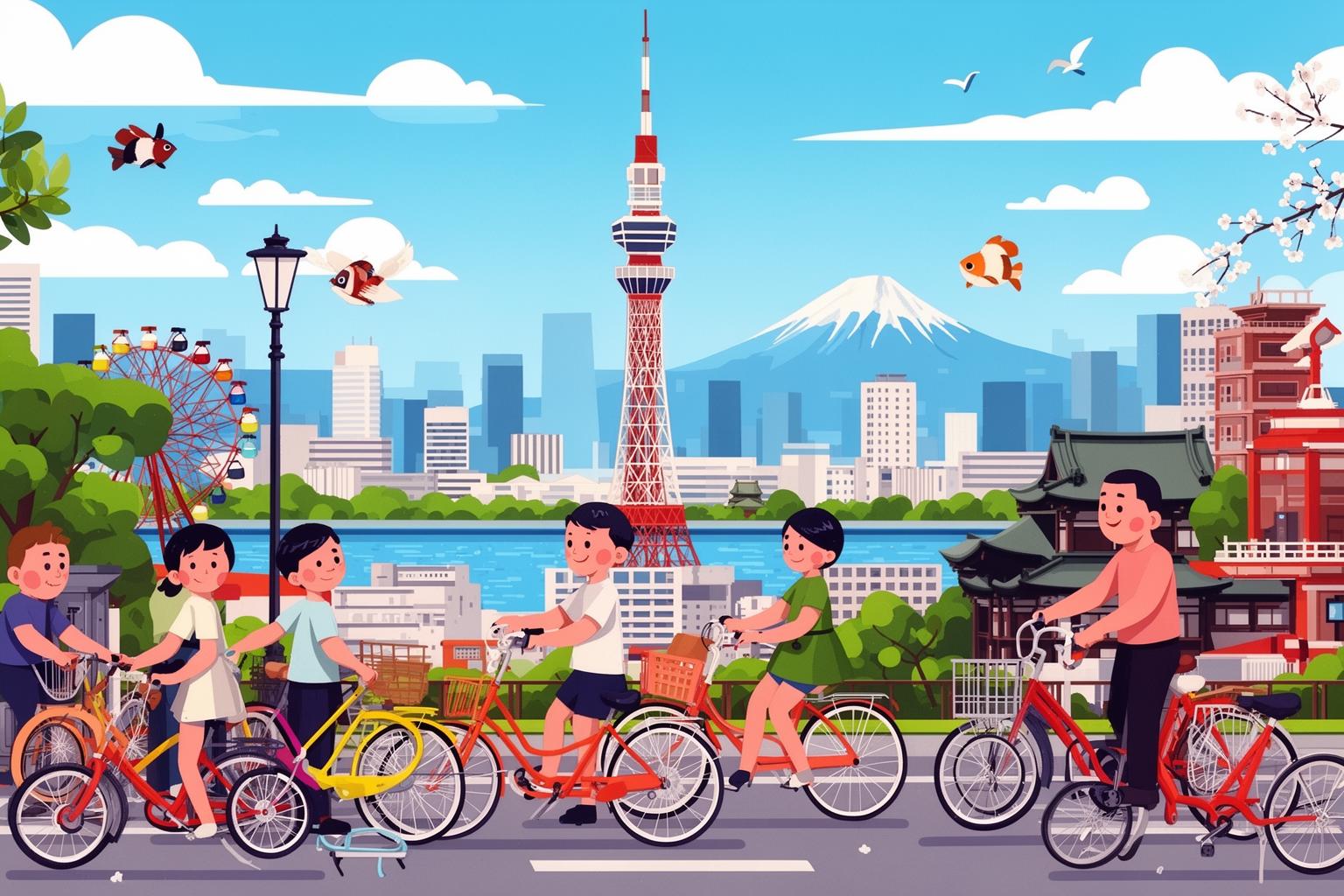
First, you need to understand the land itself. Osaka is wonderfully, thankfully, almost unnaturally flat. The city sits on an alluvial plain, a geographic blessing for cyclists. Unlike Tokyo, with its numerous hills and valleys (saka means slope, and Tokyo is full of them), getting around Osaka demands very little physical effort. This flatness changes everything. It turns the bicycle from a tool for athletes into one for everyone. Why cram into a crowded, costly subway for a two-stop trip from your apartment to the local ward office when you can leisurely pedal there in ten minutes, enjoy the breeze, and save a few hundred yen? This is the essence of the Osaka mindset in motion. It’s an ongoing, subconscious calculation of kospa, or cost performance. Time, money, and convenience are balanced, and the bicycle almost always comes out ahead. The city’s design supports this. Most neighborhoods are self-contained ecosystems. Your local train station, supermarket, clinic, favorite ramen shop, and post office are almost certainly within a ten-to-fifteen-minute bike ride. This fosters a strong sense of localism. Your world isn’t defined by subway lines, but by what your bicycle can comfortably reach. This practical, cost-aware approach is a hallmark of Osaka life, and the flat terrain is the foundation it rests upon.
The Mamachari: A Tank on Two Wheels
The undisputed champion of Osaka’s streets is the mamachari, literally “mom’s chariot.” This is not a sleek, lightweight road bike, nor a rugged mountain bike. The mamachari is a triumph of utilitarian design, a workhorse made for everyday urban demands. It’s the Honda Super Cub of bicycles. Typically, it features a low, step-through frame to make mounting and dismounting easy, even in a skirt. It comes with a sturdy rear rack, often equipped with a child seat, and a large front basket capable of holding a week’s groceries. It has a chain guard to protect your pants, fenders to shield against puddle spray, and a built-in lock on the rear wheel. The riding position is upright and comfortable, designed for visibility rather than speed. It is heavy and slow but nearly indestructible. Owning a mamachari isn’t about style; it’s a statement of practicality. No one is trying to impress anyone. The bike is a tool, an appliance, as essential as a refrigerator or washing machine. This unpretentiousness is deeply Osakan. In Tokyo, you might see more fashionable, minimalist single-speed bikes. Here, function unequivocally beats form. The mamachari, often in silver, black, or beige, symbolizes the city’s focus on what works, not on what looks stylish.
An Extension of the Home
In Osaka, a bicycle is more than just transportation; it becomes a movable extension of your home. It serves as a second pantry, a mobile closet, a personal cargo vehicle. The skill with which locals load their bikes is impressive—a practical art born of necessity. You’ll see people returning from the hardware store with long planks of wood bungeed to the frame. You’ll witness riders balancing towering stacks of toilet paper in their front baskets, trophies of a recent drugstore sale. This knack for “making it work,” pushing the limits of what a simple bike can carry, reflects a resourceful and adaptable spirit. The bicycle is woven into every chore and errand. It’s not a separate activity but part of the everyday fabric of getting things done. This contrasts with cities where cycling is a more intentional act. Here, hopping on your bike to visit the convenience store two blocks away is as natural as putting on shoes to step outside. This seamless integration is what makes the bike culture so widespread and shapes the very rhythm of neighborhood life.
The Unspoken Rules of the Road (and Sidewalk)
The Sidewalk is the Main Street
Here we reach the single most perplexing and intimidating aspect for many newcomers: in Osaka, people ride their bicycles on the sidewalk. Although technically illegal in many situations, it remains the dominant social norm by far. To grasp why, you need to experience Osaka’s roads firsthand. They are frequently narrow, congested, and lack dedicated bike lanes. For the average rider on a mamachari, the road feels like the domain of cars, trucks, and buses—a dangerous environment where you are slow, vulnerable, and in the way. In contrast, the sidewalk feels like a safer, though more chaotic, alternative. Thus, the sidewalk becomes a shared space, a bustling thoroughfare for both pedestrians and cyclists. This gives rise to what can only be called the “sidewalk dance.” It’s a slow-speed, high-stakes ballet of ongoing negotiation. Cyclists weave around strolling pedestrians, who instinctively shift aside to let them pass. The bicycle bell, the chirin-chirin, isn’t an angry alarm like a car horn but a polite auditory prompt, a gentle “excuse me, coming through.” This system rests on mutual, if occasionally reluctant, awareness. It reflects a core trait of Osaka’s character: a flexible, pragmatic attitude toward rules. Written laws mean one thing, but the unwritten social contract of the street truly governs behavior. It’s about reading the situation, not strictly following traffic signs. This system prioritizes flow and common sense above rigidly enforcing a rule that feels impractical in everyday life.
The “Osaka Stop”: A Rolling Suggestion
This flexible approach to rules extends to intersections. Watch cyclists at a stop sign or a pedestrian red light. Do they come to a full, complete stop, with one foot firmly planted on the ground? Rarely. Instead, you’ll observe the “Osaka Stop.” The rider slows, checks for traffic in all directions, and if the way is clear, rolls right through. From a Western or even Tokyo perspective, this may look shockingly reckless. Yet locally, it’s seen as a simple act of efficiency. The reasoning is, “I’ve confirmed there’s no danger, so why kill my momentum and waste energy starting from a dead stop?” It’s a split-second risk assessment. This is not motivated by a desire to break the law for fun but stems from the same pragmatism that compels people to bike in the first place. It’s about saving energy and time. Naturally, the system isn’t perfect. It depends on everyone staying alert, and accidents do occur. But it highlights a key cultural difference. In Tokyo, rules are absolute and must be obeyed for order’s sake. In Osaka, rules are often treated as strong guidelines, open to on-the-spot interpretation based on immediate circumstances. Foreigners often mistake this for rudeness, but for locals, it’s simply the most logical way to get from point A to point B.
The Hierarchy of the Sidewalk
Within this sidewalk ecosystem, there’s an unwritten but rigidly enforced hierarchy. At the very top is the oba-chan—the older, often middle-aged or elderly woman—riding an electric-assist bicycle. She is the apex predator. She has places to be and will not be slowed down. When you hear the high-pitched hum of her motor approaching from behind, you don’t question or hesitate. You make way. She’s earned this status through decades of navigating these streets, commanding a level of deference that’s both daunting and respectful. Below her are mothers with children, who are granted wide berth due to the precious and unpredictable nature of their cargo. Then come general commuters and students, expected to be alert and agile. At the bottom of the hierarchy are pedestrians absorbed in their smartphones. They’re the oblivious plankton of the sidewalk sea, drifting aimlessly and forcing cyclists into sudden evasive maneuvers. Surviving this environment demands developing a sixth sense for human movement. You learn to anticipate the sudden swerve of a distracted walker or the unpredictable dart of a small child. It’s a constant, low-level mental exercise—a form of non-verbal negotiation that soon becomes second nature.
The Dark Side of Two-Wheeled Freedom
The Parking Apocalypse
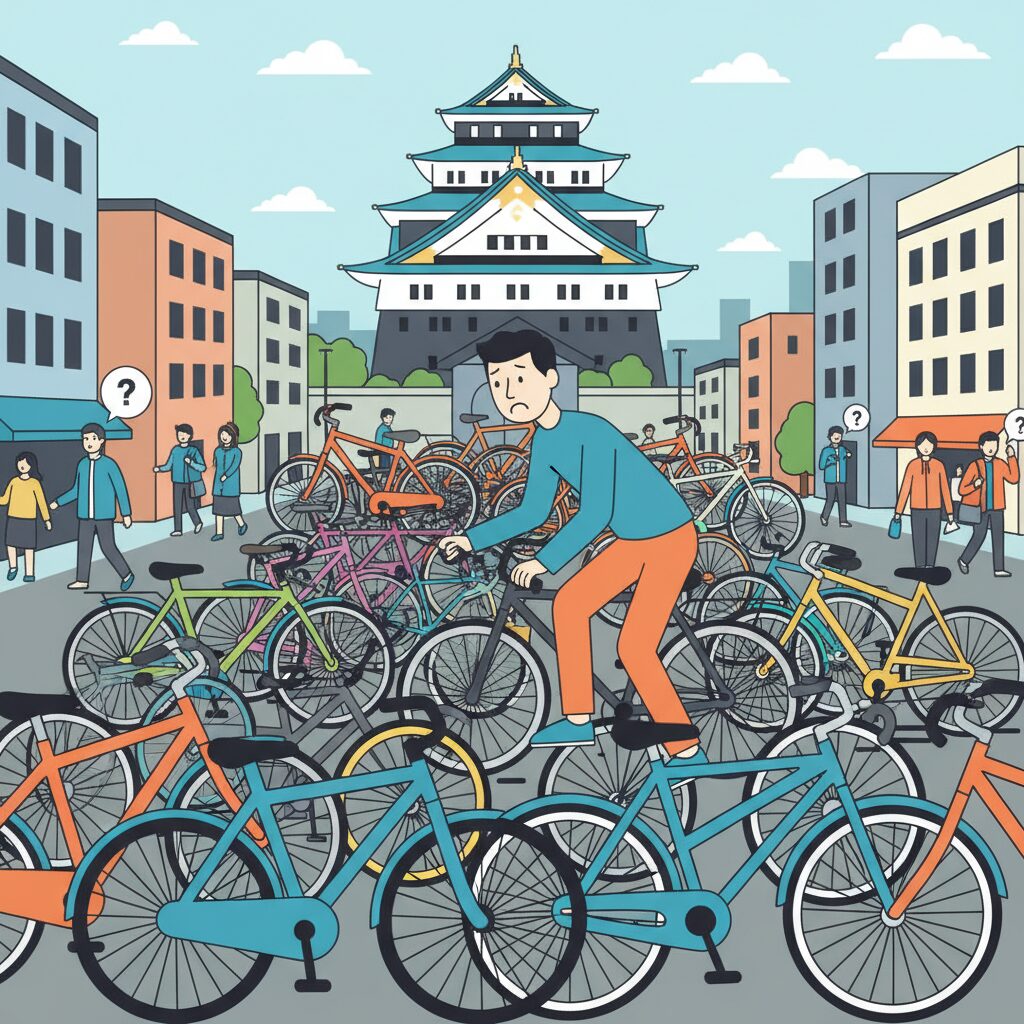
Despite its convenience, the bicycle faces one massive, soul-crushing challenge: parking. More precisely, the near-total absence of it where it’s needed most. Ride your bike to any major train station like Umeda, Tennoji, or Kyobashi, and you’ll encounter the bicycle apocalypse. Thousands of bikes are packed tightly, chained to railings, signposts, and each other, forming dense, metallic thickets that block sidewalks and storefronts. These are the mountains of illegally parked bicycles. Although there are designated, paid bicycle parking lots, they are often full, inconveniently located, or simply ignored in favor of parking right at the station entrance. This sparks a continual cat-and-mouse game. City teams sweep through these areas, tagging illegally parked bikes with warning notices. If the bike isn’t moved within a few hours, they return with a truck, cut the lock, and haul it away to an impound lot in a remote, hard-to-reach part of the city. Finding that dreaded slip of paper where your bike once stood is a rite of passage for every Osaka resident. Retrieving your bike requires a pilgrimage to the lot, paperwork, and a fine of several thousand yen. This daily struggle reveals a core contradiction in city policy: cycling is implicitly encouraged by the city’s design, yet the infrastructure to support it properly is severely lacking. It’s a classic Osaka scenario: a functional, chaotic system that has evolved organically, with authorities always one step behind.
The Rain, The Heat, and The Typhoon
Life as a cyclist is lived under the mercy of the elements. In Osaka, those elements can be harsh. Summer is a sweltering, suffocating ordeal. From June to September, a short ten-minute bike ride is enough to leave you soaked in sweat, your shirt sticking to your back. You learn to carry a small towel (tenugui) at all times and allow extra time to cool down before appointments. Then comes the rainy season, or tsuyu. This is when Osaka’s cycling skill peaks: riding while holding an umbrella. It’s a breathtakingly precarious feat of balance and coordination. To address this, a whole cottage industry of gadgets has emerged, most notably the kasasutando, a clamp that attaches to handlebars to hold your umbrella, transforming your bike into a mobile fabric shield. Yet even these clever inventions can’t withstand a typhoon. When wind and rain reach biblical levels, the entire system breaks down. Streets are empty of bikes, and everyone is forced back onto the public transit they normally avoid, packing trains and subways to inhuman levels. These moments starkly highlight the bicycle’s limits and nature’s overwhelming power.
Theft and Registration: The Bureaucratic Dance
When purchasing a bicycle in Japan, whether new or used, you are legally required to register it with the police. This is the jitensha bouhan touroku, or bicycle crime-prevention registration. You pay a small fee, and a sticker with a unique number is attached to your bike’s frame. This system aims to deter theft and assist in recovering stolen bikes. Police also conduct random checks, stopping cyclists to verify that the bike’s registration matches their ID—a surprising and somewhat intimidating experience for newcomers. Despite this, bike theft remains common. It’s rarely a professional operation, usually a crime of opportunity. An unlocked mamachari left outside a 7-Eleven for just two minutes is a prime target. Unlocked bikes are often seen as communal property. This breeds a healthy paranoia. You learn to always use the built-in wheel lock, even if you’re just popping into a store briefly. For longer stops, a second, sturdier chain lock is employed. It’s a simple lesson in urban survival. This attitude reflects a practical, slightly cynical worldview: trust in the community is strong, but personal responsibility for your property is absolute.
How Cycling Shapes the Osaka Mindset
A City Experienced at Human Speed
Living life on a bike fundamentally reshapes your connection with the city. When you travel by subway, the city becomes a series of disconnected points. You disappear underground at one station and reemerge at another, with no awareness of the space in between. On a bike, the city reveals itself as a seamless, continuous panorama. You move at a human pace—fast enough to be efficient, yet slow enough to take in the details. You discover a tiny, family-run coffee shop tucked away on a side street. You catch the sweet, savory aroma of takoyaki cooking at a local stall. You hear lively chatter spilling out from a neighborhood shotengai (shopping arcade). Cycling nurtures a strong sense of belonging and a detailed, intimate knowledge of your surroundings. Your mental map of the city is not a schematic of train lines, but a rich mosaic of streets, landmarks, and shortcuts. This is why Osaka, despite being a sprawling metropolis, often feels like a cluster of close-knit villages. The bicycle acts as the thread that connects you to your personal corner of the city.
Individualism and Assertiveness
Cycling carries an inherent sense of independence. You are the captain of your own vessel. You don’t need to follow a train timetable or wait for a bus. You choose your own route, set your own speed, and decide when to leave. This encourages self-reliance. More than that, navigating the daily ride demands a level of assertiveness that is often discouraged in more formal, group-focused cultures. On the sidewalk, passivity isn’t an option. You must claim your space, anticipate others’ movements, and make decisive actions. A hesitation could mean a collision or a near miss. This daily experience of micro-negotiation and spatial assertion may be one reason why Osaka residents are often stereotyped as more direct, outspoken, and even pushy compared to Tokyoites. The streets serve as a training ground for a distinct, confident individualism. You look out for yourself, and you expect others to do the same.
A Shared, Unspoken Language
Ultimately, the chaotic, frustrating, and liberating world of Osaka cycling functions thanks to a shared, unspoken language. What seems like a lawless free-for-all to outsiders is actually a complex system guided by countless invisible rules. It’s in a slight shoulder dip signaling a turn. It’s in the precise timing of a bell ring—not too early, not too late. It’s in the momentary eye contact between two cyclists at an intersection, a silent negotiation over who yields. This is the essence of Osaka. The city runs on a current of shared context and mutual understanding, where practical, real-world experience always trumps abstract, formal regulations. The official manual may state one thing, but everyone knows the true way it works. So, if you really want to grasp this city, don’t just ride the trains. Borrow a bike. Take a deep breath, push off the curb, and dive into the chaotic, rhythmic, and utterly authentic dance of the mamachari republic. It’s a wild ride, but the most genuine way to feel the true heart of Osaka.