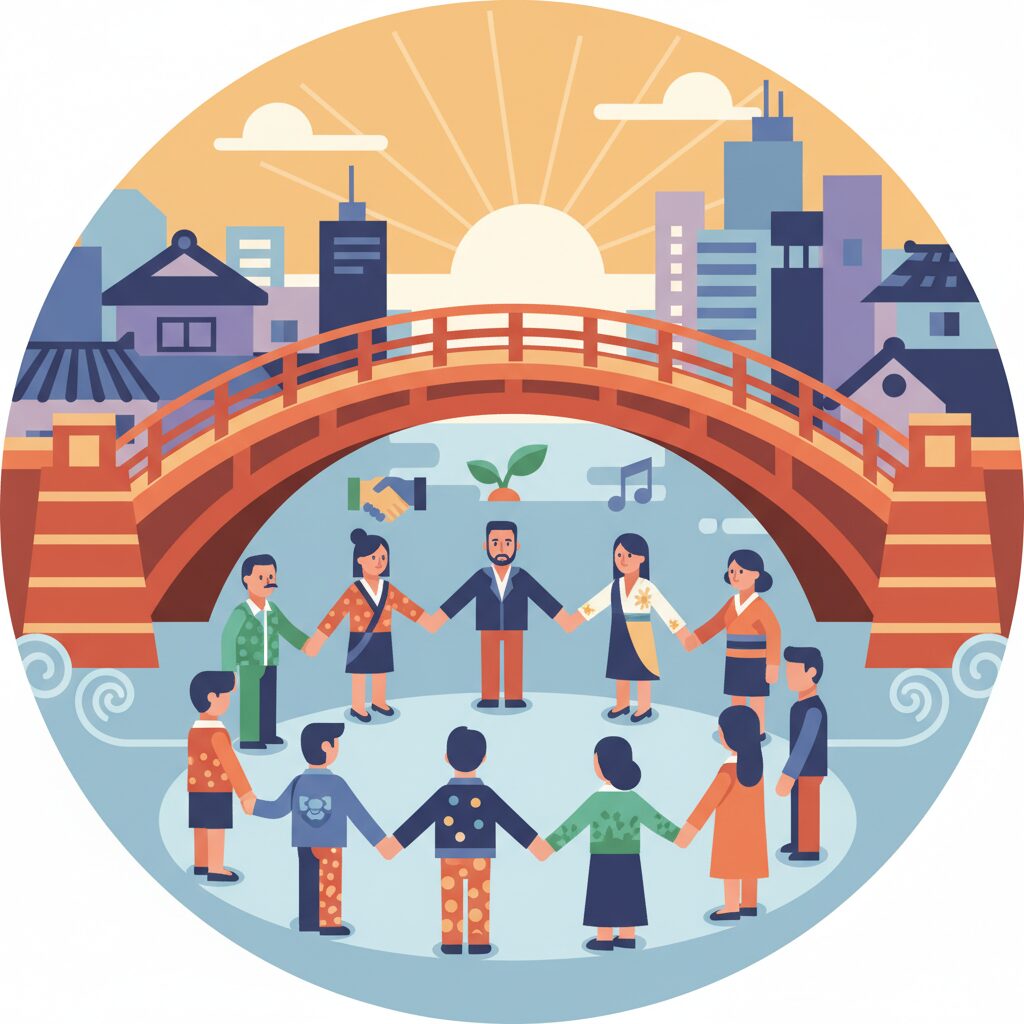
You’ve done it. You found the perfect apartment in a quiet corner of Osaka, maybe somewhere in leafy Abeno or artsy Nakazakicho. You’ve unpacked the boxes, figured out which train line gets you to Umeda the fastest, and you’re just starting to feel settled. Then, a knock at the door. It’s a neighbor, smiling, holding a clipboard and a welcome packet. They start explaining something about a ‘Chonaikai’ and a monthly fee. Your Japanese is getting there, but you’re only catching every other word: festival, cleaning duty, emergency contact list. You nod politely, take the papers, and close the door in a state of mild panic. What is this club? Do you have to join? Is this some kind of local tax? Welcome, my friend, to one of the most fundamental and confusing aspects of daily life in Japan: the neighborhood association. In Osaka, this isn’t just a formality; it’s a deep dive into the city’s very soul. The choice to join or not to join the Chonaikai is your first real test of navigating the complex, warm, and often meddlesome world of Osaka community life. It’s a decision that will shape how you experience your little slice of this chaotic, wonderful city. So let’s break down what it really means.
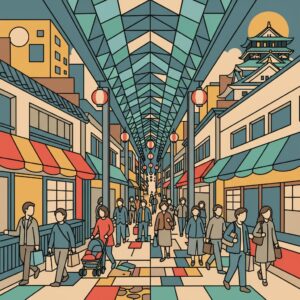
Understanding the impact of community traditions is even more insightful when you consider how local centers like Osaka shotengai help shape neighborhood identity.
What Exactly is a Chonaikai? The Unseen Engine of Osaka’s Neighborhoods
First and foremost, let’s demystify things. A Chonaikai, sometimes called a Jichikai, is a voluntary neighborhood association. Think of it as the ultra-local, unofficial governing body for your immediate few blocks. It’s the unseen mechanism that keeps daily life running smoothly. In a Western context, you might liken it to a Homeowners Association (HOA), but that analogy falls short of capturing its true essence. An HOA usually focuses on property values and regulations, while a Chonaikai centers on community bonds and civic responsibility. It’s less about enforcing rules and more about cultivating a shared sense of accountability for the space everyone lives in. These groups have deep historical roots, evolving from neighborhood units formed centuries ago for mutual protection and governance. Today, they embody the living legacy of that communal spirit.
More Than Just a Welcome Committee
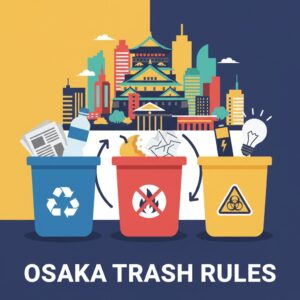
The Chonaikai’s responsibilities are surprisingly extensive and deeply practical. They manage local garbage collection points, ensuring the nets are set out and brought in, and offer gentle reminders about the complex rules for burnable, plastic, and recyclable waste. They maintain clusters of streetlights on your street that the city doesn’t cover. They organize the annual summer festival, or matsuri, in the local park, complete with takoyaki stands and kids fishing for superballs in plastic pools. They conduct disaster preparedness drills, making sure everyone knows the local evacuation point and who might need extra assistance during an earthquake or typhoon. They also circulate the ‘kairanban,’ a clipboard with local notices passed from house to house—a charmingly analog system in an ultra-digital age. In short, they take care of the countless small tasks that transform a group of houses into a true community.
The Osaka Flavor: Community with a Touch of Meddling
Here’s where the Osaka twist comes in. In many parts of Japan, especially Tokyo, the Chonaikai can be a rather formal, distant affair. But this is Osaka—a city built on close quarters and even closer relationships. Here, the Chonaikai carries a strong dose of what’s called ‘osekkai.’ There’s no perfect English equivalent, but it’s a kind of caring, meddlesome, borderline-nosy friendliness. Your Chonaikai neighbors in Osaka don’t just want your membership fee; they want to know you. They’ll notice when you’re working late and ask why you haven’t aired your futon on a sunny day. The local obachan, the grandmotherly figure who often leads the group, might gently scold you for putting out your trash fifteen minutes too early, but she’ll also be the first to knock on your door with some homemade curry if she hears you’re sick. This is the Osaka package deal: your privacy in exchange for their protection, your independence balanced by their involvement. It’s a city where the line between ‘your business’ and ‘our business’ is beautifully—and sometimes frustratingly—blurred.
The Case for Joining: Embracing the Osaka Experience
So, why would you, a foreigner adapting to a new culture, willingly sign up for this intricate network of obligations? Because joining the Chonaikai is like obtaining a backstage pass to the true Osaka. It means moving from being merely a resident to becoming a neighbor, with benefits that can be substantial both practically and socially. It’s your chance to experience firsthand how the city’s famed warmth is not just a cliché, but an active social system.
The Social Safety Net You Didn’t Realize You Needed
For a non-Japanese resident, the Chonaikai can be an invaluable resource. Suddenly, you have a direct connection to people who can answer all those confusing everyday questions. What day is for large garbage collection? Where’s the best local clinic? Why are people putting up those specific decorations for a holiday you’ve never heard of? Your neighbors hold the answers. But the most vital role is emergency support. When a typhoon approaches or after an earthquake, official city channels may become overwhelmed. The Chonaikai acts as your immediate support network. They maintain a master list of residents, check to ensure everyone’s safety, and know where emergency supplies are stored. In a disaster-prone country like Japan, this alone can make the membership fee feel like the best insurance policy you’ve ever bought. It’s a strong antidote to the loneliness that can easily settle in when you’re living far from home.
Unlocking the Real Osaka: Festivals, Food, and Faces
If you genuinely want to experience local culture beyond Dotonbori’s tourist paths, the Chonaikai is your gateway. Watching a festival from the sidelines is one thing; being part of the team that organizes it is something else entirely. When you join, you’re invited to pitch in. You might find yourself grilling yakisoba with the local liquor store owner, driving stakes for tents alongside the woman from the flower shop, or even helping carry the heavy mikoshi (portable shrine) through the streets. Real connections are built here—through shared work, inexpensive beer, and the collective joy of organizing a fantastic event for the neighborhood children. You’ll be invited to year-end mochi-pounding parties, seasonal cleanup days that turn into spontaneous picnics, and cherry blossom viewing parties exclusively for neighbors. This is the raw, authentic Osaka that most visitors never see. You stop being a spectator and become part of the neighborhood’s rhythm.
The Power of a Good Reputation
In Osaka, relationships are like currency. Being known as the foreigner who actively participates and contributes to the community carries deep significance. It builds social capital that pays off in unexpected ways. The owner of the corner fruit stand might start slipping an extra mikan into your bag. A neighbor might offer to accept a package for you when you’re away. Showing that you care about the community’s well-being means the community will invest in you in return. It signals that you’re not just a temporary visitor, but a part of the local fabric. This simple act of joining can transform you from an unknown face into ‘Kimura-san from number 203,’ a recognized and cherished member of the neighborhood.
The Case for Staying Out: Guarding Your Time and Privacy
Certainly, it’s not all smooth sailing and shared takoyaki. There’s a reason why many people, including Japanese residents, hesitate to join or quietly avoid the Chonaikai. The same system that warmly welcomes can also feel suffocating, demanding your time, money, and a degree of social interaction you might not be ready for. The responsibilities are real, and for some, they may outweigh the advantages.
The Unspoken Commitments: Fees, Meetings, and Rotations
Let’s be practical. Joining the Chonaikai involves a set of non-negotiable duties. First, there’s the fee, known as the ‘Chonaikai-hi.’ It’s usually modest, ranging from a few hundred to a couple of thousand yen per month, but it’s a recurring expense. Then there are the meetings, which can be occasional or monthly, but they do occur. These are often conducted entirely in Japanese, filled with local terminology, and can drag on with lengthy discussions about seemingly minor issues, such as the exact placement of a new recycling bin. For someone still mastering the language, these meetings can be more stressful than helpful. However, the biggest commitment comes from the rotating duties system, called ‘toban.’ This is where the real effort lies. The most common duty is the ‘gomi toban,’ or garbage duty. For one week, you are responsible for overseeing the local trash collection point. This might involve getting up early to unlock cages or unfold nets, making sure everything is sorted properly, and cleaning up after the garbage truck has passed. It’s a tough, unglamorous task. Other toban duties can include distributing the kairanban or assisting with neighborhood patrols.
Navigating the Social Landscape: Peer Pressure and Unwritten Expectations
The social dynamics within the Chonaikai can be hard to manage. The community runs on a web of unwritten rules and expectations. There is subtle but strong pressure to participate and conform. Saying “no” to a request from a senior community member can be very difficult in a culture that values group harmony. This pressure is even stronger in Osaka, where the straightforwardness of the people can come across as blunt insistence. If you refuse to help with festival preparations, you might not be openly rebuked, but you’ll sense a change in the atmosphere. For foreigners, this social maze is doubly challenging. You’re constantly trying to interpret social cues while facing a language barrier. It’s easy to feel like you’re always one step behind, agreeing to commitments you don’t fully grasp, or unintentionally offending by asserting a level of individuality that is normal in your home culture but perceived as selfish here.
Is It Truly Mandatory? The Complex Gray Area
Now we come to the big question: do you actually have to join? Legally, the answer is a definitive no. Chonaikai membership is completely voluntary. However, the social reality is much more complicated. In older neighborhoods with single-family homes or traditional ‘nagaya’ row houses, the pressure to join can be intense. Opting out might be viewed as highly antisocial, and while no one will compel you, you risk quiet exclusion. You could miss out on important information about water shut-offs or local construction. Your closest neighbors might become distant. In contrast, in modern high-rise apartments, or ‘mansions,’ the situation is often different. The community tends to be more transient and anonymous, making it easier to decline politely without social consequences. In many of these buildings, a neighborhood maintenance fee is already included in your monthly management charges, freeing you from direct Chonaikai obligations. Ultimately, your ability to opt out smoothly depends heavily on where you live and the particular culture of your neighborhood.
The Osaka vs. Tokyo Community Vibe
Understanding the Chonaikai in Osaka becomes clearer when compared to its counterpart in Tokyo. The contrast between the two cities’ approaches to neighborhood life perfectly illustrates their broader cultural differences. It’s a classic story of two cities: one that values privacy and one that embraces closeness.
Proximity vs. Privacy
Tokyo is a city of polite distances. Its vast size and the constant flow of people moving in and out for work foster a culture of anonymity. You could live in a Tokyo apartment for ten years without ever learning your next-door neighbor’s name, and this is often viewed positively. It represents mutual respect—avoiding disturbance is considered the highest form of politeness. Of course, Chonaikai exist, but they tend to feel more administrative and less personal. Participation rates are dropping, and in many central districts, their presence is barely noticeable. Osaka, conversely, functions like a village. Even in this expansive city, many neighborhoods, especially in the south and east, maintain a close-knit, small-town atmosphere. The Chonaikai serves as the organizational core of this village mindset. People expect to know you, greet you, and interact regularly. Both social and physical distances are simply much smaller.
The ‘Osekkai’ Factor
This distinction comes down to a key Osaka concept: osekkai. Tokyo’s social lubricant is ‘enryo’—a form of humble restraint and deference. You don’t want to impose. In Tokyo, a neighbor might notice you struggling with heavy bags but pretend not to see, as offering help could cause you to lose face. In Osaka, that same neighbor is more likely to come over, take a bag from you, and ask a dozen questions about what you’re cooking for dinner. Tokyo’s Chonaikai operates on the principles of enryo—it focuses on formal rules and maintaining order without intrusion. Osaka’s Chonaikai is driven by osekkai—it actively builds relationships, even if it means getting a little involved in your affairs. Neither approach is better; they simply represent two different philosophies of communal living.
Making Your Decision: A Practical Guide for Foreign Residents
Alright, theory aside, you have a decision to make: should you sign that form or not? There’s no single correct answer, but you can make an informed decision by weighing a few key factors related to your own situation and goals.
Assess Your Living Situation
The type of building you live in is the strongest indicator of social expectations. If you’re in a large, modern apartment complex, you probably have more flexibility. Review your contract—sometimes a building management fee already covers a Chonaikai-like contribution. In such cases, you can often enjoy the benefits (like a tidy garbage area) without the active responsibilities. On the other hand, if you’ve rented a standalone house or a unit in an older, low-rise building, you’re more deeply integrated into the community. Here, opting out carries a heavier social implication. In this context, it’s often wiser to join, at least initially, to establish goodwill.
Consider Your Personality and Goals
Be honest with yourself. Why are you in Osaka? If you’re here for a rich, immersive cultural experience and plan to stay long-term, joining the Chonaikai is one of the best ways to accomplish that. It will speed up your language skills, broaden your social network, and connect you to your neighborhood in a meaningful way. However, if you’re introverted, have a demanding job with long hours, or feel significant anxiety about your Japanese language abilities, the commitments might create more stress than enjoyment. If your main goal is simply to have a comfortable, private home base, opting out may be the healthier choice.
The Hybrid Approach: The ‘Friendly Outsider’
Keep in mind this isn’t an all-or-nothing decision. There’s a middle path. You can politely decline official membership yet still show your community spirit. This is the approach of the ‘friendly outsider.’ You might pay the membership fee to support financially but explain that your work schedule makes attending meetings or fulfilling toban duties difficult. This is often a perfectly acceptable compromise. Even if you don’t join at all, make an effort to be a visibly good neighbor. Always greet people with a cheerful and loud ‘Ohayo gozaimasu!’ (Good morning!) or ‘Otsukaresama desu!’ (Thanks for your hard work!) when you pass them on the street. Keep the area in front of your home spotless. When the local festival takes place, attend, purchase some food, and chat with volunteers. These small gestures demonstrate respect and goodwill, showing that you care about the community even if you’re not officially listed.
Final Thoughts: It’s Not Just a Fee, It’s a Philosophy
Ultimately, the Chonaikai question goes beyond simply filling out a membership form. It’s a decision about how you wish to engage with the city you call home. It represents a microcosm of Osaka’s fundamental social contract—a city driven by a powerful, chaotic, and deeply human engine of mutual support. Joining means plugging yourself directly into that engine, feeling its pulse, and becoming part of the force that sustains it. Choosing not to join means taking a more observational stance, appreciating the city’s warmth from a more comfortable distance.
There is no right or wrong answer. Some find profound fulfillment within the structured community of the Chonaikai, while others create their own connections, cultivating relationships naturally without formal commitments. This decision reveals something essential about what you seek from life in Osaka. Are you here to be part of the beautiful, messy, interconnected web, or to carve out your own quiet space within it? In either case, simply recognizing the choice you are making is the first step toward truly understanding the heart of this remarkable city.