Step off the Shinkansen at Shin-Osaka Station for the first time, and you’ll feel it. The air shifts. The language lilts with a different rhythm. The energy hums on a frequency that’s a little more direct, a little more raw than the polished precision of Tokyo. You follow the crowd toward the local JR lines or the Midosuji subway, a river of humanity flowing toward the city’s heart. You arrive at an escalator, step on with your left foot, and move to the left side to stand, just as you’ve done a hundred times in Tokyo or followed the signs in Narita Airport. And then it happens. A gentle but firm sumimasen. A salaryman in a slightly-less-than-pristine suit zips past you on your right. A grandmother, or obachan, gives you a look that’s not unkind, but is unmistakably a look of correction. You’ve just committed your first Osaka faux pas. You’re standing on the wrong side. Here, in the vibrant, chaotic, and fiercely independent heart of the Kansai region, everyone stands on the right.
This isn’t just a quirky local habit, a piece of trivia for a travel guide. The Osaka escalator rule—stand right, walk left—is a fundamental lesson in understanding the city’s soul. It’s a daily, silent referendum on Osaka’s identity, its history, and its perpetual, friendly rivalry with Tokyo. To a newcomer trying to build a life here, it’s the first and most important piece of the urban puzzle. Forgetting it doesn’t just slow down your commute; it marks you as an outsider, someone who hasn’t yet learned to read the city’s unspoken language. This article is your translation guide. We’re going to dive deep into the daily commute, starting with that all-important escalator stance, to decode the mindset of the Osakan and reveal what daily life in Japan’s magnificent “second city” is really like. It’s a story of merchants, rebels, and a deeply ingrained pragmatism that defines everything from how people move to how they interact.
Navigating the vibrant streets of Osaka, you’ll quickly discover how a robust Kansai economy intertwines local heritage with burgeoning prospects for tourism.
The Unspoken Rule: A Right-Handed Rebellion
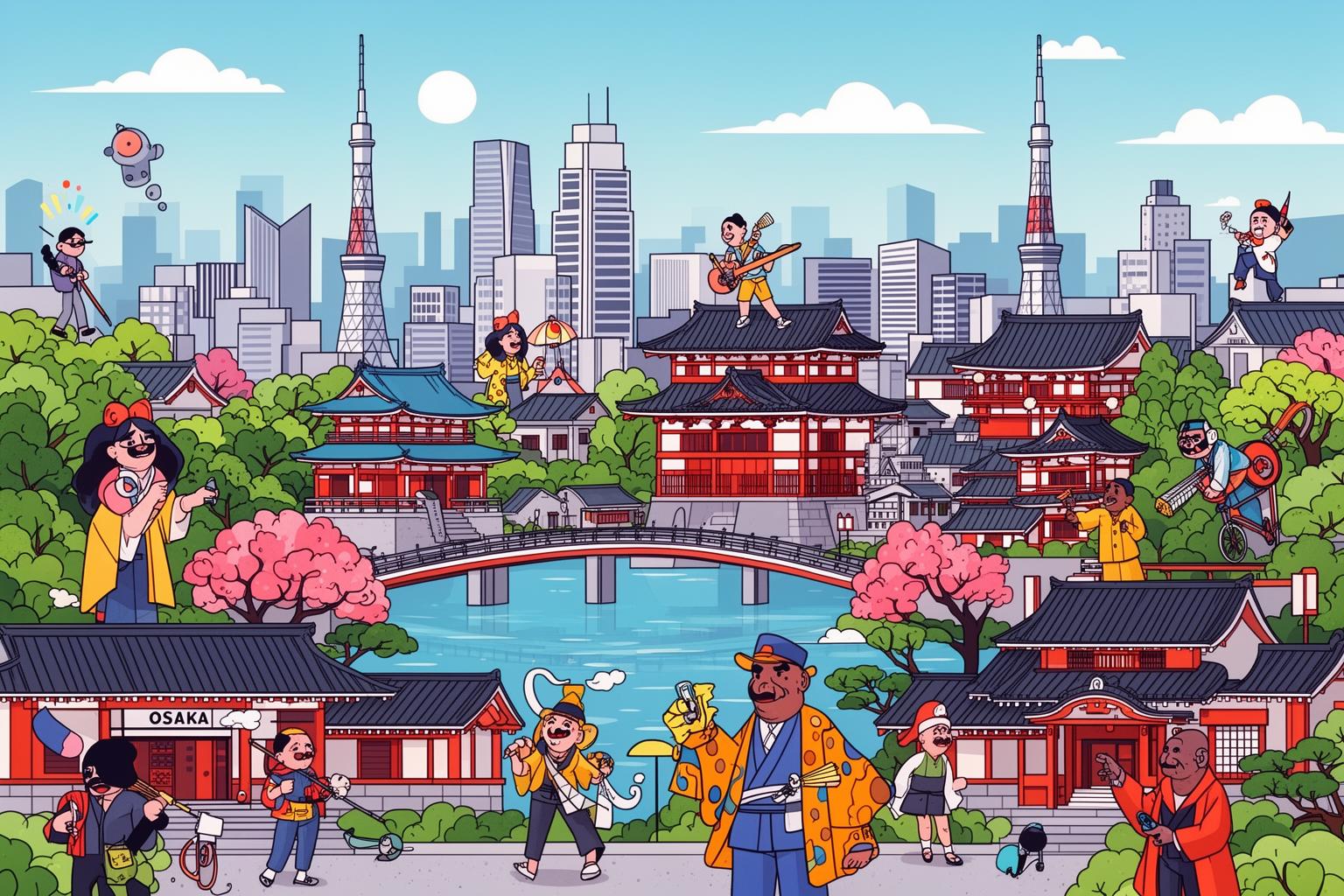
To truly understand Osaka, you must first grasp the choreography of its public spaces, and no stage illustrates this more clearly than the escalator. Whether navigating the vast underground labyrinths of Umeda, the neon-lit arteries of Namba, or the bustling business corridors of Yodoyabashi, one rule stands as firm as gravity: stand on the right, walk on the left. This straightforward practice serves as the city’s daily, silent assertion of its independence from Tokyo, where the exact opposite applies.
The Mechanics of the Flow
Take a look at the morning rush hour at Osaka-Umeda Station, a bewildering hub connecting multiple train lines that channels millions of people daily. As commuters stream from the Hankyu line toward the JR loop, they approach the escalators. No signs, announcements, or official instructions guide them—they simply know. A human column forms on the right, a still wall of people checking phones, adjusting bags, or gazing into space. On the left, a fast lane emerges for the hurried—the latecomers, the impatient, the energetic. The division is clear, instinctive, and impressively efficient. Anyone who stops on the left instantly causes a human traffic jam. The response isn’t overt anger but systemic disruption. You might catch a soft yet pointed “tch,” the common Japanese sound for mild irritation, or receive a tap on the shoulder accompanied by a quick “sumimasen, toorimasu” (“excuse me, coming through”), less a request than a statement of fact. The system polices itself. It is a beautiful, unwritten law governing vertical movement across a vast metropolis.
Historical Currents and Merchant Minds
But why the right? Why does Osaka so steadfastly defy the Tokyo-led, left-standing national standard? The answer remains uncertain, though prevailing theories are deeply entwined with the city’s identity. My research often leads me to these origins, where modern customs echo from a distant past. The most persuasive explanation hinges on the fundamental difference between Edo (old Tokyo) and Osaka. Edo was a samurai city, home to the military elite. Samurai traditionally wore two swords on their left hip. To avoid scabbards clashing with oncoming pedestrians—an act that could provoke a duel—they naturally kept to the left side of the road. This ensured their sword side stayed away from others, with the right hand, their drawing hand, free. This left-side walking culture became entrenched in the capital and, over centuries, shaped the national norm.
By contrast, Osaka was never a samurai city. It was a city of merchants, the nation’s economic powerhouse, famously called tenka no daidokoro, or “the nation’s kitchen.” For merchants, the most important tool wasn’t a sword but the abacus or money purse, often handled with the dominant right hand. To protect their valuables and conduct business smoothly, it is believed they favored walking on the right side of the road, keeping their money side close and guarded. This subtle difference in professional culture—samurai versus merchant—may have laid the groundwork for a regional divergence in escalator behavior that persists today in the city’s train stations.
A more recent theory points to the 1970 Osaka World Expo. Hankyu Railway, the influential and innovative private railway headquartered in Umeda, was a key transporter of expo visitors. To better accommodate the influx of international guests, many from countries where people stand and drive on the right, Hankyu reportedly launched a campaign: “Stand on the right, leave the left open.” The campaign was hugely successful, and the habit became ingrained locally. It was a practical solution from a famously pragmatic company in a practical city. Whichever origin story you prefer, both lead to the same conclusion: Osaka’s escalator etiquette arose from practical needs—whether protecting a merchant’s purse or managing an international crowd. It was never a top-down mandate; rather, it was a grassroots solution.
The Commuter’s Mindset: Efficiency with a Human Pulse
The escalator rule is merely the tip of the iceberg. It serves as an entry point into the broader Osakan commuter mindset, characterized by an unyielding commitment to practical efficiency, tempered by a distinctly human, sometimes blunt, touch. This contrast with Tokyo becomes even more pronounced. Living here, you quickly realize that the journey from home to work is not just a physical shift but a cultural immersion.
Gouriteki: The Religion of Pragmatism
The Japanese term gouriteki means rational or pragmatic, and it acts as the unofficial creed of Osaka. People here prioritize what works, what makes sense, and what accomplishes the task with the least fuss. The escalator rule is a prime example—it’s simply the most logical way to optimize the use of a moving staircase for the greatest number of people. Why would anyone do it differently? This mindset permeates the entire commuting experience. Consider train-boarding etiquette. In Tokyo, passengers form perfectly straight, single-file lines with almost reverential precision. In Osaka, the queues are a bit more… suggestive. People generally know where to stand, but the formation resembles a dense cluster. When the doors open, a fluid but determined surge follows. It’s not aggressive, but it’s certainly not passive. It reflects a collective, unspoken agreement to occupy every available inch of space to get everyone on board.
This pragmatism also reveals itself in a certain directness. If someone blocks the way or causes a delay, an Osakan is far more likely to speak up than a Tokyoite. You might hear a straightforward “chotto, jama ya de!” (“Hey, you’re in the way!”) delivered without malice. It’s not intended to be rude but corrective. The aim is to restore smooth flow to the system. This can be surprising to foreigners used to the indirectness typical of Japanese culture, but it’s an essential part of the local character. In Osaka, clarity takes precedence over politeness when the two clash. This is a vital lesson for anyone navigating daily life here: don’t confuse directness with hostility. It’s usually just practical course correction.
The Soundtrack of the City
The atmosphere inside train cars tells a different story. A ride on Tokyo’s Yamanote Line during rush hour can feel like being in a vacuum-sealed chamber of silent tension. Passengers are packed in, yet they maintain a bubble of personal space through sheer willpower, avoiding eye contact and remaining silent. It’s a masterpiece of collective, quiet endurance. Riding the Osaka Loop Line or the Midosuji subway line offers a different experience. Though still crowded and abiding by the cardinal rule of no phone conversations, the silence isn’t as absolute or heavy. You might hear a pair of high school students quietly giggling over a video on their phone. Conversations between friends or couples, spoken in low but audible tones, are common. The famous Kansai dialect, with its melodic intonation and expressive vocabulary, fills the air. Even automated station announcements sound different—more musical, less robotic. This subtle variation in ambient sound makes the entire experience feel less anonymous and more communal. People are sharing a space, not merely occupying it individually. It reflects a culture that is less formal and more at ease with the casual, organic sounds of human interaction.
A Tale of Two Cities: Where Right Meets Left
For anyone thinking about moving to Osaka, understanding its connection with Tokyo is crucial. These two cities represent the opposite ends of the Japanese archipelago and embody distinct approaches to life, work, and social interaction. The escalator serves as a daily, tangible expression of this deep-rooted cultural divide. It’s a boundary drawn not on maps, but ingrained in the muscle memory of millions of commuters.
The Blurred Boundary of a Habit
The transition from Tokyo’s left-side standing to Osaka’s right-side standing is not sharply defined. As you travel westward from Tokyo, the norm starts to blur. Kyoto, caught between Tokyo’s influence and its own strong pride as the former imperial capital, is infamously mixed. You’ll find both right-standers and left-standers, causing a moment of hesitation on every escalator—a rare sign of public uncertainty in Japan. Locals often say you can identify someone’s origin by the side they stand on. Typically, however, Kyoto and the rest of the Kansai region (including Kobe and Nara) default to the Osaka standard. The true switch is said to occur somewhere near Gifu or Nagoya, where the cultural pull of Japan’s two largest metropolitan areas finally evens out. This geographical subtlety is fascinating as it highlights how deeply regional identities run. This isn’t mandated by national law; it’s a cultural agreement, marked by a very real—yet invisible—border.
Misreading the Message: It’s a System, Not a Critique
One of the biggest challenges for foreigners living in Osaka is correctly understanding local social cues. A Tokyoite might perceive Osaka’s directness as rude; an Osakan might interpret Tokyo’s indirectness as cold or insincere. When a newcomer stands on the left side of an Osaka escalator, they often prepare for a moment of shame or embarrassment. But that’s a Tokyo-centered view. In Osaka, the correction—the sigh, the “sumimasen”—is rarely a personal judgment. It’s a response to a disruption in a highly efficient system. You are the wrench in the gears of a machine designed to run smoothly. The point of the correction is simply to remove the wrench and get the machine operating again.
This reflects a broader Osaka mindset often summarized by the phrase “chanto shite ya,” common in Kansai-ben, meaning “Do it properly!” or “Get it right!” It’s a call for competence and a plea for everyone to do their part to keep life functioning for the group. It’s not about strict rule-following for its own sake; it’s about a mutual understanding that following the most logical process benefits everyone. Standing on the right is part of chanto suru on an Osaka escalator. Grasping this distinction is essential. You’re not being shamed for ignorance; you’re being guided back into the collective, practical flow. It’s a subtle yet significant difference in social philosophy.
Mastering the Flow: A New Resident’s Commuting Primer
Theory is one thing, but everyday life is quite another. For anyone new to the city, navigating the morning commute can feel daunting. However, by learning a few key principles, you can quickly transform from a confused observer into a confident participant in Osaka’s daily rhythm.
Your First Week on the Midosuji Line
The Midosuji subway line serves as the main artery of Osaka, linking the city’s major centers from north to south. It will likely play a central role in your daily routine. Your first and most important lesson is straightforward: when you step onto any escalator, immediately move to the right. Make this an automatic reaction. Don’t overthink it or hesitate—just go right. This rule applies not only in train stations but also in department stores like Hankyu or Daimaru, underground shopping malls, and office buildings. The custom is widespread. If you’re ever uncertain, simply observe the feet of those ahead of you—they’ll guide you. Copying their movements will help you blend in effortlessly.
What about stairs? This can be a bit confusing. While the escalator follows the unique right-side rule, general foot traffic in Japan, including stair use, usually stays to the left. This corresponds with the side of the road cars drive on. So, on a busy staircase in Umeda Station, you’ll notice people naturally separating into left-side flows when ascending and descending. The key is to remember that the escalator is a special case—a micro-environment with its own distinct rule. Don’t let the right-side escalator custom make you question other pedestrian patterns.
Reading the Room Beyond the Escalator
Truly integrating into Osaka life means learning to sense the unspoken rules of public spaces. The escalator is just the starting point. When waiting for a train, position yourself within the painted lines on the platform and join the group waiting there. When the train arrives, be ready for passengers to exit before you board. If the train is crowded, don’t hesitate to softly say “sumimasen” as you make your way in. It’s a polite way to navigate packed Japanese spaces. Make yourself compact—bring your backpack to your front and hold your belongings close. Inside the train, if standing near the door, it’s customary to step off onto the platform at each stop to let those behind you exit, then reboard. This simple act signals an experienced commuter. While these behaviors aren’t exclusive to Osaka, they are carried out here with particular efficiency and no-nonsense practicality. The aim is always to keep pedestrian flow moving smoothly and logically.
The Right Side of Osaka
Living in Osaka means constantly navigating a city fiercely proud of its distinct identity. For centuries, it has defined itself in contrast to the political and cultural hub of Tokyo. This rivalry is not born from malice, but from pride. And nothing embodies this proud, practical, and independent spirit more than the simple act of standing on the right side of an escalator. It might seem like a trivial detail, a mere footnote in the city’s larger story. But it is far more than that—it is the story itself.
It serves as a daily, subconscious reminder of Osaka’s merchant heritage, its pragmatic character, and its refusal to blindly follow standards set elsewhere. This mundane part of the daily commute becomes a quiet form of cultural expression. For foreigners trying to make a home here, learning this rule is the first step toward genuine understanding. It’s when you stop seeing the city as just a collection of landmarks and begin to feel its rhythm. When you instinctively step to the right without hesitation, navigating past a line of stationary commuters on the left, you’ve crossed an invisible boundary. You’re no longer simply living in Osaka—you’re part of its flow. You’re truly on the right side of the city, in every sense.