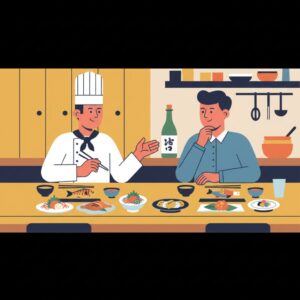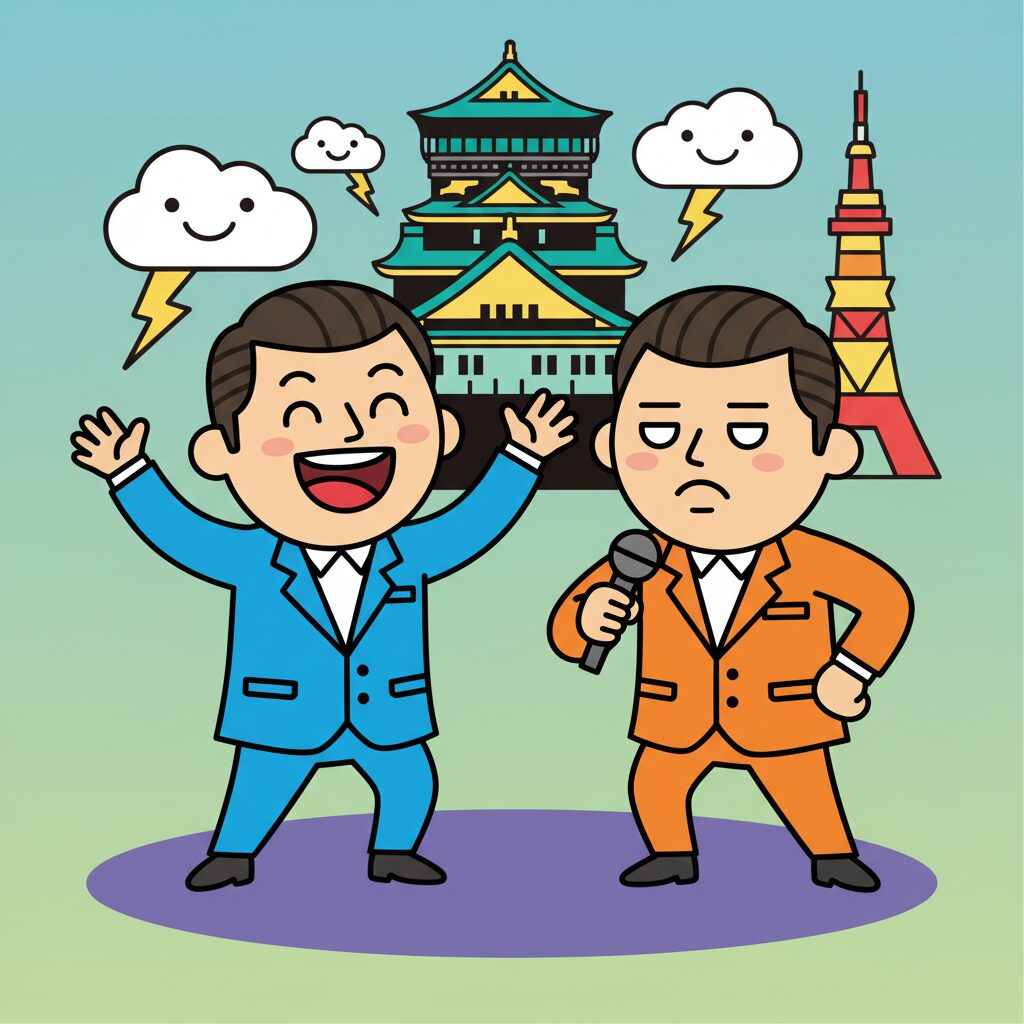
So there I was, my first few weeks in Osaka, sitting in a slightly sticky izakaya somewhere in Tenma. The air was thick with the smell of grilled skewers and the sound of clinking glasses. I was trying my best to follow a conversation between my new colleagues, a rapid-fire exchange that sounded less like a chat and more like a verbal tennis match. One guy, Tanaka-san, a senior salesman with a perpetually amused glint in his eye, was telling a story. He claimed he’d tried to pay for his train ticket with his office ID card that morning. Deadpan. Utterly serious. Before I could even process the absurdity, the woman next to him, Sato-san, smacked him lightly on the arm. “Nande ya nen!” she bellowed, a phrase I’d come to learn was Osaka’s unofficial motto, translating roughly to “Why the heck?!” or “You’ve gotta be kidding me!” Everyone at the table erupted in laughter. It wasn’t mean-spirited. It was… warm. Tanaka-san, the target of the outburst, grinned the widest. I was completely lost. In most places, saying something that nonsensical would be met with confused silence or polite correction. Here, it was an invitation. The smack and the shout weren’t an attack; they were the punchline. This was my introduction to the fundamental rhythm of Osaka, the invisible cultural software running in the background of every interaction: the world of Manzai. It’s not just a type of stand-up comedy you see on TV; it’s the city’s social blueprint, a dynamic of Boke and Tsukkomi that plays out in offices, on trains, and over bowls of ramen. To live in Osaka is to learn the steps to this dance. To understand this city, you have to understand that life here is an endless, collaborative comedy routine.
This dynamic is as integral to navigating the city as understanding the unique rhythm of Osaka’s bicycle culture.
The Anatomy of a Laugh: Deconstructing Boke and Tsukkomi
Before you can recognize it on the street, you need to understand the theory. Manzai is a comedy duo act, centered on two distinct yet symbiotic roles: the Boke and the Tsukkomi. Understanding this duality is the crucial first step to decoding Osaka’s social code. It’s the difference between hearing noise and hearing music.
The Boke: The Agent of Chaos
The Boke (ボケ) is the funny one, though not in the same way as a Western stand-up comedian. The Boke doesn’t deliver clever, structured jokes. The Boke is the joke. The term derives from bokeru, meaning to be senile, an airhead, or out of it. Their role is to say or do something completely absurd, incorrect, or nonsensical, but with unwavering conviction. They misunderstand a simple idea, misquote a famous saying, or propose a ridiculous solution to a problem. Picture my colleague Tanaka-san trying to use his office ID as a train pass—that’s a pure Boke moment. He wasn’t trying to be funny; he was living in a reality where that made perfect sense, and the humor came from confidently presenting that flawed reality. The Boke tears a hole in normalcy, sparking the comedic situation by introducing chaos that calls for order.
A great Boke keeps a straight face and masters the deadpan. Their strength lies in their commitment to the bit. If they signal that they know they’re being silly, the illusion breaks. They must truly appear to believe that cats can be trained to do accounting or that eating steaming hot oden is the best way to cool down in summer. This steadfast dedication to the absurd is what makes the reaction that follows so satisfying and necessary.
The Tsukkomi: The Voice of Reason
If the Boke represents chaos, the Tsukkomi (ツッコミ) embodies order. The Tsukkomi is the straight man, the reactor, the one who swiftly and sharply brings reality back to the conversation. The word comes from the verb tsukkomu, which means to thrust or poke in. That’s exactly their role: to metaphorically (or sometimes literally, with a fan) thrust a hand into the Boke’s fantasy and pull everyone back. When Sato-san smacked Tanaka-san’s arm and shouted, “Nande ya nen!”, she was delivering the perfect Tsukkomi. She wasn’t genuinely angry but playing her part—vocally and physically highlighting the absurdity the Boke just presented. The Tsukkomi’s response validates the audience’s (or the group’s) confusion and says, “Yes, that was as ridiculous as you thought, and I’m here to fix it.”
The Tsukkomi’s work depends on timing, sharpness, and wit. It’s not simply telling someone they’re wrong—it’s how it’s said. The Tsukkomi often uses concise, punchy phrases from the Osaka dialect, tailoring them perfectly to the role. Their verbal jab must be quicker and smarter than the Boke’s initial remark—a counterpunch. The Tsukkomi anchors the situation in reality, preventing the conversation from dissolving into nonsense. They voice the collective consciousness, expressing what everyone else is thinking. By doing so, they don’t just correct the Boke—they create the punchline. The Boke sets up the ball, and the Tsukkomi smashes it across the net.
The Unspoken Rhythm: Ma (間)
Supporting this entire exchange is a concept essential to all Japanese arts, from theater to flower arranging: ma (間). Ma means a pause, an interval, or a space, but it’s far more than silence. It’s the pregnant pause, the beat of anticipation between the Boke’s absurd statement and the Tsukkomi’s explosive reply. Tanaka-san delivers his line about the ID card. For a brief moment, the statement lingers in the air. In that split second of ma, everyone processes the absurdity. The tension builds. Then, BAM! Sato-san’s Tsukkomi breaks the tension, releasing it as laughter. Without that ma, the exchange would be just two people talking over each other. With it, it becomes a performance. Learning to feel this rhythm is vital. It’s the heartbeat of Osaka conversation. Their interplay isn’t a battle; it’s a duet. Neither can exist without the other. They are two halves of a whole, creating a comedic harmony deeply embedded in the city’s DNA.
The Manzai Safari: Spotting Comedic Duos in Their Natural Habitat
Once you understand the basic structure of Boke and Tsukkomi, you start noticing it everywhere. It’s like learning a new word and then hearing it repeatedly throughout the day. The entire city of Osaka transforms into a stage, and its residents become the unwitting (and enthusiastic) performers. Their interactions flow so naturally that they can easily go unnoticed if you’re not attuned to the rhythm.
Scene One: The Izakaya After Work
The local izakaya serves as the prime theater for everyday Manzai. With lowered inhibitions thanks to alcohol, the shared aim is to unwind and connect. Here, the Boke-Tsukkomi relationship is loud, quick, and affectionate. Imagine a group of coworkers clustered around a small table, with plates of karaage and edamame scattered between them.
The Setup (Boke): A younger employee, perhaps a bit of a class clown, studies the menu with intense focus. He slowly lowers it and solemnly announces to the table, “I’ve decided. I’m ordering one of everything. For myself.” He delivers this with a perfectly straight face, as if he’s just solved a major problem.
The Pause (Ma): A moment of silence falls. The colleagues glance at him, then at the vast menu, then back again. You can almost see the wheels turning in their heads. Is he serious? Of course not. But the game is on.
The Punchline (Tsukkomi): His manager, a seasoned veteran in these exchanges, leans forward, points his chopsticks at the young man, and says sharply, but with playful annoyance, “Omae no kyuryo de tariru ka, aho!” (“Can your salary even cover that, idiot!”). The word “aho,” which can be harsh elsewhere in Japan, here carries a tone of affectionate exasperation—it’s a verbal head-pat. The table bursts into laughter. The manager then adds, “Just get the big bottle of beer for the table like a normal person.” Crisis averted, social order restored, everyone shares a laugh. The young employee successfully played the lovable Boke, and the manager reinforced his role as the witty Tsukkomi, strengthening their bond.
Scene Two: The Office Meeting Room
Manzai at work is more subtle but just as present. It plays a vital role in easing tension, sparking creativity, and building rapport in a typically stressful setting. The format remains the same, just quieter.
The Setup (Boke): During a brainstorming session for a marketing campaign, energy is flagging. A designer, known for her quiet yet quirky ideas, presents her mockup. She clicks to the last slide featuring the company’s product being used by a capybara. Without any hint of irony, she says, “Our primary target is the affluent, spa-going capybara demographic.”
The Pause (Ma): The project lead stares at the screen, adjusts his glasses, and looks at the designer who maintains perfect composure. He’s not irritated; he’s processing her clever conversational move.
The Punchline (Tsukkomi): Instead of dismissing the idea, he sighs and replies, “Suzuki-san, as much as I appreciate your dedication to untapped markets, I’m not sure our logistics team is ready to deliver to hot springs—plus, they don’t have thumbs.” Turning to the team, he adds, “But the feeling of relaxation she’s aiming for… let’s build on that. How can we convey the ‘happy capybara’ vibe to our human customers?” The designer’s playful Boke moment broke the creative block, and the project lead’s Tsukkomi gently brought her joke back to reality while inspiring fresh ideas. This is Manzai as a business tool—a way to say “that idea is crazy” without discouraging the thinker.
Scene Three: The Neighborhood Shotengai (Shopping Arcade)
No place embodies the Manzai spirit more than the interactions between shopkeepers and customers, especially with the legendary “Osaka Oba-chan” (the quintessential middle-aged Osaka woman). These women are undisputed masters of the Tsukkomi.
The Setup (Boke): A customer at a vegetable stand holds up two cabbages that look identical. He turns to the shopkeeper—an Oba-chan with arms crossed and a knowing gaze—and asks an absurdly detailed question: “Which of these cabbages has a more cheerful disposition? I’m making a salad for a party, and I want it to be optimistic.”
The Pause (Ma): The Oba-chan doesn’t flinch. She studies the cabbages, then the man. You can almost hear her mind weighing a hundred witty comebacks.
The Punchline (Tsukkomi): She snatches one cabbage, bags it, and says, “Kocchi ya! Mitemi, waroteru yaろ!” (“This one! Look, it’s smiling!”). Then she winks and adds, “Anata yori yoppo otokomae ya de.” (“It’s way more handsome than you, too.”). The customer laughs, pays for his “smiling” cabbage, and leaves with a story to tell. This isn’t just customer service—it’s the service. The transaction wasn’t merely about the cabbage; it was a brief comedic exchange that created a human connection. This is why people in Osaka show fierce loyalty to their local shops: you’re not just a customer, you’re a potential comedy partner.
The Soul of a Merchant City: Why Osaka Laughs
This conversational style is no accident. It directly mirrors Osaka’s history, economy, and its fundamental contrast to the dignified, reserved culture of Tokyo. To understand why an Osakan will joke with a stranger while a Tokyoite might avoid eye contact, you need to look back at what shaped these cities.
A Foundation Built on Commerce, Not Bureaucracy
Tokyo, formerly Edo, was the shogun’s seat. It was a city of samurai, bureaucrats, and aristocrats. Society was rigid, hierarchical, and governed by strict rules of etiquette. Formality was essential for survival. Communication was precise, indirect, and designed to avoid causing offense at all costs. The goal was to maintain wa (和), or group harmony, by smoothing over any rough individual edges.
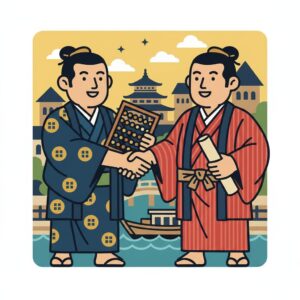
Osaka, by contrast, was Japan’s commercial center, the tenka no daidokoro (the nation’s kitchen). It was a city of merchants, artisans, and traders. For an akindo (merchant), success relied not on following strict rules but on being quick-witted, adaptable, and personable. Relationships had to be built—and fast. You needed to haggle, persuade, and read people instantly. A stiff, formal manner wouldn’t sell rice or textiles. A sharp, funny, and direct personality did. Humor became a business tool. It was a social lubricant that could break the ice, a negotiation tactic to defuse tension, and a way to build the trust necessary for deals. The Boke-Tsukkomi style, with its rapid-fire setup and punchline, was the perfect conversational model for a city that valued speed, efficiency, and a human touch. This merchant spirit prized honne—a person’s true feelings and intentions—over the polite facades of tatemae common in the capital. Layering honne with humor made it both palatable and effective.
Yoshimoto Kogyo: The Comedy Industrial Powerhouse
While the merchant spirit laid the foundation, one company solidified Osaka’s status as Japan’s comedy capital: Yoshimoto Kogyo. Founded in Osaka in 1912, Yoshimoto transformed the raw, folksy tradition of Manzai into a nationwide entertainment empire. They built theaters, most notably the legendary Namba Grand Kagetsu (NGK), known as the Carnegie Hall of Japanese comedy. They recruited and trained generations of comedians, broadcasting their acts on radio and television until the entire country linked the Osaka dialect with laughter.
This created a profound feedback loop in the city itself. Comedy wasn’t just an activity; it became a key export and a core part of civic identity. Children grew up watching Yoshimoto comedians on TV each weekend, idolizing famous Manzai duos like Downtown or All Hanshin-Kyojin. The rhythms and phrases they heard became the rhythms and phrases they used on the playground. Aspiring to be a comedian became a legitimate career choice, as common as aspiring to be a baseball player. The presence of this massive entertainment industry blurs the line between professional comedy and everyday conversation. The professionals are just a more polished, higher-stakes version of the banter you’ll hear on any street corner.
The Language of Laughter: Why Osaka-ben is Made for Comedy
The Osaka dialect, or Osaka-ben, perfectly suits Manzai. Compared to the standard Japanese spoken in Tokyo (Hyojungo), it feels more musical, more direct, and infinitely punchier. It’s packed with colorful expressions and grammatical structures perfectly suited to the Tsukkomi role.
Take the classic Tsukkomi phrase, “Nande ya nen!” (なんでやねん!). The Tokyo equivalent would be something like “Doushite desu ka?” (どうしてですか?). The latter is polite and neutral. The former is emotional and rhythmic. The “-nen” ending adds emphasis and a cadence begging to be delivered with force. Likewise, the word for “no” or “wrong” in Tokyo is “chigaimasu.” In Osaka, it’s the playful, repetitive “chau chau!” (ちゃうちゃう!). It’s simply more fun and lively to say.
This directness is a dialect hallmark. Where a Tokyoite might say, “Sore wa sukoshi muzukashii kamo shiremasen ne” (“That might be a little difficult, you know”), an Osakan is more likely to say, “Sonna mon, akan ni kimatteru yan!” (“There’s no way that’ll work!”). The first is a gentle, indirect refusal; the second is a swift, clear, humorous shutdown. This linguistic difference goes beyond regional accents; it reflects two fundamentally different communication philosophies. One aims to avoid conflict, while the other values clarity and engagement, cushioning honesty with humor.
Navigating the Great Divide: Osaka vs. Tokyo Mindset
For any foreigner living in Japan, the cultural divide between Osaka and Tokyo is one of the most intriguing—and sometimes perplexing—aspects to navigate. At the core of this difference lies the Boke-Tsukkomi dynamic, which influences public interactions, relationship building, and conversational values.
The Art of Reading the Air vs. Creating the Air
In Tokyo, the most essential social skill is kuuki wo yomu (空気を読む), or “reading the air.” This means sensing the situation, grasping unspoken social cues and hierarchies, and behaving in a way that maintains group harmony. Conversations often rely on subtlety, where what’s left unsaid holds more weight than what is expressed. Direct confrontation is avoided, and opinions are cushioned with politeness and ambiguity. Individuals are expected to blend smoothly into the group.
In Osaka, while people certainly know how to read the air, there’s a stronger focus on making the air. The aim isn’t just to sustain calm harmony but to foster a lively, entertaining atmosphere. This is where the Manzai style plays a role. The Boke “makes the air” by adding an unexpected, humorous twist, while the Tsukkomi responds by turning that into shared laughter. Conversations aren’t placid lakes but bubbling hot springs. For those used to Tokyo’s style, this can feel startling. A direct question or teasing joke that builds rapport in Osaka might be seen as somewhat rude or aggressive in Tokyo. Recognizing this difference is vital for anyone working or socializing in both cities.
A Practical Example: The After-Work Invitation
Imagine inviting a colleague out for a drink after work—the approach and expected reaction would vary greatly between the two cities.
Tokyo Scenario: You would approach your colleague cautiously. “Suzuki-san, I know you are probably busy, but if you happen to have some free time this evening, I was wondering if you might be interested in going for a drink? No pressure, of course.” The language is full of qualifiers and escape routes for both parties. Even if they want to accept, they might reply, “Ah, let me check my schedule. That sounds nice.” The exchange is polite, formal, and low-risk.
Osaka Scenario: You’d be much more straightforward. “Sato-san, nomu ni iko! Hima yaro?” (“Sato-san, let’s go drinking! You’re free, right?”). It’s an assumption, an invitation, and a gentle challenge all at once. The response might include a Tsukkomi. If they’re busy, rather than just saying “I’m busy,” they might say, “Akan! Watashi anata to chigatte, shigoto dekiru hito ya kara!” (“No way! Unlike you, I’m someone who can actually get work done!”). Though this sounds harsh literally, in context it’s a friendly refusal that keeps the playful tone alive. It implies, “I can’t tonight, but I enjoy our banter.” If they agree, they might say, “Shoganai naa, ittaru wa!” (“Can’t be helped, I’ll go!”), as if doing you a big favor. The whole exchange is a mini-performance, quite different from Tokyo’s careful choreography.
Common Misunderstandings for Foreigners
This cultural gap is a potential minefield of misunderstandings for non-Japanese residents. Since we are often taught Tokyo Japanese as the norm, arriving in Osaka can feel like entering a rock concert dressed in formal wear.
“Are they making fun of me?” A shopkeeper’s teasing remark about your flashy shirt or a colleague’s joke on your chopstick skills is rarely meant to offend. It’s an invitation—they are treating you not as a delicate foreign visitor (gaijin-san), but as an insider who can take friendly ribbing. Responding with laughter or self-deprecation is the best way to embrace it. Getting offended or flustered risks ending the interaction.
“Are those people fighting?” You might see two friends on the street shouting, gesturing wildly, or even playfully shoving each other. Nine times out of ten, it’s not a fight but a high-energy Boke-Tsukkomi exchange. The loudness and physicality are part of the act. Listen for the laughter that inevitably follows the “Nande ya nen!” punchline.
“Why is everyone so direct?” After becoming accustomed to the indirectness of standard Japanese, Osaka’s bluntness can be shocking. People will ask more personal questions, share opinions more freely, and offer unsolicited advice. This isn’t rudeness but the merchant city’s focus on efficiency and honesty. They aim to connect with you directly, without layers of formality. The humor softens what might otherwise feel blunt.
Joining the Conversation: A Foreigner’s Guide to Playing Along
So, you grasp the theory and can recognize it in everyday situations. The final step is learning how to engage. This is the advanced stage and requires carefulness. You don’t want to come across as the unfunny outsider trying too hard. However, with a bit of observation and a few essential phrases, you can definitely join in the fun. The aim isn’t to become a Manzai expert but to show that you understand and appreciate the local style of communication.
The Golden Rule: Begin by Listening
Before attempting to make a joke, spend months simply listening. Absorb the rhythm. Notice who takes on the Boke and who plays the Tsukkomi in your social groups. Pay attention to the timing—that crucial ma before the punchline. Observe the common phrases people use. Trying to force a joke without understanding the flow is the quickest way to create an awkward silence. Observation is your greatest asset.
Your Starting Point: The Reactive Tsukkomi
For non-native speakers, performing as the Boke is extremely challenging. It demands a nuanced mastery of cultural context to say something perfectly and believably absurd. It’s much easier and safer to begin by mastering the simple, reactive Tsukkomi. Your Japanese friends and colleagues will frequently serve up Boke moments. Your role is to recognize them and return the volley with a classic phrase. You don’t need to be clever; you just need to be timely.
“Nande ya nen!” (なんでやねん!): The Swiss Army knife of Tsukkomi. When a friend says they’re going to climb Mount Fuji in flip-flops, this is your line. Deliver it with some energy and a shake of the head. It’s almost always the right response to an absurd statement.
“Honma ka?” (ほんまか?): “Really?” or “Seriously?” Use this when someone tells a clearly exaggerated comedic story. Your colleague claims they fought off a wild boar on their way to work? Respond with a skeptical “Honma ka?” It shows you’re in on the joke.
“Akan!” (あかん!): “No way!” or “That’s no good!” This is a straightforward, playful shutdown of a silly suggestion. When someone suggests putting pineapple on okonomiyaki, “Akan!” is the only correct reply. It’s firm yet light-hearted.
“Chau chau!” (ちゃうちゃう!): “No, no, that’s wrong!” Ideal for correcting a funny factual mistake. If someone points at a poodle and calls it a lion, “Chau chau! Are wa inu ya!” (“No, no! That’s a dog!”) is the move.
Using one of these phrases at the right moment will earn you a surprised, appreciative laugh. It signals you’re not just a passive observer of the culture, but an active participant. It’s a big step toward being seen as a local.
The Safe Boke: Self-Deprecation
If you want to try Boke territory, the safest and most effective approach is through self-deprecation. Making fun of your own mistakes, especially your struggles with the language or culture, is a universally understood kind of humor. It’s endearing and relatable. You’re offering a Boke moment on a silver platter, inviting a friendly Tsukkomi.
For example, you might say, “I confidently ordered what I thought was chicken for lunch, but it turns out I just told the waiter my uncle is a handsome bird.” This sets up the perfect moment. It invites your Japanese friend to respond with a laugh and a Tsukkomi like, “Aho ya naa! Taberarehenやん!” (“You idiot! You can’t eat that!”). By making yourself the gentle butt of the joke, you create shared laughter and camaraderie without risking offending others.
Ultimately, the Boke and Tsukkomi dynamic is more than just a comedic formula. It’s the social engine of Osaka. It’s a way of showing affection, building trust, smoothing daily frictions, and finding joy in the ordinary. It turns a simple transaction at the vegetable stand into a performance, and a dull office meeting into an opportunity for connection. To outsiders, it might seem loud, chaotic, and sometimes abrasive. But once you understand the rhythm and unspoken rules, you realize it’s a deeply human and highly effective way of communicating. It’s a language of laughter, founded on mutual participation. Learning to recognize this interplay, and perhaps gently join in, is the real key to unlocking the heart of this vibrant, witty, and wonderfully welcoming city. It’s how you stop being just someone living in Osaka, and start truly belonging there.