Ever been in a meeting in Osaka that felt… different? Maybe you’re from Tokyo, maybe you’re from Toronto, but you’re sitting in a conference room in Namba or Yodoyabashi, and the whole rhythm is off. The conversation zigs where you expect it to zag. A serious discussion about budget deficits suddenly detours into a passionate debate about the best takoyaki stand in Tennoji. A senior manager cracks a self-deprecating joke that would be unthinkable in a Marunouchi high-rise. You present a meticulously prepared, data-driven proposal, and the first question you get is, “So, where did you go for lunch? Was it good?” It can feel like you’ve stumbled into a business negotiation that’s been hijacked by a comedy routine. This isn’t chaos. This is commerce, Osaka-style. You’re witnessing the living, breathing legacy of the Akindo spirit—the merchant soul that has powered this city for centuries and continues to define its unique approach to work, negotiation, and relationships.
For anyone trying to build a life or a career here, understanding this mindset isn’t just a fun cultural footnote; it’s the master key to unlocking how this city truly operates. It’s the invisible software running beneath the surface of every deal, every email, every after-work drink. Tokyo might run on procedure and propriety, but Osaka runs on personality, pragmatism, and a relentless focus on mutual benefit. It’s a culture forged not in the halls of government or the courts of samurai, but in the clamor of the marketplace. For centuries, this was the commercial engine of Japan, the `tenka no daidokoro`, or the “nation’s kitchen,” where rice was traded, fortunes were made, and a unique philosophy of business took root. That philosophy, the Akindo spirit, is about more than just making money. It’s about seeing business as a fundamentally human interaction—a dynamic, ongoing relationship between people, not just a transaction between companies. It prizes cleverness over credentials, results over rhetoric, and a strong personal connection over a perfectly formatted contract. This guide is your deep dive into that world. We’ll peel back the layers of jokes and direct questions to reveal the sophisticated logic underneath. Welcome to the real rhythm of Osaka’s working world. Let’s get down to business.
To truly master this unique business rhythm, it’s essential to understand the local customs, such as the role of Osaka’s ‘Ame-chan’ culture in building trust.
The Roots of the Deal: Where the Akindo Spirit Was Forged
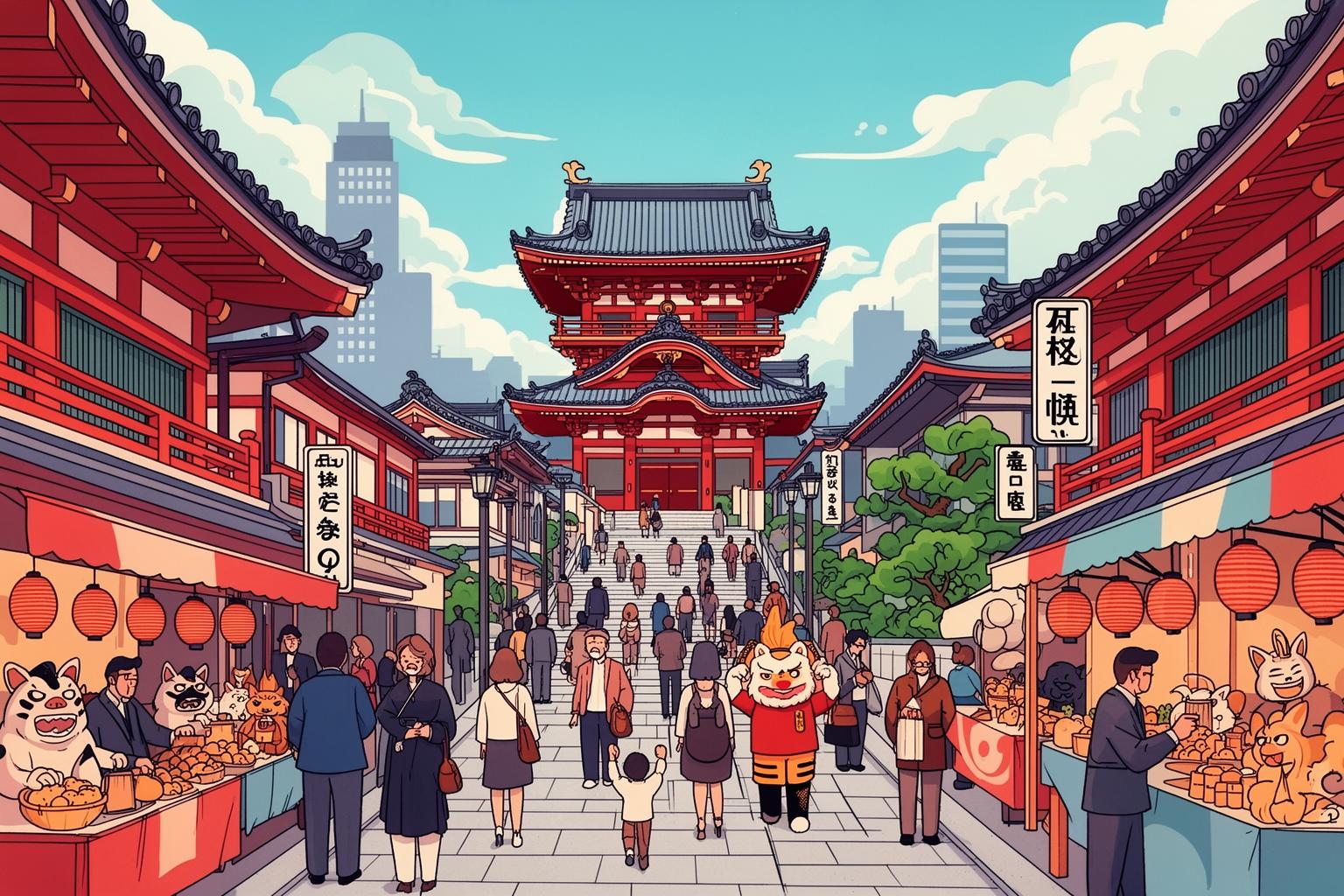
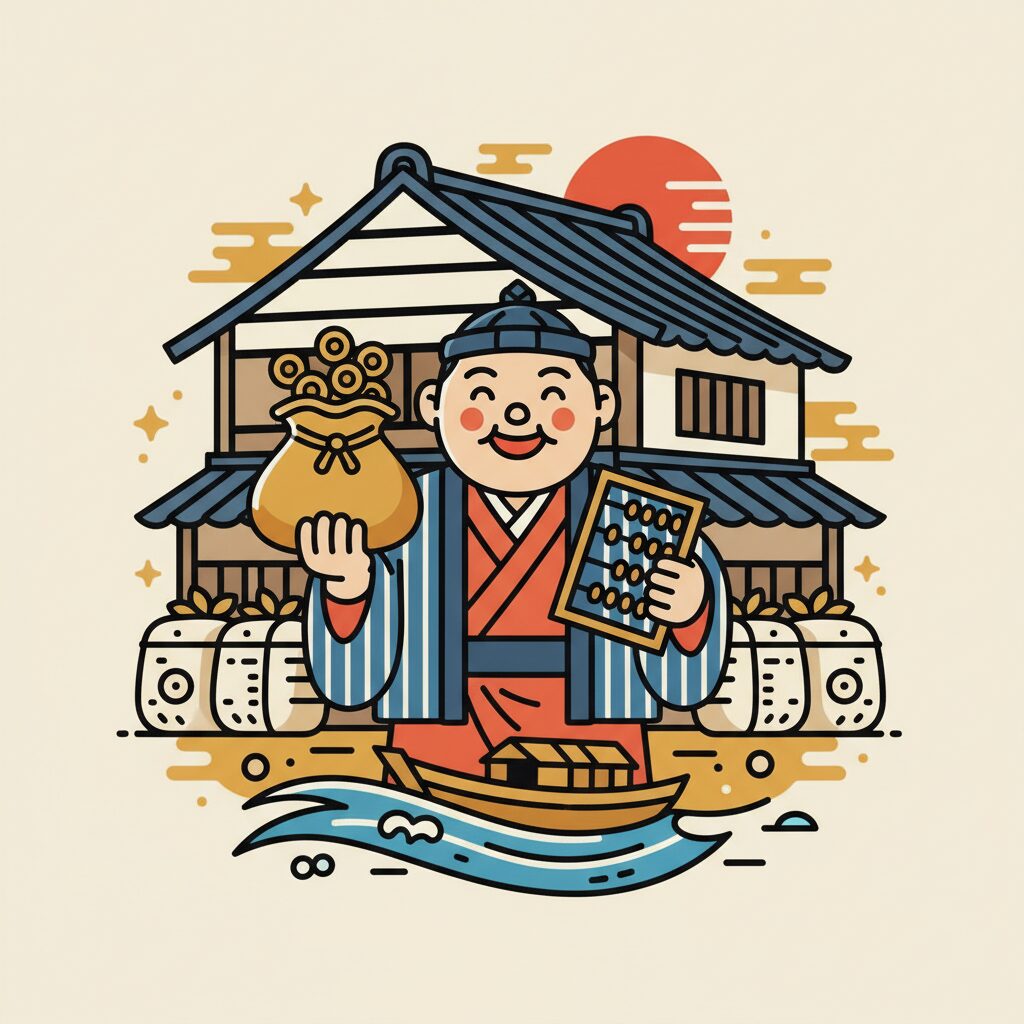
To understand why your Osaka boss appears to care more about your weekend fishing trip than your quarterly report, you need to look back—far back. Osaka’s modern business culture is inseparable from its history as the undisputed commercial center of Edo-period Japan. While Tokyo (then Edo) was the seat of political power, governed by samurai and bureaucrats, Osaka belonged to the merchants, the chonin. They weren’t born into influence; they earned it through intelligence, determination, and an exceptional ability to forge networks of trust.
The Nation’s Kitchen: A Crucible of Commerce
The city’s geography shaped its fate. Located at the mouth of the Yodo River with a vast bay, it naturally became a hub for shipping. Feudal lords from across Japan sent their surplus rice—the era’s currency—to Osaka for storage, trade, and conversion into cash. This led to the creation of the Dojima Rice Exchange, arguably the world’s first modern futures market. Here, merchants weren’t merely selling rice; they were trading promises, projections, and pure economic information. This environment required a particular set of skills. Sharpness, quick thinking, and the ability to read people—not just ledgers—were essential because one’s word was a bond. A handshake deal in the bustling pits of Dojima carried more weight than a scroll sealed by samurai. This legacy is the foundation of Osaka’s deeply rooted belief that business is essentially personal. The system didn’t rely on abstract rules but on the reputation and reliability of the individual Akindo.
A Culture of Pragmatism Over Pedigree
In the strict four-tiered class system of Edo Japan, merchants were officially ranked at the bottom—below samurai, farmers, and artisans. This social status had a profound psychological effect. Akindo couldn’t depend on rank or family name to advance. All they had was their skill, their product, and their power of persuasion. This fostered a culture of intense pragmatism. Does it work? Does it sell? Does it profit both parties? These were the questions that mattered. The elaborate rituals and face-saving formalities of the samurai were viewed as inefficient—wasted time and energy better spent closing deals. This historical aversion to needless formality explains why a modern Osaka office may feel refreshingly, or even shockingly, direct. The aim isn’t to perform a flawless business ceremony; the goal is to reach a mutually agreeable conclusion as efficiently as possible.
The Birth of Rationality and Trust
The Akindo culture also gave rise to a unique form of rationality. Thinkers like Yamagata Banto, an Osaka merchant-scholar, championed a worldview grounded in observable facts and practical reasoning, sharply contrasting with the neo-Confucian ideology of the ruling class. This rational, almost scientific approach to commerce meant that everything was open to discussion, everything negotiable. Price, terms, delivery dates—it was all part of a dynamic dialogue aimed at finding the ideal balance. This forms the core of Osaka’s negotiation culture. A price isn’t a fixed, sacred figure; it’s an opening move in a conversation about value. For that conversation to succeed, an underlying layer of trust was essential. You negotiated hard, but you always fulfilled your promises. This blend of fierce bargaining and steadfast reliability became the hallmark of the Osaka merchant, a reputation that businesses here continue to uphold today.
The Art of the Conversation: `Ne-giri` as a Business Ritual
One of the earliest and most striking experiences a newcomer has with the Akindo spirit is the practice of `ne-giri`, or price negotiation. In many Western cultures, and certainly within Tokyo’s more formal business environment, haggling can be viewed as impolite, suggesting that you don’t appreciate the other party’s offer. In Osaka, however, the opposite holds true. Declining to participate in `ne-giri` can come across as cold, uninterested, or even arrogant. It’s not merely about lowering the price; it’s a crucial communication ritual, a dance that builds rapport and gauges the other party’s commitment.
It’s Not Haggling, It’s a Dialogue About Value
The main misconception is treating `ne-giri` as a zero-sum game where one person’s gain equals another’s loss. For an Osaka Akindo, it’s a collaborative effort to uncover the true value of a deal. The listed price is just a starting point, a `tataki-dai` (a striking board) to kick off the conversation. Questioning it isn’t an insult to the seller. Instead, it shows engagement, critical thinking about the proposal, and a shared investment in finding a price that benefits both parties.
Let’s consider a typical example. You’re a small business owner looking to purchase 1,000 custom-made parts from a factory in Higashiosaka. The initial quote is 500 yen per unit.
The Tokyo Approach (Simplified): You receive the quote and might request a 5% volume discount as standard. They likely have a pre-established discount matrix and will accept or reject based on internal policies. The process is transactional and follows a clear, predictable pattern.
The Osaka Approach (The Dance): You get the quote but don’t immediately counter. Instead, you call. “Maido! Tanaka-san! I saw your estimate. It’s a masterpiece, such beautiful numbers! You must be thriving!” You start with praise and a personal touch. Then comes a gentle tease. “But you know, 500 yen… that’s a real ‘Tokyo price’ you’ve given me! Are you planning to build a skyscraper over there?” This is said with a laugh—a signal that the game has begun. The factory owner laughs back. “Come on, Suzuki-san, we use only the best materials! Quality doesn’t come cheap!” Now the true negotiation starts. You might say, “I get it, and that’s why I called—because of your quality. But my client is really squeezing me. If you could bring it down to 450 yen, I could place the order today. `Nantoka naran ka?` (Can’t you do something?).” This phrase isn’t a demand; it’s an appeal to the relationship, a request for joint problem-solving. The factory owner might respond, “450 is tough… but if you pay 60% upfront, I can do 460, and I’ll include free delivery.”
Notice the difference? It becomes a creative, collaborative exchange. The final price is more than a number; it’s a story of compromise and mutual understanding. The `ne-giri` process itself strengthens the relationship. Together, you shape the deal, building a foundation of trust far stronger than a simple transactional discount.
The Role of Humor and `Tsukkomi`
Humor is the essential lubricant in Osaka negotiations. It breaks tension and lets both sides push limits without offending. The classic `manzai` comedy style of `boke` (the silly fool) and `tsukkomi` (the sharp straight man) is deeply woven into the city’s communication. During negotiation, an overly optimistic offer might be met with an exaggerated `Ahochauka!` (“Are you an idiot?!”) or `Nandeyanen!` (“Why the heck?!”). To outsiders, this can sound harsh, but the tone is key. It’s almost always said with a smile—a `tsukkomi` that means “Your offer is ridiculous, but I’m still in this conversation. Now give me a serious one.” Learning to both give and receive a bit of `tsukkomi` signals you understand the local business language. It shows you’re not a stiff outsider but someone who truly gets the game.
Straight Talk and Sharp Wit: The Osaka Communication Protocol
The Akindo spirit influences not only what is expressed but also how it is conveyed. Osaka people are often stereotyped as loud, direct, and humorous. While this is a simplification, it highlights a communication style that values clarity, efficiency, and genuine connection over the subtle ambiguity commonly found in Japanese business interactions elsewhere.
Directness as a Sign of Respect
In Tokyo, business communication tends to be indirect. People use `keigo` (honorific language) carefully and avoid saying “no” outright, opting for vague expressions like `chotto kentou shimasu` (“I’ll consider it a little”), which is widely understood as a polite refusal. This approach aims to maintain harmony and prevent conflict. The Osaka style, however, is quite different. An Akindo believes the greatest respect for a business partner is not wasting their time. If an idea is poor, they will say so plainly. If a price is too high, they will speak up. This directness is not meant to offend but to be efficient. The principle is: let’s pinpoint the problem quickly so we can resolve it fast and both return to making money.
A foreign colleague spent weeks drafting a partnership proposal for an Osaka-based company. In Tokyo, the feedback he received was always polite but non-committal: “This is a very interesting perspective,” or “We need to discuss this internally.” Nothing moved forward. When he presented the same proposal to the Osaka company’s president, the response was immediate. Ten minutes in, the president raised his hand: “Stop. This part doesn’t make sense for us. The risk is all on our side. And this section, the timeline is impossible. But,” he added, leaning in, “if you can revise this and we adjust that, then we might have something to discuss.” My colleague was initially surprised by the bluntness but soon recognized it as a gift. In one meeting, he gained more clear, actionable feedback than in a month of polite evasions in Tokyo. This is the Akindo spirit at work: directness fueling progress.
`Honma-ka?` (Really?): Embracing Healthy Skepticism
Osaka communication also features a deeply ingrained healthy skepticism. People here question everything—not out of cynicism, but as a form of due diligence rooted in merchants’ need to verify value. If you make a bold claim in a presentation, don’t be shocked if someone immediately responds with `Honma-ka?` (“Is that really true?”) or `Sore de, moukaruno?` (“So, does it make money?”). This is not meant to embarrass you but to test your idea on the spot. They expect you to have the data, the reasoning, and the confidence to support your claims. If you can withstand this friendly interrogation and defend your position with solid logic (and perhaps a bit of humor), you will earn their respect quickly. They will see you not just as a presenter but as a potential partner who has done their homework.
The Language of `Maido` and `Moukari-makka`
Even everyday greetings reflect the Akindo spirit. The quintessential Osaka business greeting is `Maido!`, which literally means “every time” but conveys “Thanks for your continued patronage!” It is warm and familiar, immediately creating a sense of ongoing relationship. This is followed by the classic call-and-response: “`Moukari-makka?`” (“Are you making money?”). The usual reply is a wry smile and “`Bochi bochi denna`” (“So-so, getting by”). This is not a literal inquiry into the company’s finances but a verbal handshake, a ritual that reaffirms shared identity. It means: “We’re both in the same business—the tough game of making a living. I see you. I respect your effort.” It may seem small, but it continually reinforces the idea that business is a community of fellow players, not a battlefield of faceless rivals.
More Than a Contract: Building Relationships, `Ningen-kankei` Style
If there is one fundamental principle of the Akindo spirit, it is this: business moves at the speed of trust. In a world increasingly dominated by algorithms and automated processes, the Osaka business scene remains stubbornly, wonderfully human. The relationship, or `ningen-kankei`, is not just a soft skill or a nice-to-have; it is the core asset, the invisible foundation on which all successful commerce is built. A contract is merely a piece of paper that formalizes an agreement already made between two people who trust each other.
`Go-en`: The Belief in Fateful Connections
In Japanese culture, there is a concept called `go-en`, which refers to a fateful connection or bond with another person. Across much of Japan, this is often seen as a spiritual or romantic notion. In Osaka, however, `go-en` is a business strategy. An Akindo believes that every meeting, every introduction, could be the beginning of a valuable, long-term relationship. This is why early meetings often feel unstructured. They are not trying to check off items on an agenda. Instead, they are trying to understand you as a person. Do they like you? Can they trust you? Do you share similar values? Can they imagine sharing a beer with you after a tough negotiation? These questions often carry more weight than the fine print of your proposal. They are thinking long-term. A single profitable deal today is good, but a reliable partner for the next twenty years is infinitely more valuable.
This is why much business takes place outside the office. The `nomikai` (drinking party), the golf course, or even a shared meal at a cramped ramen shop—these are not trivial activities. They serve as primary venues for building genuine `ningen-kankei`. It’s in these informal settings that the masks of corporate formality fall away. You learn about your client’s family, hobbies, and frustrations. You share stories. You laugh. You build authentic human connection. This forms the foundation of trust. When a crisis arises—a supply chain breaks, a deadline is missed—an Osaka partner who has this kind of relationship with you won’t pull out the contract to point to the penalty clause. Instead, they’ll pick up the phone and say, “Sato-san, we have a problem. How can we fix this together?” The relationship transcends the transaction.
`Ninjo`: The Logic of Human Feeling
Closely linked to this is the concept of `ninjo`, or human feeling. The rational Akindo is also deeply empathetic. They recognize that people are driven by more than just profit. Pride, loyalty, and the desire to help someone you like—these are powerful forces in business. An appeal to `ninjo` can often be more persuasive than a purely logical argument. I once witnessed a small supplier in a difficult situation. A major customer had suddenly canceled a large order, leaving them with a warehouse full of unsellable inventory. They were facing bankruptcy. The owner didn’t send a formal letter to his other clients; he visited them one by one. He sat down, explained the situation honestly, and said, “I’m in trouble. I know you don’t need this product right now, but if you could buy even a small amount, it would help me keep my people employed.” He wasn’t relying on a business case. He was relying on `ninjo`, on the goodwill he had built over years. And it worked. His partners, the people with whom he had cultivated real relationships, stepped up. They bought what they could, not because it made immediate economic sense, but because it was the right thing to do for someone who was part of their business community. That is the power of the Akindo network.
The Great Divide: Osaka vs. Tokyo in the Corporate Arena
For any foreigner working in Japan, grasping the cultural divide between Kanto (the Tokyo area) and Kansai (the Osaka area) is essential. It’s a friendly rivalry influencing everything from cuisine and dialect to comedy and, most crucially, business practices. These differences run deep, reflecting the distinct histories of a merchant city versus one of samurai and bureaucrats.
Meeting Culture: Spontaneity vs. Formality
Tokyo: Meetings in Tokyo are highly structured events. An agenda is distributed days beforehand, and materials are expected to be flawless and thorough. Often, the main purpose is not to debate or decide but to formally confirm a decision already reached through a careful, behind-the-scenes consensus-building process known as `nemawashi` (“tending the roots”). Junior staff rarely speak unless prompted. The aim is to show preparedness and reach harmonious agreement.
Osaka: An Osaka meeting resembles a workshop. The agenda might be flexible or even disregarded altogether. The objective is to gather key people for a lively, honest discussion. To outsiders, it may seem disorderly and chaotic. People interrupt one another, challenge ideas directly, and laughter is frequent. Yet, this seeming disorder is highly effective. Decisions can be made very quickly because all arguments and objections are openly expressed. The company president might even turn to the newest team member and ask, “What do you think? Don’t be shy!” The belief is that good ideas can come from anywhere and the best way to test them is through open debate.
Decision-Making and Risk: Proceed Cautiously vs. Act Quickly
Tokyo: Decision-making follows a bottom-up, consensus-based approach. Proposals begin at lower levels and gradually move up the hierarchy, collecting `hanko` (personal seals of approval) at each stage. This slow, deliberate process is designed to reduce risk and ensure unanimous support. Although it fosters stability, it can also hinder innovation.
Osaka: Decision-making tends to be top-down and much quicker. The city has a strong entrepreneurial spirit exemplified by the phrase `yatteminahare` (“just give it a try!”), popularized by Shinjiro Torii, founder of Suntory. Leaders in Osaka, particularly in small or medium businesses, often rely on intuition and make swift choices. They are comfortable with ambiguity and calculated risks. The idea is that in a fast-paced market, speed is advantageous—it’s better to decide quickly and adjust later than to be stalled by over-analysis.
Hierarchy and Formality: Rigid vs. Flexible
Tokyo: Corporate hierarchy is clearly defined and deeply valued. Proper use of `keigo`, seating arrangements during meetings, and the order of exchanging business cards all emphasize the organization’s vertical structure. Formality is a sign of respect.
Osaka: Although hierarchy exists, it is much more fluid and accessible in practice. The boss is often a hands-on team leader rather than a remote authority figure. While addressed by title, interactions are much more casual. Humor may be used to self-deprecate, breaking down barriers between leader and staff. The emphasis is on function, not rank. Those with the best information or ideas are expected to speak up, regardless of their position on the chart. Efficiency and results take precedence over strict protocol.
A Foreigner’s Field Guide: How to Navigate the Akindo World
So, how do you apply all this knowledge in practice? How can you, as a non-Japanese professional, not only survive but flourish within Osaka’s distinctive business environment? It calls for a shift in mindset—from focusing solely on transactions to valuing relationships.
Your First Meeting (`Shodankai`)
- Do: Spend the first 10-15 minutes on small talk. This isn’t wasted time; it’s the most crucial part of the meeting. Inquire about their company’s history. Mention you’ve tried the local specialty food. Share a bit about yourself—your hobbies, your family. You are establishing the groundwork for `ningen-kankei`.
- Don’t: Dive straight into your PowerPoint presentation. Starting immediately with the business agenda can come across as cold and impatient. It signals that you only care about the transaction, not the person in front of you.
- Pro Tip: Learn a few simple phrases in Osaka-ben. A well-timed `Ooki ni` (“Thanks”) or `Meccha ee desu ne` (“This is really great”) will make a strong impression. It shows you’re making an effort to connect with their local culture.
The Price Negotiation (`Ne-giri`)
- Do: Approach it as a creative problem-solving session. Be ready to support your position with logic, but keep the atmosphere light and friendly. Use humor. Present your requests as ways to achieve a win-win outcome. “If we can agree on price X, I can place a larger order, which benefits us both in the long term.”
- Don’t: Accept the initial offer without discussion (unless it’s genuinely excellent). While you might think you’re being agreeable, it can appear as a lack of engagement. Also, don’t take a playful `tsukkomi` or a blunt counter-offer personally—it’s part of the negotiation rhythm.
The After-Work Drink (`Nomikai`)
- Do: Attend if invited. This is where genuine relationship-building occurs. You don’t have to consume alcohol, but you should participate. Listen more than you speak. Be yourself. This is their opportunity to see the real you, and yours to see them beyond their corporate roles.
- Don’t: Discuss business all night unless your host brings it up. The `nomikai` is meant for fostering personal connections. Stick to safe topics like travel, food, sports, and family. It’s definitely not the time for hard negotiations.
The Final Word: Embrace the Human Element
Working in Osaka is a constant reminder of the importance of human connection. It may feel confusing at first. It challenges the neat flowcharts and standardized procedures many of us expect in a professional setting. But once you decode it, you’ll discover a business culture that is dynamic, highly efficient, and deeply fulfilling. The Akindo spirit isn’t a relic of the past; it’s a practical, time-honored philosophy for conducting business and living a life that prioritizes people. It teaches that the strongest contracts are forged in the ink of mutual trust and respect. In a world that often seems anonymous and transactional, Osaka reminds you that, at the end of the day, every deal is simply a conversation between people. So relax, share a laugh, and ask about that takoyaki stand. You’re not just closing a deal; you’re beginning a relationship.