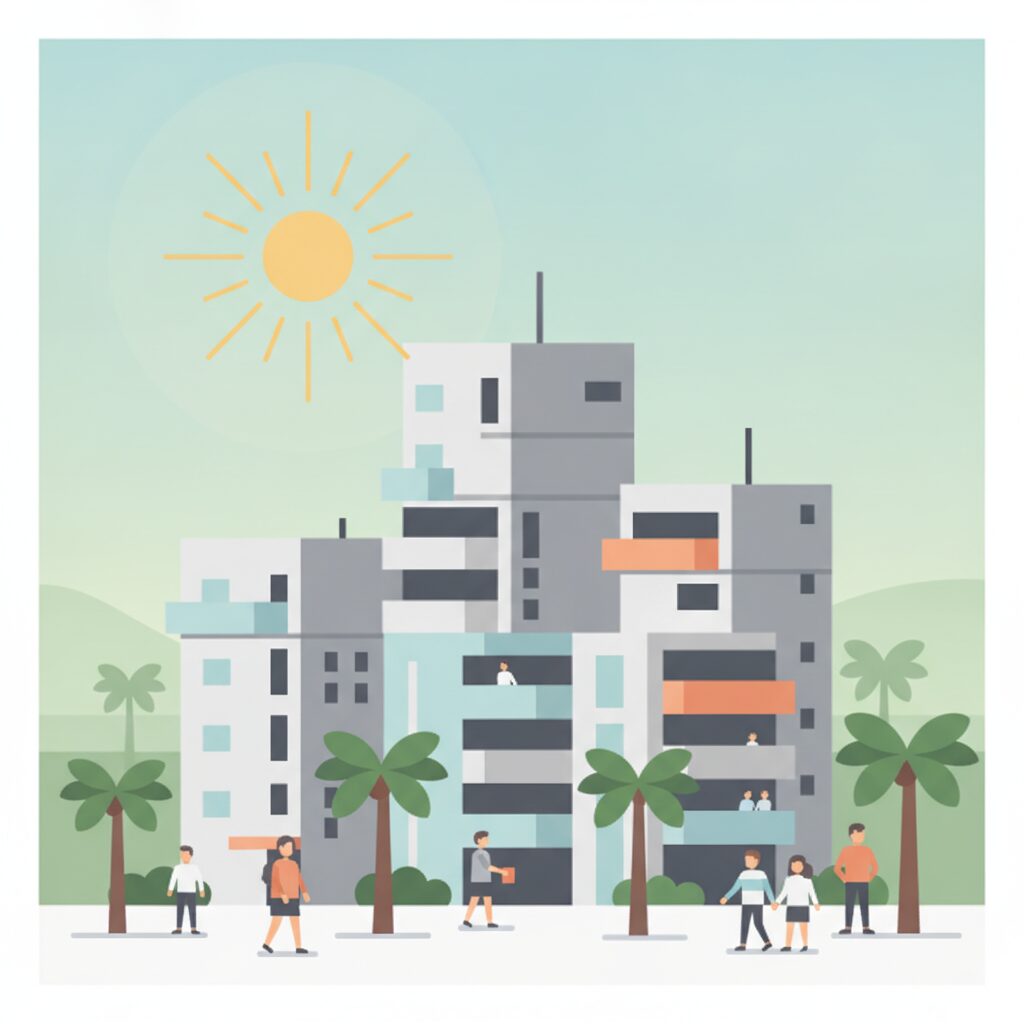
When you first move to Osaka, or any big Japanese city, your eyes are drawn to the new. The gleaming towers piercing the sky in Umeda, the sleek, minimalist architecture of a Nakanoshima art gallery, the impossibly chic apartment buildings in Kitahorie with their auto-locking doors and silent elevators. But as you start to live here, really live here, your gaze shifts. You start noticing the other buildings. The ones that have been here for a while. They’re usually a bit shorter, set back from the main roads, and almost always painted in a muted palette of beige, grey, or off-white. They are sprawling collections of identical concrete blocks, linked by open-air corridors and surrounded by well-worn playgrounds and meticulously pruned azalea bushes. This is the danchi, Japan’s public housing complex, and in Osaka, it’s not just architecture; it’s a living, breathing ecosystem with its own currency, its own laws, and its own undeniable gravity.
The first thing any foreigner learns about danchi is the price. The rent is low. Shockingly low. You hear stories of three-bedroom apartments for the price of a shoebox studio in a private building, and your mind immediately starts calculating the savings. It seems like a cheat code for urban living, a way to hack the system in one of the world’s most developed countries. But here’s the thing about Osaka: there’s no such thing as a free lunch, though you might get a plate of free takoyaki from a neighbor. The low rent isn’t a discount; it’s a down payment. You pay the rest not in yen, but in time, in privacy, and in participation. Living in a danchi is an exchange, a social contract written in invisible ink. And to understand that contract is to understand a fundamental, pragmatic, and deeply communal slice of the Osaka soul that you’ll never find in a tourist guide.
While the danchi’s worn elegance invites you into a slow-paced community life, encountering a hyper-realistic diorama room offers a striking contrast to Osaka’s modern urban pulse.
The Allure of the Yen: Deconstructing the Danchi Deal
Let’s begin with money, as in Osaka, that’s nearly always where the discussion starts. This is a city shaped by merchants, and negotiating a good deal is viewed as an art form. The danchi exemplifies this philosophy: maximum utility for minimal cost.
The Numbers on the Page
When my family was searching for a larger apartment, we did what everyone does: we combed through real estate websites. The prices for a family-sized 3LDK (three rooms plus a living/dining/kitchen area) in a private building, known as a “mansion,” were intimidating. Then, we checked the listings from UR, the semi-public Urban Renaissance Agency, and the municipal housing offices. The difference was astonishing. A danchi apartment in a convenient, leafy suburb could cost half as much as a private rental just down the street.
Even better, the notorious initial fees of Japanese apartment hunting were mostly absent. There was no reikin, or “key money,” that strange, non-refundable gift paid to the landlord simply for the privilege of renting. The shikikin, or security deposit, was often lower, and agent fees were non-existent. The application process was a clear lottery, based on income brackets, rather than whether the landlord felt comfortable renting to a foreign family. On paper, it was an unbelievably good deal. It felt like we’d discovered a loophole in the high cost of Japanese urban living.
The Hidden Ledger: Fees You Didn’t Budget For
But rent is just the headline. The fine print appears later, not in legal documents, but through social osmosis. First, there’s the kyoekihi, the common area maintenance fee. This is standard in most Japanese apartments and covers lighting in hallways, lobby cleaning, and elevator upkeep. It’s a predictable, transparent charge.
The real initiation into the danchi economy is the chonaikaihi, the neighborhood association fee. This monthly payment, usually a modest few hundred to a thousand yen, is your mandatory subscription to the community. It funds the summer festival, the New Year’s mochi-pounding event, emergency supplies stored in the community shed, and the electricity for extra lights during festival season. Refusing to pay it is not an option. It’s like refusing to breathe. This fee financially signifies your membership; it’s the first sign you’re not just renting an apartment—you’re joining a club.
Then there are potential renovation expenses. Many danchi units are old, dating back to Japan’s post-war economic boom of the 1960s and 70s. They’re sturdy but basic. When you move in, you might find the apartment is a concrete shell—no air conditioners, no light fixtures, no gas stove. These are all items you must buy, install, and later uninstall and take with you when you leave. The low rent suddenly feels more balanced when you’re staring at a 150,000 yen bill for three new air conditioning units.
The Social Contract: Paying Your Dues in Time and Sweat
The most significant costs of danchi life never show up on any bank statement. The true price is your active—and often obligatory—participation in the life of the complex. This is where the pragmatic Osaka mindset truly shines. The community doesn’t thrive on good vibes alone; it operates through a carefully organized, shared labor system.
Your Weekend, Their Schedule: The Mandatory Community Roster
At exactly 9 a.m. on the first Sunday of every month, a soft chime sounds over the danchi’s public address system. This is the signal—it’s time for isseei seiso, the all-hands cleaning day. Within minutes, residents pour out of their apartments equipped with brooms, dustpans, and gardening shears. Toddlers toddle along carrying tiny buckets, while elderly men, the unofficial foremen, oversee the operation with surprising authority.
This isn’t a voluntary beautification effort. It’s an essential civic duty. A roster, posted on the central community bulletin board, assigns each building’s responsibility for the month. One month you’re pulling weeds from flowerbeds. The next, you’re scrubbing the grimy, cavernous garbage collection area. The month after, you’re clearing leaves from drainage ditches. Your attendance is recorded, and if you miss it, expect a polite but firm inquiry from your floor’s designated representative. The unspoken rule is clear: we all keep the common areas clean to keep fees low. Your sweat is part of the rent.
Beyond cleaning, other duties arise. You might be assigned to fire-watch patrol, walking the corridors at night with a partner and wooden clappers. At some point, you’ll be expected to serve on the chonaikai committee, a rotating role requiring attendance at monthly meetings and assistance in organizing the year’s events. This is a substantial time commitment—a second, unpaid job you take on with your apartment keys.
The Unwritten Rules of the Concrete Village
Living so close to hundreds of families demands a strict social code, far more complex than any rental agreement. Garbage rules, already a maze for any foreigner in Japan, take on almost sacred status in the danchi. Veteran residents closely monitor your sorted trash. A mistake—like putting a plastic bottle in the burnable bag or failing to rinse a milk carton—won’t go unnoticed. You may receive a gentle correction, or find the offending bag returned to your door with a note.
Noise is another sensitive issue. While the concrete walls are sturdy, they’re not soundproof. You become attuned to your neighbors’ daily rhythms through sound: the hum of a washing machine at 6 a.m., the notes of a piano lesson at 4 p.m., the joyful shouts during family bath time in the evening. You also learn to monitor your own noise, fully aware that your life is audible to others. This fosters a collective quiet—a shared understanding that personal peace depends on mutual respect.
Anonymity, the great luxury of modern city life, simply doesn’t exist here. Everyone knows you: the Australian family in 402. They know when you leave for work, when your groceries arrive, and when you have guests. This total lack of privacy can feel stifling at first. It’s the exact opposite of life in a sleek Tokyo high-rise, where you might live for years without knowing a neighbor’s name. But this constant, low-level surveillance is double-edged. It’s intrusive, yes, but it also forms the bedrock of the danchi’s greatest strength: its community.
The Danchi Dividend: Where Your Investment Pays Off
If you’re willing to invest your dues in fees, time, and privacy, the benefits begin to show. The danchi dividend comes in the form of social capital, safety, and a deep sense of belonging that is increasingly rare in today’s world.
The Neighborhood Watch You Never Signed Up For
The same nosiness that monitors your every move also forms a strong, organic security system. The danchi is arguably one of the safest places worldwide to raise children. Kids play in courtyards and playgrounds, watched over by dozens of “grandmothers” from their balconies. If a child falls and scrapes a knee, three concerned matriarchs with tissues and bandages appear before their parents have even reached the stairs.
Strangers are noticed immediately. A strange car in the resident parking lot becomes a topic of conversation within minutes. This constant vigilance keeps crime exceptionally low and fosters a trust that feels like a relic from a bygone era. You can confidently send your six-year-old to the danchi’s small co-op store to buy milk, knowing they’re watched at every step. This freedom and peace of mind offer a priceless benefit beyond any yen value.
An Instant Family: The Power of the Obachan Network
The spirit of Osaka is most evident in the danchi’s social fabric, embodied by the formidable obachan—the middle-aged and elderly women who serve as the community’s heart and central nervous system. This network provides powerful mutual support.
This isn’t the polite, reserved friendliness seen elsewhere in Japan. It’s a practical, hands-on, deeply involved form of care. For example, if you have a baby, neighbors on your floor will bring food to your door without asking. They simply hand over a pot of curry, assuming you’re too exhausted to cook. This is osuso-wake, the beautiful tradition of sharing a portion of what you’ve made. In the danchi, it’s an everyday practice rather than a special occasion. One day you might receive tomatoes from someone’s garden; the next, a few pieces of leftover tempura.
When my child was sick, a neighbor I barely knew knocked on our door. She’d heard him coughing through the walls and brought homemade barley tea and okayu, Japanese rice porridge, saying, “it’s all a sick child should eat.” She didn’t wait to be asked; she noticed a need and stepped in. This is the danchi support system at work. It’s about more than friendliness—it’s about taking responsibility for one another’s well-being. For a foreign family without local relatives, this informal family can be a genuine lifeline.
Festivals, Fire Drills, and Forced Fun
The fees paid to the chonaikai return as shared experiences. The annual summer festival is the highlight. For one hot weekend in August, the central plaza is transformed. Paper lanterns hang, a stage is set up, and the air fills with the aroma of grilled squid and yakisoba noodles, all cooked and served by residents. There are games for children, a bingo tournament with prizes, and a beer tent for adults.
Participation is, naturally, expected. You’ll be pulled into running the fried noodle stand for an hour or helping set up tables. It may feel like a chore, another demand on your time. But as you stand flipping noodles beside the stern man who usually organizes cleaning days, conversations begin. You learn he once worked for Panasonic. You jointly grumble about the humidity. You share a laugh. This forced interaction turns neighbors into a community. These shared rituals—the summer festival, mochi pounding, and even the semi-annual fire drill—are the bonds that tie everyone together.
Osaka vs. The World: Why Danchi Life is Different Here
You’ll find danchi throughout Japan, but living in one in Osaka is shaped by the distinct character of the city and its residents. It captures the essence of the Osakan spirit: practical, communal, and refreshingly straightforward.
Pragmatism over Polish: The Osaka Mindset
In Tokyo, there is often a stronger focus on aesthetics and social status. Residing in a stylish, new building in a fashionable neighborhood is seen as a symbol of success. In Osaka, however, the ultimate mark of status is securing a great deal. Boasting about how little you pay in rent carries more weight socially than bragging about your address. The danchi physically represents this mentality. It’s not about appearance; it’s about practicality. It’s the sensible, economic choice to prioritize financial security and community bonds over superficial appeal. “It might be old, and the bathroom a bit outdated,” a neighbor once said to me, tapping the concrete balcony wall, “but it’s sturdy, affordable, and my grandkids can play outside. What else do you need?” This straightforward, substance-over-style mindset defines Osaka at its core.
Closer, Louder, More Involved
The perception of Osaka people as more direct and expressive than their Tokyo counterparts is clearly evident in the tight quarters of a danchi. While a Tokyo resident might slip a polite, anonymous note under a noisy neighbor’s door, an Osaka resident is more inclined to knock and engage in a candid, face-to-face conversation. Community meetings tend to be lively events, with residents passionately debating the budget for the summer festival or the new bicycle parking regulations.
For outsiders, this can seem confrontational. But it rarely comes from ill will. It reflects a culture that values open dialogue and believes issues should be addressed openly and resolved straightforwardly. Residents are deeply committed to their shared space and unafraid to express their opinions to safeguard it. Participation and having a viewpoint are expected. This constant, energetic involvement is what brings the community to life, even if it can sometimes be tiring.
Is Danchi Life Right for You? A Practical Guide
Living in a danchi offers a deeply immersive cultural experience, but it’s not suited for everyone. It demands a particular mindset and a readiness to exchange one set of modern conveniences for another, more traditional range of benefits.
Who Thrives in the Concrete Jungle?
Danchi life is perfect for certain people. Families with young children are the most apparent beneficiaries. The blend of low rent, abundant green space, built-in playmates, and the constant safety net provided by watchful neighbors makes for an unbeatable combination. It’s also ideal for those on a tight budget who don’t want to sacrifice space. Long-term residents intending to settle down and integrate into a local community will find a welcoming, though demanding, environment. For any foreigner genuinely wanting to understand Japan beyond the surface, who wishes to see how a community functions from within, there is no better, more unfiltered experience.
Who Should Steer Clear?
On the other hand, if you highly value your privacy and anonymity, a danchi can feel like a prison. If your work hours are irregular and you can’t commit to weekend community duties, you may quickly fall out of favor. Short-term residents will likely bear the costs of integration without ever enjoying the long-term benefits of belonging. And if you’re the kind of person who resents being told what to do and struggles with a system of strict, collectively enforced rules, you should probably pay the extra rent for a private apartment. The financial savings aren’t worth the everyday social friction.
Final Thoughts
Living in an Osaka danchi involves constant negotiation. You negotiate with your neighbors about noise, parking, and whose turn it is to clean the stairwell. But on a deeper level, you negotiate with an entirely different lifestyle. You exchange some personal freedom for a strong sense of community support. You give up anonymity in return for safety. You devote your time and energy to gain a place that feels less like a group of apartments and more like a vertical village.
The concrete may be worn and the designs outdated, but these complexes hold a community spirit that is disappearing in many parts of the world. They stand as a testament to the Osaka belief that the best things in life often come from a smart, pragmatic bargain. The rent may be low, but what you receive—a safety net, a support system, and a front-row view of the honest, unpolished reality of daily life in Osaka—is invaluable.