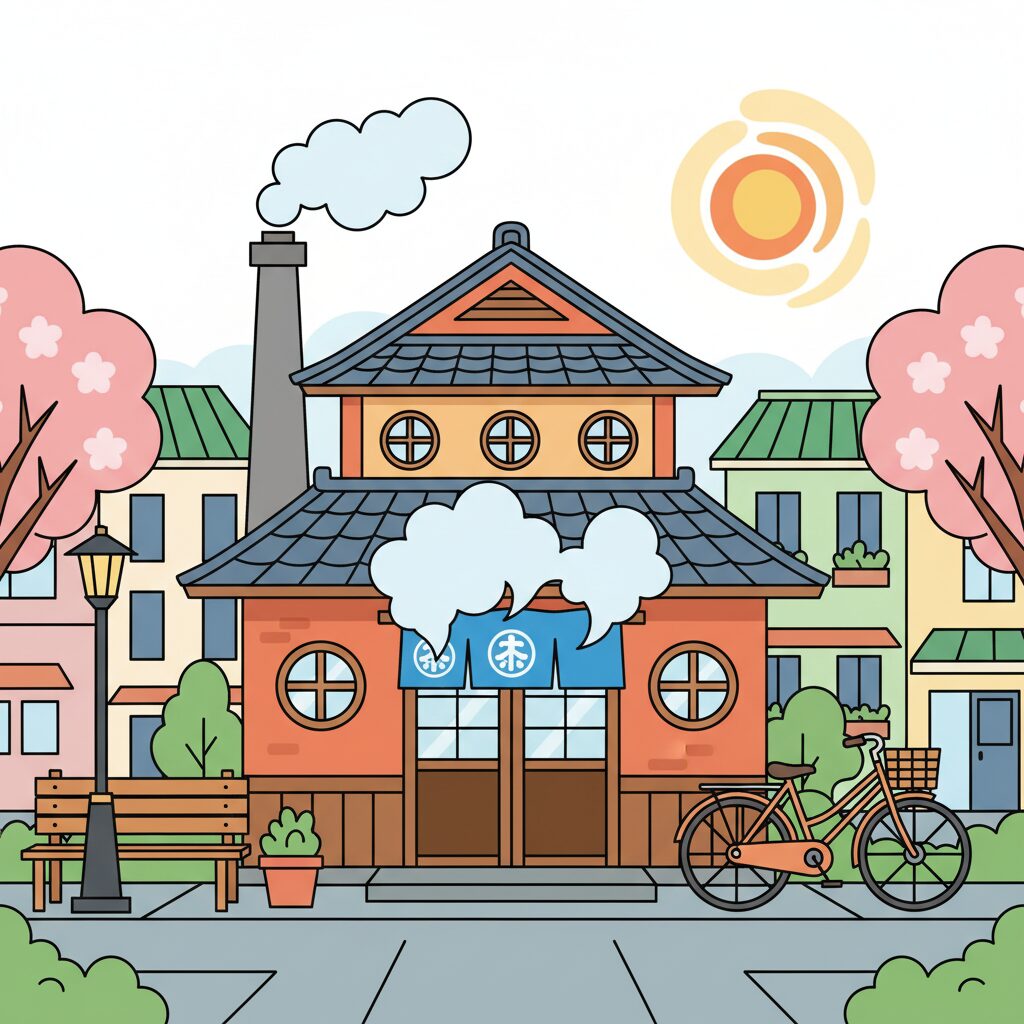
Walk down a quiet residential street in Osaka, away from the roaring consumer canyons of Umeda or the electric pulse of Namba. You’ll pass rows of tightly packed houses, a small shrine tucked between apartment buildings, and the clatter of a local shopkeeper rolling up their metal shutter. Then you might see it: a grand, temple-like entrance with an ornate, sweeping roof, a short curtain called a noren hanging in the doorway, and a simple, elegant character painted on it: ゆ (yu). This is the sign for hot water, the emblem of the neighborhood sento, or public bathhouse. For many foreigners, it’s a curiosity, a relic from a bygone era. You might wonder, “Who even goes there anymore? Doesn’t everyone have a shower at home?” It’s a logical question, but it misses the point entirely. In Osaka, the sento isn’t just a place to get clean. It’s a community center, a social equalizer, a therapist’s office, and a living room, all rolled into one steamy, tile-lined space. It’s where the city’s unspoken social codes are practiced and passed down. It’s where you can understand the heart of Osaka in a way you never will at a tourist attraction. This isn’t a guide to onsen resorts or high-tech “super sento” spas with massage chairs and karaoke rooms. This is about the humble machi-no-sento, the neighborhood bathhouse that serves as the anchor for daily life, and understanding its role is fundamental to understanding how this city and its people really work. It’s a world where status is left in a wicker basket with your clothes, and the only thing that matters is the shared warmth of the water and the easy flow of conversation.
To truly experience the city like a local, consider exploring these unique social hubs on two wheels, as detailed in our guide to navigating Osaka by bicycle.
The Great Equalizer: Hadaka no Tsukiai in a City That Hates Pretense
In Japan, a country renowned for its complex social hierarchies and unspoken status rules, the sento presents a radical idea: complete equality. This concept is known as hadaka no tsukiai, literally meaning “naked communication” or “naked relationship.” The moment you remove your clothes, you also shed your social rank. The CEO of a large corporation, the local butcher, the university student, and the retired bus driver become equals. They are simply people, sitting together in the same hot water, sharing the same space. This notion strongly aligns with the Osaka mindset. Osakans are famously pragmatic, harboring a healthy skepticism toward authority and empty formalities. They prioritize substance over style and value a person’s character over their job title. The sento embodies this ethos physically. It is a place where social pretenses are stripped away, leaving only raw, genuine human interaction.
Picture a typical evening. An elderly man with intricate, fading tattoos from his youth—a symbol of a past life, not yakuza ties—is soaking in the main tub. A young salaryman, his body tense from a long workday, slides in beside him. In most other situations, a conversation might be stiff, shaped by age and professional status. Here, it flows naturally. The older man might grunt a comment about the Hanshin Tigers’ recent game. The salaryman, freed from the constraints of keigo (honorific language), might vent about his boss. There’s a shared vulnerability that breaks down social barriers. I’ve witnessed passionate political debates, sincere parenting advice, and loud laughter over a silly joke—all occurring between complete strangers who, ten minutes earlier, were separated by vast divides of age, income, and occupation. This contrasts sharply with Tokyo, where even in casual settings, a certain social distance is usually kept. A Tokyo sento tends to be a quiet, almost meditative experience. People generally keep to themselves, respecting personal space even in a shared bath. In an Osaka sento, the shared space is an invitation to engage. The silence is often broken by the gruff but friendly chatter that fuels the city’s spirit. This is one of the first things foreigners often misunderstand. The noise and directness aren’t impolite; they signify an open, inclusive community. The sento reveals Osaka’s famed friendliness not as a stereotype, but as a lived, everyday reality.
The Unspoken Choreography: Rules of the Water
While the social atmosphere remains relaxed, the sento functions under a strict set of unwritten rules. These guidelines aren’t displayed on any wall; instead, they are learned through observation and participation, and following them shows respect for the community. Breaking these rules is a serious faux pas—not because you’ll necessarily be scolded (although in Osaka, that can happen)—but because it reveals a lack of understanding of the sento’s core principle: it is a shared space, and your main responsibility is to avoid causing inconvenience to others.
The Gateway: From Getabako to Bandai
Your journey starts at the entrance. You slip off your shoes and place them in a small wooden locker called a getabako, taking the wooden key with you. This simple act marks the first step in leaving the outside world behind. Next, you approach the bandai, a raised platform where the owner, often an elderly man or woman, sits like a welcoming sentinel, collecting the entrance fee. The bandai-san is the sento’s heart, serving as the neighborhood’s memory keeper and information hub. They know everyone’s stories and often greet regulars by name, inquiring about family members or recent events. Paying your 500 yen is not just a transaction; it represents entry into a social contract. You have now become part of this temporary community.
The Changing Room: A Study in Trust
The datsuijo, or changing room, is where social leveling genuinely begins. In older sento, you won’t find modern metal lockers with keys. Instead, there are rows of simple wicker or plastic baskets. You place your clothes, wallet, phone—your entire identity—into an open basket and leave it there. This can feel unsettling for newcomers. Yet theft in a sento is almost unheard of, akin to stealing from family in their own home. Using the basket is an act of trust, a belief in the community’s collective decency. This space also serves as a pre- and post-bath lounge. Don’t be surprised to see people weighing themselves on old, rattling scales, drying off while watching a small television mounted on the wall, or sitting on a bench enjoying a post-bath drink. The classic choice is fruit-flavored milk or coffee milk in a vintage glass bottle, often sipped with one hand on the hip. This lingering is part of the ritual—a gentle transition back into the clothed world, a moment to let the bath’s warmth settle into your bones while catching up on neighborhood news.
The Bathing Area: A Ritual of Respect
Upon entering the yokujo, the bathing area, you are greeted by a wall of steam, the sound of running water, and quiet conversation. The air is thick with the scent of soap and cypress. The first and most important rule is to wash yourself thoroughly before entering any of the tubs. You’ll find rows of low plastic stools and faucets. This is your station. You take a stool and bucket, find an empty spot, and scrub completely. This act goes beyond personal hygiene: it is a profound gesture of respect. The bathwater is communal—a shared blessing. To enter it unclean would be to disrespect everyone who uses it. It is the ultimate social sin in this space. You are, in essence, saying, “My own convenience is more important than the comfort of the entire group.” In a place like Osaka, where mutual consideration is key, this is unforgivable.
Then there’s the towel. You receive a small, thin towel roughly the size of a large handkerchief. This towel is not for drying off but serves as your washcloth. You use it to scrub your body. Crucially, this towel must never, under any circumstances, touch the water in the bathtub, as it’s considered unclean. Regulars often fold it neatly and place it on their heads or lay it on the tub’s edge. This small detail is a powerful social signifier, indicating you know the rules and belong to the culture. Splashing is another matter: children are given some leeway, but adults are expected to move gently. You don’t cannonball into the tub; you enter slowly, minimizing disturbance. You are sharing a small space, and the goal is collective relaxation. When leaving your washing station to soak, you don’t leave your bucket and stool behind to “save” your spot. That violates the shared-space principle. Everything operates on a first-come, first-served basis. If you follow this unspoken choreography, you will be accepted effortlessly. No one will care where you’re from or what you look like—you’ve shown respect for the community.
The Neighborhood’s Living Room: More Than Just a Bath
The decline of the sento is a story unfolding across Japan. As modern homes with private bathrooms became commonplace, the number of public bathhouses sharply decreased. Yet, in the working-class neighborhoods of Osaka, the sento has persisted with remarkable resilience. This endurance stems from its role being more social than purely hygienic. It serves as the community’s connective tissue, the neighborhood’s living room, and an informal safety net.
For many elderly residents living alone, the daily visit to the sento is their primary social encounter. It provides a routine that offers both structure and connection. The bandai-san and other regulars act as an unofficial neighborhood watch. If old Mr. Sato misses his usual 4 PM bath for two consecutive days, someone will take notice and check on him. In a country facing an aging population and growing social isolation, this informal system of mutual care is invaluable. It’s a grassroots solution shaped by decades of shared experience, exemplifying Osaka’s practical, people-centered approach to community.
The sento is also a site of intergenerational bonding. Grandfathers bring their young grandchildren, teaching them not only how to wash properly but also the subtle art of social interaction. Children learn to bow to the adults, express gratitude, and be considerate of their noise and splashing. They absorb the stories and humor of the older generation, along with the local dialect and rhythms of neighborhood life. The sento becomes a classroom for social etiquette, where lessons are learned not through formal instruction but through lived experience. It is where a sense of belonging to a place is cultivated. When a sento closes in Osaka, it’s more than a business shutting down. It represents the loss of a landmark, the silencing of a hub of conversation, and the weakening of the social safety net. This is why local communities often fight fiercely to keep them open, recognizing that they are preserving not just a building but a vital part of their collective soul.
Osaka vs. Tokyo: A Tale of Two Tubs
While Tokyo certainly has its own historic sento culture, the experience can differ significantly, reflecting the unique personalities of the two cities. If an Osaka sento feels like a lively family gathering in the living room, a Tokyo sento resembles a quiet library. In Tokyo, the focus is often on serene, individual relaxation. Strangers are less inclined to start a conversation, and the overall noise level is much lower. This doesn’t mean Tokyo sento are unfriendly—they are simply politely reserved—the default mode leans toward private calm. In contrast, Osaka encourages engagement, where a bit of banter is expected.
I once saw a perfect example of this difference in a sento in East Osaka’s shitamachi area. An older regular noticed a younger man he hadn’t seen before and promptly called out through the steam, “Hey, you’re new! Where’d you come from?” The younger man, who was actually from Tokyo, seemed momentarily panicked, like a student caught off guard by a teacher. In Tokyo, such attention might feel intrusive, but here, it was an invitation. After a brief pause, he responded, and within minutes, three or four other men joined in, asking about his work, recommending a nearby spot for takoyaki, and joking about the differences between the cities. The initial awkwardness soon turned into easy camaraderie. This captures the essence of the Osaka sento experience—proactive, curious, and a bit nosy, all in the spirit of forming connections.
Even the physical experience can differ. Many Osakans claim their bathwater is hotter, reflecting the city’s sekkachi (impatient) character. You immerse yourself, let the heat penetrate your bones, and move on with your day. Whether this is true or not, it symbolizes a sense of efficiency and intensity that defines Osaka. The amenities might be simpler, with less focus on aesthetics and more on function. The ultimate aim of an Osaka sento isn’t to offer a Zen-like retreat, but rather a robust, efficient, and highly social bathing experience that recharges you for life in the lively, nonstop city just beyond its doors.
The Foreigner’s First Dip: What to Expect
For someone who isn’t Japanese, the idea of visiting a local sento can feel intimidating. The language barrier, nudity, and fear of unknowingly breaking rules—it’s a lot to navigate. However, the reality, particularly in Osaka, is much more welcoming than you might expect.
Let’s start with the biggest concern: tattoos. Many large hot spring resorts and fitness centers still enforce strict “No Tattoos” rules, a remnant of their connection to the yakuza. Yet, the modest neighborhood sento often operates differently. The rules tend to be unspoken and far more lenient. Regulars and owners are more likely to judge your behavior than your ink. If you enter politely and, most importantly, follow the washing etiquette carefully, having a small or medium-sized tattoo usually won’t be a problem. You are a guest in their space; showing humility and respect is essential. The communal spirit of the local sento often outweighs formal regulations. A foreigner with tattoos who washes properly is far more welcome than a Japanese person without tattoos who jumps directly into the bath.
Then there’s the matter of being stared at. Yes, if you look obviously foreign, you will probably draw some attention. It’s unavoidable. But it’s important to recognize the intent behind the gaze in Osaka—it’s almost never hostile. It’s genuine curiosity. An elderly man might watch you for a full minute before his curiosity prompts him to ask, in halting English or enthusiastic Japanese, “Where from?” This isn’t a challenge; it’s an invitation. It’s an icebreaker. If you smile and answer, you could find yourself in a surprisingly friendly conversation. Many foreigners misinterpret direct stares in Japan as rude. In an Osaka sento, it’s often just the start of a connection.
Don’t worry about the language barrier. The whole process is intuitive and visual. Observe others and imitate them. A few simple words like konnichiwa (hello), arigato (thank you), and sumimasen (excuse me) will help a lot. If you forget your soap or towel, you can usually purchase a tebura set (“empty-handed” set) at the front desk for a few hundred yen. The barrier to entry is low, and the reward—a genuine glimpse into the core of local life—is immense.
The Future of Steam: A Tradition at a Crossroads
Despite their strong community roots, the future of the sento remains uncertain. The economics are harsh: fuel costs are high, the buildings are old and need constant upkeep, and the owners are aging with no one to inherit the family business. For every sento lovingly maintained, another quietly shuts its doors for good, leaving a void in the neighborhood’s social fabric.
Yet, a new wave of appreciation is emerging. Younger generations, raised with private baths, are rediscovering the sento—not just for its retro appeal but for the genuine sense of community it provides in an increasingly digital and isolated world. Artists are hosting exhibitions in decommissioned bathhouses, and young entrepreneurs are revitalizing old sento by adding modern features like craft beer bars in the lobby or DJ booths in the changing rooms. They are finding ways to honor tradition while making it relevant to a new generation.
This effort to preserve the sento is deeply emblematic of Osaka. This city takes pride in its history in a practical, unsentimental way. People aren’t trying to save the sento as a museum relic; they are fighting to keep it alive as a functioning, vital part of their community. They recognize that its value cannot be measured in yen. Instead, it’s measured in the conversations held in the steam, the friendships built across generations, and the quiet reassurance that someone in your neighborhood is looking out for you. The sento stands as a testament to Osaka’s enduring belief in the power of human connection—face-to-face and shoulder-to-shoulder.
So, if you truly want to understand what makes Osaka tick, look beyond the dazzling lights of Dotonbori and the towering heights of Abeno Harukas. Find a street with that simple ゆ sign. Pay your fee, grab a basket, and step into the steam. Don’t visit just to wash—go to listen, observe, and take part in the daily, unscripted drama of city life. In the warm, welcoming water of a neighborhood bathhouse, you’ll discover the true, unapologetically human soul of Osaka.