I’ll never forget my first invitation to a local sentō. It wasn’t a gentle suggestion. It was a declaration. My neighbor, Tanaka-san, a woman whose age could be anywhere between sixty and a hundred, slapped me on the back with the force of a collapsing scaffold. “Kim-san,” she boomed, her voice raspy from years of unfiltered cigarettes and unfiltered opinions, “You look tired. You work too much on that computer. Tonight, we go to the bath. My treat.” There was no room for negotiation. This wasn’t a question. In Osaka, an invitation like this is a summons, a friendly but firm command to participate in the real rhythm of the neighborhood. I was an American writer, here to decode the vibrant chaos of anime culture, but I was quickly learning that the most profound stories weren’t on the screen; they were steaming in the tiled halls of the local public bath. My mind raced with the usual foreigner anxieties. The nudity, the rules, the fear of doing something profoundly, unforgivably wrong. I had a small, discreet tattoo on my shoulder blade, a relic of a rebellious college phase. In Tokyo, I’d heard, that alone could get you blacklisted. But this was Osaka. And in Osaka, as I was about to discover, the rules are written in steam, not stone. The local sentō isn’t a tourist trap or a wellness retreat. It’s the city’s living room, its confession booth, and its comedy club, all rolled into one. It’s where the varnish of Japanese politeness is scrubbed off, leaving behind a raw, honest, and often hilarious humanity. This isn’t about finding a picturesque onsen with a view of a manicured garden. This is about diving headfirst into the heart of daily life, into the boisterous, unpretentious soul of Osaka. Forget what you’ve seen in travel guides. We’re going to the machinoyu, the neighborhood bath, the real deal.
To truly understand the rhythm of Osaka’s social life, you should also explore the local custom of an after-work drink.
The Sentō is Not a Spa: It’s Osaka’s Community Center
Before even crossing the threshold, you need to reset your mindset. If your vision of a Japanese bath is a tranquil, silent retreat adorned with bamboo and smooth stones, you’re imagining a high-end onsen resort, probably in Hakone or Kyoto. That’s a vacation. A sentō in Osaka is everyday life. It’s the spiritual heir to the village well—a place designed for practicality and community, not for Instagram. The air isn’t filled with eucalyptus and lavender; instead, it’s thick with steam, the faint chemical scent of soap, and the lively sounds of life unfolding at full volume. Understanding this distinction is crucial because it reveals everything about the experience ahead.
The Vanishing Tradition: Why Local Baths Still Matter Here
Throughout Japan, the traditional sentō is fading away. With modern plumbing, nearly every home has its own bath, making public baths a nostalgic memory. Thousands have shuttered over recent decades. But in Osaka, they survive with a stubborn determination mirroring the city itself. Why? Because in Osaka, the neighborhood is more than a location; it’s the core of social life. Your existence is intertwined with the local shotengai (shopping street), the corner takoyaki stand, and the elderly women watching the world from their doorsteps. The sentō is a cornerstone of this intensely local ecosystem. It’s where social ties are created and preserved in a way a private bathroom never could.
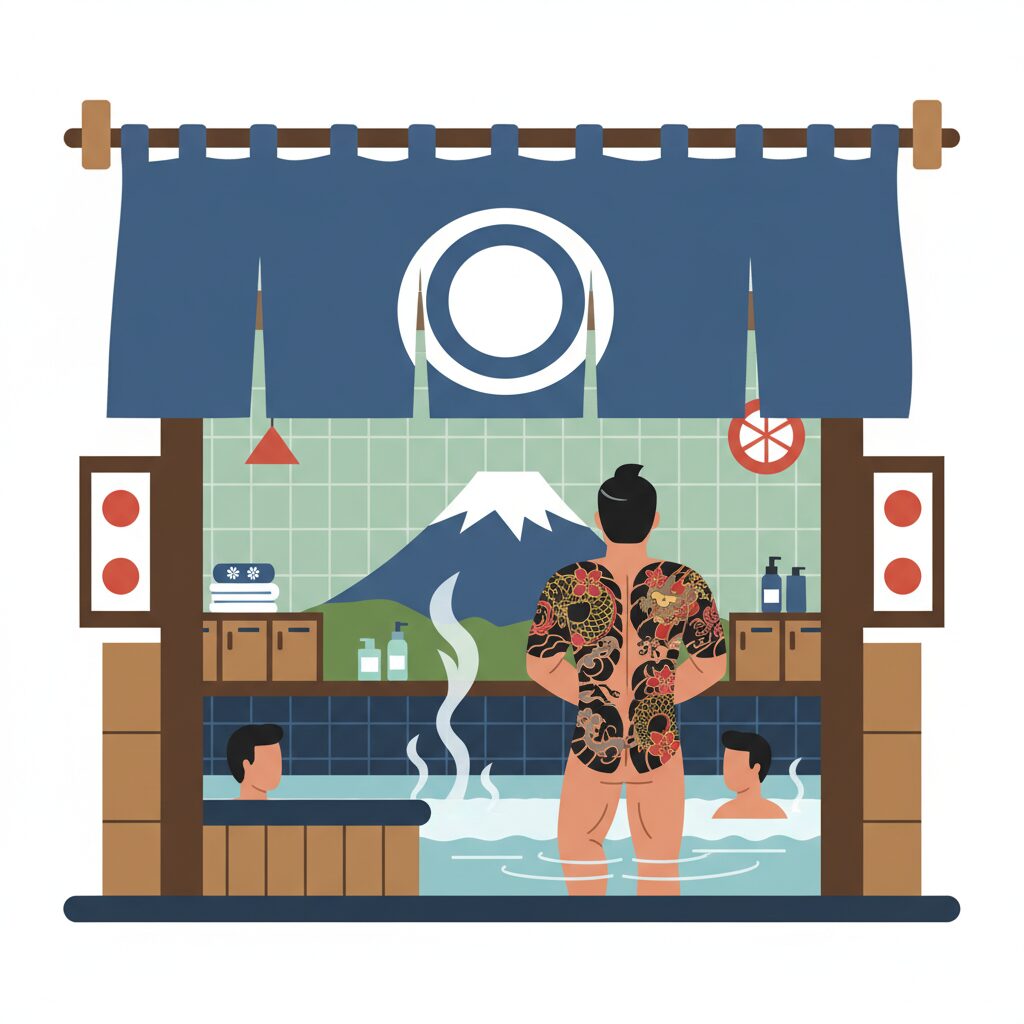
The typical Osaka sentō reflects Showa-era design and resilience. You’ll pass under a faded noren curtain into a small entryway lined with shoe lockers. The center of activity is the bandai, a high, throne-like seat where the attendant—often an elderly man or woman—oversees both men’s and women’s changing rooms, collects the fee (a municipally set 490 yen, a bargain for the experience), and keeps watch over everything. The décor is practical, often somewhat worn. The tile work might be cracked, plastic stools marked from decades of use. Almost always, dominating a wall, is a grand mural of Mount Fuji. The irony of seeing Japan’s iconic eastern peak in western Japan is not lost on anyone, but this tradition is so embedded it feels natural. This isn’t a flaw; it’s the point. The sentō isn’t trying to be a sleek, modern facility. It embraces its age and history as a badge of honor. It is a living museum of a more communal era—a time Osaka appears less ready to forget than the rest of Japan.
Tokyo vs. Osaka Atmosphere: Efficiency vs. Eavesdropping
The cultural divide between Tokyo and Osaka is perhaps most evident in their bathhouses. A sentō in Tokyo, especially newer, popular ones, often resembles an extension of the city’s work ethic: efficient, clean, and anonymous. People enter, clean themselves, relax quietly, and leave. It’s a transaction. You’re there to use a service. Socializing is minimal, often absent. A polite nod might be exchanged, but full conversations with strangers are rare. The goal is personal rejuvenation in a calm, orderly setting.
Step into an Osaka sentō, and silence gives way to a low, continuous murmur of chatter mingling with the clatter of buckets and running faucets. It’s an intensely social space. This is where real conversations happen—the kind of frank gossip and commentary unheard in formal settings. Grandmothers argue over the price of daikon with the intensity of stock traders. Middle-aged men, submerged in 42-degree Celsius water, loudly analyze the latest disappointing performance of the Hanshin Tigers baseball team. It’s not just noise; it’s the city’s heartbeat. On my first visit with Tanaka-san, I observed a group of women carefully planning a neighborhood festival, their voices ringing off the tiles as they assigned tasks for food stalls and decorations. I learned more about the local community in that one hour of passive listening than in six months of living there. Here, you aren’t an anonymous customer; for a while, you’re woven into the fabric. The direct, open nature of Osaka’s people finds its perfect expression here. There’s no pretense, no tatemae (public face). It’s all honne (true feelings), all the time. This can be intimidating, but also deeply refreshing. It’s a place to be a fly on the wall of authentic, everyday life.
The Naked Truth: Navigating Nudity with Osaka Confidence
Let’s confront the obvious concern, or rather, the lack of clothing on everyone present. For many Westerners, communal bathing is the biggest challenge. We grow up in cultures that heavily sexualize nudity and fiercely protect privacy. The idea of undressing in front of strangers can trigger a flood of anxieties about body image, judgment, and personal space. The first step to enjoying a sentō is to consciously and deliberately leave those cultural hang-ups at the door, right alongside your shoes.
It’s Not About You, It’s About the Water
Here’s the most important fact about the Japanese bathhouse: nobody is looking at you. Let me emphasize that again. Nobody cares about your appearance. They are not judging your body, your tan lines, or your lack of muscle tone. Everyone is there for one reason: to get clean and soak in hot water. Nudity is purely functional, a necessary part of bathing. In this setting, it is completely desexualized. You’ll see bodies of all shapes, sizes, and ages—sagging skin of the elderly, taut forms of the young, round bellies of middle-aged men. It’s a powerful lesson in body neutrality. All bodies are simply vessels for life, and here, they are just vessels for getting clean.
The Osaka mindset enhances this liberating feeling. Osakans are known for being practical and unconcerned with superficial details. There’s a general “just get on with it” attitude. This applies to business, conversation, and certainly bathing. The pretense and performative modesty found elsewhere don’t exist here. People undress with straightforward efficiency that can be surprising at first but ultimately freeing. There’s no awkwardness or attempts to hide. This isn’t exhibitionism; it’s supreme confidence and comfort in a shared space. Once you realize your self-consciousness is a shield no one else notices, you can relax and enjoy the experience. The vulnerability you feel is your own projection. To others, you’re just another person needing a wash.
The Modesty Towel: Your Only Friend (and How to Use It)
Though the atmosphere is casual, it comes with unspoken rules and etiquette. Your key tool in this new environment is the small, thin towel, either brought from home or rented cheaply. Often called a “modesty towel,” this term is somewhat misleading. While it can provide a bit of coverage when moving between washing areas and baths, its main purpose is for washing your body—it’s your washcloth. Observing the etiquette around this small fabric is essential.
The most important rule is that the towel must never enter the bathwater. The tubs are for soaking clean bodies, and since you use the towel to scrub yourself, it is considered dirty. Bringing it into the communal bath is a major faux pas. So, what to do with it? Locals show two acceptable options: either fold it neatly and place it on the bath’s edge, or, demonstrating practiced skill, rest it atop your head. Though it might look odd at first, it signals someone who knows the rituals. This keeps the towel clean and out of the way. In Tokyo, accidentally dropping your towel in the water might earn a subtle, disapproving glance. In Osaka, an old man might simply shout, “Oi, the towel!” without hostility. It’s not an insult but a straightforward correction. They aren’t shaming you; they’re efficiently enforcing shared rules. Think of it less as a strict law and more as part of the sentō choreography. Adhering to it shows respect for the space and fellow bathers, marking you as someone who understands and values the culture rather than just a passing tourist.
Ink and Onsen: The Thorny Issue of Tattoos
The issue of tattoos is perhaps the most sensitive topic for foreigners eager to experience Japanese bathing culture. The numerous “No Tattoos” signs posted at the entrances of many onsen, gyms, and swimming pools can feel like a personal rejection. While this policy may seem outdated and discriminatory to outsiders, it is deeply rooted in a complex social history. Understanding this background is the first step to navigating the reality on the ground, especially in a pragmatic city like Osaka.
The “No Tattoos” Sign: A Vestige of Another Time?
The link between tattoos (irezumi) and organized crime (yakuza) in Japan is not merely a stereotype but a historical reality. Throughout much of the 20th century, elaborate, full-body tattoos were exclusive to the yakuza, serving as a visible symbol of their commitment to a life outside mainstream society. The tattoo bans in public facilities were therefore not about aesthetics or a dislike of body art but were a straightforward, effective way for businesses to reassure customers that their venue was a safe, neutral space free from the influence of organized crime—a promise of safety for ordinary families.
In the 21st century, however, this association has significantly weakened. Tattoos have become increasingly popular among young Japanese as a form of fashion and self-expression, heavily influenced by Western culture. Many foreigners living and working in Japan have tattoos that bear no relation to criminality. Yet, the bans persist. Why? Because for many establishments—especially large, corporate-owned chains and upscale resorts—a blanket ban remains the simplest, safest policy. It avoids any potential confrontation or ambiguity. It’s a rule from a past era, applied rigidly today. In Tokyo, a city that often values order and strict rule-following, this ban is commonly enforced without exception. Even a small butterfly tattoo might get you turned away as swiftly as a full back piece. But Osaka, true to its nature, plays by a slightly different set of rules.
Osaka’s Gray Area: The Unspoken Sentō Norms
Here, living in Osaka showcases its distinctive character. While “No Tattoos” signs may still hang on some sentō doors, the reality inside is often far more nuanced and flexible. Many of Osaka’s traditional, family-run neighborhood baths operate on a different basis: community familiarity over corporate policy. The owner of a local sentō—the oyaji (old man) or obachan (auntie) behind the bandai—knows their customers well. They recognize the carpenter from down the street who sports sleeves on both arms and has been coming faithfully every Friday for thirty years. They know he isn’t a gangster; he’s simply someone who appreciates tattoos. They won’t suddenly exclude him based on a rule that no longer holds its original significance.
In Osaka, pragmatism and personal relationships outweigh abstract rules. The city’s history as a merchant town emphasizes reputation and conduct over strict social codes. This mindset extends to the sentō. The true, unspoken rule in many such establishments isn’t “no tattoos,” but rather “don’t cause trouble.” If you are respectful, follow bathing etiquette, and avoid drawing attention to yourself, your tattoos are far less likely to become an issue. Your behavior is what truly matters.
For tattooed foreigners, a bit of strategy is advisable. Your best option is to seek out smaller, older, more local machinoyu in residential neighborhoods, away from the tourist-heavy areas of Namba or Umeda. Avoid large, glossy “super sentō” complexes, which are more likely to enforce strict corporate-style rules. If you’re apprehensive, try visiting during off-peak hours, such as a weekday afternoon. Upon entering, be polite and confident—bow slightly to the attendant, pay your fee, and go about your business. The key is to project the demeanor of someone who belongs and understands the etiquette. More often than not, no one will say a word. Other patrons come for their own bath, not to judge the tattooed skin of a stranger. In Osaka, a city known as a melting pot and refuge for the slightly non-conformist, there is greater willingness to judge people by their actions rather than their appearance. And in the honest, exposed environment of the sentō, this principle shines clearly.
The Sentō Ritual: A Step-by-Step Guide for the Uninitiated
While the social atmosphere in an Osaka sentō is relaxed and informal, the bathing process itself follows a well-known, almost sacred, ritual. These steps are not intended to be intimidating; rather, they form a practical sequence designed to promote hygiene, respect, and relaxation for everyone. Mastering this ritual is essential to experiencing a truly authentic visit and transitioning from a nervous outsider to a confident participant.
Before You Even See the Water
Your journey starts at the entrance. You’ll remove your shoes and place them in a small locker, taking the wooden key with you. Next, you’ll approach the bandai or a ticket machine to pay the entrance fee. You might also have the option to purchase or rent any forgotten items like a small towel, soap, or a disposable razor. Many regular visitors bring their own bath kits—a small plastic basket or waterproof bag containing their favorite shampoo, conditioner, body wash, and face cleanser. This is a savvy move, but not mandatory. After paying, proceed to the appropriate noren curtain: blue or purple with the kanji for man (男) or red or pink with the kanji for woman (女). Inside is the changing room (datsuijo), a simple space with lockers, benches, and perhaps a few fans or an old TV. Find an empty locker, take the key (usually on an elastic wristband), and face the moment of truth: undress completely. Store your clothes and large towel in the locker, and with only your small wash towel and toiletries in hand, you’re ready to enter the bathing area.
The Cardinal Sin: Washing Before You Soak
If you remember just one rule, let it be this: you must wash your entire body thoroughly before even thinking about entering the tubs. The baths contain shared, clean water meant for soaking, not cleaning. Entering the tub with an unwashed body is the most serious breach of sentō etiquette. Upon entering the main bathing room, you will see rows of washing stations along the walls. Each station features a faucet (often with a shower head), a small plastic stool, and a bucket. The proper etiquette is to sit on the stool while washing. Standing while washing is considered rude because it may splash others. Use your small towel as a washcloth to give yourself a thorough scrubbing from head to toe. This is not a quick rinse; take your time. This pre-soak cleansing is as integral to the ritual as the soak itself. After you’re completely clean and have rinsed off all soap, you may approach the tubs. You might notice a small basin for kakeyu near the main bath, used to scoop some bath water to pour over your body to help acclimate to the temperature before entering—it’s a final respectful gesture before the main soak.
The Art of the Soak: From Atsuyu to Denkiburo
Now comes the reward. Osaka sentō typically feature various baths, each providing a unique experience. The main tub usually contains scalding hot water (atsuyu), often between 41 and 43 degrees Celsius (106–109°F). Ease yourself in slowly, as it can initially be shocking to the system. The goal isn’t to splash or swim but to submerge your shoulders and allow the heat to relax your muscles. Here, you’ll find people in states of blissful repose, gazing at the Mount Fuji mural or quietly chatting with friends.
Beyond the main bath, there may be a jet bath (jetto-buro) with powerful water streams designed to massage your back and legs. Then there’s the denkiburo, or electric bath, a uniquely Japanese feature that adventurous visitors should try. Two plates on opposite walls of a small tub pass a low-voltage electric current through the water; as you sit between them, your muscles will tingle and contract involuntarily. It’s a strange, slightly startling sensation, believed to relieve muscle pain, and a classic feature of older sentō. There is almost always a cold plunge pool (mizuburo), intended for a brief, refreshing dip after warming up in the main bath or a sauna (if available). The contrast invigorates and is said to have various health benefits. The key is to move slowly, listen to your body, and find what works best for you. This part of the ritual is about pure, undisturbed relaxation.
Beyond the Bath: The Real Cultural Immersion
The sentō experience doesn’t conclude the moment you step out of the water. The post-bath ritual, which happens back in the changing room, is just as vital a part of the cultural immersion. This cool-down phase offers a relaxed transition back to the outside world and is where some of the most delightful and memorable moments take place. It’s here that the sentō establishes its role not simply as a place for cleanliness, but as a genuine third space within the community.
The Post-Soak Attire: Yukata and Vending Machine Milk
After drying off completely, you’ll notice the changing room feels more like a lounge than a locker room. People don’t rush to get dressed and leave; they linger. You might see elderly men in simple cotton yukata, sitting in front of fans, reading the horse racing section of the newspaper. There could be an old, bulky massage chair in the corner that will shake you for 100 yen. There’s almost always a classic analog weighing scale with sliding weights, used with a sense of ritualistic seriousness. But the key element of the post-bath experience is the drink. Every sentō features a vending machine or a traditional cooler stocked with various beverages, yet the undisputed favorite is milk, served in a nostalgic glass bottle. You have three main options: plain milk, coffee milk, or fruit milk (a sweet, somewhat fruity blend). The proper way to enjoy it, as shown by generations of bathers, is to place one hand on your hip, tilt your head back, and gulp down the entire bottle in one go. It’s a simple, perfect pleasure—a nostalgic taste of childhood for many Japanese and a refreshingly effective way to rehydrate. This shared cultural moment is a small act that connects everyone who has participated in the same ritual in this same spot.
The Sentō’s Role in Everyday Life in Osaka
Ultimately, the local sentō is a microcosm of Osaka itself. It reflects the city’s practicality, lively social nature, straightforwardness, and strong community ties. This isn’t a special occasion but a fundamental part of the weekly routine for countless residents. It’s where construction workers and office clerks soak side by side, leaving behind their daily uniforms and social status in a locker. Nude, everyone stands equal. This spirit of equality lies at the heart of the Osaka mindset. People here tend to value character, humor, and openness more than hierarchy. The sentō perfectly embodies this ethos. It’s a place built on trust and mutual respect, governed less by strict rules and more by a shared understanding of communal living. To truly grasp why Osaka feels so different from Tokyo—why it seems more grounded, human, and unvarnished—you must experience it at its most unguarded. And nowhere is more unguarded, honest, or quintessentially Osaka than inside the steamy, noisy, and welcoming walls of a neighborhood sentō. It’s more than just a bath—it’s a lesson in how to live together.