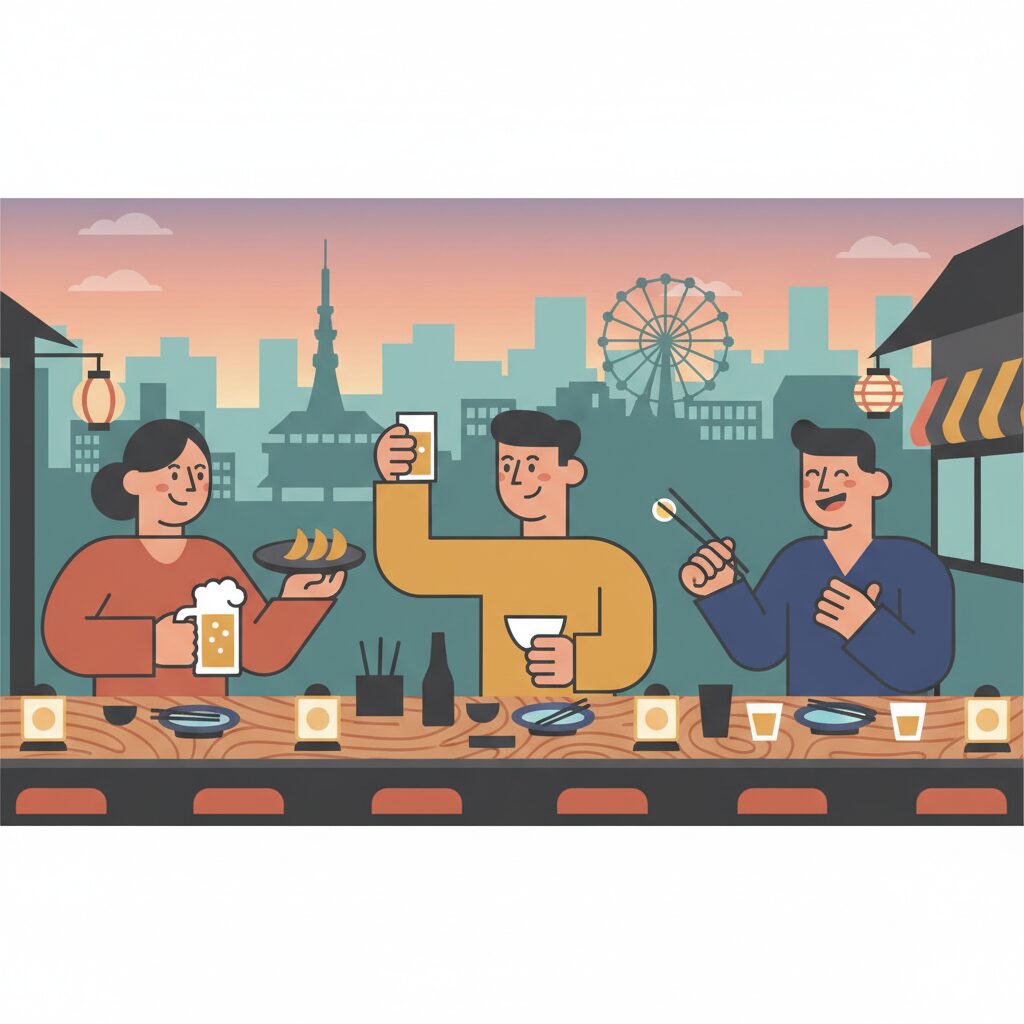
When you first arrive in Osaka, especially if you’re coming from the polished, almost reverently quiet corridors of Tokyo, the city hits you with a different kind of energy. It’s a rhythmic chaos, a symphony of bicycle bells, sizzling takoyaki, and booming vendor calls. You feel it in the way people walk, a little faster, a little more purpose in their step, but with eyes that are always scanning, always ready to connect. But to truly understand the heartbeat of this city, you have to find your way into one of its most essential, and initially intimidating, institutions: the tachinomi. The standing bar. From the outside, they can look like nothing more than a cramped, smoky box crammed with grizzled old men, a blur of motion and noise spilling onto the street. You might walk past, thinking, “That’s not for me. That’s a locals-only club.” That’s where you’d be wrong. Dead wrong. The tachinomi is not a club with a secret handshake; it’s an open invitation. It’s the city’s communal living room, its decompression chamber, and the most honest classroom you’ll ever find for learning what it truly means to live and breathe Osaka. As a Tokyo native, my first encounters were a culture shock. In Tokyo, drinking is often a structured affair, something you do with colleagues you’re supposed to be with, or friends you’ve made a reservation with weeks in advance. Here, it’s as casual as grabbing a coffee. It’s a pit stop, a punctuation mark in the long sentence of a working day. Forget what you think you know about bars. Forget the moody lighting, the curated playlists, the pretense. A tachinomi is a transaction of a different kind—not just of money for beer, but of stories, of laughter, of a shared, fleeting moment of community. This is where you’ll understand why people say Osakans are friendly, not because it’s a cute cliché, but because in a space this tight, with no chairs to hide behind, being anything else is simply inefficient. The tachinomi is the soul of Osaka, standing up, shoulder-to-shoulder, and ready to talk.
To truly immerse yourself in the city’s unique rhythm, understanding the passion for the local baseball team is as essential as navigating its vibrant standing bar culture.
The Unspoken Architecture of the Tachinomi
To truly grasp what a standing bar is all about, you need to look beyond the worn Noren curtains and the hand-written menus taped to the walls. You have to appreciate the philosophy behind its design. It’s an architecture of interaction—a space crafted not for comfort, but for connection. Every detail, from the absence of chairs to the cash-on-the-counter system, is a purposeful choice shaping the social dynamics inside. It’s a masterclass in social engineering, Osaka style, where efficiency and humanity are not opposing forces but two sides of the same coin. This isn’t just a bar; it’s a finely tuned machine for creating fleeting, genuine moments of community among strangers.
No Chairs, No Walls: The Philosophy of Open Space
The most noticeable feature, of course, is the lack of chairs. A first-time visitor might assume this is just a space-saving strategy, a way to fit more paying customers into a small area. And yes, in a city where real estate is precious, that plays a part. But it goes far deeper than that. The absence of seating fosters a fundamental sense of impermanence and fluidity. You’re not settling in for the night; you’re just dropping by. This lowers the barrier to entry to almost nothing. You don’t need to commit to a full evening; you can grab a quick beer and a skewer, then be out the door in fifteen minutes. This gentle, continuous turnover of patrons is the lifeblood of the tachinomi. New faces bring fresh energy and new conversations. The entire space remains in a state of soft, constant motion.
Then there’s the counter. It’s more than a place to set your drink; it’s the stage. In most tachinomi, the layout is designed so everyone faces inward, toward the action—the chef frying kushikatsu, the bartender pulling draft beer. This creates a shared focal point. Unlike a traditional bar with private tables and booths encouraging isolated groups, here everyone shares the same scene. You’re not just with your friends; you’re part of the entire room. You can’t help but overhear the conversation next to you about the Hanshin Tigers‘ latest game or gossip about a new shop opening in the shotengai. This shared experience is the unspoken catalyst for interaction. The physical boundaries are fluid, too. Many tachinomi are fully open to the street, with only a vinyl curtain to block the worst of the winter chill. This blurs the line between the bar and the city itself. The sounds and smells of the street flow in, and the lively energy of the bar flows out. It’s an open invitation, a living advertisement that says, “We’re here, we’re having fun, come on in.” This is a sharp contrast to Tokyo’s often discreet, subterranean bars, where the entrance feels like a secret you have to uncover. In Osaka, the community isn’t hidden; it’s on full display.
The Art of ‘Senbero’: The Thousand-Yen Buzz
Now, let’s look at the engine driving this social machine: the concept of ‘Senbero.’ The word itself is a clever piece of Japanese slang—a blend of ‘sen-en’ (1,000 yen) and ‘berobero’ (drunk or tipsy). The promise is simple: you can enter with just one 1,000-yen coin and leave pleasantly buzzed. This isn’t a mere happy hour deal; it’s a fundamental principle. In a typical tachinomi, a draft beer might cost 300 or 400 yen. A chuhai (shochu highball) could be even cheaper. The food—the essential ‘otsumami’ that pairs with the drink—comes in small, very affordable portions. A couple of kushikatsu skewers for 200 yen. A small bowl of doteyaki, the rich, savory beef sinew stew, for 300 yen. A scoop of potato salad for 250 yen. You can easily enjoy two or three drinks and a couple of snacks and still get change from your 1,000-yen bill.
The economic importance of this cannot be overstated. Senbero makes socializing radically accessible. It democratizes the after-work drink. Whether you’re a company president or a part-time construction worker, everyone can stand at the same counter, drink the same beer, and grumble about the same politicians. This is deeply rooted in Osaka’s history as a city of merchants. Value for money, or ‘cosupa’ (cost performance) as it’s called in Japan, is paramount. Osakans have an almost allergic reaction to being overcharged. A tachinomi thrives by offering unbeatable value. The food isn’t fancy, but it’s delicious, honest, and satisfying. It’s fuel for conversation. While Tokyo certainly has cheap drinking spots, the Senbero culture in Osaka feels less like a trend and more like a birthright. It embodies the city’s pragmatic, no-frills character. It proclaims that community shouldn’t be a luxury—it should be as affordable and accessible as a bowl of udon.
Decoding the Social Code: How to Behave in an Osaka Standing Bar
Walking into a crowded tachinomi for the first time can feel like stepping onto a stage without a script. The rules are unwritten, the pace is quick, and everyone appears to know their role. Yet, the social code, though unspoken, is actually quite straightforward and remarkably welcoming once you grasp the basic principles. It centers on a shared understanding of space, time, and the communal nature of the experience. Mastering it isn’t about memorizing a set of dos and don’ts; it’s about tuning into the room’s rhythm and embracing the local spirit of cheerful, efficient camaraderie.
‘Tonari wa Minna Tomodachi’: Your Neighbor is Your Friend
There’s a phrase you might hear in Osaka: ‘Tonari wa minna tomodachi,’ which roughly means, “Everyone next to you is a friend.” In a packed tachinomi, this is more than just a charming saying; it’s a practical reality. The close physical proximity and the need to shuffle around to make space for newcomers quickly break down personal barriers. You’re literally rubbing elbows with strangers, so you may as well strike up a conversation. Coming from Tokyo, this was the biggest change. In a Tokyo bar, invisible walls separate strangers, creating a barrier. Starting a chat with someone you don’t know is a bold move, often met with hesitation. In an Osaka tachinomi, it’s quite the opposite—silence stands out more than conversation.
Don’t be shocked if the elderly man next to you asks where you’re from, what you do for a living, or your thoughts on the local baseball team. This isn’t nosiness; it’s a common icebreaker. This is how connections begin. The conversation might be brief, just long enough to finish a beer, but it’s authentic. You’ll also see the classic Osaka ‘boke’ (funny man) and ‘tsukkomi’ (straight man) comedic interplay unfolding spontaneously between strangers. A playful jab, a teasing insult, an exaggerated reaction—this is their way of showing affection. It’s a way of saying, “I see you, I recognize you, let’s share a laugh.” The key is to relax and go with the flow. If someone jokes at your expense, smile. If they offer some of their fried chicken, accept it. You’re not just a customer; for that brief moment, you’re part of the bar’s temporary, ever-changing family.
The Ritual of the Order: Speed, Simplicity, and Cash on the Counter
Watching the ordering process in a busy tachinomi is like observing a well-rehearsed dance. It’s all about speed and efficiency. Many bars operate on a ‘cash on delivery’ system, known as ‘kyasshu on deribarii’ in Japanglish. When you order a drink or a dish, you place your money on the counter, often in a small tray. The staff then takes the money and brings your change along with your order. This clever system removes the need to ask for the bill at the end, making the transaction fast, clean, and transparent.
This system also highlights the transient nature of the tachinomi experience. Since you’re always paid up, you can leave at any time. There’s no awkward signaling for service or figuring out how to split the bill. When you’re ready to go, simply nod slightly or say a quiet ‘gochisousama’ (thank you for the meal) and slip out. This reflects the ‘sassato nonde, sassato kaeru’ philosophy—drink quickly, leave quickly. The unspoken rule is not to occupy a spot at the counter for hours, especially when it’s busy. A tachinomi is neither an office nor a lounge. It’s a high-turnover social spot. You come in, enjoy your drink and conversation, then make way for the next person. It’s a beautifully efficient system that helps the bar serve many guests, keeping energy high and prices low.
What to Order When You Don’t Know What to Order
For newcomers, the menu—often just strips of paper with handwritten Japanese—can be intimidating. But don’t worry. There are some universal constants. The safest and most common opening line in any Japanese drinking spot is ‘Toriaezu biru,’ which means “Beer for now.” It buys you time and gets a drink in your hand. From there, observe what others are eating. Pointing is perfectly acceptable. Some classic tachinomi staples you can’t go wrong with include ‘Doteyaki’ (slow-cooked beef sinew in miso sauce), ‘Kushikatsu’ (deep-fried skewers of meat and veggies; remember the cardinal rule: no double-dipping in the communal sauce!), and surprisingly, ‘Potesara’ (potato salad). Nearly every tachinomi has its own version of potato salad, often surprisingly delicious. The key is to be decisive. Catch the staff’s eye, state your order clearly and confidently, and have your money ready. They’re busy and appreciate a customer who understands the rhythm. Don’t hesitate—just jump in. The worst that can happen is you get something unexpected, which often makes for a great story later.
The People You’ll Meet: A Cross-Section of Osaka Life
A tachinomi serves as a powerful social equalizer. People from every background gather side by side, free from the status symbols of office chairs or upscale restaurant tables. It’s a small reflection of the city, where you can observe the everyday dramas, comedies, and quiet moments of ordinary Osakans. The regular cast of characters remains largely the same from one bar to another, each playing an essential role in the ecosystem of this distinctive social space. Spending an hour at the counter is like fast-forwarded people-watching, offering an unvarnished, intimate glimpse into the city’s spirit.
The Salaryman’s Decompression Chamber
By 5:30 PM, the mood in any tachinomi near a major train station begins to change. A steady stream of office workers—salarymen and office ladies alike—file through the door. Arriving solo or in pairs, their faces still carry the weight of corporate discipline. But with the first cold beer in hand, a shift happens. Shoulders loosen. Ties slacken. The strict formalities of the Japanese workplace dissolve beneath the fluorescent lights. This is their decompression chamber. It’s a place to move from ‘tatemae’ (public facade) to ‘honne’ (true feelings). Here, they can vent about a difficult boss, grumble over missed targets, or toast small victories, all free of workplace judgment. The conversations blend work talk, sports commentary—especially if the Hanshin Tigers have won—and thoughtful reflections on life. This stands in stark contrast to the structured, often compulsory, corporate drinking parties known as ‘nomikai.’ The tachinomi is a voluntary refuge, a personal ritual. It’s where the individual worker reclaims a bit of themselves before boarding the crowded train home.
The ‘Obachan’ and the ‘Ojjichan’: Guardians of the Tradition
At the core of any enduring tachinomi are the regulars—the older men (‘ojjichan’) and women (‘obachan’) who have held the same spot at the counter for years or even decades. They embody the living memory of the place. They know the owner, the ‘taisho,’ by his first name and recall when his children were born. They serve as an unofficial welcome committee and protect the bar’s distinctive culture. These are the folks most likely to spark a conversation with a newcomer, their curiosity stirred by a fresh face. Their questions may seem blunt—‘Where are you from? Are you married? How much is your rent?’—but they stem from genuine interest, a wish to locate you within their world map. They might offer unsolicited advice on everything from love life to the best way to enjoy a dish. This is where the stereotype of the “friendly Osakan” comes to life. It’s not shallow friendliness; it’s pragmatic, neighborly connection. In a community, you watch out for one another, and for the duration of your drink, you become part of theirs. Listening to their stories—in rich Osaka dialect, full of dry humor—is like getting a history lesson no book could offer.
The New Generation: Young People and Foreigners
It would be wrong to see tachinomi as places only inhabited by the older crowd. In recent years, a new generation of Osakans has rediscovered these standing bars. Young people, tired of pricey and often impersonal trendy bistros, are drawn to tachinomi for their authenticity, affordability, and lively social vibe. You’ll find young couples on budget-friendly dates, groups of university students kicking off evenings out, and solo drinkers of all ages savoring moments of quiet amidst the bustle. This influx of new energy keeps the tradition vibrant and evolving. Alongside them, a growing number of foreigners also frequent these spots. For expats seeking to escape the expat bubble and connect with the real city, the tachinomi offers a unique doorway. Contrary to the misconception that these bars are closed or unfriendly to outsiders, the truth is often quite the opposite. As a foreigner, you’re seen as a novelty, a source of intrigue. Your presence breaks the monotony. With even a few Japanese phrases—‘konbanwa’ (good evening) and ‘arigatou’ (thank you)—you’ll find doors opening wide. Locals will be eager to practice English, ask about your home country, and share their city with you. At the tachinomi, being a foreigner isn’t a barrier but an instant icebreaker.
Tachinomi as a Mirror to the Osaka Mindset
If you want to grasp the core values of Osaka, you don’t need to study a sociology textbook. Simply spend an evening in a tachinomi. These standing bars are more than just cultural fixtures; they perfectly embody the city’s spirit. Their design, the behavior of patrons, and the very purpose they serve all reveal Osaka’s defining traits: fierce pragmatism, a deep-rooted skepticism of pretense, and a steadfast faith in the power of genuine human connection. In a tachinomi, the abstract ideas of the “Osaka mindset” become tangible, edible, and audible.
Practicality Over Polish: ‘Yasui, Umai, Hayai’
Much of life in Osaka is guided by an unofficial motto: ‘Yasui, Umai, Hayai’—Cheap, Delicious, Fast. This trio of values, born from centuries of merchant culture, forms the city’s operating system and is vividly on display in every tachinomi. The emphasis is unwaveringly on substance rather than style. The décor might feature peeling posters and a calendar from years past. The floor could be somewhat sticky. The lighting is often harsh and unflattering. Yet none of that matters. What matters is the cold beer, the hot and flavorful food, and the speed and affordability of service. This is Osaka pragmatism at its core. Why spend on fancy interiors when you can invest in better ingredients or pass savings on to customers? It stands in sharp contrast to Tokyo, where presentation, branding, and aesthetic polish often matter as much as the product itself. In Tokyo, you pay extra for ambiance and a curated experience. In Osaka, you pay for the product itself. A tachinomi is valued not for its looks, but for its performance. This relentless prioritization of function and value manifests the city’s merchant spirit.
The Rejection of ‘Tatemae’: Honesty in a Glass
To understand Japan, you must grasp the concepts of ‘tatemae’—the polite, public facade one shows the world—and ‘honne’—one’s true, private feelings. In much of Japanese society, especially in Tokyo, maintaining ‘tatemae’ is a crucial social skill. People are indirect, considerate of others’ feelings, and rarely voice true opinions, especially if negative. The Osaka tachinomi is a ‘tatemae-free’ zone. It serves as a sanctuary of ‘honne.’ Here, powered by alcohol and the safety of a judgment-free space, people speak their minds with a directness that might surprise outsiders. They loudly gripe about work, passionately debate politics, and tease one another mercilessly. This frankness isn’t seen as rude but as honest. Emotions run high—laughter is louder, complaints sharper, and joy more openly shown. For someone from Tokyo, like myself, this can initially seem abrasive. But you soon recognize it as social intimacy. People feel comfortable enough—even with strangers—to let down their guard. The tachinomi offers a vital release from a society that often demands emotional restraint, a place where it’s okay to be imperfectly, messily, and authentically human.
The Human-Sized Scale of Community
The locations of tachinomi also reveal much. They are rarely found in gleaming skyscrapers or sterile corporate malls. Instead, they’re tucked beneath train tracks, nestled inside covered shopping arcades (‘shotengai’), and hidden in narrow residential side streets. They are woven into daily life’s fabric, acting as fundamentally local, human-sized institutions. Their presence is a quiet rebellion against the isolating trends of modern urban life. In a world dominated by smartphones and social media, tachinomi insist on the value of face-to-face, unmediated interaction. They serve as powerful “third places”—a sociological term coined by Ray Oldenburg—neither home nor work, where informal public life occurs. For many Tokyo commuters, life can feel like a silent, anonymous shuttle between private apartments and corporate office towers. The tachinomi rejects this model, insisting on a messy, noisy, vibrant intersection of public and private life—a place where you are not just a commuter or employee, but a neighbor and fellow citizen.
Finding Your Spot: Navigating Osaka’s Tachinomi Landscape
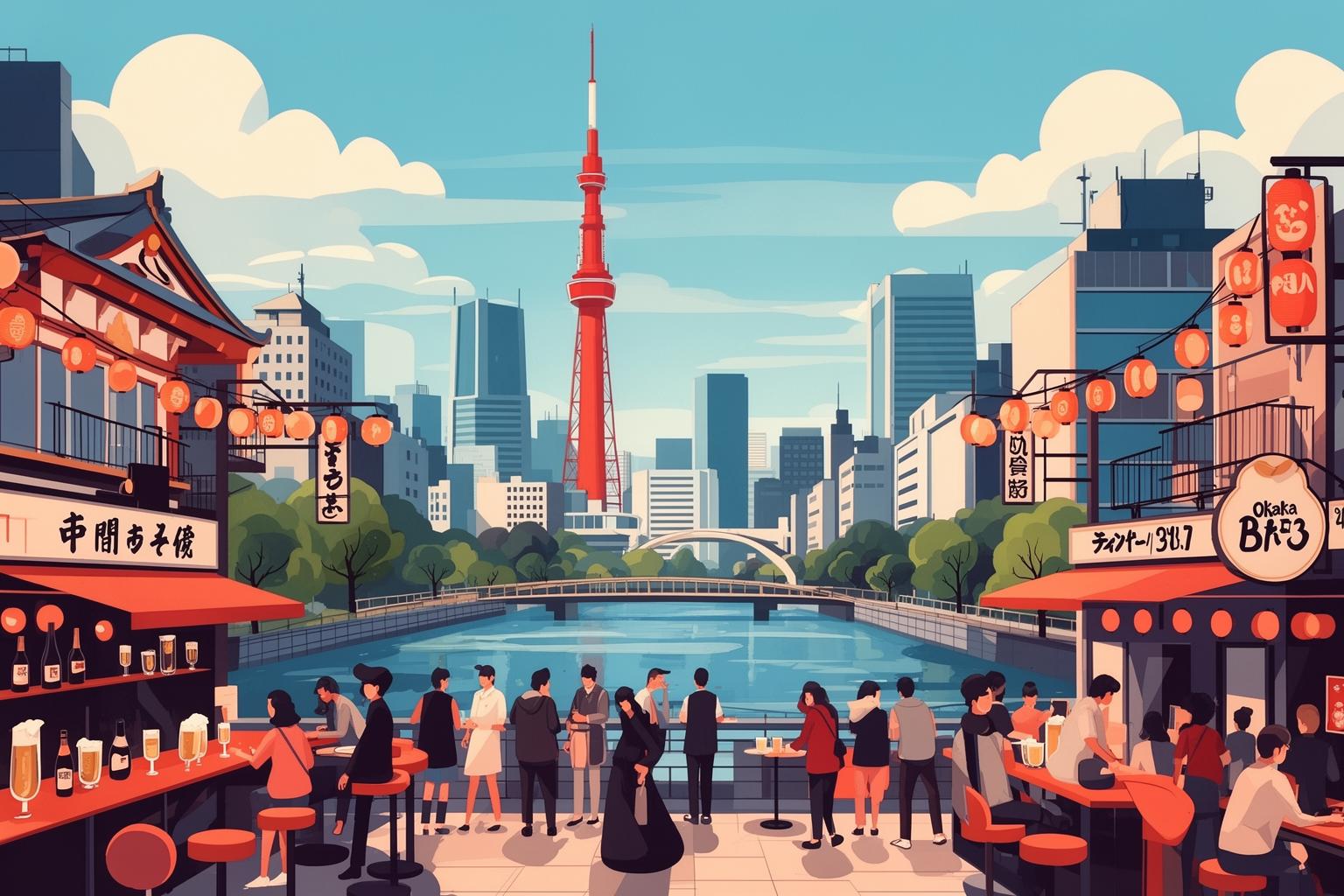
Osaka is bursting with tachinomi spots, ranging from long-established institutions to sleek, contemporary newcomers. Figuring out where to begin can be half the challenge. While you can find a standing bar in nearly every neighborhood, some districts have earned legendary reputations for their dense concentration and quality of choices. Each area boasts its own unique character, presenting a different facet of Osaka life. Exploring them is like discovering the city itself, one beer and one plate of doteyaki at a time. Whether you seek the classic, gritty atmosphere or a more approachable introduction, there’s a tachinomi neighborhood to suit you.
Kyobashi and Tenma: The Heavyweights
To plunge into the heart of Osaka’s tachinomi culture, head to Kyobashi or Tenma. These two areas stand as the undisputed titans—vast, chaotic mazes of standing bars, izakayas, and eateries. Kyobashi, a major transit hub on the city’s east side, is raw, lively, and proudly working-class. Around the station, covered arcades and narrow alleys intertwine, packed with tiny bars spilling patrons and noise onto the streets. It’s a salaryman’s haven, the perfect spot to unwind after a tough day. The atmosphere is loud, gritty, and vibrantly alive, feeling like one continuous neighborhood party.
Tenma, just north of the city center, offers a slightly different taste. Located next to the Tenjinbashi-suji Shotengai, Japan’s longest covered shopping arcade, Tenma mixes traditional, veteran tachinomi with a younger, trendier crowd and creative modern standing bars. You might encounter a bar focusing on Italian fare, craft beer, or fine sake beside a place that hasn’t altered its menu in fifty years. This blend of old and new makes Tenma an exciting area to explore. Equally chaotic and crowded as Kyobashi, it carries a more diverse and fashion-forward vibe.
Umeda and Namba: The Accessible Entry Points
If the full-on sensory barrage of Kyobashi or Tenma feels overwhelming, the main commercial hubs of Umeda and Namba offer more approachable yet still authentic options. Umeda, surrounding Osaka and Umeda Stations, serves as the city’s business and transport core. Despite being dominated by department stores and skyscrapers, a hidden world of tachinomi thrives in the basements of the ‘Ekimae Buildings’—Dai-ichi, Dai-ni, Dai-san, and Dai-yon. These unassuming office buildings house legendary basement floors filled with affordable and cheerful eateries and standing bars, making them a great place to begin your tachinomi adventure.
Namba, Osaka’s southern entertainment and nightlife center, is another excellent choice. While its main streets bustle with tourists and bright signs, the back alleys, known as ‘ura-Namba,’ hold hidden treasures. Away from the neon glare, classic tachinomi joints have served locals for generations. These spots offer a welcome break from the main district’s hustle, providing a more traditional, grounded experience right in the action’s heart.
Shinsekai: A Trip Back in Time
For a truly unique and memorable experience, visit Shinsekai. Despite its name meaning ‘New World,’ this district is one of Osaka’s most nostalgic and old-fashioned areas. Dominated by the iconic Tsutenkaku Tower, Shinsekai feels like a set from the Showa Era. It’s gritty, slightly rough around the edges, and deeply proud of its working-class heritage. Known for kushikatsu, many tachinomi here are linked to kushikatsu restaurants. The atmosphere is even more raw and unfiltered than elsewhere in the city. You’ll find elderly men playing shogi (Japanese chess) in corners, listening to horse racing broadcasts on the radio. Shinsekai offers a glimpse into a disappearing side of Osaka’s soul. It’s fascinating, photogenic, and richly atmospheric. While perfectly safe during the day and evening, it’s a place where staying aware of your surroundings pays off, rewarding visitors with a rare, unvarnished experience of Osaka life.
Final Thoughts: The Standing Bar as Osaka’s Soul
Ultimately, a tachinomi is much more than just a place to grab a cheap drink. It functions as a social institution, a community hub, a living museum, and the most genuine stage for witnessing the everyday life of Osaka. It represents the city’s most treasured values: pragmatism, good value, a dismissal of empty formalities, and a strong, enduring belief in the importance of direct human connection. Standing at a crowded counter, you become part of a ritual as integral to Osaka’s identity as takoyaki or the local dialect. It’s where the city relaxes, speaks openly, and strengthens communal ties, one beer at a time.
My advice to anyone living in or visiting Osaka is simple: don’t be intimidated. Don’t let the noise, the smoke, or the seemingly unbreakable wall of regulars deter you. Walk up to a busy bar, find a small spot to squeeze in, catch the eye of the bartender, and say, “Biru, kudasai.” Order whatever looks good. Smile at the person next to you. You may not catch every word of the fast-paced conversation around you, but you will understand something far more important. You will feel the city’s heartbeat. You will realize that in Osaka, community is not something you have to search for; it happens to you, right there, standing shoulder-to-shoulder with a stranger who might just become a friend, if only for the next fifteen minutes.