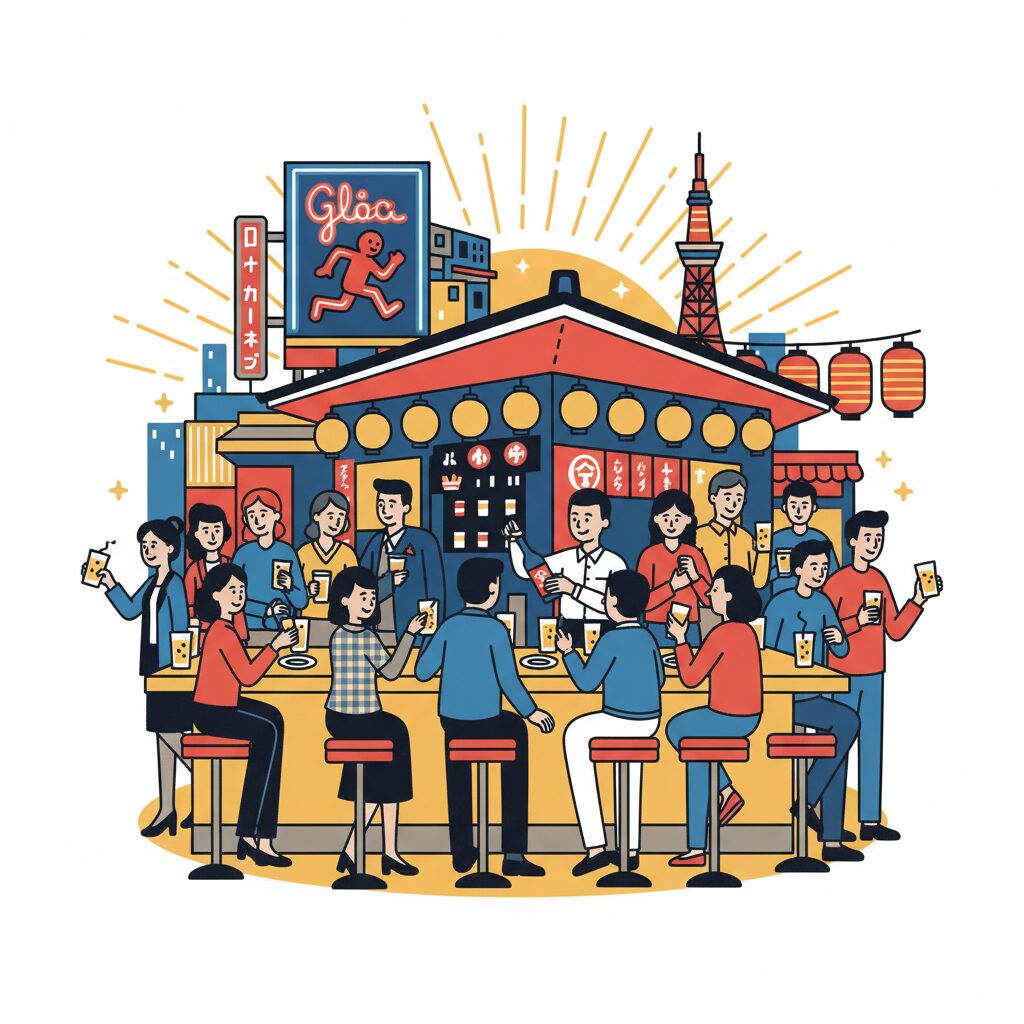
You’ve seen them, tucked into the narrow arteries of the city, glowing under a single red lantern. A cluster of people, standing shoulder to shoulder, glasses in hand, laughter spilling onto the street. This is the world of `tachi-nomi`, Japan’s standing bars. If you’ve spent any time in Tokyo, you might have filed them away as a simple concept: a place for a quick, cheap drink and a bite after a long day at the office. A functional, efficient transaction to bridge the gap between work and home. And in Tokyo, you’d often be right. It’s a pit stop, a human charging station running on highballs and yakitori, designed for speed and anonymity.
But here in Osaka, that assumption will lead you astray. It’s one of the first and most fundamental cultural misreads a newcomer can make. To equate an Osaka `tachi-nomi` with its Tokyo counterpart is like comparing a shared family dinner table to a sterile cafeteria counter. They may both serve food, but their purpose, their very soul, is worlds apart. Here, the standing bar is not a transitional space; it is a destination. It’s the city’s messy, vibrant, and incredibly accessible living room. It’s where the social fabric of a neighborhood is woven, thread by thread, over glasses of draft beer and plates of doteyaki. Forget the idea of a quiet, solitary drink. In Osaka, standing still means jumping into the conversation. This isn’t just about drinking; it’s about connecting in a way that feels raw, unfiltered, and uniquely Osakan.
Osaka’s communal energy isn’t confined to its bustling tachi-nomi, as delving into the vibrant shotengai scene reveals another cornerstone of the city’s rich social fabric.
The Tokyo Model: Efficiency in a Glass

To truly understand what sets Osaka’s standing bars apart, you first need to grasp the Tokyo model they challenge. Imagine a typical `tachi-nomi` hidden deep within a maze-like alley near Shimbashi or Shinjuku. The air is thick with the scent of grilled meat and stale cigarette smoke, but the noise is different. It’s a low, functional murmur. You’ll see salarymen in matching dark suits, standing in orderly rows along a straight counter. Each man is an island, focused solely on the glass before him. His shoulders may brush against the person next to him, but his mental space is a fortress.
If conversation occurs, it’s quiet and intentional, usually between two colleagues who arrived together. They review the day’s meetings, vent about a manager, and then, as if triggered by a silent signal, they finish their drinks, pay, and disappear into the night. Interaction with strangers is rare. The bartender is efficient, a quiet provider of services. You order, you receive, you pay. The entire experience is designed for a swift turnover. It’s a response to a need: affordable decompression before facing a taxing one-hour-plus commute home on a crowded train.
This model perfectly mirrors Tokyo itself. The city is built on safeguarding personal space in a densely packed environment. Anonymity is a form of courtesy. People get through the day by maintaining a respectful distance, both physically and emotionally. In this context, the `tachi-nomi` is not a social spot; it’s a private booth without walls. The aim is to recharge your own energy, not to connect to a shared power source. It fulfills its role perfectly, but that role is essentially individualistic.
The Osaka Standard: Where Strangers Become Neighbors
Now, let’s teleport to Kyobashi or Tenma in Osaka. The moment you step into a `tachi-nomi` here, the atmosphere hits you like a wave. It’s loud. It’s chaotic. And it’s intensely communal. Instead of a low hum, you hear roaring laughter, the sharp crack of a joke landing, and a dozen conversations weaving in and out of each other. People aren’t lined up in neat, silent rows. They’re clustered in loose groups, leaning toward each other to talk, gesturing animatedly, and passing food along the counter.
The entire experience is built on the assumption that everyone is a potential friend. The invisible walls that define personal space in Tokyo simply don’t exist here. You’ll order a drink, and the old man next to you will lean over and say, “That’s a good choice! But you should try the atsukan sake, it’s better for this weather.” Before long, he’s telling you about his grandkids and asking where you’re from. The woman on your other side might chime in, insisting the shochu is better. Suddenly, you’re not just a customer; you’re part of a lively debate.
This isn’t an exception; it’s the norm. The Osaka standing bar is a social melting pot by design. It’s a place where your job title, your background, and your status fade into the background. You’re judged not by who you are outside those walls, but by your willingness to engage within them. The goal isn’t to escape the world for a few minutes. It’s to dive into a smaller, more intimate version of it. The drink is merely your ticket of admission to the real show: the human connection.
The Anatomy of an Osaka Standing Bar
Understanding why these bars work this way means examining their core elements. It’s no accident; it’s a carefully cultivated environment, whether the owners realize it or not.
The Master: The Social Conductor
At the heart of every great Osaka `tachi-nomi` is the `taisho` (master) or `mama-san`. They are far more than just a bartender or cook. They are the conductor of the social orchestra. Standing at the center of the U-shaped counter, they do more than take orders—they read the room, connect people, and fuel the conversational fire. A good master knows the names of all the regulars, their jobs, their favorite baseball teams, and their recent challenges. They serve as a social hub, making introductions with a casual, “Ah, Kobayashi-san, this is Mike. He’s from America but he loves the Hanshin Tigers, just like you!” Just like that, a bridge is formed. They remember what you drank last time, ask how that project at work went, and make you feel seen. This personal investment turns a commercial transaction into a relationship.
The `Jouren`: The Core Community
The regulars, or `jouren`, are the bar’s pillars. They come several times a week, have their unofficial “spot” at the counter, and uphold the bar’s unique culture. To a newcomer, they might seem like an intimidating clique, but in Osaka, their role is quite the opposite. They are the welcoming committee. When they see a new face, their instinct is curiosity, not suspicion. They’ll be the first to start a conversation, recommend a dish, or include you in a round of jokes. Becoming a `jouren` yourself is a rite of passage that happens gradually. You show up consistently, engage, share a laugh. Then one day, you walk in and the master pours your usual drink before you even order, and the person next to you says, “You’re late tonight!” In that moment, you’re no longer simply a customer—you’re part of the community.
The Physical Space: Designed for Collision
Look at the layout of a typical Osaka standing bar. It’s often a cramped, U-shaped counter or a series of small, shared tables. This isn’t poor design; it’s a deliberate strategy. The tight quarters encourage interaction. You can’t help but make eye contact. You have to say “sumimasen” as you squeeze past someone to reach the restroom. This ongoing, low-level physical negotiation breaks down social barriers. It’s impossible to remain an anonymous ghost when you’re literally rubbing elbows with your neighbors. The U-shaped counter is especially clever. It puts everyone within everyone else’s sightline. Unlike a long, straight bar where you see only those immediately beside you, here you catch the expressions and reactions of everyone. It creates a shared stage where the entire room becomes one flowing conversation.
The Unspoken Rules of Osaka’s Tachi-nomi
Navigating this vibrant environment for the first time can feel overwhelming. There’s a set of unspoken rules, a social contract that everyone seems to grasp instinctively. Learning them is essential to fully embracing the experience.
Rule One: Don’t Isolate Yourself
The biggest mistake you can make in an Osaka `tachi-nomi` is trying to recreate the Tokyo experience. Standing quietly in a corner, staring at your phone, and ignoring those around you is viewed as odd, even somewhat rude. It contradicts the entire spirit of the place. You don’t have to be outgoing or fluent in Japanese. A simple nod to your neighbors upon arrival, a smile, or a `kanpai` toast to the room is enough to show you’re open to interaction. The expectation isn’t that you’ll lead the conversation, but that you’re willing to join in. Your presence implies a willingness to be part of the community, even in a small way.
Rule Two: The Etiquette of Sharing Plates
In many Western bars, ordering food is a solitary act. Here, it’s a social gesture. When you order a plate of `karaage` (fried chicken) or `toriwasa` (lightly seared chicken), don’t be surprised if your neighbor says, “Oishisou!” (That looks delicious!). This isn’t just a comment; it’s an invitation. The proper response is to smile and offer them a piece: “Douzo, hitotsu!” (Go ahead, have one!). This small act of goodwill is a powerful social lubricant. It’s an investment that immediately turns you from a stranger into a friendly face. This embodies a core Osaka value: while people may be famously frugal (`kechi`), they are also remarkably generous in hospitality and sharing good moments.
Rule Three: Understand the Cash-On System
Forget about running a tab or waiting for the bill at the end. Many traditional `tachi-nomi` operate on a “cash on” method. You’ll receive a small tray or bowl where you place a few thousand yen, and with each order, the staff will take the exact amount and return your change. This system is brilliantly efficient, but its social role is even more significant. It removes the formalities of payment from the interaction. There’s no awkward moment splitting the bill or waiting for card processing. Payments happen in real time, letting social flow continue smoothly. It keeps things casual, quick, and focused on connection rather than transaction.
Rule Four: Know When to Call It
An Osaka `tachi-nomi` isn’t for heavy drinking. It’s a marathon, not a sprint. The aim is to linger, chat, and enjoy the atmosphere. Although drinks are cheap, the social norm is to drink slowly and moderately. Getting drunk too quickly is a major faux pas that disrupts the room’s harmony. The goal is to be pleasantly buzzed—`horoyoi`, that ideal state where your guard is down just enough to ease conversation. The usual pace is ordering a drink and a small dish, finishing them over a good chat, then deciding if you’ll stay for another round. It’s about savoring the experience, not just consuming alcohol.
Why This Culture Thrives in Osaka
This distinctive social ecosystem is not a mere historical accident; it is a direct reflection of Osaka’s DNA. The city’s identity was shaped by its merchant heritage, and that spirit influences everything, particularly how people interact.
The Merchant City Mentality
While Tokyo was the city of samurai and bureaucrats, marked by hierarchy and formality, Osaka was known as the nation’s kitchen—a city of merchants (`shonin`). For centuries, business here was conducted not through strict protocols but through face-to-face relationships, trust, and sharp negotiation. A merchant’s success relied on their ability to understand people, build rapport, and seal deals with a handshake. This culture of straightforward, pragmatic, and personable communication has endured. The `tachi-nomi` is the modern incarnation of the merchant’s salon—a place where information is exchanged, networks are created, and relationships are strengthened in an informal setting. The skills developed over generations trading rice and textiles are now applied to making friends over a beer.
The Value of Comedy
In Osaka, a good story or a well-timed joke serves as social currency. The city’s identity as the home of Japanese comedy reflects a deep appreciation for humor and wit. People constantly seek out `neta`—material for an entertaining story or laugh. A `tachi-nomi` acts like a stage where everyone plays a role. Participants aren’t just talking; they are performing—telling stories with exaggerated gestures, playfully teasing friends (`tsukkomi`), and trying to outdo each other with funnier anecdotes. This creates a lively, engaging atmosphere where conversation is a form of sport. For outsiders, this can feel daunting, yet it is also warmly inviting. If you can enjoy a joke or simply laugh along, you’re already halfway to acceptance.
Convenience and Closeness
From a practical standpoint, the `tachi-nomi` fits perfectly with Osaka’s urban landscape. It’s a dense, compact city where many people live, work, and socialize within a handful of train stops. Unlike Tokyo’s vast metropolis requiring long commutes, life in Osaka is more localized. A standing bar offers an affordable, convenient “third place”—a neutral spot apart from home and work—where people can unwind and connect without traveling far or spending much. It extends one’s living space, particularly for those in smaller apartments, providing a readily accessible sense of community and belonging any night of the week.
What This Means for You, the Foreign Resident
So, what’s the main takeaway for someone aiming to build a life in Osaka? It’s straightforward: the standing bar is one of your strongest tools for integration. It serves as a living classroom for language, culture, and connection.
Of course, you can learn Japanese from a textbook, but you’ll grasp the real, living language—the slang, the Kansai dialect’s cadence, the flow of natural conversation—by listening and joining in at a `tachi-nomi`. The atmosphere is welcoming. People are patient, and the alcohol helps ease the anxiety of making mistakes. It’s the quickest way to move from textbook phrases to authentic communication.
Even more importantly, it’s a direct path to feeling a sense of belonging. Loneliness is often a genuine struggle when living abroad. In many cities, making local friends involves deliberate effort: joining clubs, attending organized events, or navigating intricate social scenes. In Osaka, you can create community simply by becoming a regular at your local standing bar. It provides an opportunity for spontaneous, serendipitous connections that are rare in today’s world.
Don’t hesitate to take the leap. Begin by finding a spot near your home. Walk by a few times to get a sense of the vibe. Then, one evening, take a deep breath and step inside. Order a beer. Smile at the person next to you. You might not have a life-changing conversation on your first visit, but you will have taken the most important step—you’ll have shown that you’re open to embracing the Osaka way.
In Tokyo, a standing bar is a place to be alone, together. It’s a pause button. In Osaka, it’s a play button. It’s a place to be together, together. It’s an invitation, a challenge, and an opportunity. It’s a microcosm of the city itself: slightly crowded, a bit loud, but with a heart big enough to welcome anyone willing to step in and say `kanpai`.