Welcome to Osaka, a city that moves to a different beat. If you’ve spent any time in Tokyo, you’ve likely mastered the art of polite distance, the subtle dance of reading the air, the world of ‘tatemae’. It’s a culture of unspoken rules, where social harmony is the ultimate prize, and conversations flow with a gentle, predictable current. Then you arrive in Osaka, and it feels like someone switched the music from a serene classical piece to a high-energy jazz improvisation. The quiet hum is replaced by a vibrant, sometimes chaotic, symphony of laughter, loud chatter, and a peculiar form of verbal jousting that can leave newcomers feeling both bewildered and strangely welcome. That signature phrase you’ve heard, ‘Nande ya nen?’—roughly, ‘Why the heck?!’ or ‘You’ve gotta be kidding me!’—is just the tip of the iceberg. It’s the gateway to a communication style built not on avoiding friction, but on embracing it with a playful shove and a wink. This isn’t about rudeness; it’s about connection. It’s about a city where the lines between public and private, stranger and friend, are wonderfully, confusingly blurred. Forget what you learned about reserved Japanese interactions. Here, the rulebook is different. It was written in the bustling markets and raucous theaters of a merchant city that has always valued a quick wit and a genuine laugh over quiet formality. To truly live here, you have to learn the rhythm of the banter.
Osaka’s vibrant community spirit can also be experienced in its bustling shotengai, where lively commerce and casual interaction blend to create an unmistakably local atmosphere.
The Heartbeat of Banter: Understanding ‘Boke’ and ‘Tsukkomi’
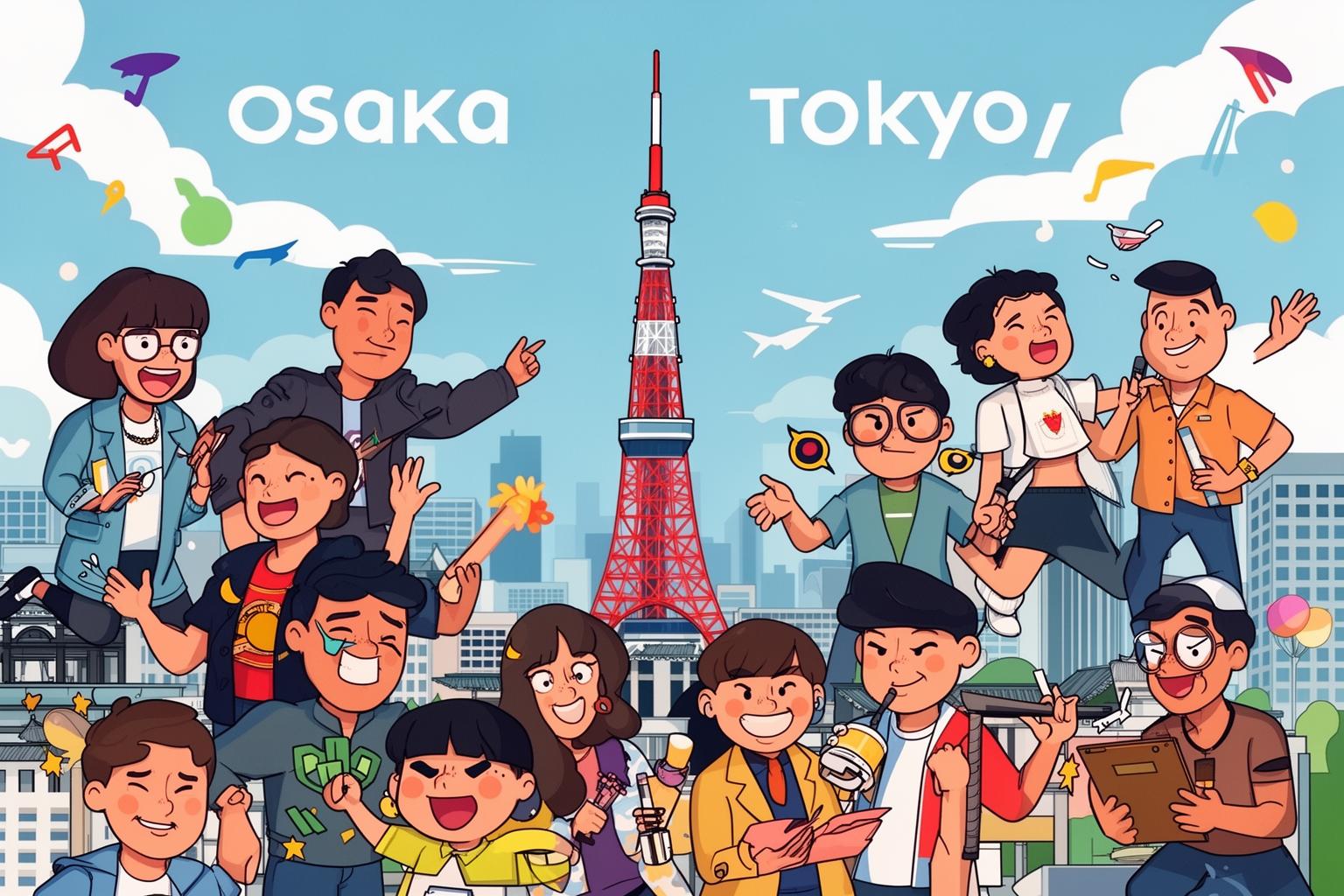
To grasp daily conversation in Osaka, you first need to understand the two essential roles in Japanese comedy, which extend beyond the stage to everyday interactions on sidewalks, in shops, and at dinner tables. These roles are the ‘boke’ and the ‘tsukkomi’. The ‘boke’ is the humorous one, the airhead, who utters or does something absurd, silly, or nonsensical. The ‘tsukkomi’ is the straight man, who quickly points out the absurdity with a sharp, witty comeback. Think of it as a conversational rally. The ‘boke’ serves the ball, and the ‘tsukkomi’ returns it with a smash. This isn’t a single joke; it’s the basic framework of countless exchanges.
Imagine this: you’re in a clothing store in Amerikamura, holding up a brightly colored, somewhat outrageous jacket. In Tokyo, a shop assistant might approach and say, “That’s a very unique design. It would make a bold statement.” They’re being polite, descriptive, and encouraging without imposing a strong opinion. In Osaka, the shopkeeper might come over, look at the jacket, then at you, and say with a grin, “Wow, you’re brave! Planning to join the circus with that thing?” This isn’t an insult. It’s an invitation. Your role now is to play along. You’ve been given the ‘boke’ (the absurd notion of you joining the circus). The expected reply is a ‘tsukkomi’. You might laugh and say, “Nande ya nen! I’m just trying to bring some color into this city.” Or, “Yeah, I’m the main act. You want a ticket?” By responding, you complete the cycle. You’ve shared a moment of humor. You’re no longer just a customer; you’re part of the local culture. This dynamic is everywhere. Your friend trips on a perfectly flat sidewalk (‘boke’). You immediately quip, “Nice dance moves. What do you call that one?” (‘tsukkomi’). The cashier at the supermarket scans your single onigiri and says, “Big dinner tonight, huh?” (‘boke’). You reply, “I’m on a diet for my circus audition, remember?” (‘tsukkomi’). It’s a game, a way to turn mundane moments into small performances. It lubricates the gears of social life, fostering a sense of community through shared laughter.
Tokyo’s Polished Surface vs. Osaka’s Playful Honesty
In Tokyo, social interactions are frequently guided by the concepts of ‘tatemae‘ and ‘honne.’ ‘Tatemae’ refers to the public persona—the polite and socially acceptable views you express to maintain harmony. ‘Honne’ reflects your true, private feelings, which are often kept concealed. This duality helps society operate with remarkable smoothness and minimal conflict. For instance, if you ask a colleague in Tokyo for a favor they cannot fulfill, they might respond, “That sounds a little difficult right now, but I will check my schedule and see.” This exemplifies ‘tatemae.’ The ‘honne’ behind it is simply a “no,” but a direct refusal is viewed as too blunt and disruptive to the group’s harmony. The system functions because everyone understands this unspoken code.
Osaka, on the other hand, functions on a different wavelength. It’s not that Osakans are always revealing their raw, unfiltered ‘honne’—that can be just as harsh here as anywhere else. Instead, they operate in a space we might call ‘honne-adjacent banter.’ They express what they think but cloak it in humor, exaggeration, and warmth. The aim isn’t to maintain a flawless, serene façade but to foster a robust, genuine connection, even if it gets a little loud. Returning to the workplace scenario, when you present a new idea in a meeting, a Tokyo boss might nod thoughtfully and say, “Thank you for the proposal. Let’s review the potential challenges and opportunities.” This is a neutral, professional reply. In Osaka, a boss might lean back, laugh, and declare, “Are you crazy? That’s the most ridiculous idea I’ve heard all week! Where would we even start?” Your heart might stop briefly, but then they’ll lean forward with a spark in their eye and add, “…but I love it. It’s so crazy it might just work. Let’s figure it out.” The Osaka style uses humor to disarm, break down formality, and get to the heart of the matter faster. The directness is softened by playful delivery. They’re not attacking your idea; they’re engaging with it on an energetic, emotional level. This preference for playful honesty means you rarely have to wonder what an Osakan is thinking. They’ll usually tell you and expect you to take the joke and throw one back.
Common Misunderstandings: Reading Between the Laughs
For those used to more reserved cultures, Osaka’s communication style can be a potential minefield of misunderstandings. What is intended as a friendly gesture might easily be seen as intrusive or even rude if you’re not in tune with the local vibe.
Is That Teasing or an Insult?
One common challenge is interpreting the local form of teasing, called ‘ijiri‘. For example, an ‘obachan’ (a middle-aged or older woman) might pat your stomach and say, “Eating well, I see! Getting healthy!” Or a friend might comment on your new, slightly expensive bag with, “Oh là là, look at the rich girl! Did you rob a bank?” In many cultures, such remarks would be inappropriate. Here, they are often expressions of affection. ‘Ijiri’ is a way to show familiarity and fondness. If people tease you, it means they feel comfortable with you. They consider you part of the group, close enough to be teased without causing offense. The real sign of being an outsider in Osaka isn’t being teased—it’s being treated with continuous, formal politeness. That distant respect is the real barrier. When this happens, the best approach is to lean in. Laugh, exaggerate, and reply. To the ‘obachan,’ you might say, “Yes, I’m storing energy for winter!” To your friend, “I did! Want to be my getaway driver?” Demonstrating you can take a joke and return one is the quickest way to earn respect.
Why is Everyone Shouting?
Conversations in Osaka tend to be loud. They are filled with hearty laughs, expressive gestures, and exclamations that might sound like the start of a heated argument to outsiders. Two friends might debate the best takoyaki stand with the passion and volume of politicians arguing a major policy. It’s important to realize that in Osaka, loudness often means engagement, not anger. It’s a form of performance—a way to show you are passionate and invested in the conversation. The dramatic sighs, hands thrown up in mock despair, the loud ‘Nande ya nen!’—are all part of the act. Genuine anger is usually quieter, colder, and involves withdrawing from this expressive interaction. So unless the smiles vanish completely and the tone turns genuinely icy, assume you’re witnessing a spirited exchange—the Osaka version of a friendly chat.
The Friendly Invasion of Personal Space
People in Osaka are naturally curious. Strangers may ask questions that feel quite personal by Western or even Tokyo standards. “Where are you from?” is just the beginning. It could be followed by “What do you do for work?”, “Are you married?”, or “How much is your rent?” This isn’t meant to be an interrogation. It comes from a deeply rooted community spirit. Osaka was built around close-knit merchant networks where everyone’s business was, to some degree, everyone else’s business. This attitude persists. People ask questions to find common ground and place you within their mental map of the world. They offer unsolicited advice for the same reason. An older man might stop you to show a faster route to the station. A woman in the grocery store might recommend a different brand of soy sauce as better and cheaper. They’re not judging your choices; they’re trying to help and welcome you into the community. It’s a kind of social grooming, a way of saying, “You’re here with us, so let’s look out for each other.”
The Merchant’s Soul: History’s Echo in Modern Banter
Osaka’s distinctive communication style did not emerge in isolation. It is a direct outcome of its history as Japan’s commercial powerhouse. For centuries, while Tokyo (then Edo) served as the rigid, hierarchical hub of the samurai government, Osaka was known as the ‘tenka no daidokoro’, the Nation’s Kitchen. This city was home to merchants, artisans, and entertainers. Here, power was not determined by birthright but by one’s ability to negotiate, innovate, and, most importantly, build relationships.
In the marketplace, shyness and indirectness were luxuries merchants couldn’t afford. To thrive, they had to be quick-witted, persuasive, and personable. They needed to instantly size up customers, build rapport, and close deals. Humor was a valuable tool—a joke could break the ice, a clever comeback could show sharpness, and haggling was a dialogue, a performance in itself. This fostered a culture that values pragmatism, efficiency, and a certain transparency in dealings. Why waste time with layers of ‘tatemae’ when you can get straight to the point, share a laugh, and make a sale? This spirit thrives today in the city’s shotengai (covered shopping arcades). The call-and-response between shopkeepers and customers, the friendly heckling, and bargaining over a few yen—it’s a living reflection of Osaka’s mercantile heritage.
In contrast, the samurai culture of Edo was founded on a strict class system. Language played a crucial role in showing respect and maintaining social order. A misstep in speech could have serious repercussions. Formality, indirectness, and mastery of ‘tatemae’ were vital for survival and social advancement. This historical background helps explain the cultural divide we observe today. Tokyo’s communication style is tailored for order and harmony within a densely populated, hierarchical society, whereas Osaka’s is geared toward connection and commerce in a world built on negotiation and personality.
Spotting the Osaka Style in the Wild
Once you know what to look for, you’ll notice these dynamics unfolding everywhere. It’s in the small, everyday moments that the city’s true character comes to life.
In the Shopping Arcades
Visit a place like the Tenjinbashisuji Shotengai, Japan’s longest shopping arcade. Don’t just pass through; take the time to engage. Ask the fruit seller which melon is best. He won’t merely point one out. He might cut you a slice, share a story about the farmer who grew it, and then joke that if you don’t buy it, he’ll have to eat it all himself—and his wife will get mad. At the fish stall, the vendor might shout, “Hey, look at this beautiful sea bream! It’s so fresh it nearly swam away this morning!” It’s theater. It’s connection. The transaction comes second to the interaction.
At the Counter of a Tachinomi
Find a ‘tachinomi’ (a standing bar) in the evening, perhaps in the lively neighborhoods of Kyobashi or Tenma. In Tokyo, a standing bar can still be a relatively quiet affair, with people sticking to their own small circles. In Osaka, however, the counter usually becomes one long, flowing conversation. The person next to you will likely ask what you’re drinking, comment on the food you ordered, and before long, you’ll be sharing stories with the salaryman on your left and the bar owner behind the counter. The social barrier to entry is remarkably low. A shared laugh over a spilled drink or a mutual compliment about the quality of the sashimi is all it takes to be welcomed in.
On the Escalator
Even the simple act of riding an escalator reveals the city’s distinct rhythm. In Osaka, you stand on the right and walk on the left—the opposite of Tokyo and most other places. There are several theories why, one being that it suited merchants who were often in a hurry. But more than the rule itself, watch the behavior. People tend to talk on escalators, call out to friends, and continue their loud, laughing conversations. There’s a kinetic energy in public spaces here that feels less restrained than in Tokyo. It’s a city unafraid to be heard.
Two Cities, Two Rhythms
Ultimately, it’s misguided to view the difference between Osaka and Tokyo as a competition over which city is ‘better.’ They represent two distinct approaches to the question of how to live together. Tokyo presents a beautifully orchestrated peace. Its ‘tatemae’ and social conventions shape a city that is remarkably efficient, clean, and free of friction. It enables millions of people to coexist in a confined space with minimal stress and maximum personal privacy. This is a culture of consideration, expressed through quiet respect.
Osaka offers a livelier, more chaotic, and openly emotional way of living. Its culture of banter and playful directness values human connection more than flawless social etiquette. It can be loud and somewhat intrusive, but rarely cold. This is a city that openly displays its emotions and welcomes you to do the same. To thrive here, you don’t have to be a master comedian—you just need to be open. Be ready to laugh, both at the world and at yourself. When the ‘obachan’ teases you, smile. When the shopkeeper throws a ‘boke’ your way, try to return a ‘tsukkomi,’ even a clumsy one. That effort will be noticed and appreciated. Beneath the endless jokes and the ‘Nande ya nen!’ spirit, you’ll discover a city with a big heart, eager to see if you’re willing to join in the fun.